


-
In economics, things take longer to happen than you think they will, and then they happen faster than you thought they could.
-
Join 1,200 other subscribers
Contribute To GMM

Categories
- 3D Printing
- Agriculture
- AI
- Algos
- Apple
- Automation
- Banking
- BFTP
- Bitcoin
- Black Swan Watch
- Bonds
- Brazil
- Brexit
- BRICs
- Budget Deficit
- Capital Flows
- Cartoon of the Day
- Cashless Society
- Chart of the Day
- Charts
- China
- Clean Tech
- Climate Change
- Coach C
- Commodities
- Coronavirus
- COVID
- Credit
- Crude Oil
- Currency
- Cyprus
- Daily Risk Monitor
- Day In History
- Debt
- Demographics
- Disinflaton
- Dollar
- Earnings
- ECB
- Economics
- Economist
- Egypt
- Electric Vehicles
- Emerging Markets
- Employment
- Energy
- Environment
- Equities
- Equity
- Euro
- Eurozone Sovereign Spreads
- Exchange Rates
- Fed
- Finance and the Good Society
- FinTech
- Fiscal Cliff Monitor
- Fiscal Policy
- Food Prices
- France
- Futurist
- Game Theory
- General Interest
- Geopolitical
- Geopolitics
- German Bund
- Germany
- Global Macro Watch
- Global Reset
- Global Risk Monitor
- Global Stock Performance
- Global Trend Indicators
- Gold
- Greece
- Healthcare
- Heat Map
- Hedge Funds
- Housing
- Human Interest
- Immigration
- Impeachment
- India
- Inequality
- Inflation/Deflation
- Infographics
- Innovation
- Institutional Investors
- Interest Rate Monitor
- Interest Rates
- Interviews
- Italian Yields
- Italy
- Japan
- Jobs
- Lectures
- Macro Notes from Conference Calls
- Manufacturing
- Masters
- Mexico
- Monetary Policy
- Movies
- Muni Bonds
- Muni Market
- Natural Gas
- News
- Nonlinear Thinking
- North Korea
- Overbought Markets
- Picture of the Day
- PIIGS
- PMIs
- Policy
- Politics
- Population
- Populism
- Poverty
- President Trump
- Qunat Strategies
- Quote of the Day
- Quotes
- Rare Earth Elements
- Readership
- Reads
- Real Estate
- Relative Strength Index
- Robert Shiller
- RSIs
- S&P500
- Sector ETF Peformance
- Semiconductor prices
- Semiconductors
- Social Media
- Socialism
- Song for the Week
- Sovereign Debt
- Sovereign Risk
- Spain
- Sports
- State and Local Government
- Tail Risk
- Technical Analysis
- Technology
- The Big Reset
- The Weekend Read
- This Day In Financial History
- Trade War
- Trades
- Tweet of the Day
- Ugly Chart Contest
- Uncategorized
- US Releases
- Video
- Volatility
- Wages
- Week Ahead
- Week in Review
- Weekend Reads
- Weekly Eurozone Watch
- Whales
-
Recent Posts
Meta
Global Risk Monitor: Week In Review – January 17
Weekly Economic and Market Summary
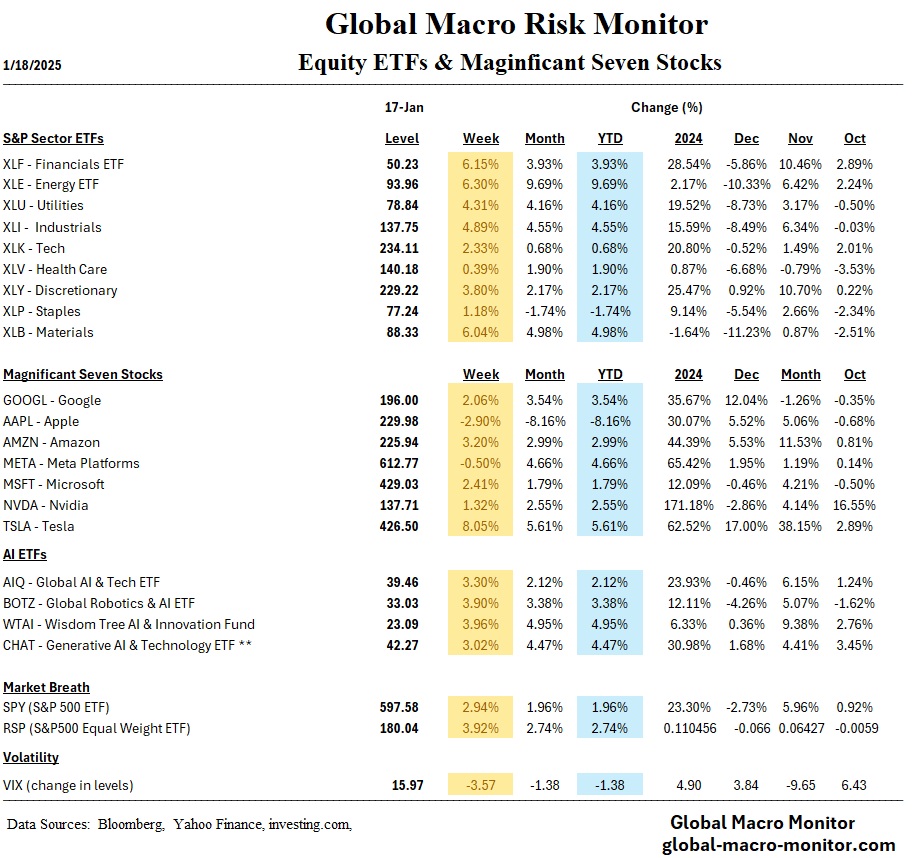
Global markets rallied amid softer U.S. inflation data, with the S&P 500 rising +2.94% for the week, driven by gains in financials and industrials. European markets outperformed, led by France’s CAC 40 (+3.75%), Germany’s DAX (+3.41%), and Italy’s FTSE MIB (+3.36%). The UK’s FTSE 100 climbed +3.11%, benefiting from cooling inflation and expectations of Bank of England rate cuts. In Asia, China’s Shanghai Composite gained +2.31%, supported by robust economic data, while Japan’s NIKKEI fell -1.90%, pressured by yen appreciation and declining export sector margins. Emerging markets delivered mixed results, with Vietnam’s VN Index dropping -1.39%.
Global Economics
The Eurozone saw easing inflation, with December data supporting ECB plans for gradual rate cuts in 2025. Germany’s GDP contracted -0.20% in 2024, marking its second consecutive annual decline, driven by weak investment and slowing exports. The UK’s inflation decelerated to +2.50% in December, down from +2.60% in November, fueling speculation of monetary easing.
In Asia, China’s Q4 GDP exceeded expectations at +5.40% year-over-year, with industrial production growing +6.20% and retail sales expanding +3.70%. Japan faced mixed signals; real wages fell -0.30% year-over-year, while the yen’s appreciation weighed on equities. Elsewhere, Hungary’s inflation rose to +4.60% in December, while Poland’s central bank held rates at 5.75%, citing elevated inflation expectations.
Easy Financial Conditions
The Chicago Fed’s National Financial Conditions Index (NFCI) indicates the loosest financial conditions since October 2021, when quantitative easing and zero interest rate policies were in full effect. Such easy financial conditions could reignite inflation, especially amid the incoming administration’s trinity of inflationary policies—tariffs, expansionary fiscal policy (mainly tax cuts), and mass deportations. These easing financial conditions act as the dry brush that could magnify and accelerate the inflationary pressures.




Posted in Uncategorized
Tagged Economy, Federal Reserve, finance, Inflation, Interest rates, Investing
Leave a comment
Europe’s North/South Economic Reversal
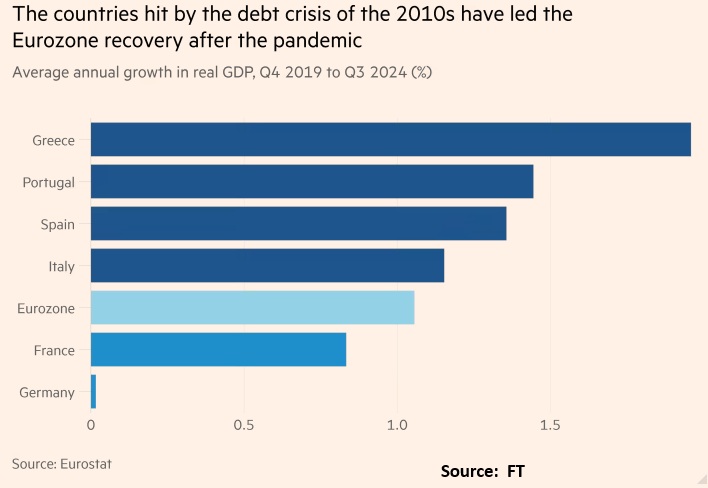
Great piece in today’s FT on the reversal of fortune in European economies.
The Eurozone is experiencing a significant shift as the southern nations plus —Portugal, Italy, Ireland, Greece, and Spain—outperform their northern counterparts, particularly Germany, which faces economic stagnation. This reversal stems from targeted structural reforms, substantial EU investments, and favorable industry dynamics, including a reliance on tourism and green energy.
Southern countries have embraced the €800 billion EU-backed NextGenerationEU program, channeling funds into infrastructure, digital innovation, and green energy while undertaking necessary economic reforms. Tourism and renewable energy sectors have driven economic expansion, with Spain leading through substantial growth in foreign direct investments and renewable energy projects.
Despite the progress, challenges persist. Southern Europe grapples with high public debt, bureaucratic inertia, and workforce shortages. Germany’s industrial decline raises concerns about potential ripple effects, especially for nations reliant on German demand. Meanwhile, socioeconomic disparities linger, with Greece still recovering from its debt crisis and struggling with high poverty rates.
The sustainability of this growth hinges on continuing reforms, balancing structural weaknesses, and mitigating external shocks.

Posted in Uncategorized
Leave a comment
The Trump Bump Fizzles
The “Trump bump” following the recent election contrasts sharply with 2016. In 2016, Trump’s unexpected victory over Hillary Clinton surprised markets, leading to a significant rally as investors bet on policies like tax cuts and deregulation. This surge reflected the element of surprise and “animal spirits.” However, the 2024 race between Trump and Vice President Kamala Harris was closely contested, with betting markets favoring a Trump win before Election Day. As a result, markets had largely priced in his victory, muting post-election gains. This context underscores how pre-election expectations can temper market reactions, reducing the dramatic movements seen in 2016. Context, folks.

Posted in Uncategorized
Leave a comment
20 Stunning Things At CES 2025
Must view, folks. See these stunning new products showcased at the recent Las Vegas Consumer Electronics Show (CES).
Posted in Uncategorized
Leave a comment
Global Risk Monitor: Week In Review – January 10
Weekly Economic and Market Summary
Macroeconomics
- Strong Jobs Report: December added 256,000 jobs, surpassing forecasts by 100,000, and unemployment dropped to 4.1%. This robust labor market supports the Fed’s decision to slow rate cuts.
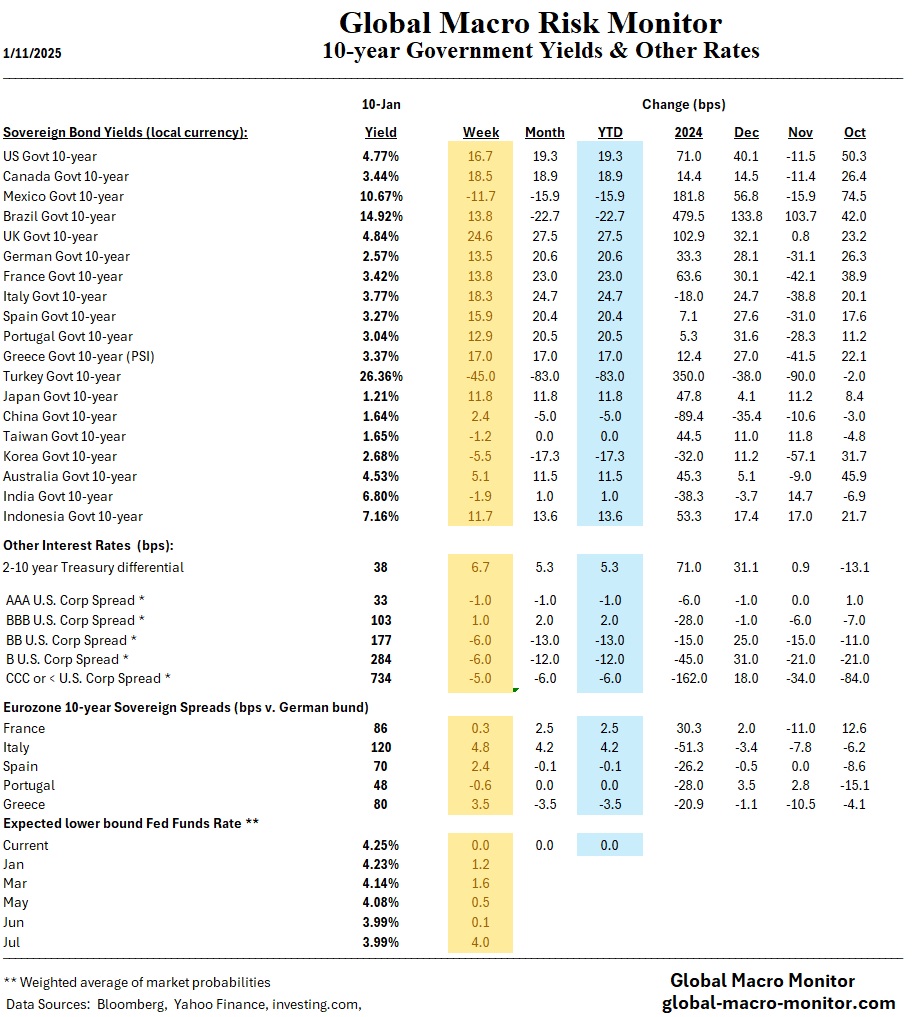
- Fed Policy: Federal Reserve minutes reflect a hawkish stance, with no significant rate cuts expected in 2025. Upside inflation risks persist, and Treasury yields hit multi-year highs.
Global Markets
- UK Bond Market Concerns: UK 10-year gilt yields reached 4.92%, the highest since 2008, driven by fiscal concerns and investor skepticism about government borrowing.
- European Inflation: The eurozone saw inflation rise to 2.4% in December, spurred by energy and services costs, while the ECB signaled disinflation progress and potential rate cuts.
- China’s Economic Struggles: Persistent deflationary pressures saw China’s consumer prices inch up 0.1% annually, while its producer prices fell for the 27th consecutive month. Stimulus measures aim to boost activity.
Market Performance
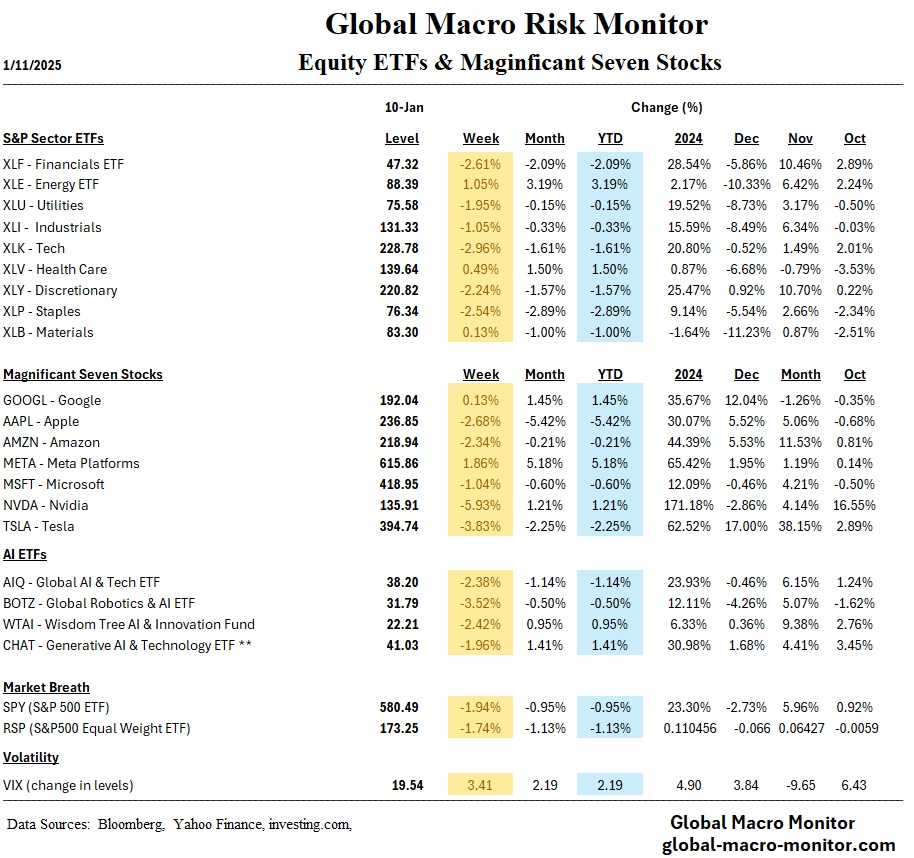
- U.S. Equities Decline: The S&P 500 dropped 2% for the week, with small-cap stocks entering correction territory. Rising bond yields weighed on valuations, particularly in rate-sensitive sectors.
- Treasury Yield Spike: The 10-year U.S. Treasury yield surged to 4.77%, its highest level in over a year, reflecting expectations of fewer Fed rate cuts.
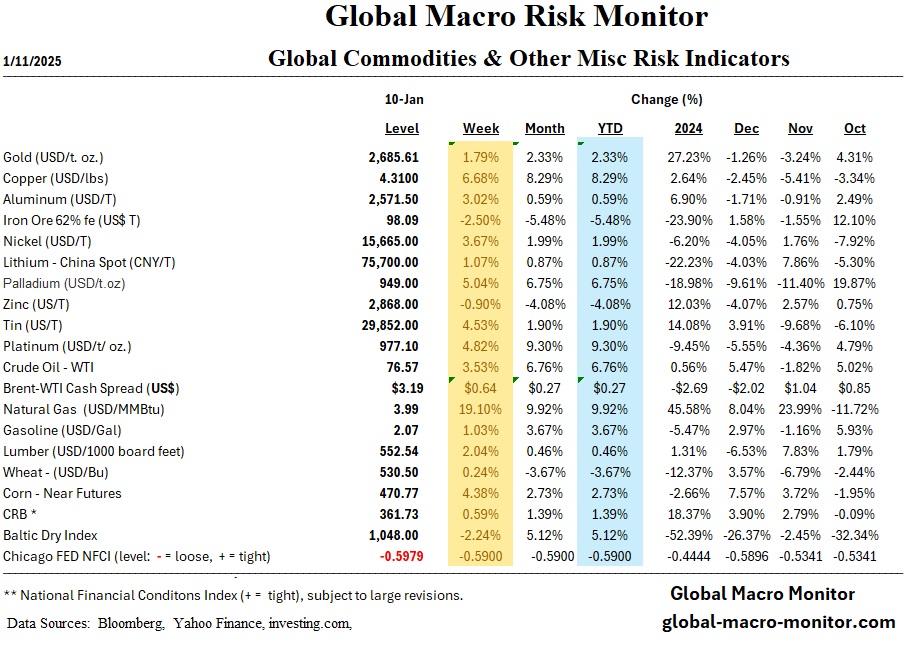
- Commodity Gains: Oil prices climbed 10% over three weeks, reaching $77, while gold rose for a second week to $2,717, nearing record highs.
These developments illustrate the dynamic interplay of inflation, central bank policies, and global economic pressures, which continue to shape market trajectories.


Posted in Uncategorized
Tagged Economy, finance, Inflation, Interest rates, Investing
Leave a comment
Econ 101: Thinking On The Margin In The Gym
Here’s a repost to help kickstart your New Year of better health.
One of the most complex concepts for my students to internalize when I taught Econ 101 was that of thinking on the margin. You probably remember the theory of diminishing marginal productivity, diminishing marginal returns, and diminishing marginal utility (satisfaction). For the math inclined, they are functions with a positive first derivative coupled with a negative second derivative.
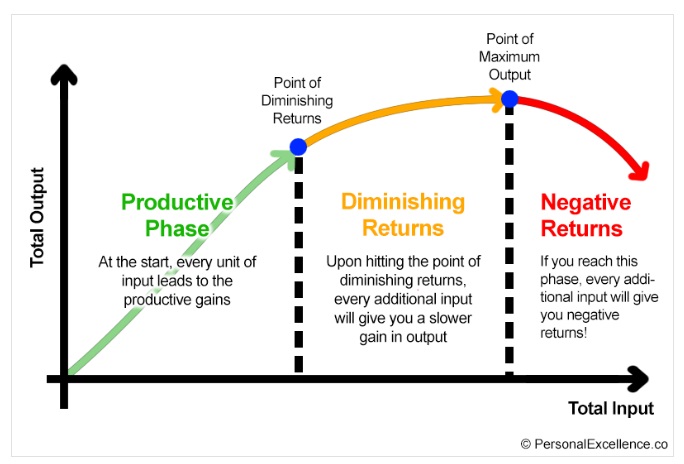
Economists like to dress up pretty straightforward ideas with very big words, most likely to obfuscate the fact that economics is just reasonably simple logic.
Traders And Investors Must Also Think On The Margin
It is also essential for traders and investors to think on the margin. They must understand and identify the marginal (last) buyers and sellers in the markets they traffic because those buyers and sellers set and determine the market price. It applies to all asset markets, from stocks to residential real estate.
You have undoubtedly heard the adage “retail always buys the top,” which was a reasonably good contrarian indicator before central banks flooded the markets with liquidity and repressed market interest rates. When I was a trader on Wall Street, the Japanese piling into a market was usually a sign of a top. Not because they were inferior but because they had so much asset purchasing power, i.e, money, and their conservative culture of decision-making by committee almost guaranteed they were always late to the party.
Diminishing Marginal Returns In The Weight Room
I have discovered the law of diminishing marginal returns in the gym, which has changed my life and significantly improved my health.
In their MOOC (massive online open course) – Hacking Exercise For Health. The surprising new science of fitness – Martin Gibala and Stuart Phillips of McMaster University teach the concept of diminishing marginal productivity or returns in the gym without using the economic mumbo jumbo. It cut down my workout time from, say, two hours to just 30 minutes, and here’s how.
I used to be very rigid in my workout, never straying from three sets of 10 repetitions. That third set I hated most would slow me down, procrastinating to pump it out until the cows came home.
Two or three hours in the gym was too much and led to an inconsistent workout schedule and less than optimal health.
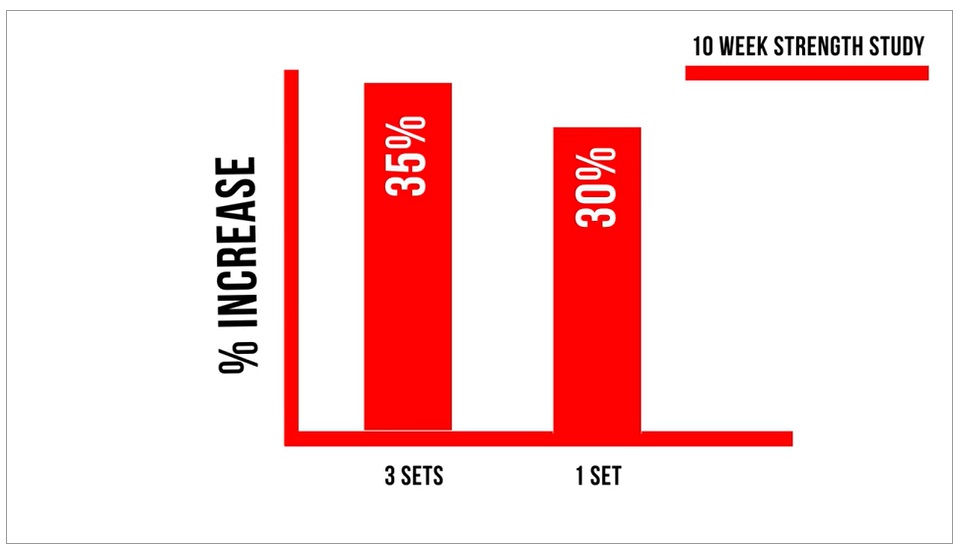
I learned from the McMaster MOOC that 85 percent of the benefit of a three-set exercise comes from the first set! Doing just one set over a 10-week period improves your strength by 30 percent, while doing three sets increases your muscle by 35 percent, just an extra 5 percent increase for the last two sets.
That is the best and most practical example of diminishing marginal productivity or returns I have seen and experienced. The second and third set, though, still improves overall strength, but most of the bang for your buck is in the first set.
I cut my workouts down to just two sets for each muscle group and get in and out of the gym in thirty minutes. I will trade off the extra 7 percent benefit of the third set for a shorter and more consistent and disciplined workout schedule, any day.
Thirty minutes work for me.
Diminishing Marginal Utility (Satisfaction)
I used a simple golf analogy to teach the concept of diminishing marginal utility, which my students could relate to.
After a four-hour round of golf in the hot sun, the first beer on the 19th hole tastes fabulous. The second is fantastic but not as awesome as the first. —a classic case of diminishing marginal utility (satisfaction). The third? Call an Uber. We’re talking craft beer, folks, not Coors Light.
Pretty simple, no?
Watch This Video!
We highly recommend this video, which taught us how to make our exercise more efficient. The five-minute investment of your time will change and may save your life.
Posted in Sports, Uncategorized
Tagged Diminishing marginal returns, exercise, fitness, health, Health Hacks, workout, Workout routine
1 Comment
Lies, Damn Lies and BLS’ Budget
BLS = Bureau of Labor Statistics
There are three kinds of lies: lies, damned lies, and statistics. – Benjamin Disraeli via Mark Twain
The BLS gets that data [employment data] by contacting a representative sample of the population and then weights those results to reflect the broader population. The trouble is…that sample is at risk of getting smaller. And one key reason for that… is how much money the BLS has to conduct those surveys. – Bloomberg


Posted in Uncategorized
Leave a comment
 Global Macro Monitor