Inside the bitter Oval Office tariff fight – Axios

Interesting story by Axios about the war between Peter Navarro’s economic nationalist camp and Gary Cohn’s free trader-cohort inside the Oval Office which culminated in Cohn leaving the White House tonight.

The money quote that says it all:

Cohn tried to argue that these tariffs would ruin Trump’s record-setting stock market streak and wipe away benefits of tax reform. But Trump kept saying Cohn was a “globalist” while he himself was an economic nationalist.  – Axios

We believe it is going to be difficult to be an economic nationalist when global investors and central banks:  1)  hold 1/3rd of U.S. marketable public debt;  2) finance the bulk of the federal budget deficit, and 3) allow the U.S. to run current account deficits ad infinitum “without tears” — i.e., without a currency crisis.

We fear that may be about to change.

The economic nationalist label is going to comeback to haunt President Trump.

Posted in President Trump, Uncategorized | Tagged , , | Leave a comment

Policy Leanings Of Current FOMC

Fed_Leanings_Mar6

Posted in Fed, Monetary Policy, Uncategorized | Tagged , , | Leave a comment

It’s On Like Donkey Kong…

Now that Cohn is out it looks like game on for a new trade war.  You never know with Trump, however,  but Cohn’s departure is not a good signal.

The British newspaper, City A.M., gives us a hint at how the Europeans may retaliate.  Hit the industries in the red states, particularly the home of the Congressional leadership.

City AM_Mar6

Trump Increasingly Viewed As A Paper Tiger

The question now has President Trump painted himself into a corner?

Backing down would only reinforce the growing image that Trump is a bit of policy flake and a  Paper Tiger.

I see no evidence that the president’s reputation as a paper tiger has improved at all since the summer.  Just this week, as Ponnuru says, Trump floated a new protectionist plan   – Ramesh Ponnuru,  Bloomberg

Time to back down?  Will he?  Can he?

President Trump sounding a lot like Tom Petty these daze

.

I Won’t Back Down – Tom Petty

[Verse 3]
Well I know what’s right
I got just one life
In a world that keeps on pushin’ me around
But I stand my ground
And I won’t back down


Posted in China, Economics, Uncategorized | Tagged , , , | 4 Comments

The “Navarro Falls” Beckon

Right on schedule the barrel and catalyst —  in the form of Gary Cohn’s resignation — cue up to take stocks over the waterfall.

Let’s call it what it is, “The Niagara Navarro Falls“.

Navarro Falls_Mar6

.JFK-Trump_Mar6

Cramer’s Mad Money

Wow, it looks like Jim Cramer was lip synching his cheerleading.  They just cut into the Mad Money program and patched in the announcement of Gary Cohn’s resignation.

Market Impact

Dow futures down 300 hundo since the open just eight minutes ago and S&P futures down 30 points.

We suspect foreigners are fast losing confidence in the management of USA, Inc.   This could get brutal for the big three:  bonds (unless major risk-off triggers flight to quality), the dollar, and stocks.

Now let’s see if the real sellers come out.

Stay tuned.

Posted in Bonds, Equities, President Trump, Uncategorized | Tagged , , , | 4 Comments

Gary Cohn Out

Buckle up, folks…..

Posted in Politics, Uncategorized | Tagged | Leave a comment

The New Economy

In 1999, I called one of my professors from graduate school who taught monetary theory.  Let’s call him Joe.

Here’s a short summary of the conversation:

Me:  Professor Joe,  can you believe how big this stock market bubble has grown?

Prof Joe:  It’s a new economy, [Gregor].

I put down the phone in astonishment.  Professor Joe drank the kool-aide.

In hindsight,  indeed he was right, but not for the reasons he had concluded.

The economy did change in the 1990’s as is illustrated in the charts below.   Not, however,  for the reason Wall Street was touting to justify extreme asset valuations.

The New (Wealth Driven Asset) Economy 

Household net worth, or asset prices, became more volatile and a much bigger driver of economic growth as illustrated in the charts below.  The second chart normalizes the data by gross domestic product.

The average change in household net worth on a quarterly basis relative to GDP from 1952 to 1994 was 6.17 percent with a standard deviation of 4.68 percent.  Since 1995, the average change has been 5.89 percent, but the standard deviation has more than doubled to 10.21 percent.   The similar mean of the two periods most likely reflects the mean reverting nature of asset returns.

Why The Change?

We posted a couple reasons we believe were the cause for this financial and economic structural shift in the mid-90’s:

1) Moral Hazard

First,  moral hazard was internalized by traders and investors.   Though the “Greenspan put” was born almost a decade earlier after the 1987 stock market crash,  the 1994-1995 monetary tightening culminated in the collapse of the Mexican peso and set off the Tequila Crisis in emerging markets.  The U.S. government had to step in and bailout Mexico with $50 billion-plus in loans…

2) Money Velocity

Second,  the rise of the internet and technological changes fundamentally changed the U.S. economy and its payments system.   We do not have time to research the specifics, but we suspect it is reflected in the secular decline in money velocity which peaked in the 1990’s and has fallen ever since with the exception of a small bump just before the credit/bubble popped…

3) Asset Markets Became The Economy

The labor shock caused by the entry of China and Eastern Europe into the global economy contributed to a significant hollowing out the U.S. middle class as policymakers failed to compensate the losers of free trade.  They were effectively swept under the rug as globalization took off, corporate profits soared, and consumer prices were held in check with cheap imports.  This effect culminated in the 2016 political Black Swan.

Fundamental Shift In Aggregate Demand

It is our contention the decline in the purchasing power of a relatively large swath of  Americans, with a relatively high propensity to consume, were crippled and when coupled with the rapid rise in income and wealth inequality aggregate demand has become insufficient to drive economic growth at an adequate pace…  – Global Macro Monitor,  Feb 5, 2018

If you haven’t seen the post,  Start Of A Mean “Mean Reversion” In Stock Values?, run don’t walk to read it. 

.

Net Worth_Mar5

.

Net Worth_GDP_Mar5

Upshot?

Our hypothesis that the economy is becoming more influenced by asset prices and debt, and to a lesser extent by income (which is endogenous) due to a secular stagnation in real wages, is a work in progress.

Moreover, the whole inflation/deflation debate has morphed into a dialectic, which is path dependent on asset prices.   Stocks values move up to a critical level (which holders likely believe to be permanent) that stirs the animal spirits and kicks economic growth into gear.  Inflation eventually becomes an issue moving interest rates higher.  The asset bubble pops, stock values go down,  confidence declines, aggregate demand softens and deflation now becomes the headline issue.   Wash, rinse, repeat.

In addition, each asset cycle results in greater divergent of valuations from the economy (see charts below) as the wealth disparity increases.   The marginal propensity to consume is much higher for middle and working class consumers.   As wealth becomes more concentrated at the higher end, aggregate demand weakens on a relative basis and more theoretical wealth is needed to generate the same demand.

“The wealthy buy Apple stock with their gains, whereas the middle class buy apples.”

We have run some preliminary statistical analysis and regressions and thus far the data do support our priors.  Back to you when we complete the analysis.

.

MeanR_1

.

MeanR_2

Posted in Economics, Uncategorized | Tagged , , | 91 Comments

Tweet of the Day: Italy’s Impossible Trinity

Posted in Italy, Policy, Uncategorized | Tagged , , | Leave a comment

Merkel Nails Down Coalition; Italy’s “Mother of All Hung Parliments”


Finally, after five months of wrangling,  Germany will form a new government.

All that changed on Sunday with the SPD referendum result. Ms Merkel can now look forward to a fourth four-year term as chancellor, heading a unified party and stable coalition government. Europe’s most powerful leader is back in control.  – FT

In Italy, “the mother of all hung parliments,”

Euro/dollar a tad stronger..

Posted in Uncategorized | Leave a comment

Week In Review – March 2

The stock market recovery topped out and failed last week on the hawkish tone of new Fed chairman, Jay Powell, and President Trump’s announcement he will impose steel and aluminum tariffs across the board.  Most of the indices recovered off their lows to rally higher on Friday in the hope that the U.S. administration will walk back the implementation of the restrictions on and tough trade talk.  Dream on.

World Tariffs

Note the world map of the average applied MFN tariff by country.  Very informative.

The perception the U.S. is the only open market in the trading world and raped by protectionist nations is just not right.  We calculated that around 40 countries, or territories,  have a lower or within about one percent of the U.S’s simple average applied MFN tariff.

Here’s an idea.  If China wants to dump its steel at cut-throat prices in the U.S,  pass legislation fixing that price or they can no longer sell into the U.S. market at higher prices.   We suspect that would work and consumers would get a great deal.

Market Risk And Bearishness Increasing

Risks are building in the markets but so is bearishness.   Though markets are going to do what they are going to do in short-term, we have learned there are still not a lot of natural sellers, and if the market gets too offside,  you can bet the other side for a trade.

The fast money is now so short-term focused, especially the growing number of HFTs that don’t hold overnight risk, they have no patience and must cover quickly especially if the market begins to move against them.   We do believe investors are going to get a chance to buy stocks and much lower levels, however.

Market Focus Next Week

The big focus this week will be on the wage data in Friday’s employment number and the Trump tariff implementation, and the fallout from today’s Italian elections.

Politics

Then there is the political chaos in Washington and growing worries over a massive blue wave election in November, which will only increase after the primaries begin.

Watch This Name:  Conor Lamb

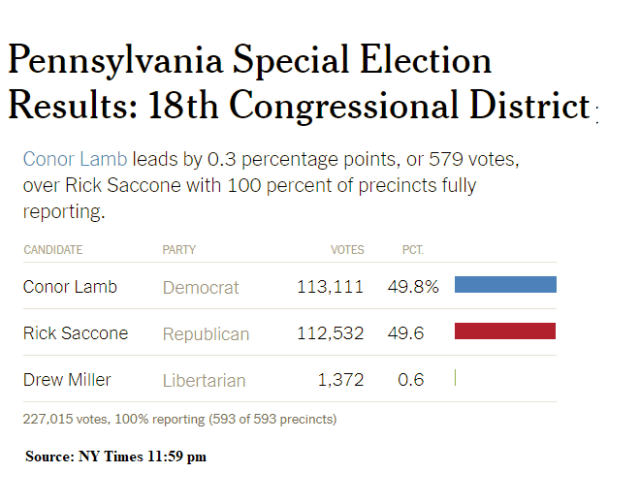
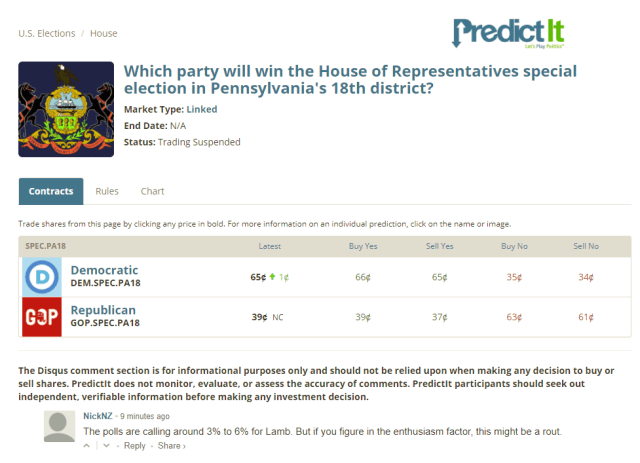
Big focus on the March 13th special election in Pennsylvania’s 18th congressional district, which President Trump won by over 20 points in 2016.   Though it takes place in deep Trump country, the Democratic candidate, Conor Lamb, is now statistically tied in the latest poll and has a significant financial advantage over Republican Rick Saccone.

Republicans are in panic mode and this election could move markets and raise fears of a Grant-like midterm lambasting for Republicans in November.   President Grant’s Republicans lost 93 congressional seats in the 1874 midterms.

A more dismal performance considering there were only 292 seats in the lower chamber back then as compared to 435 today.   The Republicans loss  31 percent of the total House seats in 1874.  On a similar proportional basis that would equate to a 139 Republican seat loss in the House today.  Fat tails, yes.  But, nonetheless,  OUCH, just thinking about it!

Some speculate the steel tariffs are aimed at shoring up support for the Republican candidate in Pennsylvania’s 18th district.

Stay tuned.

Chart1_Weekend

.

Table_Weekend

.

JFK_Trump_Analog_Weekly

.

Week_2018_ETFs

.

Weekly_Table

Posted in Uncategorized | Leave a comment

Sector ETF Performance – March 2

ETF_D

ETF_W

ETF_M

ETF_YTD

Posted in Sector ETF Peformance, Uncategorized | Tagged , | Leave a comment