
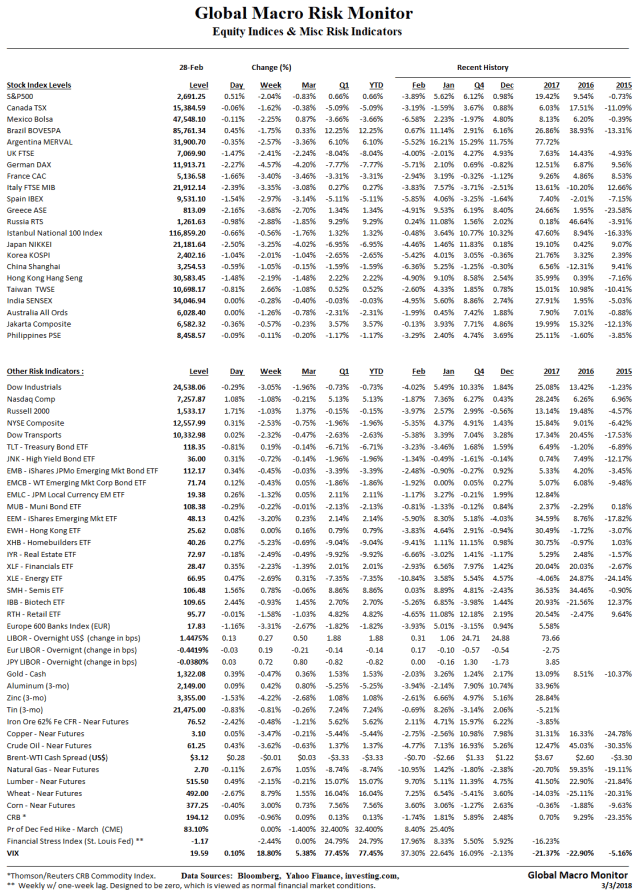
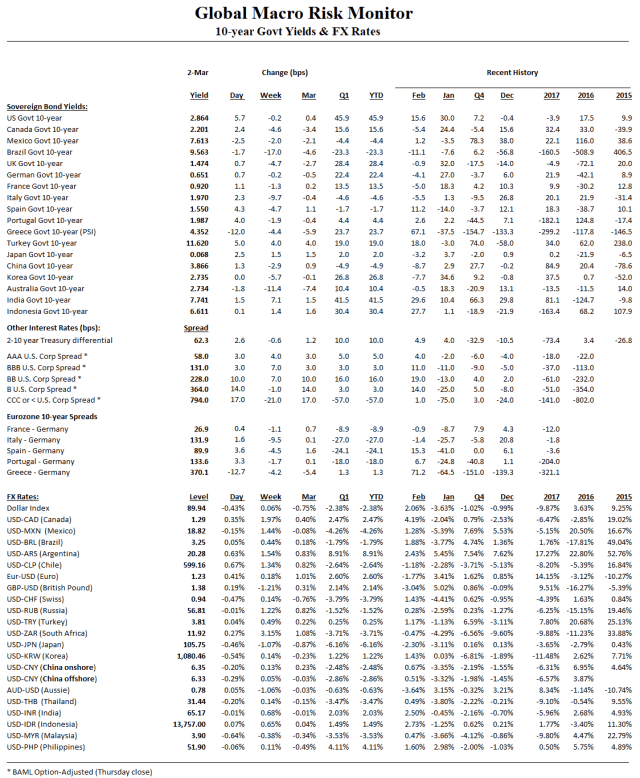
Upshot: Not recovering. EVA015 Heavy.

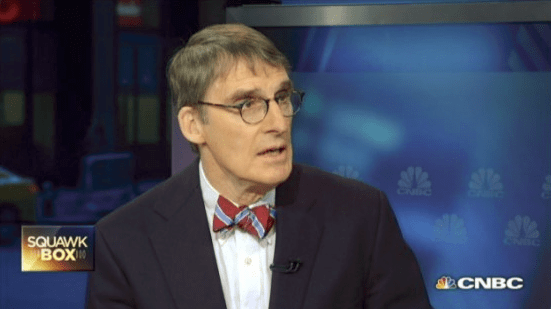
Great video clip with Jim Grant dishing on the upside-down world of risk assets and the massively distorted global bond markets.
“As an example of where the world is mispricing interest rates…look to Italy, which is having a big election on Sunday…there is a speculative grade Italian security, Italian Telecom, the 5 1/4’s of 2022 are trading at 0.61 percent, that is a junk bond with a zero handle.” – Jim Grant, CNBC, March 1
(click here for interview)
Italy is going to the polls on Sunday, March 4. Here we look at the data behind the key election issues.… READ MORE : http://www.euronews.com/2018/03/01/fi…
This is astounding. Not so much robots but artificial intelligence (AI),
The world of fashion is always looking ahead to the future for the latest innovations and avant-garde ideas.
However, models could be facing the prospect of being rendered useless thanks to a novel creation by celebrity photographer Cameron-James Wilson.
Wilson has created a digital persona called Shudu Gram, which he has dubbed as the “world’s first digital supermodel”.
Shudu currently has 40,500 followers on Instagram, ever since her Instagram account was first created by Wilson in April last year. – The Independent

Is Blue Horseshoe the secret service’s code name for President Trump? Just askin’.
Then there is this on Uncle Carl Whoops!

Hat Tip: Tom Hearden
In general, trade benefits the great majority of the population by increasing real incomes, and creates many more jobs than it destroys, but a small minority become losers from increased trade. The winners should, or have a duty to compensate the losers.
Read on and you will see how President Reagan tried to help the steelworkers in the mid-1980’s when the industry was being decimated by a skyrocketing dollar.
How Trade Helps The Majority And Creates Jobs
Here is a simple example I used to teach in my class on the benefits of trade. In particular, the income effect and how trade among nations creates new jobs:
One Reason Why Trade Creates More Jobs Than It Destroys
I used to pay $5,000 for a personal computer made and assembled in the United States. Ten years later, I now pay $500 because of trade and offshoring. That leaves me with $4,500 freed up to spend on other goods and services. That is the real or purchasing power of my current income has gone up because of the lower prices of goods and services as the result of trade.
I can now take my family out to dinner more and leave bigger tips for the waiter. This creates more jobs and income in the restaurant industry.
I can go to the movies more, creating jobs in the entertainment industry.
That new car I have been eyeing is now more affordable, creating jobs in the auto industry.
I can afford a landscaper, creating jobs for local labor.
I can better afford to do home improvements, creating jobs for local construction workers.
On and on and on….and very impressive when scaled to the national population. This is the case even if the trading partner is deemed to be “unfair.”
However, a small minority, those who made the computers in the U.S. in the above, example are hurt through trade and should not be forgotten.
The federal government has a Trade Adjustment Assistance (TAA) program to compensate them. It has fallen woefully short and needs to be beefed up considerably.
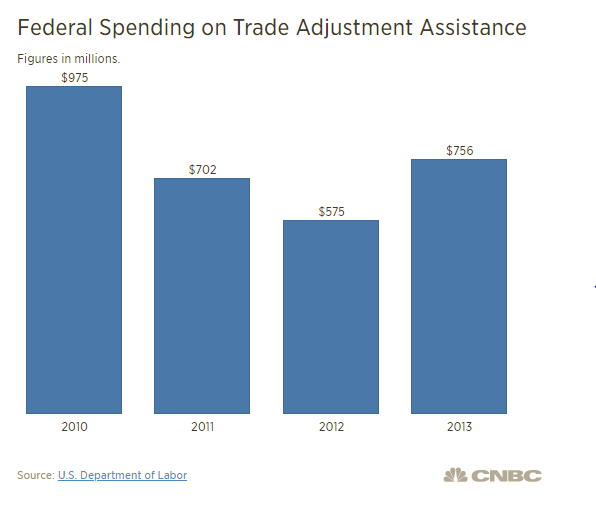
The above data are an outrage and a paltry or token attempt to compensate those who have lost their jobs to free trade. The losers have been swept under the rug.
The total amount spent on trade adjustment assistance is about equivalent to 20 thousand new dining tables that the HUD Secretary, Ben Carson, just purchased to beef up his office. That is not even enough tables for only the number of steelworkers employed at U.S. Steel!
Now you understand why the rust belt states are pissed off at their government, and rebelled in 2016 and voted for Trump.
Better Compensation For The Losers Of Trade
Here is a personal story from one of our earlier posts about a time when politicians and the country used to care about those hurt by trade but understood its benefits:
After finishing up my Ph.D. comprehensive exams in economics and in between the dissertation, I interviewed at the White House, Council of Economic Advisors (CEA), as a junior economist. They had a program where the CEA would hire graduate students for one year who were in between their comp exams and the dissertation.
Ronald Reagan was President at the time and the day long interview took place in April 1986, just a few days after the U.S. bombed Muammar Gaddafi. That day, security on the White House grounds and in the Old Executive Office Building, where the Council is located, was intense. Secret Service, dressed in their black garb and flack jackets, everywhere.
Beryl Sprinkel was Chairman of the CEA and Michael Mussa was the real intellectual heavy weight of the CEA. The entire council was made up of “Chicago Boys,” not Chileans, but academics from the University of Chicago. Very free market thinking in everything.
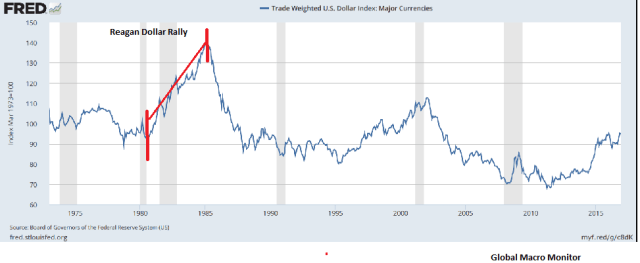
Note, this was during a period in the economy when the trade sector was getting hammered by the strong dollar. The trade weighted U.S. dollar index had increased almost 30 percent since Reagan took office and was causing real hardship in the tradable goods sector.
So, the first question I was asked at the beginning of the interview was, “there is a bill in Congress to write the steelworkers, who have been displaced and lost their jobs through trade, a check for $100,000 [$221,000 in 2016 dollars]. What do you think of this bill?
I answered, “no, I think retraining and other polices may be more optimal”. They replied, “that’s what the Democrats think.” I didn’t get the job.
The Chicago boys think the individual can choose their future and retraining better than the government.
That $100,000 was real money and compensation back then, much more than what the government offers to the losers of free trade and globalization today. And, let’s get real, at the end of the day, it was an “effective bribe” to the steelworkers to allow the country to keep pursuing free trade policies.
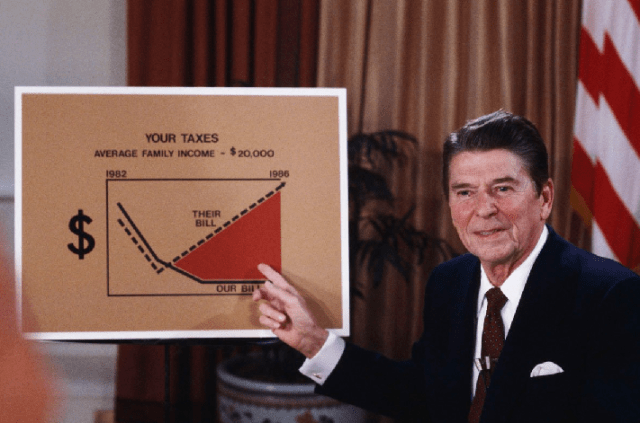
The day long interview ended in Beryl Sprinkel’s office where he asked me, “[Gregor], can you make good charts? The President likes his charts.” Indeed, President Reagan did.
When I was leaving the Old Executive Office Building (OEOB) after the interview, I thought of taking a little tour of the White House grounds. I walked out of the east end of OEOB onto the White House grounds, probably no less than 100 feet from the Oval Office. I was met by a Secret Service officer in a black flack jacket carrying a high powered rifle, who asked what I was doing there. He booted me faster than a fighter jet. But, oh, so close to power!
So, concluding, I ask folks — whatever happened to that kind of thinking among the policymakers? That is, really compensating and taking care of the losers from free trade and globalization as we, the elites, enjoy the benefits of free trade and globalization in lower prices of goods and higher profit margins and stock prices? Tariffs and shrinking free trade and globalization are going to hurt all of us, including margins and stock prices.
Better compensation for the losers and continue to pursue free trade. Tariffs help a small minority and hurt the majority — a Tyranny of the Minority, if you will.
Yikes! Buckle up, folks.
We almost got the Jackie Moon moment – i.e., a panic sell-off – which we warned about in our early morning post if trade tariffs were announced today. We believe a five percent one day downdraft would constitute a Jackie Moon move.
Uncanny Similarities With 1962
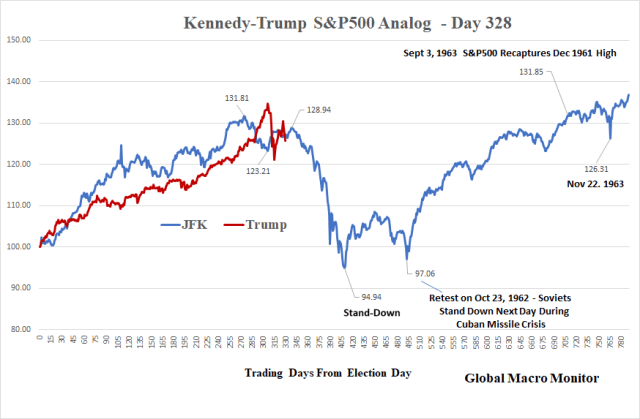
In our JFK-Trump S&P500 Analog post we mentioned how steel was a big part of the 1962 bear market, when the president referred to steel executives, who broke an agreement with the labor unions and the administration to hold down inflation, as sons of bitches. JFK’s rant helped accelerate what was a modest correction over inflation worries into a full blown bear market. The S&P500 was down 5.8 percent off its peak when President Kennedy held his press conference on April 11, 1962 accusing the execs of having “utter contempt” for the United States. Imagine if Jack had access to Twitter back then!
Today, steel was also at the center of the sell-off in what looks to be the next leg down in what we suspect will also end in a bear market. The S&P500 was off a similar 5.5 percent from ts peak when President Trump announced his steel tariffs today. Hmmmm,..
The Steel Curtain bear markets?
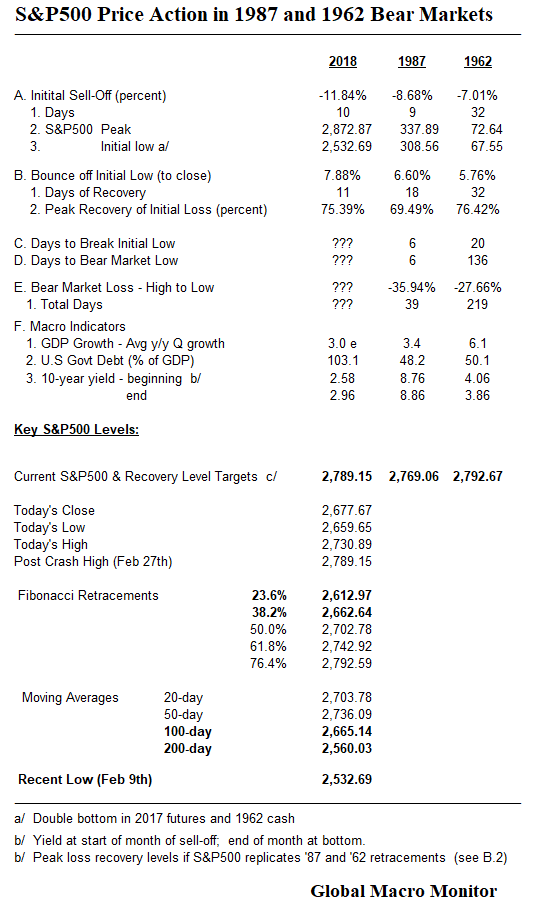
The table also illustrates very similar trough to peak bounces in the first leg of the bear market, 76.42 percent, in 1962, versus today’s 75.39 percent, which occurred just this past Tuesday. Close enough for government work, in our opinion.
Moreover, check out this headline today:
Pentagon: We Are “Fully Prepared” For A Russian Nuclear Attack
In 1962,
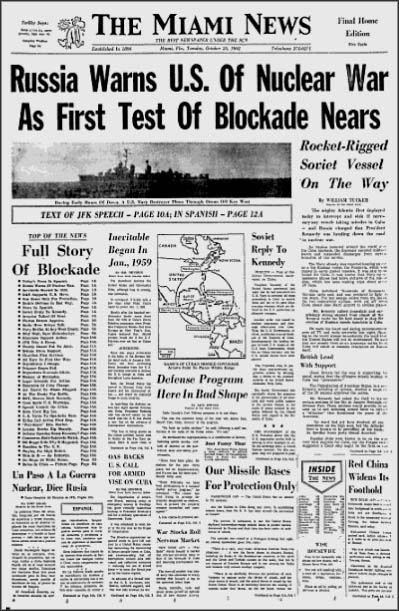
No comparison of today’s danger to the 1962 headline but, hey, we thought the cold war was way over?
Back to the future, folks. Let’s hope not.
Watch These Levels
The S&P500 breached its 100-day moving average at 2,665.14 and the key Fibonacci retracement level of 38.2 percent at 2,662.64 today but managed to close above both. We doubt they hold and a retest of of 2,532.69 low is in cards in the next week or two.
We don’t think that holds either.
Unless President Trump walks back the tariffs and his tough trade rhetoric, consider today a game changer, and not for the better.
Appendix
Beware Of Share Buyback Alchemy
Just finished looking through a market cheerleader data set on earnings and revenue projections. Always quoting earnings on an EPS basis, which is distorted by buyback alchemy, and non-GAAP accounting. An example of Truth Decay in the financial sector.
The later stages of the 2009-2017 bull market are a valuation illusion built on share buyback alchemy. Absent this accounting trick the S&P500 index would already be in an earnings recession. Share buybacks have accounted for +40% of the total earnings-per-share growth since 2009, and an astounding +72% of the earnings growth since 2012, compared to +24%. Since 2009, an estimated +30% of the stock market gains are attributable to share buybacks. Without share buybacks the S&P500 index would currently trade at an expensive 27x earnings. Not surprisingly, a recent study found a positive relationship between insider equity sales and share repurchases, supporting the idea that buybacks are more about managerial self-interest than share holder value — Artemis Capital, October 2017
Stocks are not cheap, folks. Be patient. We may be wrong but believe you will get them much cheaper. The time to buy will be when the cheerleaders are panicking.
Nevertheless, don’t bet your career on our views and have a plan to act contingent on if stocks tank or rally from here.
S&P500 Approaching the Navarro Falls

 Global Macro Monitor