The Only Dip To Buy Is A French Dip

Stunning to watch the financial pundits and the action of some investors with their reflexive buy the dip mentality after the massive volatility shock.  The S&P500 moves straight up for two years without a back-to-back 1/2 percent correction and then is hit out of the blue with an explosion, and the natural impulse is to rush in, buying the mantra,  “stocks are on sale.”

If Macys marks up its inventory of, say, underwear by 50 percent over the past year, and then has a 10 percent off sale,  is the underwear on sale really a buy?

BTFD

BTFD has worked for past several years.   However, after the financial tornado that has just ripped through markets,  “Toto, I have a feeling we are not in Kansas anymore.  We must be over the rainbow.

Short term volatility is greatest at turning points and diminishes as a trend becomes established — George Soros  

The stock market, which has been driven by sentiment, had priced in almost all things good yet ignored the change in,  and changing global monetary regimes and move up in interest rates,  is now unhinged.

Look how the Dow whipped around today — opens down 100, climbs to up 400, moves back into the red only to climb back up to 300 again and lose it all in the last half hour to close down.  The biggest reversal in the Dow since August 2015.

Ditto for the S&P500 and double ditto for the NASDAQ.   That is a market unhinged from its anchor and needs to find a mooring.

eDow_Feb7

The world may (and, we emphasize may, as nobody knows the future) have changed, folks.  No rush to buy, no Russians buying.

What We Are Buying

Therefore the only dip we are buying for an investment (trading is a whole different ballgame) is a big juicy French Dip.   Moreover,  we are certainly not rushing to the head of the line to buy the first Dip.

We will reassess when we feel we are back in Kansas,  Toto.

.

French Dip_Feb7

Posted in Equities, Uncategorized | Tagged , | 8 Comments

SPD To Get German Finance Ministry

Breaking.

Angela Merkel has agreed with Social Democrats on a new coalition German government.

Political leaders in Germany have reportedly reached a breakthrough in talks to form a new coalition government, following months of uncertainty after elections in September failed to produce an overall majority for any party.

German Chancellor Angela Merkel’s Christian alliance and the Social Democrats (SPD) have agreed on a deal, according to media reports on Wednesday. Citing anonymous sources within Merkel’s conservatives, Reuters reported that the two sides had agreed on a formal coalition deal. However, another source could not confirm that, saying that the parties were still at odds on some issues.  – CNBC 

Not a done deal as agreement must be ratified by SDP,

Upshot

The SPD is very pro Europe.  A big boost for eMac in France and should soften Germany’s hardline austerity policy in the periphery.

Look for bond Convergence 2.0  to continue.  An SPD-led German FinMin is a positive economic shock to the eurozone economy.  Higher euro, higher bund yields putting more pressure on ECB to end QE.

One big caveat is the SPD’s greater influence in the economy could stoke more pushback from the growing hard right in the country.

Posted in Demographics, ECB, Germany, Uncategorized | Tagged , | Leave a comment

Tweet Of The Day: Turkey Investments

Posted in Tweet of the Day, Ugly Chart Contest, Uncategorized | Tagged , | Leave a comment

QOTD: Soros On Volatility

Posted in Quote of the Day, Uncategorized | Tagged , , | Leave a comment

Start Of A Mean “Mean Reversion” In Stock Values?

Asset valuations, including stock prices, eventually revert to their long-term mean (average) valuation or at least attempt to if not interrupted by outside intervention, such as central banks.    It has been the major factor in the steep sell-off in stocks over the past few days, in our opinion.

Stock valuations are at extreme levels, are running way ahead of fundamentals, and sentiment and positioning were off the charts.  Many investors even began to delude themselves that stocks can and never go down.

Moreover,  it is the new Fed Chairman’s,  Jerome Powell,  first day on the job.  It is less than certain that the new regime at the Fed will step in to prop up stock valuations.   Don’t bet against it, however,  as ever since the mid-1990’s,  the stock and asset markets have become the economy.

Macro Triggers

There are other short and medium-term macro factors at play that may have triggered the sell off:   1) the end of quantitative easing;   2) rising interest rates, inflation, and fears of bursting bond bubbles;  3) U.S. fiscal promiscuity and worries about how the government will finance itself, including $1 trillion in 2018 (stunning and gone unnoticed);  4) the botching of dollar policy by Secretary Mnuchin at Davos, which could spook off foreign buyers of U.S. Treasury debt;   5) fears central banks are way behind the curve as almost all still have negative real policy rates;  6)  threat of increased political instability in the world’s oldest democracy;  7) the first day on the job for new Fed Chair and uncertainty about Fed independence from the White House;  8) machines gone wild;  9) money supply growing slower than the economy;  10) other;  11)  we don’t know;  12) all of the above; and 13) none of the above.

Then there are the technical issues.  Massive short volatility positioning by everyone and their Target manager which got drilled today as the new VIX had its highest one day increase in history.  The old VIX, linked to the OEX or S&P100,  which was in play in 1987, was up much higher.     Take a look at the short volatility ETF, XIV, today, which disintegrated in after hours.

Asset Values And Nominal GDP

Interestingly,  former Secretary of Treasury,  Larry Summers,  comments in today’s Washington Post on the prospect that:  “Asset values and levels of borrowing cannot grow faster than gross domestic product.”

Asset values and levels of borrowing cannot indefinitely grow faster than gross domestic product, even though their ability to do so for a time has contributed to economic success over the past few years. If the Fed raises rates sufficiently to assure financial stability, there is the risk that the economy will slow too much. If it focuses on maintaining the growth necessary to meet its inflation target, there is the risk of further increases in leverage and asset prices setting the stage for trouble down the road.  – Larry Summers, WashPost

Prescient and he did not even know it.

U.S. Household Net Worth and Nominal GDP

After all,  it was under Mr. Summers’ watch in the 1990’s that U.S. asset values, as measured by household net worth,  began to significantly diverge from the nominal gross domestic product.

.

MeanR_1

.

Chart 1 illustrates this point.

More than forty years before 1995,  household net worth tracked nominal gross domestic product in a very tight relationship (note we estimated the last data point in both time series).   The largest divergence of the two series prior to 1995 was at the beginning of 1979, when the net worth index, after a decade of inflation, was 12 percent below the GDP index.

Furthermore, it was during the 1970’s;  the net worth index was below GDP in every quarter except one,  Q4 1972, the Nixon reelection rally.  The take away here is that net asset value growth lags nominal GDP growth in periods of relatively high inflation.  In other words, inflation has been, historically, bad for assets.

The largest positive divergence of net worth to GDP was 8.41 percent, at the beginning of 1961.

During the 1952-1995 period, household net worth growth would thus mean revert to nominal GDP.   Asset prices were closely linked and anchored to the fundamentals of the economy.

Net Worth To GDP Ratio

The above is  also illustrated in Chart 2, which shows the ratio of household net worth to GDP.   Similarly, during the 1952-1995 net worth remained in a range of 3.15 – 3.87  to nominal GDP and mean reverting to its average of 3.55 during the period.

.

MeanR_2

The chart also illustrates household net worth is now completely unhinged from nominal GDP as assets are currently at extreme valuations and this sell-off may be the start of a mean reverting process.   Also see the Household Net Worth to Personal Income ratio.

Note how  the ratio moved back into the range during the collapse of the NASDAQ in 2001 and the bursting of the credit/housing bubble in 2009.  Policymakers deemed it too painful and potentially deflationary to allow assets to mean revert fully and intervened with extraordinary monetary policy, more so after the collapse of the credit bubble.

The result was to push asset values ever higher and away from their fundamental value, albeit,  asset valuation is ambiguous and nobody knows their “true value.”

Stock prices are likely to be among the prices that are relatively vulnerable to purely social movements because there is no accepted theory by which to understand the worth of stocks….investors have no model or at best a very incomplete model of behavior of prices, dividend, or earnings, of speculative assets. – Professor Robert Shiller

.

What Happened In The Mid-1990’s? 

So why did asset values begin their rapid divergence from the economy in the mid 1990’s?

Nobody knows for certain but we have our priors.

1) Moral Hazard

First,  moral hazard was internalized by traders and investors.   Though the “Greenspan put” was born almost a decade earlier after the 1987 stock market crash,  the 1994-1995 monetary tightening culminated in the collapse of the Mexican peso and set off the Tequila Crisis in emerging markets.  The U.S. government had to step in and bailout Mexico with $50 billion-plus in loans.

The Fed moves after the Russian debt crisis, the dot.com collapse, and the bursting of the credit bubble, ultimately led to quantitative easing (QE) with the goal of inflating asset prices.

Many of those bailed out during Mexico’s peso crisis were U.S. investors trapped in the country’s bonds and short-term debt securities.   Though we think it was the right thing to do, as a collapse of the Mexican economy was not in the interest of anyone,  it did set in motion significant inflationary expectations in financial assets and as consequence institutionalized moral hazard.

2) Money Velocity

Second,  the rise of the internet and technological changes fundamentally changed the U.S. economy and its payments system.   We do not have time to research the specifics, but we suspect it is reflected in the secular decline in money velocity which peaked in the 1990’s and has fallen ever since with the exception of a small bump just before the credit/bubble popped.

Chart 3 illustrates the coincidental timing of the fundamental divergence in asset values and decline in M2 money velocity.  We inverted the velocity axis to show more clear its inverse tracking the net worth series.  That is as the money velocity declined,  assets values rose relative to nominal GDP.

MeanR_3

Monetary policy is a complicated beast, and nobody knows exactly why M2 velocity has been falling,   just as it difficult to even define money and come up with its true measure.    Nevertheless,  by definition falling money velocity is a simple mathematical calculation that the money supply is growing faster than nominal GDP.  The hypothesis is that the “excess money,”  rather than being absorbed into the economy flows into the asset markets.

It is interesting to note the increase in velocity just before the housing/bubble collapse.  That is the “excess liquidity” as we just defined was declining leading some to believe it contributed to the bursting the bubble.

Ironically, we awoke this morning to the following tweet.   Same concept.

MeanR_4

Hat Tip:  @Schuldensuehner

This fits our “liquidity über alles” model as we think, above all else, excess liquidity fuels momentum markets and trumps even fundamental valuation in the short and medium-term.

3) Asset Markets Became The Economy

The labor shock caused by the entry of China and Eastern Europe into the global economy contributed to a significant hollowing out the U.S. middle class as policymakers failed to compensate the losers of free trade.  They were effectively swept under the rug as globalization took off, corporate profits soared, and consumer prices were held in check with cheap imports.  This effect culminated in the 2016 political Black Swan.

Fundamental Shift In Aggregate Demand

It is our contention the decline in the purchasing power of a relatively large swath of  Americans, with a relatively high propensity to consume, were crippled and when coupled with the rapid rise in income and wealth inequality aggregate demand has become insufficient to drive economic growth at an adequate pace.

The simple circular flow of income, which we all learned in Econ 101, no longer applies to the new economy.   Income needs thus needs a kicker in the form of inflated asset values and household net worth.

MeanR_5

Policymakers therefore have little choice but to keep asset prices high and continue to generate asset inflation to induce consumption through an ever diminishing wealth effect and boost confidence in the business sector to positively influence CapX.

Go no further and look at the new channels of monetary policy in the following chart from the IMF.

IMF_Monetary Transmission

Conclusion

Finally,  we have no idea if this recent sell-off is the beginning of a major mean reversion to fundamental value for stock prices and asset values.  Major, meaning net worth moving back into the 1952-1995 range.    We seriously doubt policymakers will stand idly by and let that happen and if markets continue to deteriorate we could soon be back in QE mode.

What is clear from the above charts, however, is that the efficacy and efficiency of monetary policy are diminishing after the bursting of each bubble.   As the size of each bubble increases a larger policy response is warranted.   We suspect the next round of QE in the U.S. will be the direct buying of corporate equities ala the Bank of Japan.

We doubt this can continue, ad infinitum, however.   Either inflation will take hold and/or dollar holders will lose confidence in the currency.  Sorry, deflationistas.

Time For Gary Cohn To Step Up

One last thing.   After Secretary Mnuchin’s currency debacle in Davos, it would behoove the Trump Administration to keep him in the closet and let Gary Cohn become the face of government during this period of market turbulence.  Mr. Mnuchin does not exactly exude confidence, and the new Fed Chair is an untested unknown.

It was comical to watch the money channel today.  The financial pundits are seeing only the tip of the iceberg or, it could be, we are seeing icebergs that are  just ice cubes?  Doubt that.

Good luck,  folks.

Posted in Currency, Equities, Uncategorized | Tagged , , | 28 Comments

When Stock Prices Become A Social Movement

Stock prices are likely to be among the prices that are relatively vulnerable to purely social movements because there is no accepted theory by which to understand the worth of stocks….investors have no model or at best a very incomplete model of behavior of prices, dividend, or earnings, of speculative assets.  – Prof. Robert Shiller

When CEOs buy Super Bowl ads to move their stock price, that is the definition of a “social movement.”    Wonder if we will  see Bitcoin ads today?  Ya’ think?

Super Bowl XXXIV was dominated by dot.com ads just a little over one month before the NASDAQ collapsed.

This from Wikipedia,

Super Bowl XXXIV (played in January 2000) featured 14 advertisements from 14 different dot-com companies, each of which paid an average of $2.2 million per spot.  In addition, five companies that were founded before the dot-com bubble also ran tech-related ads, for a grand total of 22 different dot-com ads. These ads amounted to nearly 20 percent of the 61 spots available,  and $44 million in advertising.  In addition to ads which ran during the game, several companies also purchased pre-game ads, most of which are lesser known. All of the publicly held companies which advertised saw their stocks slump after the game as the dot-com bubble began to rapidly deflate

The sheer amount of dot-com-related ads was so unusual that Super Bowl XXXIV has been widely been referred to as the “Dot-Com Super Bowl”,and it is often used as a high-water mark for the dot-com bubble.  Of these companies, 4 are still active, 5 were bought by other companies, and the remaining 5 are defunct or of unknown status.[when?]  – Wikipedia

.

Here’s an ad from Super Bowl XXXIV for Pets.com.   The stock price eventually went to zero.

.

.

Jeff Bezos comes out today and stars in a Super Bowl Amazon ad.  Great company, not going to zero, but……hmmm.  Makes us kind of wonder.

Political Movement

Furthermore, stock prices have become sort of a political movement with the POTUS tweets that tout the $8 trillion increase in market cap (need confirmation) since the 2016 election.  It’s all theoretical wealth unless cashed especially  in a momentum market where more new money has to come in than the profits being taken out.

If you can believe it, we even heard whispers on Friday the market is being pushed lower by political partisans.  Are you freakin’ kidding me?

Danger, Will Robinson, danger!

The stock market being weaponized for partisan politics?   What has happened to this country?   God help us.

Posted in Equities, Sports, Uncategorized | Tagged , , | Leave a comment

Week In Review – February 2

No poetry, no prose in the Week In Review.

We gave you plenty to munch on this past week and today is a holy day, Super Bowl Sunday.  We posted many warnings about the events of last week and  how they might unfold.  See here, here, here, and here.

Bond markets around the world are repricing to a new environment.   Bonds and, especially,  central banks (all majors still have negative real policy rates),  have along way to go.   The market turbulence is thus far from over, in our opinion.


Weekly Chart_1

Weekly Chart_2

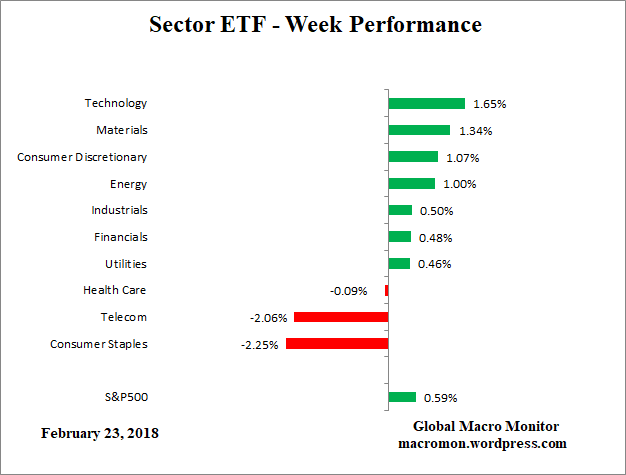
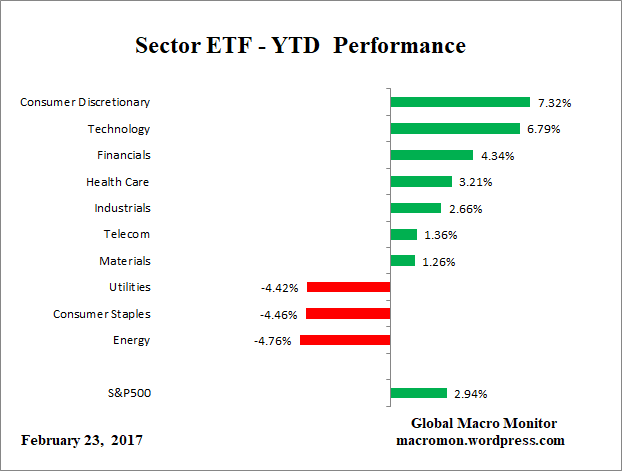
Week_2017_ETFs

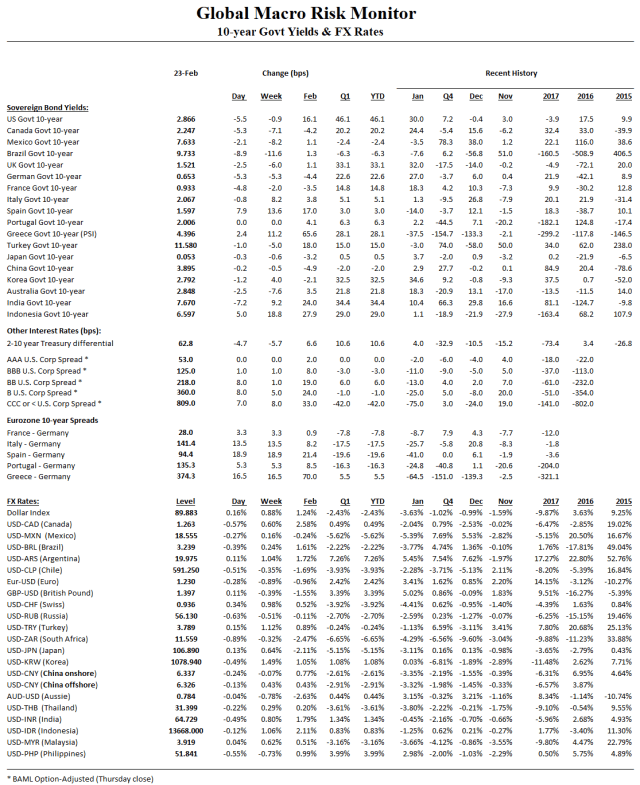
Weekly_Table

Posted in Charts, Daily Risk Monitor | Tagged , | Leave a comment

BEST SUPER BOWL Commercials Sneak Peek!

Good stuff!

Remember the dot.com Super Bowl ads during the 1990’s Nasdaq bubble?  Dot.coms  with no earnings and big burn rates would spend 70 percent (+/-) of their V.C. funding on Super Bowl ads to generate “eyeballs”?  Moreover,  their stock price would double the next Monday.

Hey, it was a “new economy” back then.    Beware of delusionary market narratives to justify extreme valuations.

More importantly, today, how can you bet against Tom Brady?   Pats by 11.


Posted in Sports, Uncategorized | Tagged , | Leave a comment

Gundlach Channels Our “Mark Of The Beast” Market

Love Jeffrey Gundlach.  As with everyone, not always right as nobody knows the future, but his analytical roadmap to decision making is rigorous, and he has the big ‘nads to pound the contrarian table. That earns him much respect, in our book.

Here is his latest tweet on the Dow’s 666 (rounded up) point fall on Friday and the 666 S&P bottom in March 2009 on S&P500.  We gave it to you first with some context in our, Another Streak Snappled, post just after the market close on Friday.

The number 666 is the Mark of the Beast in the Book of Revelations.


It also forced all people, great and small, rich and poor, free and slave, to receive a mark on their right hands or on their foreheads, so that they could not buy or sell unless they had the mark, which is the name of the beast or the number of its name.

This calls for wisdom. Let the person who has insight calculate the number of the beast, for it is the number of a man. That number is 666. – Revelation 13: 16-18

So, if Gundlach is correct, and 666 bookends the latest bull market, the number 666 will be indelibly stamped on the forehead of investors and traders.

Satire, folks, market satire!

https://twitter.com/TruthGundlach/status/959913388724965381


Booyah!

Posted in Equities, Uncategorized | Tagged , , | Leave a comment

Sector ETF Performance – February 2

ETF_D

ETF_W

ETF_M

Posted in Sector ETF Peformance, Uncategorized | Tagged , | Leave a comment