China’s fake data masks economic rebound – FT

Economic data are unlikely to reflect China’s revival because, as a series of admissions of falsified data attest, the true extent of the preceding downturn was never revealed. The country is on course to be the world’s largest economy by any measure

► Subscribe to FT.com here: http://bit.ly/2r8RJzM

.


Posted in China, Uncategorized | Tagged , , , | Leave a comment

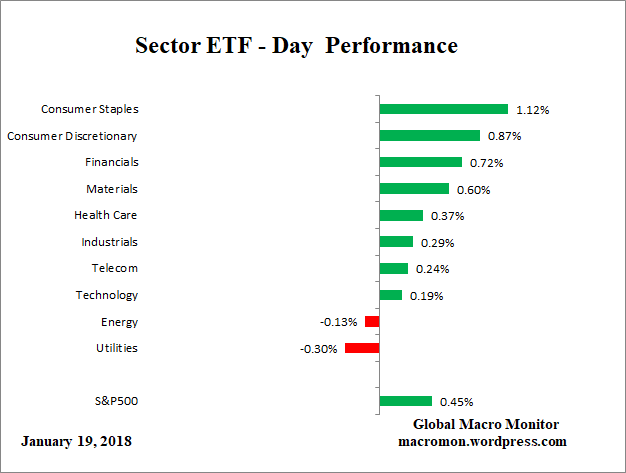
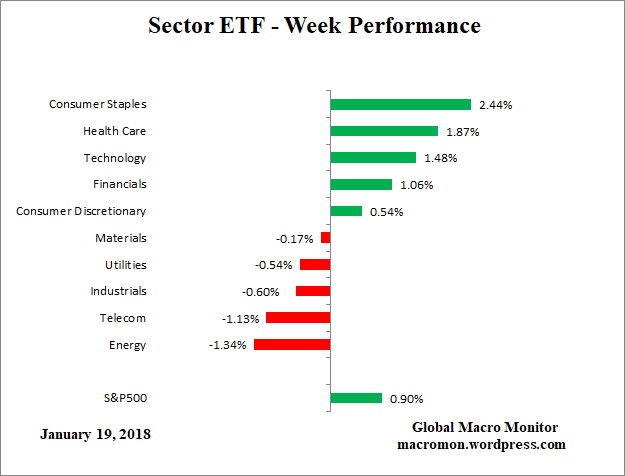
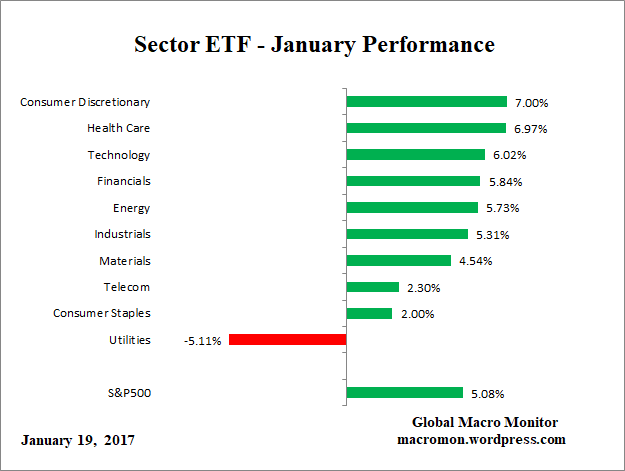
Sector ETF Performance – January 19

ETF_D

ETF_W

ETF_M

Posted in Sector ETF Peformance, Uncategorized | Tagged , | Leave a comment

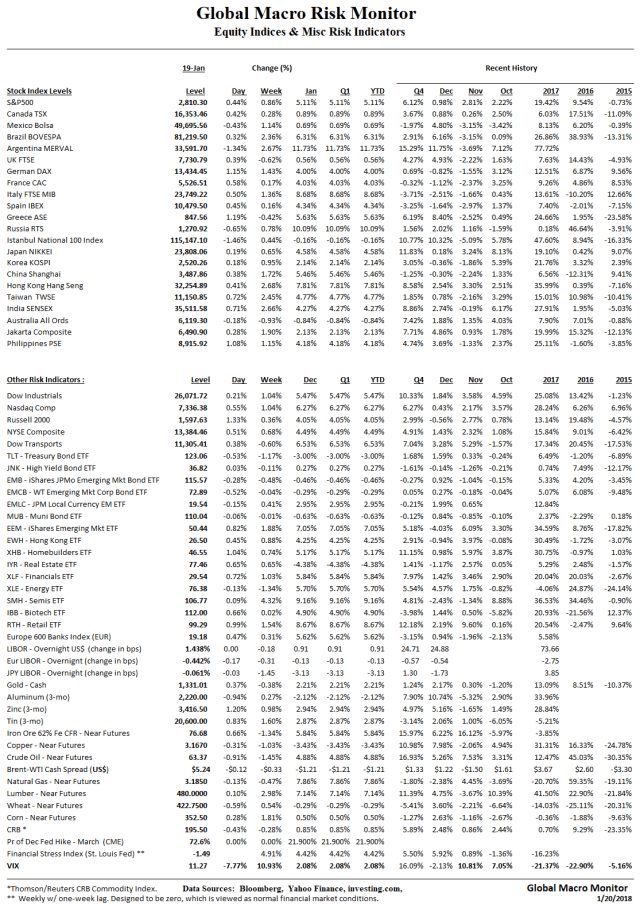
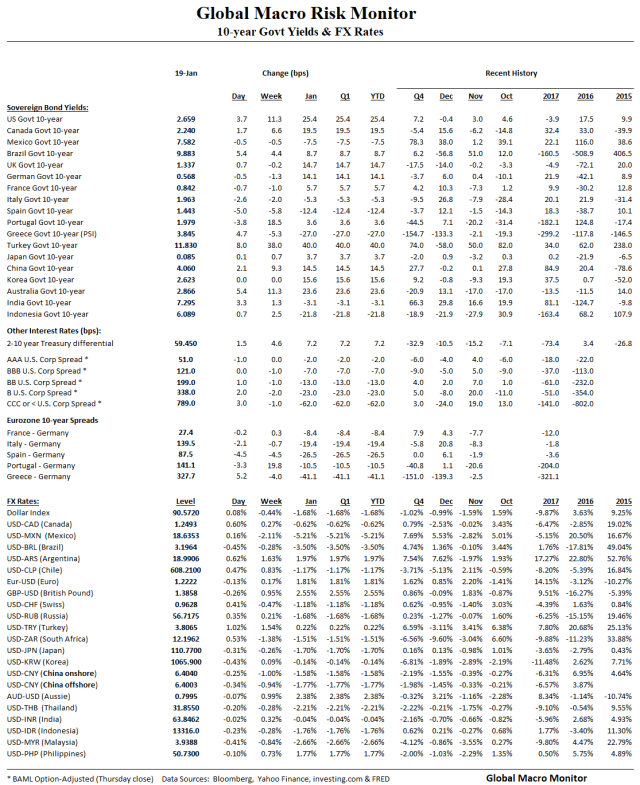
Global Risk Monitor – January 19

RiskMon_1

RiskMon_2

Posted in Daily Risk Monitor, Uncategorized | Tagged , , , , , | Leave a comment

The History of Federal Government Shutdowns

Title_Chart_Jan19

Background

The routine activities of most federal agencies are funded annually by one or more of the regular appropriations acts. When action on the regular appropriations acts is delayed, a continuing appropriations act, also sometimes referred to as a continuing resolution or CR, may be used to provide interim budget authority.1

Since FY1952, all of the regular appropriations acts have been enacted by the beginning of the fiscal year in only four instances (FY1977, FY1989, FY1995, and FY1997). No CRs were enacted for three of these fiscal years, but CRs were enacted for FY1977 to fund certain unauthorized programs whose funding had been dropped from the regular appropriations acts.2 Further, no CRs were enacted for FY1953, even though all but one of the regular appropriations was enacted after the start of the fiscal year.3

The Antideficiency Act (31 U.S.C. 1341-1342, 1511-1519) generally bars the obligation or expenditure of federal funds in the absence of appropriations.4 Exceptions under the act include activities involving “the safety of human life or the protection of property.”5 The interval during the fiscal year when appropriations for a particular project or activity are not enacted into law, either in the form of a regular appropriations act or a CR, is referred to as a funding gap.6

Although funding gaps may occur at the start of the fiscal year, they may also occur any time a CR expires and another CR (or the relevant regular appropriations bill) is not enacted immediately thereafter. Multiple funding gaps may occur within a fiscal year.

In 1980 and early 1981, then Attorney General Benjamin Civiletti issued opinions clarifying the need for the federal government to begin terminating regular activities upon the occurrence of a funding gap.7 As a consequence of these more strict guidelines, when a funding gap occurs, executive agencies begin a shutdown of the affected projects and activities, which includes the prompt furlough of non-excepted personnel. The general practice of the federal government after the shutdown has ended has been to retroactively pay furloughed employees for the time they missed, as well as employees who were required to come to work.

Funding Gaps Since FY1977

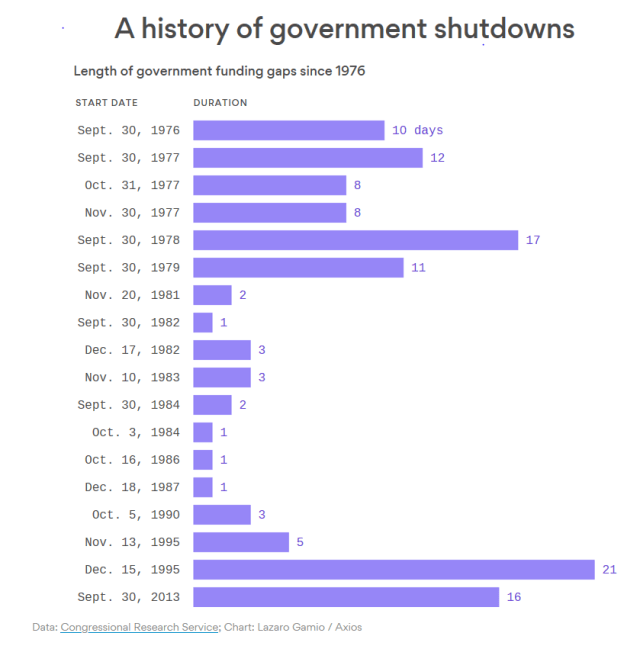
…As illustrated in Table 1, there have been 18 funding gaps since FY1977.10 The enactment of a CR on the day after the budget authority in the previous CR expired, which has occurred often, is not counted in this report as involving a funding gap. For example, between FY2000-FY2013, “next-day” CRs were enacted 18 times.

Almost all of the funding gaps occurred between FY1977 and FY1995. During this 19-fiscal-year period, 15 funding gaps occurred. 

Multiple funding gaps occurred during a single fiscal year in four instances: (1) three gaps covering a total of 28 days in FY1978, (2) two gaps covering a total of four days in FY1983, (3) two gaps covering a total of three days in FY1985, and (4) two gaps covering a total of 26 days in FY1996. S

Seven of the funding gaps commenced with the beginning of the fiscal year on October 1. The remaining 11 funding gaps occurred at least more than one day after the fiscal year had begun. Ten of the funding gaps ended in October, four ended in November, three ended in December, and one ended in January.

Funding gaps have ranged in duration from one to 21 full days. Six of the eight lengthiest funding gaps, lasting between eight days and 17 days, occurred between FY1977 and FY1980—before the Civiletti opinions were issued in 1980 and early 1981. After the issuance of these opinions, the duration of funding gaps in general shortened considerably, typically ranging from one day to three days. Of these, most occurred over a weekend.
Congressional Research Service

Shutdown_Chart_Jan19

.

ShutdownTable_Jan19

Posted in Fiscal Policy, Uncategorized | Tagged , , | 30 Comments

Is This Why The Dollar Is Tanking?

Some nasty polling data out of Gallup about American global leadership that may explain, in part,  the dollar’s weakness, which is surprising to many given the strong economic data and ebullient equity markets.

We thus suspect the weak Dixie is more than just that the economic data and markets around the world are relatively stronger and more ebullient than in the United States (see our post, Making The World Great Again).

Dollary_Jan18

We have written over the past year about the “Trump Slump” in the dollar.  That is, the dollar has tended to move down with the president’s poll numbers (see here).

Now this from Gallup (which is more concerning given China’s reduction of Treasury holdings),   World’s Approval of U.S. Leadership Drops to New Low,

WASHINGTON, D.C. — One year into Donald Trump’s presidency, the image of U.S. leadership is weaker worldwide than it was under his two predecessors. Median approval of U.S. leadership across 134 countries and areas stands at a new low of 30%, according to a new Gallup report.

The most recent approval rating, based on Gallup World Poll surveys conducted between March and November last year, is down 18 percentage points from the 48% approval rating in the last year of President Barack Obama’s administration, and is four points lower than the previous low of 34% in the last year of President George W. Bush’s administration.  – Gallup

.

Gallup1_Jan18

.

Big Losses Are Among Close Allies, Few Gains

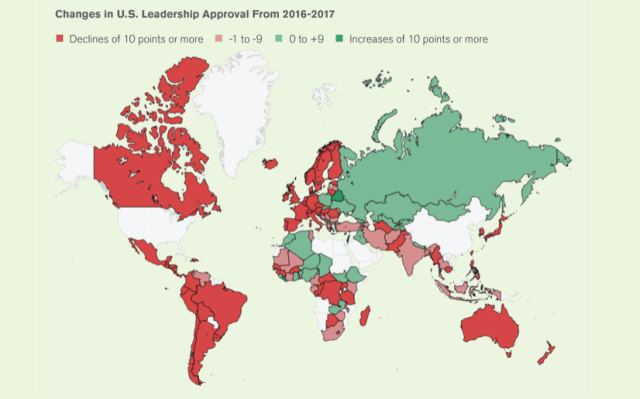
The relatively fragile image of U.S. leadership in 2017 reflects large and widespread losses in approval and relatively few gains. Out of 134 countries, U.S. leadership approval ratings declined substantially — by 10 percentage points or more — in 65 countries that include many longtime U.S. allies and partners.

Portugal, Belgium, Norway and Canada led the declines worldwide, with approval ratings of U.S. leadership dropping 40 points or more in each country. While majorities in each of these countries approved of U.S. leadership in 2016, majorities disapproved in 2017. – Gallup

.
Gallup2_Jan18

.

…in contrast, U.S. leadership approval increased 10 points or more in just four countries: Liberia (+17), Macedonia (+15), Israel (+14), and Belarus (+11). The 67% of Israelis who approve of U.S. leadership is on par with the ratings Israelis gave the U.S. during the Bush administration. Notably, interviewing in Israel took place before Trump officially recognized Jerusalem as Israel’s capital, but he had repeatedly promised to do so during his campaign for president.  — Gallup
Gallup3_Jan18

.

U.S. Approval Drops to New Lows in Americas

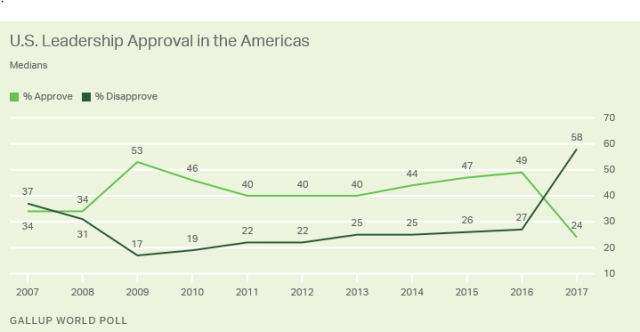
Regionally, the image of U.S. leadership suffered most in the Americas, where approval ratings dropped to a new low. The median of 24% who approve of U.S. leadership in the region now stands at about half of what it was in the last year of the Obama administration (49%).

Approval of U.S. leadership plunged in every country in the region in 2017. In fact, there were double-digit decreases in all countries except Venezuela, where approval dropped nine points.

U.S. leadership approval ratings suffered nearly as much in Europe as they did in the Americas; however, the current 25% approval rating there is not the lowest on record — the ratings during the last two years of George W. Bush’s administration still hold that distinction. In Asia, approval dropped to 30%, tying the previous low that Gallup measured during the Bush administration.

Africa as a whole remained the bright spot for U.S. leadership approval, as it has been for the past decade. Nonetheless, the approval rating for the region is at its lowest level yet, clinging to a bare majority (51%) that may be at risk after the president’s alleged remarks about the continent last week. — Gallup

.
Gallup4_Jan18

.

Trump’s First Year: Hard Times for U.S. Soft Power

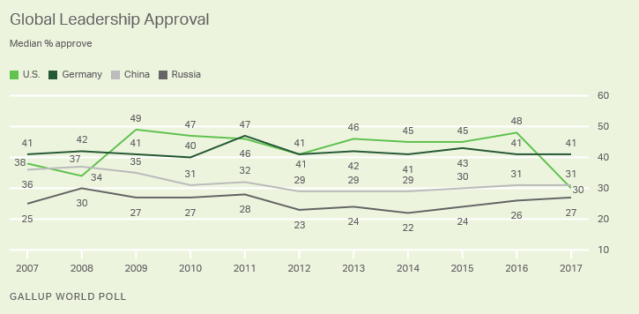
The losses in U.S. leadership approval may have implications on U.S. influence abroad. With its stable approval rating of 41%, Germany has replaced the U.S. as the top-rated global power in the world. The U.S. is now on nearly even footing with China (31%) and barely more popular than Russia (27%) — two countries that Trump sees as rivals seeking to “challenge American influence, values and wealth.”– Gallup

Double yikes!!    Interest rates rising, dollar weakening.  This would matter in less irrationally exuberant markets.   It won’t until it will.

Posted in Dollar, Economics, Politics, Uncategorized | Tagged , | 13 Comments

Nonlinear Thinking: Lifeguard drone completes world-first ocean rescue

It has been a while since our last nonlinear thinking post. We think it is time to start up again.

We wrote about the coming of the iLifeguard back in in 2013,

Nonlinear Thinking: iLifeguards
Posted on March 26, 2013

Wow! The robots are even coming for the lifeguards…

Amazing world we now live.

Swimmers on Californian beaches are likely to be rescued by a different kind of lifeguard if they get into trouble this summer. The Emergency Integrated Lifesaving Lanyard, or EMILY, is a remote controlled buoy that can quickly relieve a drowning person and help them stay afloat until further help arrives. The EMILY can be deployed from a boat or helicopter, and supports up to four people. It can also be equipped with cameras, speakers and other hardware to enable enhanced rescued performance.

SOURCES: BBC, Popsci – Global Macro Monitor, March 2013

So here is the latest from the Sydney Morning Herald:

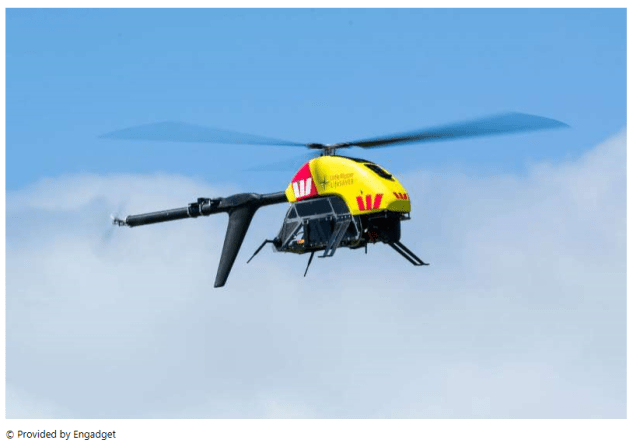
Australia’s ‘Little Ripper’ drone has saved a pair of swimmers caught in rough seas in what’s thought to be a world-first rescue operation. Lifeguards were busy testing the UAV off Lennox Head as part of New South Wales’ $250,000 shark-spotting strategy when the distress call came in. Within 70 seconds the aerial helper had tracked down the stranded duo and dropped them a flotation pod, which they used to safely make their way to shore, according to The Sydney Morning Herald.

Australia has been leading the charge in deploying drone coast guards, with countries like the UK following suit. The ‘Little Ripper’ UAVs, packed with supplies including inflatable rafts and GPS beacons, can fly through the air for two-and-half hours on a single charge. In August, it was reported that the drones were being fitted with AI smarts to map Australia’s shark-infested waters. Around 40 Little Rippers were reportedly shipped to Australia’s Surf Life Saving Clubs last year. — The Sydney Morning Herald

Amazing!

Nonlinear Thinking_Jan18

.

Posted in Uncategorized | Leave a comment

Hardest Working Countries – Statista

Interesting stuff from Statista.  Should blow away the priors of the hoi polloi, especially in the EU.

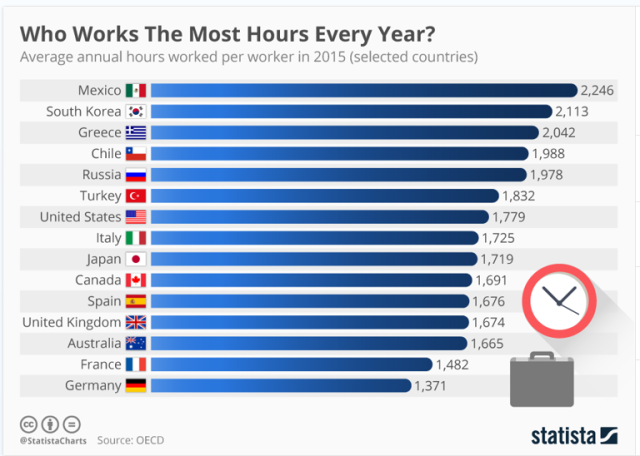
Across the globe, people are firmly back in the working groove after all the fun, relaxation and overindulgence of the holiday season. This year, some workers are going to have a far longer shift than others. According to the OECD, Mexicans work the most hours out of any country with 2,246 on average. That’s 467 more than an average American worker and for less than a fifth of the pay.

In recent years, the South Korean government has attempted to reduce the long working hours in the country but its workers are still averaging 2,113 hours annually. Greek workers were sometimes labeled as over-paid, lazy and eager to retire early after the financial crisis struck but those accusations were certainly unfounded. People in Greece work the most hours of any European country with 2,042 every year on average.

U.S. workers put in a 1,779 hour shift every year while across the border in Canada, the annual total adds up to 1,691. French workers get a much better deal with 1,482 hours while in Germany, the total only comes to 1,371. – Statista 

.

Hours per Day_Jan16

Posted in Employment, Uncategorized | Tagged , , | 1 Comment

QOTD: Dr. King

The ultimate tragedy is not the oppression and cruelty by the bad people but the silence over that by the good people.  – Martin Luther King, Jr

.martin-luther-king-jr-mini-biography

Posted in Quote of the Day, Tweet of the Day, Uncategorized | Tagged | Leave a comment

Week In Review – Jan 12

Frothy the Snowman, was a jolly, happy soul…. Thumpety, thump, thump, thumpety thump, thump, look at Frothy go!”

Momentum is a very powerful thang, especially when powered by a theme of synchronized global expansion and  “blockbuster” retail money flows into stocks.   No worries about extreme valuations in MoMo markets, however.

Note to self:  Will not chase, will not short until market tells us to.

Of course, global asset markets are in a huge bubble.  Let the trend play out and let markets break before getting shorty.

Could go until beginning of summer – maybe – but trying to pick exact tops and time corrections are a mug’s game.  Why our preference is for trend based models.

Fixed-income
– Euro periphery tightening on spec ECB to issue EURO bond to extract from QE;
– Yield seekers going all-in in Brazil;
– German 10-year approaches key resistance at 60-ish bps as ‘zone economy rips;

Currency
– Dollar seems to have caught Trump flu.  Usually gets sneezy  squeezy down here;
– Dollar/yen weak on speculation BoJ to start tapering; Continue reading

Posted in Uncategorized, Week in Review | Tagged , , , , | Leave a comment

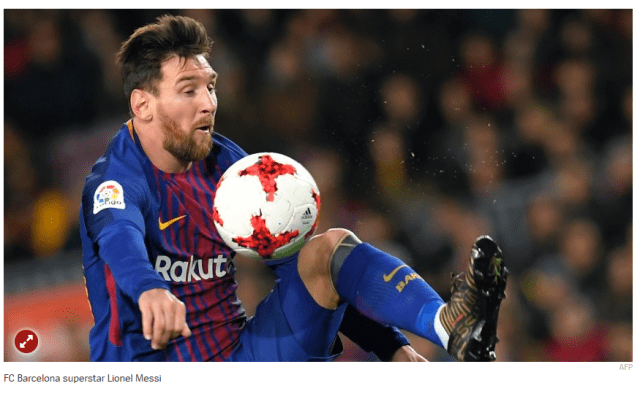
Lionel Messi’s 100-Million-Euro Contract – Spiegel

Betcha Messi glad he didn’t quit now!

Lionel Messi’s new contracts with FC Barcelona exceed all limits. Two contracts that Messi signed with FC Barcelona on June 30, 2017 — an employment contract and one covering his marketing rights — show that the Argentinian has become the first professional football player ever who will earn more than 100 million euros a season.

The revelations, which come from documents obtained from the Football Leaks whistleblower platform, are covered in the latest issue of DER SPIEGEL. The documents show that Messi is to receive an annual fixed salary of 71,053,846 euros through the end of the 2020/21 season. He is also to get a one-time bonus of 63.5 million as well as a “loyalty bonus” of 70 million euros. On top of that come performance bonuses. If the team wins the Champions League, for example, Messi would receive an additional 12,057,513 euros.  – Spiegel

.

Messi_Jan13.png

Posted in Sports, Uncategorized | Tagged , , | Leave a comment