The “Firming” Global Recovery

The IMF upgraded their view of the global economy, while slightly downgrading U.S. economic growth due to lack of fiscal progress.

The Global Economy Maintains Momentum

The cyclical recovery continues. Growth outturns in the first quarter of 2017 were higher than the April WEO forecasts in large emerging and developing economies such as Brazil, China, and Mexico, and in several advanced economies including Canada, France, Germany, Italy, and Spain. High-frequency indicators for the second quarter provide signs of continued strengthening of global activity. Specifically, growth in global trade and industrial production remained well above 2015–16 rates despite retreating from the very strong pace registered in late 2016 and early 2017. Purchasing managers’ indices (PMIs) signal sustained strength ahead in manufacturing and services.

  • The pickup in global growth anticipated in the April World Economic Outlook remains on track, with global output projected to grow by 3.5 percent in 2017 and 3.6 percent in 2018. The unchanged global growth projections mask somewhat different contributions at the country level. U.S. growth projections are lower than in April, primarily reflecting the assumption that fiscal policy will be less expansionary going forward than previously anticipated. Growth has been revised up for Japan and especially the euro area, where positive surprises to activity in late 2016 and early 2017 point to solid momentum. China’s growth projections have also been revised up, reflecting a strong first quarter of 2017 and expectations of continued fiscal support. Inflation in advanced economies remains subdued and generally below targets; it has also been declining in several emerging economies, such as Brazil, India, and Russia.
  • While risks around the global growth forecast appear broadly balanced in the near term, they remain skewed to the downside over the medium term. On the upside, the cyclical rebound could be stronger and more sustained in Europe, where political risk has diminished. On the downside, rich market valuations and very low volatility in an environment of high policy uncertainty raise the likelihood of a market correction, which could dampen growth and confidence. The more supportive policy tilt in China, especially strong credit growth, comes with rising downside risks to medium-term growth. Monetary policy normalization in some advanced economies, notably the United States, could trigger a faster-than-anticipated tightening in global financial conditions. And other risks discussed in the April 2017 WEO, including a turn toward inward-looking policies and geopolitical risks, remain salient.
  • Projected global growth rates for 2017–18, though higher than the 3.2 percent estimated for 2016, are below pre-crisis averages, especially for most advanced economies and for commodity-exporting emerging and developing economies. Among the former, many face excess capacity as well as headwinds to potential growth from aging populations, weak investment, and slowly advancing productivity. In view of weak core inflation and muted wage pressures, policy settings should remain consistent with lifting inflation expectations in line with targets, closing output gaps, and—where appropriate—external rebalancing. Reforms to boost potential output are of the essence, and slow aggregate output growth makes it even more important that gains are shared widely across the income distribution. Financial stability risks need close monitoring in many emerging economies. Commodity exporters should continue adjusting to lower revenues, while diversifying their sources of growth over time.

.

IMF_Firming Global Recovery

Posted in Economics, Uncategorized | Tagged , , | Leave a comment

Week In Review

Global Stocks

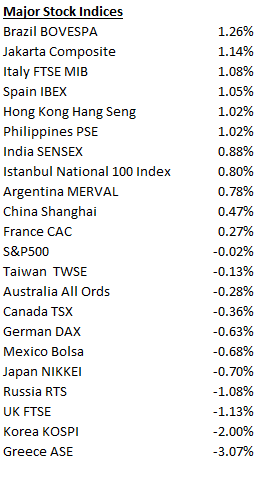
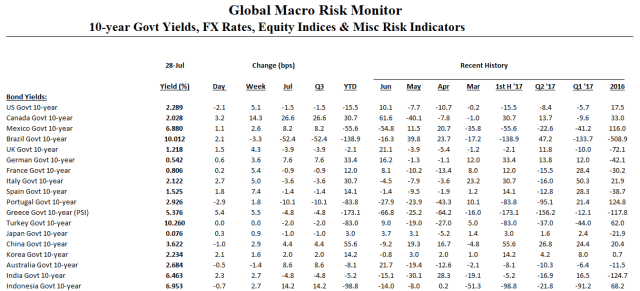
Flat week for the S&P500 after making new all-time earlier in the week although the Dow continues to make record highs.  Nasdaq also new record early in week then  succumbed to profit taking on Thursday and Friday.   India, one of our favorite EM’s continues to perform well.  Greece weak, closing down over 3 percent after profit taking.  Greece up almost 30 percent YTD.


Week_Stocks

Fixed Income

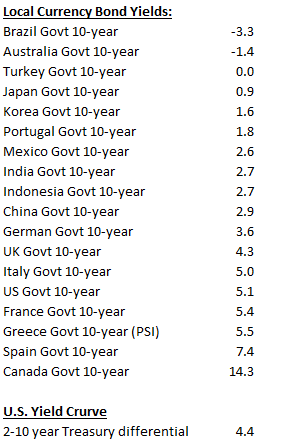
Fairly quiet week for local currency bonds.   Interest rates up slighly on week with biggest move in Canada – + 14.3 bps.   U.S. yield curve steeper by 4 1/2 bps.


Week_Bonds

Currencies

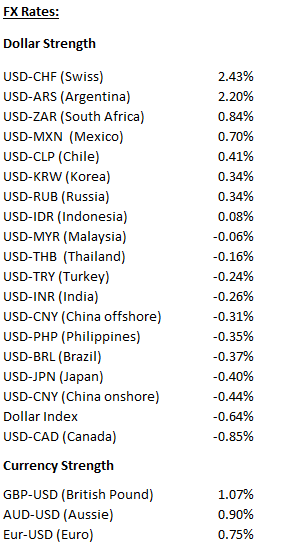
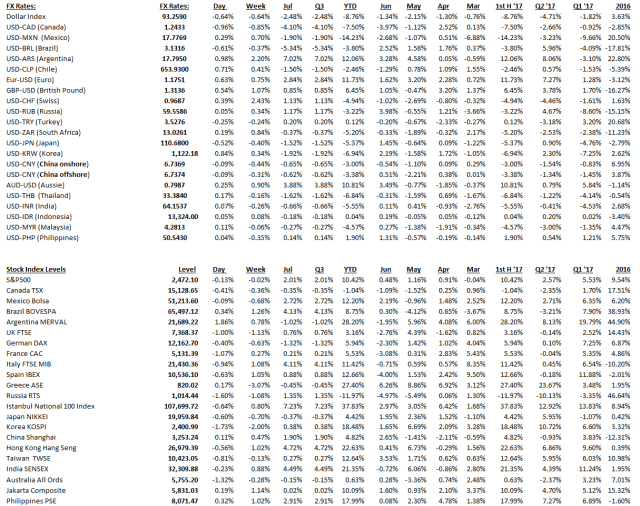
Dollar index continues to slide toward the key 92 critical level,  after what was percieved as a dovish FOMC statement.   Pound, Aussie, Euro, and Canada pairs versus dollar all strong.  China strengthening.   Mexico gave a little back after its YTD rip.


Week_Currencies

Other Risk Indicators

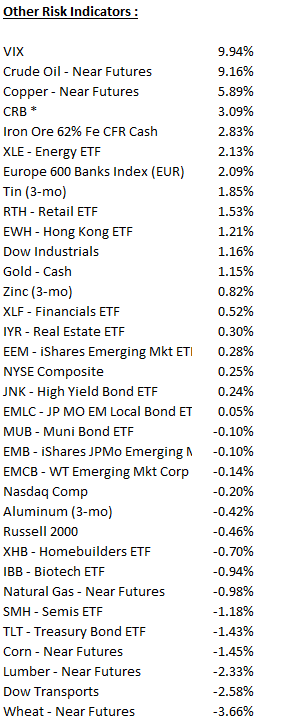
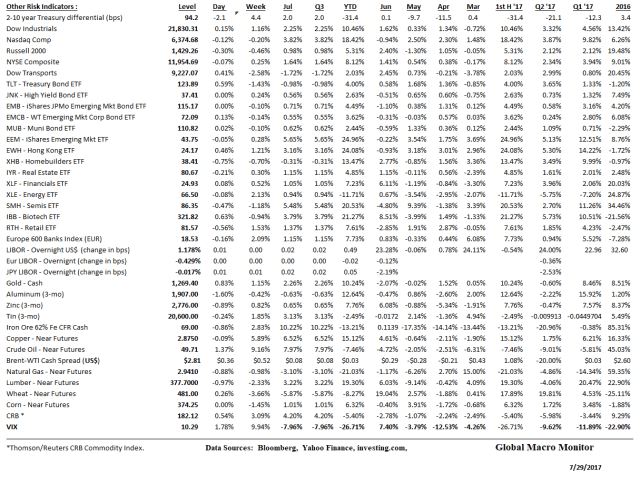
After trading with 8 handle for only its second time in history,  the volatility index increased to close over 10 for the week.   The Dow Transports sold off hard, down over  2 1/2 percent.   Inflation commodities picked up strength with CRB up over 3 percent.  Crude up almost 10 percent and Copper up 5 percent.   Iron Ore looks like it has turned and was up almost 3 pecent.


Week_Others


Posted in Uncategorized, Week in Review | Tagged , , , , | Leave a comment

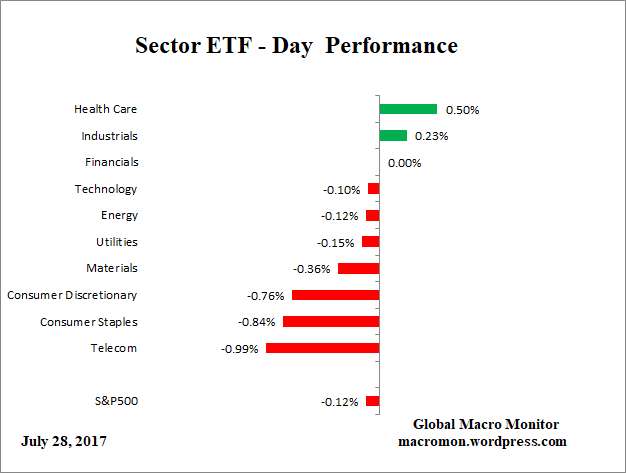
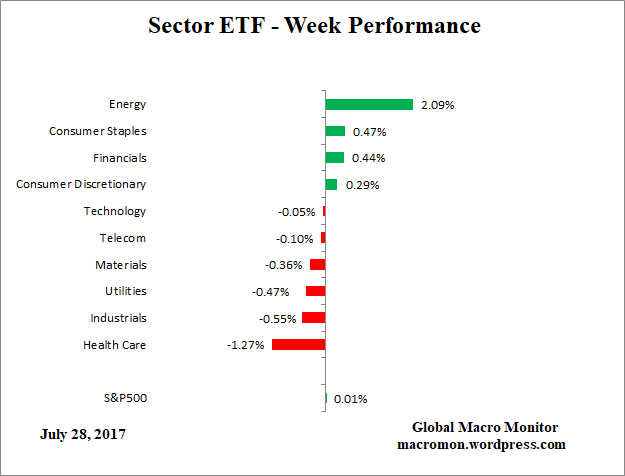
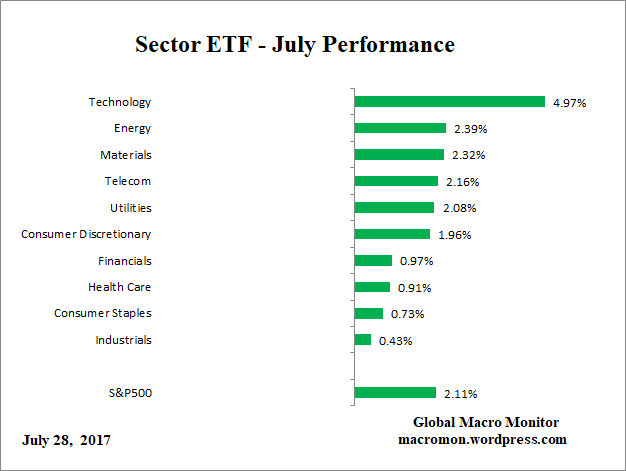
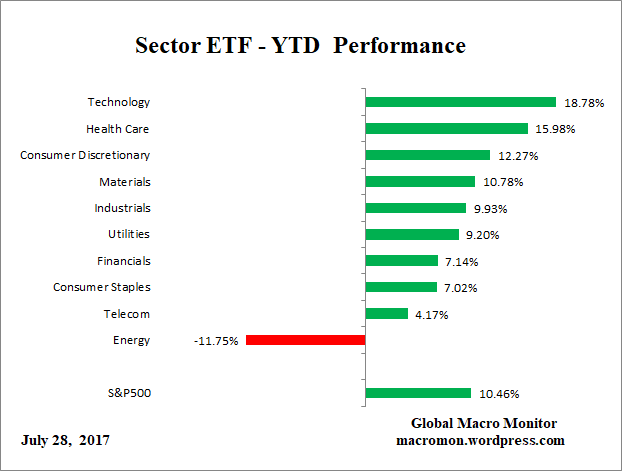
US Sector ETF Performance – July 28

ETF_DETF_WeekETF_MonthETF_YTD

Posted in Sector ETF Peformance, Uncategorized | Tagged , | Leave a comment

Global Risk Monitor – July 28

Posted in Daily Risk Monitor, Uncategorized | Tagged , , , , , | Leave a comment

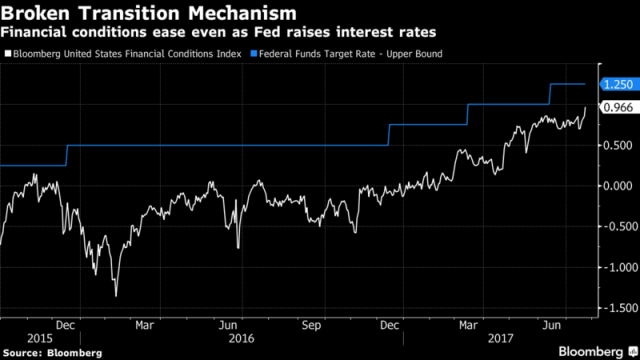
COTD: “Easy Financial Conditions”

You heard it here first, folks, in our July 16th post,  Market Liquidity Conditions Still Loose As A Goose.

Here is Bloomberg on the easy money,

Easier financial conditions affect the Fed in three ways. First, officials will associate them with faster economic growth. But they don’t want so much growth that the unemployment rate falls too far below the natural rate. At the current pace of job growth, that seems likely.

Second, some members will associate easier financial conditions with financial instability. The dynamics of the last two cycles leave them wary of recreating the same conditions a third time. They will worry that halting the current path of monetary policy only sets the stage for more froth in financial markets down the road — markets that Yellen has already called “somewhat rich.”

Third, a falling dollar is contributing to easier financial conditions. The Fed will see that as another reason to expect their inflation forecasts to become reality after the impact of the recent “special factors” restraining consumer prices fade.  –  Bloomberg

.

Financial Condidtions_July27

(COTD = Chart of the Day)

Posted in Monetary Policy, Uncategorized | Tagged , | Leave a comment

QOTD: AI And China

China recognizes that AI will be critical to its future “comprehensive national power” – The Diplomat

Posted in China, Technology, Uncategorized | Tagged , | Leave a comment

Dollar Index Spanked After FOMC – Nears Key Support

The Dollar Index was spanked today after what the market percieved as a dovish FOMC statement.    Kind of odd as early inflation indicators starting to pick up.

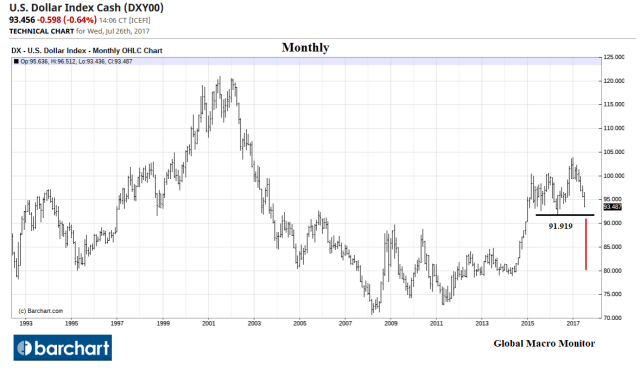
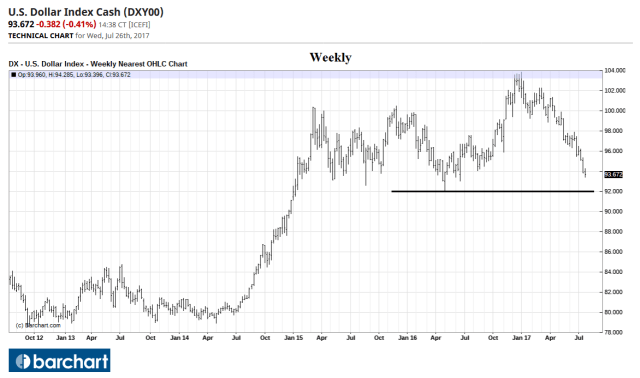
We were expecting a short-term rally as everyone is long the euro/dollar pair, i.e., short the dollar (see chart below), and as the weights listed below illustrate the Dollar Index is essentially a euro trade.   If 92 holds,  the Dollar Index may still be set for a short-term rally.

In fact, the non-commercials haven’t been this long the euro/dollar since 2011, just a few months before the Eurozone almost melted down.

Watch 91.919, the May 2016 low, which is about 1.6 percent lower.  If that breaks, the weekly and monthly chart show little support until the 80 level.   Ouch!  That will get Super Mario’s attention and we doubt he will allow it to get there.   We think a 1.18 euro/dollar is pretty close to his threshold of pain and it’s currently just about there.

Also, note,  at the beginning of the year the dollar was overvalued, to the extreme,  on a purchasing power parity basis across almost every currency in the world.

We know how President Trump feels about weak currencies that contribute to bilateral U.S. trade deficits .

U.S. Dollar Index

It is a weighted geometric mean of the dollar’s value relative to other select currencies:

  • Euro (EUR), 57.6% weight
  • Japanese yen (JPY) 13.6% weight
  • Pound sterling (GBP), 11.9% weight
  • Canadian dollar (CAD), 9.1% weight
  • Swedish krona (SEK), 4.2% weight
  • Swiss franc (CHF) 3.6% weight

– Wikipedia

Dollar_July26Dollar_2_July26

.

CFTC_EuroFX

Posted in Dollar, Uncategorized | Tagged , , | Leave a comment

This Rhyme Is Different: Base Money > M1

“History doesn’t repeat itself but it often rhymes.” –  Mark Twain (maybe)

We have been speaking a lot about how the liquidity in the market today is different than in the past.   The chart below reflects this better than anything we have seen.

M1_Monetary Base

The monetary base in the U.S. has exceeded M1,  the most narrow definiton of money,  since the financial crisis.   The monetary base consists of money in circulation and reserves held at the Fed (see definition below).

The M1 money multiplier is still less than one, which reflects that for every dollar created by the Fed – an increase in the monetary base – results in a less than one dollar increase in the money supply (M1).   Credit and deposit creation of commercial banks  is thus still impaired, though improving and its repairment may be one reason why the Fed is a bit nervous and in tightening mode.

Watch This Space

A rapid turnaround and improvement in the money multiplier, which may be also be reflected in improving bank net interest margins and growing balance sheets,  could act as an early indicator of potential inflationary pressures and a flag that the massive amount of high powered money in the financial system is being converted to credit based money.

The Fed is therefore walking a tightrope of an unstable equilibrium with inflation on one side and deflation on the other, especially if your main policy tool is to pay interest on a large portion of that high powered money.   This, as the markets become increasingly convinced the global economy is now in a “Goldilocks” scenario,  justifying extreme asset valuations and the record low volatility.

Note, the secular decline in the money multiplier, which reflects many factors,  including the almost irrelevance of M1,  foreign capital flows, financial innovation, technology and the rise of non-bank banks.   For example,  private direct lending is all the rage now with hedge funds and other non-bank banks.

Different Kind of Liquidity

The above  illustrates why we are in a period of mainly central bank based liquidity rather than credit based liquidity — which can evaporate almost over night with, say,  a financial or economic  shock — as it did in 2008.

Upshot?  It’s all up to the central banks, mainly the Fed and ECB, and when markets perceive it matters that they are removing money/liquidity from the system.  And there is a lot of it out there, folks.   Flooding the reservoirs with nowhere to go but to overflow into the asset and financial markets.

The stock of reserves in the financial system are what matter now (the Fed’s position), but flows will dominate when the market perceives they are approaching drought level conditions.

There is also a tipping point policy interest rate that will bite the economy and destabilize the markets, but we believe that is at least 100-200 basis points higher.  After all,

“John Bull can stand many things, but he cannot stand 2.0 , [-1.5 or 1.25] percent” – Bagehot

Maybe Caterpillar’s earnings release this morning reflects that the excess liquidity is starting to kick into the global economy.   Take a look at Dr. Copper breaking out to a two-year high  today,  though is doesn’t take much copper to write an AI program, does it?

In additon, the future trajectory of the economy and risk markets are also dependent on how and how much credit, liquidity, and “money” —  economists can’t even agree on what is money — are now being created.   Good luck measuring that.

Markets are acting as if  “money” is far from “tight” or nowhere close to getting there.  And central banks are too nervous to tighten up monetary conditions to any significant level.

That, in our opinion, is another reason why volatility is breaking to record lows and risk markets are so elevated experiencing only just very shallow pullbacks.   And it can, and is, lasting longer than many have expected.

October Correction Is Our Best Guess

We are are waiting for Mr. October to step up and knock the risk markets for a loop, however, resulting in a nice fall correction (pun intended).  We believe many factors will be converging  by then, including:

1) seasonality;  2) the Fed balance sheet should, or could be shrinking ;  3) China’s Party Congress may have concluded, removing the country’s  implicit policy put, and thus increasing the risk of a China policy or economic shock;  4) the new U.S. Federal government fiscal year begins October 1 and if the Trump administration has not passed any significant economic legislation, the markets may begin to throw in the towel;  5) there will be more clarity on ECB tapering; 6) even more elevated asset prices as the risk markets grind higher through the rest of summer as we suspect, setting up for a potential blow-off by the end of September;  7) nervousness over the debt ceiling;  and, finally,  8) by then, the souffle now being baked and puffed up by the markets should barely be able to withstand the slamming of the oven door.

Will it kill the bull?   Not until monetary conditions tighten up significantly in our opinion, and the Fed believes the economy can survive a prolonged bear or sideways market,  which probably won’t happen unless John Taylor replaces Janet Yellen.

Central banks now, not even with the undercover of, say, a plunge protection team,  buy equities outright  if they think it will help stimulate aggregate demand.   The Bank of Japan is now set to become the number one shareholder in 55 of the Nikkei 225 companies  How did we ever get to this place?

A Caveat:  Difficulty of Fully Understanding The Global Monetary System

Trying to understand the global monetary system,  a black box, in our opinion,  is similar to watching shadow puppets dancing on the side of the wall of a cave or seeing through a glass darkly.

The monetary system is too complex and too dynamic for you to understand it all. So it’s better to understand enough that you can be competent, but not so much that you become a danger to yourself.  – Cullen Roche

A good friend of mine and great economist,  David Herstle Jones,  describes the execution of monetary policy as,

“…driving on a narrow mountain road in the fog.”  – DHJ

Good luck.

Appendix:

M1 Money Supply

M1 includes funds that are readily accessible for spending. M1 consists of: (1) currency outside the U.S. Treasury, Federal Reserve Banks, and the vaults of depository institutions; (2) traveler’s checks of non bank issuers; (3) demand deposits; and (4) other checkable deposits (OCDs), which consist primarily of negotiable order of withdrawal (NOW) accounts at depository institutions and credit union share draft accounts. Seasonally adjusted M1 is calculated by summing currency, traveler’s checks, demand deposits, and OCDs, each seasonally adjusted separately.  – St. Louis Fed,  FRED

Monetary Base

The Adjusted Monetary Base is the sum of currency (including coin) in circulation outside Federal Reserve Banks and the U.S. Treasury, plus deposits held by depository institutions at Federal Reserve Banks. These data are adjusted for the effects of changes in statutory reserve requirements on the quantity of base money held by depositories.
– St. Louis Fed,  FRED

Money Multiplier

The M1 multiplier is the ratio of M1 to the St. Louis Adjusted Monetary Base. For further information on monetary aggregates, please refer to the Definitions, Notes, and Sources at http://research.stlouisfed.org/publications/mt/.  – St. Louis Fed,  FRED


Posted in Economics | Tagged , , , | 23 Comments

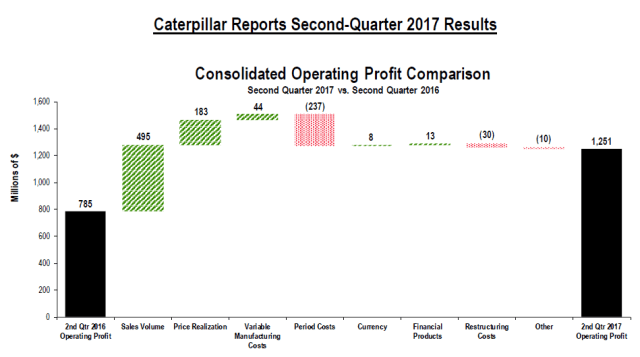
Caterpillar Beats For All The Right Reasons

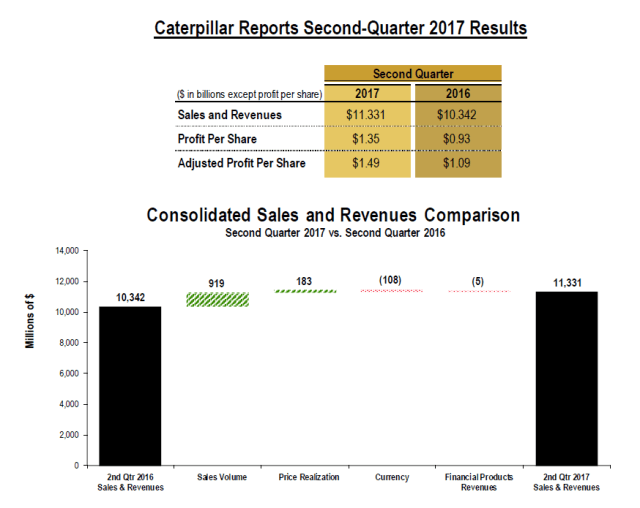
Caterpillar, a bellwether for the global economy,   beat on both the top and bottom line for all the right reasons (increase in sales and revenues) with their earnings release this morning.  The stock is up over 5 percent at 11 AM eastern.   Revenues were up 9.6 percent y/y with decent growth in all geographical regions — x/ Middle East (flat) — especially China.

Money excerpts from the release:

CAT_IntroCAT_1CAT_2CAT_RegionsCAT_Outlook

Posted in Earnings, Uncategorized | Tagged , , | 3 Comments