The Good Public Servant

Don’t you wish the hombre in La Casa Blanca had this guy’s character, maturity,  and rhetoric?   Proud of our Chief Justice.   What a good man and public servant.

Chief Justice John G. Roberts Jr. delivered eight opinions and two dissents in the just-concluded Supreme Court term.

But none probably meant as much as the statement he handed down on a rainy, early June morning in a small New Hampshire town.

It was the ninth-grade commencement address for the Cardigan Mountain School, an elite boarding school for boys grades six through nine. Sitting up front under a large white tent as John Glover Roberts Jr. took the stage was graduating student John Glover Roberts III.

…Success, he reminded them, comes to those who are unafraid to fail. “And if you did fail, you got up and tried again. And if you failed again, you got up and tried again. And if you failed again — it might be time to think about doing something else.”

Roberts said commencement addresses customarily wish graduates success. He thought it better for them to experience challenges.

“From time to time in the years to come, I hope you will be treated unfairly,” Roberts said, “so that you will come to learn the value of justice.”

Betrayal “will teach you the importance of loyalty.” Loneliness will instruct people not to “take friends for granted.” Pain will cause someone “to learn compassion.”

“I wish you bad luck — again, from time to time — so that you will be conscious of the role of chance in life,” Roberts said. “And understand that your success is not completely deserved, and that the failure of others is not completely deserved, either.”

A commencement speech is supposed to offer “grand advice,” Roberts said, so his first was to recognize the exalted perch from which they started — a school with a 4-to-1 student-teacher ratio, where students dine in jackets and ties, and tuition and board cost about $55,000.

Through his son, Roberts had come to know many of the students, he said, and “I know you are good guys.”

“But you are also privileged young men, and if you weren’t privileged when you came here, you’re privileged now because you have been here,” Roberts said. “My advice is: Don’t act like it.”

He urged them, at their next school, to introduce themselves to the people “raking the leaves, shoveling the snow or emptying the trash.” Learn their names, smile and call them by name. “The worst thing that will happen is you will become known as the young man who smiles and says hello,” he said.
– Washington Post

 

Posted in Uncategorized, US Releases | Tagged , | Leave a comment

2017 First Half Key Takeaways

Bonds

  1.  Big outperformance by local emerging markets and Euro periphery in first half.
  2.  Last week was pivotal as some bonds gave back almost entire year due to ECB hawkishness.
  3.  Watch this space.  More big moves here will determine asset trading for summer and set up big correction in the fall, in our opinion.

.

FH_Bonds

Currencies

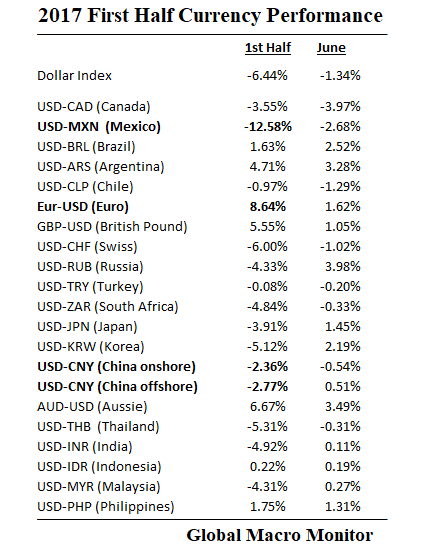
  1. Surprise weakness in dollar, mainly due to stalling of Trump agenda.
  2. We expect a big dollar rally in second half as we move closer  to tax reform.  All bets off if  Trump fails.

FH_Currency

Stocks

  1. Big outperforrmance in emerging markets.  We expect this to continue.  Especially like India.
  2. If bond markets stablize in Europe, which we expect moves to become more muted, but still expect higher interest rates,  Euro stocks should outperform U.S.
  3. Russia looking cheap as crude oil stablizes.  Watch Trump/Putin meeting next week.

FH_Stock Index

Selected Indicators

  1. High beta tech big outperformance.  Expecting a rotation into laggards, such as financials and energy.

FH_Selected Indicators

Commodities

  1. Crude oil collapse soured commodity index.  Natural gas gave back some of last year’s 50 percent gain.
  2. Lumber has been a leading indicator of economy over past history although some of move can be attributed to duties imposed on Canadian lumber.
  3. Copper had strong bookends.  Up over 10 percent in January, weak during intervenng months and finished strong with over 4 percent gain in June.
  4. Looks like Iron Ore has bottomed.
  5. Gold going to be a tough trade in a rising rate and QT world unless all hell breaks lose.

FH_Commodities

Conclusions

  1. We expect markets to grind around with a bit more volatility as central banks move away from QE and toward quantitative tightening (QT).
  2. Preparing for a choppy summer with lots of sector and stock rotation with a slight bias to upside in risk markets.
  3. Expecting  algos and trading ‘bots to continue to play their games, setting bull and bear traps, shaking the trees, and, you know, your basic market manipulaton.  Bastards!
  4. Looking for full blown correction in the fall.
  5. WE KNOW NOTHING ABOUT WHAT THE FUTURE HOLDS.  JUST OUR CALCULATED GUESS.     
Posted in Bonds, Commodities, Currency, Equities, Uncategorized | Tagged , , , , | 9 Comments

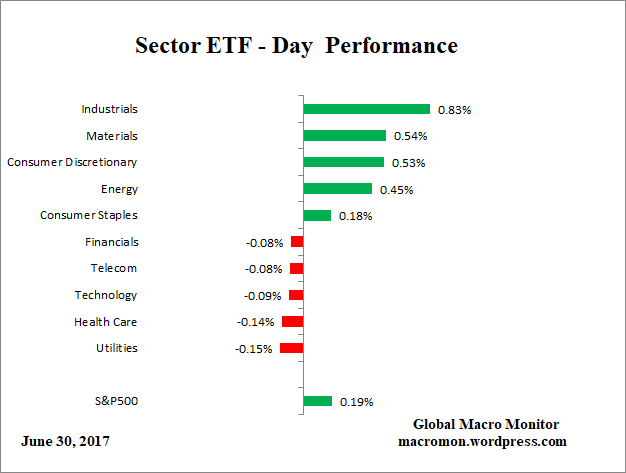
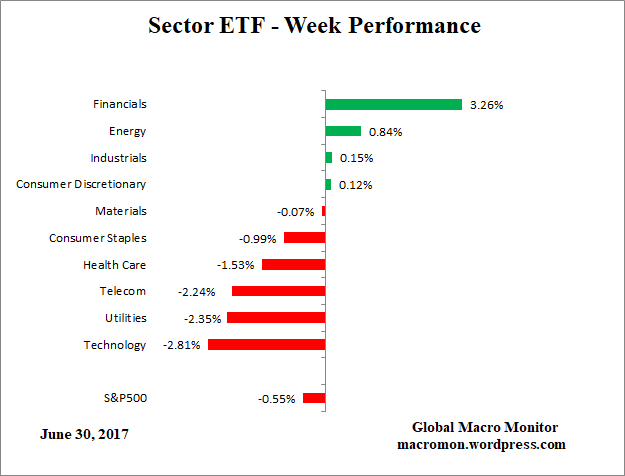
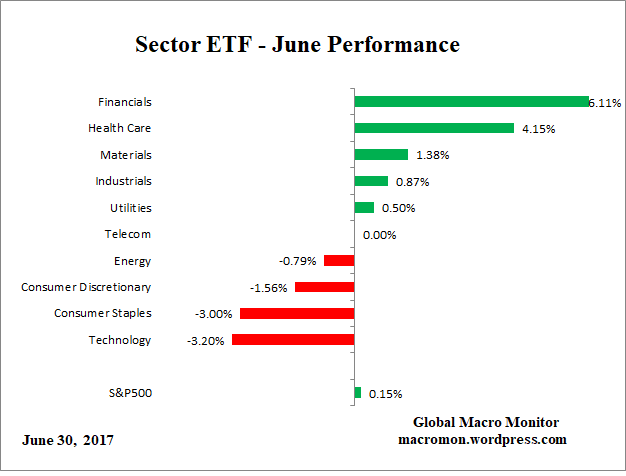
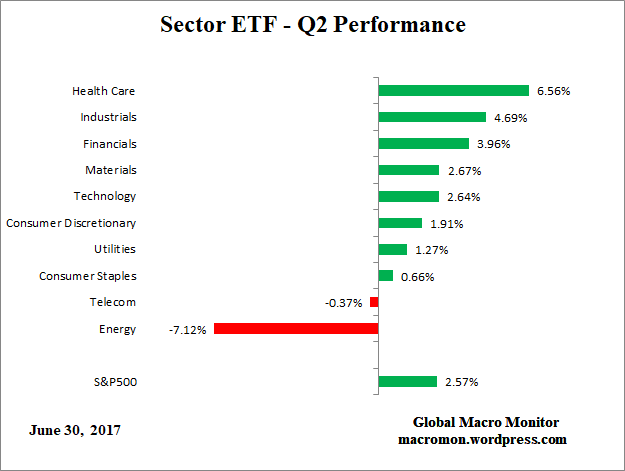
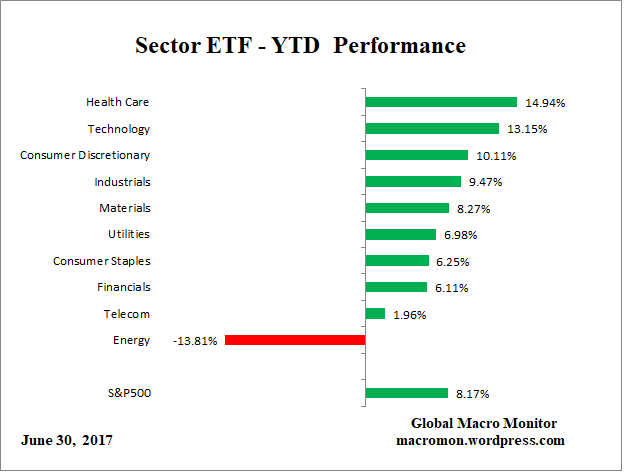
US Sector ETF Performance – June 30

ETF_DETF_WeekETF_MonthETF_Q2ETF_YTD

Posted in Sector ETF Peformance, Uncategorized | Tagged , | Leave a comment

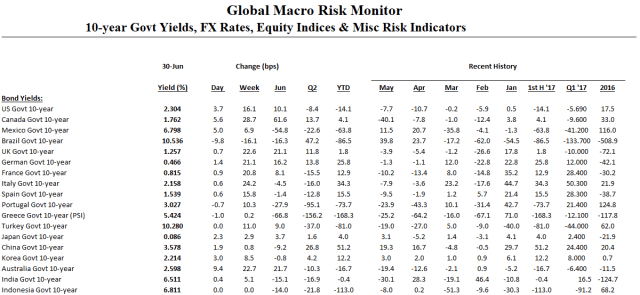
Global Risk Monitor – June 30

Click on table to enlarge and for better resolution

RiskMon_1RiskMon_2RiskMon_3

Posted in Daily Risk Monitor, Uncategorized | Tagged , , , , , | Leave a comment

COTD: Starbucks Latte Cross-Country Index

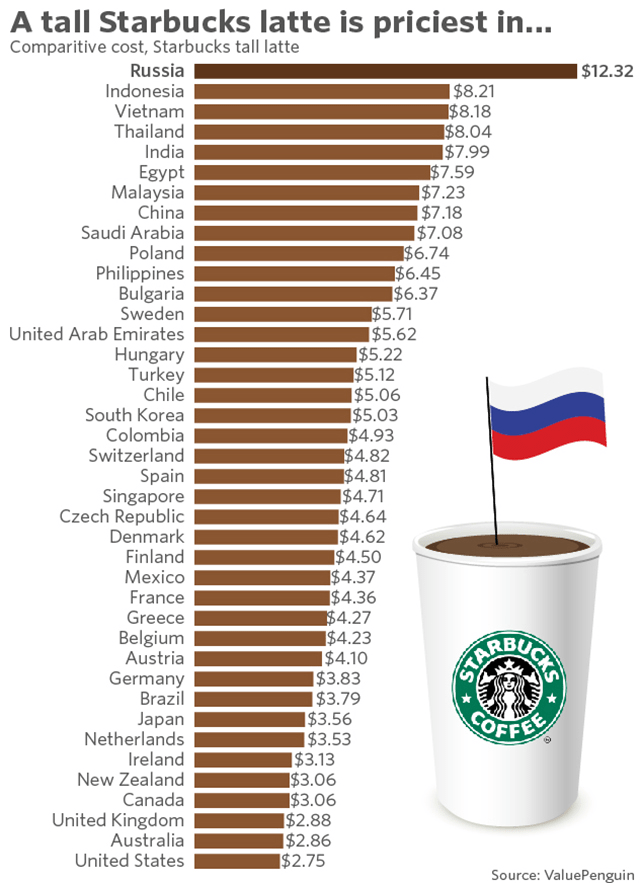
The folowing chart illustrates the price of a tall Starbucks Latte across countries based on the relative prices of other goods.  Note it’s more than just a currency purchasing power parity measure such as the Big Mac Index.

But how indulgent is Starbucks beyond our borders? To assess that, we took prices for the drink in 39 other countries and adjusted them to reflect the cost of other goods and services there compared with the U.S. (See the methodology below for more on how we generated this data.) – ValuePenguin

Starbucks_July1

(COTD = Chart of the Day)

Posted in Charts, Economics, Uncategorized | Tagged , | 1 Comment

The Bonds With A Draghi Tattoo

On Tuesday,  June 27th,  Super Mario said this,

“Deflationary forces have been replaced by reflationary ones.”  – Mario Draghi

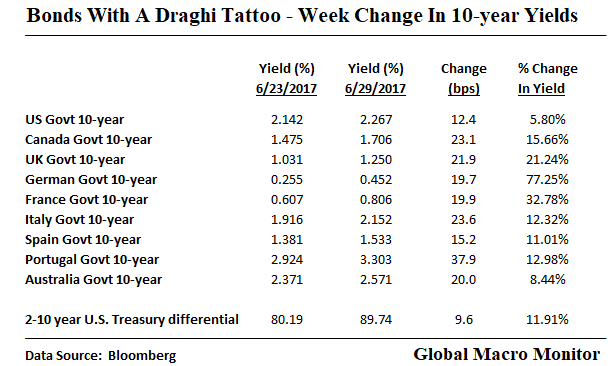
And here is how global 10-year bond yields reacted,

Bonds_Draghi

The German 10-year Bund yield increased 77 percent — OK, from a low base —  and bonds across the world from Canada to Australia to the United States were tattooed.

Change In Fundamentals? 
Absolutely not!

Bond yields haven’t been trading on economic fundamentals for several years due to central bank financial represssion via quantitative easing (QE), ZIRP and NIRP.   We have been pounding the table on this point,

Lot’s of hand wringing these days about the flattening yield curve.  We still maintain our position that the signal from the bond market is significantly distorted due to the global central bank intervention (QE) into the bond markets.   See here and here. 

Most of what is happening with the U.S. yield curve is technical. – Global Macro Monitor,  June 22, 2017

Beach Ball Effect
The major central banks have repressed interest rates throughout the world by engineering a structural shortage of high grade sovereign bonds with their quantitative easing (QE) programs.   For example,  as we posted last week, the combined market cap of just two stocks in the U.S. — Apple and Amazon — exceeds the entire stock of U.S. Treasury notes and bonds maturing in 2027-2047 when holdings of the Federal Reserve are excluded.

Market Cap and Treasury Float

This is tantamount to holding a beach ball underwater.  You know what happens when when the ball is released.  Such as when a prominent central banker unexpectedly speaks out that the days of holding that ball underwater may be coming to an end.  We just had a little taste of that this week.

Beach Ball_Draghi


Conclusion
The European Central Bank tried to walk back or dilute Draghi’s comments, but bond markets are not having it.   The train has left the station and the path toward monetary normalization is, at least in rheotric, been entered into the GPS.    The next few months shall be interesting.

Though we think the “correct” or equiblrium price for interest rates on bonds is serveral hundred basis points higher — 2-3 percent real yield plus inflation —  we don’t think they get there “by way the crow flies” or in a straight line.

Several months ago,  we cited a 2012 Federal Reserve paper estimating that yields on the 5-year note should be several hundred basis points higher if not for the recycling of reserves into U.S. Treasuries by the PBOC.   The paper didn’t even take into account the impact of QE on bond and note yields,

A paper published by the Federal Reserve Board (FRB) in 2012 estimated the impact on interest rates of the capital flow recycling into the U.S. bond market,

We find that a $100 billion increase in foreign official inflows into U.S. Treasury notes and bonds lowers the 5-year yield by roughly 40 to 60 basis points in the short run. However, our VAR analysis shows that in the long-run, when we allow foreign private investors to react to the effects induced by a shock to foreign official holdings, the estimated effect is roughly -20 basis points per $100 billion. Putting these results into context, between 1995 and 2010 China acquired roughly $1.1 trillion in U.S. Treasury notes and bonds. A literal interpretation of our long-run estimates suggests that if China had not accumulated any foreign exchange reserves during this period, and therefore not acquired these $1.1 trillion in Treasuries, all else equal, the 5-year Treasury yield would have been roughly 2 percentage points higher by 2010. This effect is large enough to have implications for the effectiveness of monetary policy. – FRB

Extrapolating the above analysis to the current stock of foreign official Treasury holdings of around $4 trillion leads to nonsensical results, such as the 5-year yield should be 800 basis points higher than it is today.   Obviously, the analysis should truncate the dependent variable – 5-year note yield — and ceteris paribus (other things being equal) does not hold in the real world.  –   GMM, March 18, 2017

Deflation is an urban myth, at least it has been in the U.S., as central banks have revealed their hand to do “whatever it takes” to fight it.  Let us not conflate relative price moves with generalized deflation.

The end game will thus be an episode of ugly monetary/debt induced inflation,  in our opinion.   Not yet, however.   Timing,  my friends.

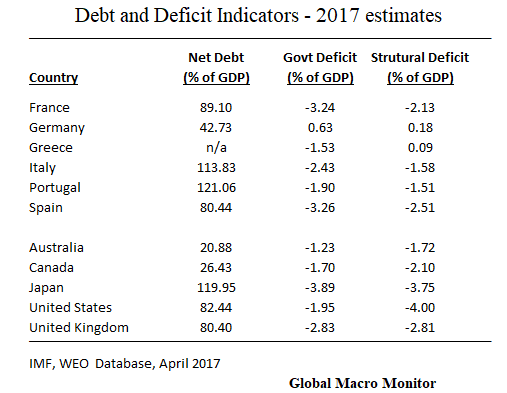
Maybe it’s time to start looking at debt fundamentals again.


Debt Indicators_Draghi

Posted in Bonds, Euro, Uncategorized | Tagged , , | 25 Comments

The Ambiguity of Stock Value: Why It’s So Difficult to Call The Top

This is one of our favorite posts of all-time.

Thought it apropos to re-post given that everyone and their mother is trying to call the top in stocks.  It’s all about yield-seeking capital flows, my friends.   Tell us what interest rate is the tipping point which thwarts that behavior and we will tell you when the stock and credit markets top and flop.

“John Bull can stand many things, but he cannot stand  2 , 0, .5 ,1, 1.5 , 2 percent”  – Bagehot

We are still far from the tipping point interest rate that sends the yield seekers back to their caves, in our opinion.

I just borrowed 5-year money for my daughter’s first car at 2.64 percent.  That is less than 85 basis points over the 5-year note, for a used car!

Expensive Assets
Yes, absolutely, all assets are incredibly expensive.  But pension funds are not going to make their nut sitting in cash waiting for them to get cheaper.   Seniors in Europe can’t eat with their interest earnings from negative rates.

Argentina floating a 100-year bond at 7 percent-ish, even after defaulting several times over the past 30 years, is definitely the warning bell of a credit bubble closer to the top.   And a contrarian call inflation is about to ignite.

The FOMO * yield and return chasing behavior of the markets  reminds us of portfolio managers running to catch the Titanic,  knowing full well the ship is going down.  They just want to enjoy the 3-day party.

How long will the party last?   O Lordy, help us.

* Fear of Missing Out

The Ambiguity of Stock Value

Professor Robert Shiller,  of Yale University,  is probably best known for his book, Irrational Exuberance, which called the top of the dot.com bubble and the second edition called the top in the housing market.  During our days on Wall Street we were big fans of Shiller’s book,  Market Volatility.

We asked him once  to visit us in our offices and the meeting took place the day after then Fed Chairman Alan Greenspan’s famous Irrational Exuberance speech in December 1996,

But how do we know when irrational exuberance has unduly escalated asset values, which then become subject to unexpected and prolonged contractions as they have in Japan over the past decade?

The professor said he was in town to meet with Greenspan who was concerned about the run-up in stock prices.  During the meeting Greenspan solicited his thoughts on why stocks were rising.  The professor answered maybe it was just “irrational exuberance” among investors.  Hmmmm….

We think Shiller’s best work was Martket Volatility and specifically the following,

The Ambiguity of Stock Value

Stock prices are likely to be among the prices that are relatively vulnerable to purely social movements because there is no accepted theory by which to understand the worth of stocks….investors have no model or at best a very incomplete model of behavior of prices, dividend, or earnings, of speculative assets.

Shiller nails it here.  Stock values are ambiguous as there are no models to determine their “true” price. Even at the macroeconomic level this is true and Greenspan addressed it in his Irrational Exuberance speech,

There is, regrettably, no simple model of the American economy that can effectively explain the levels of output, employment, and inflation. In principle, there may be some unbelievably complex set of equations that does that. But we have not been able to find them, and do not believe anyone else has either.

Consequently, we are led, of necessity, to employ ad hoc partial models and intensive informative analysis to aid in evaluating economic developments and implementing policy. There is no alternative to this, though we continuously seek to enhance our knowledge to match the ever growing complexity of the world economy.

So to it is with our job in forecasting asset values, which can only be done with “ad hoc partial models” in the ether of ambiguity.   Because prices are determined by simple buying and selling, we paraphrase Shiller in constructing our ad hoc model,

Stock prices are likely to be among the prices that are relatively determined by capital flows because there is no accepted theory by which to understand the worth of stocks.

In our experience getting ahead of the capital flows has been more profitable than buying what we believe to be a “cheap” stock or selling an “expensive” stock.

And that leads us into the next issue of perspective based on reference points, time frames, and historical bias.

Take a look at the three objects.   Two charts of the exact same market, the S&P500 over different time horizons;   and one picture.

Do you see an S&P500 that is overvalued?  Undervalued?  Oversold? About to rollover or break to new highs?   Do you see a young lady or an old hag?  It most likely depends on your confirmation bias.     Larry Summers, who will leave the White House at the New Year,  coauthored a paper in the late 1980’s stating market volatility is caused by investors and traders with different time horizons.

But, like Keynes’ beauty contest analogy, the true question to ask for 2011 is not what we see, but what we believe the market – i.e., the dominant marginal buyers – will see.  Do they  see the young lady or the old hag?

Or maybe beauty is relative, or even ambiguous,  and we have to determine which markets will be deemed the least old or the most pretty.   And that just may be the best lesson here, which we think certainly is the case for the world’s major currencies.  Dollar strength doesn’t necessary equate to the young lady!

Posted in Bonds, Equity, Uncategorized | Tagged , | 9 Comments

History’s Biggest “Butterfly Effect” Occurred On This Day

The butterfly effect is the concept that small causes can have large effects. Initially, it was used with weather prediction but later the term became a metaphor used in and out of science.

In chaos theory, the butterfly effect is the sensitive dependence on initial conditions in which a small change in one state of a deterministic nonlinear system can result in large differences in a later state. The name, coined by Edward Lorenz for the effect which had been known long before, is derived from the metaphorical example of the details of a tornado (exact time of formation, exact path taken) being influenced by minor perturbations such as the flapping of the wings of a distant butterfly several weeks earlier. Lorenz discovered the effect when he observed that runs of his weather model with initial condition data that was rounded in a seemingly inconsequential manner would fail to reproduce the results of runs with the unrounded initial condition data. A very small change in initial conditions had created a significantly different outcome.  — Wikipedia

On this day in history, June 28, 1914, the driver for Archduke Franz Ferdinand,  nephew of Emperor Franz Josef and heir to the Austro-Hungarian Empire,  made a wrong turn onto Franzjosefstrasse in Sarajevo.

Just hours earlier, Franz Ferdinand narrowly escaped assassination as a bomb bounced off  his car as he and his wife,  Sophie,  traveled from the local train station to the city’s civic city.   Rather than making the wrong turn onto Franz Josef  Street, the car was supposed to travel on the river expressway allowing for a higher speed ensuring the Archduke’s safety.

Yet, somehow, the driver made a fatal mistake and tuned onto Franz Josef Street.

The 19-year-old anarchist and Serbian nationalist, Gavrilo Princip, who was part of a small group who had traveled to Sarajevo to kill the Archduke,  and a cohort of the earlier bomb thrower, was on his way home thinking the plot had failed.   He stopped for a sandwich on Franz Josef Street.

Seeing the driver of the Archduke’s car trying to back up onto the river expressway, Princi seized the opportunity and fired into the car, shooting Franz Ferdinand and Sophie at point-blank range,  killing both.

That small wrong turn,  a minor perturbation to the initial conditions, or deviation from the original plan,  set off the chain events that led to World War I.

Archduke_Jan27

Stumbling Into The Great War
Fearing Russian support of Serbia, Franz Josef would not retaliate by invading Serbia unless he was assured he had the backing of Germany.   It is uncertain as to whether the Kaiser gave Franz Josef Germany’s unequivocal support.   Russia, fearing Germany would intervene, mobilized its troops forcing Germany’s hand.

The great European powers thus stumbled into a war they didn’t want through complicated entanglements and alliances, and miscalculation.  Russia backing Serbia;  France aligned with Russia,  Germany backing the Austro-Hungarian Empire;  and Britian, who really didn’t have a dog in the fight except her economic interests, aligned with France and Russia.

Later the U.S. would enter the war due to Germany’s unrestricted submarine warfare threatening American merchant ships and the Kaiser floating the idea of an alliance with Mexico in the famous Zimmerman Telegram, which was intercepted by the British.

Of course, some will argue that Great War in Europe was inevitable

The great Prussian statesman Otto von Bismarck, the man most responsible for the unification of Germany in 1871, was quoted as saying at the end of his life that “One day the great European War will come out of some damned foolish thing in the Balkans.” It went as he predicted.  – History.com

Nevertheless,  maybe the course of history would have been different if not for that wrong turn on June 28, 1914, which created the humongous butterfly effect, which we still experience the consequences this very day.

The botched Treaty of Versailles  sowed the seeds the for World II.  The War contributed to the Russian revolution and Cold War.  The redrawing of borders in the Middle East after the War created the conditions for the instability and breakdown to tribalism the region experiences today.

A map marked with crude chinagraph-pencil in the second decade of the 20th Century shows the ambition – and folly – of the 100-year old British-French plan that helped create the modern-day Middle East.

Straight lines make uncomplicated borders. Most probably that was the reason why most of the lines that Mark Sykes, representing the British government, and Francois Georges-Picot, from the French government, agreed upon in 1916 were straight ones.  — BBC News

If Franz Ferdinand had not been murdered on this day in history,  that conflict between the Serbs and the Austro-Hungarian Empire may have been contained to just the Balkans.   Maybe.

The butterfly effect.  Think how many small events, decisions, mistakes, one small turn, or “minor perturbations” in plans have had enormous consequences in your own personal life.

Posted in Economics, Geopolitical, Uncategorized | Tagged , , | 37 Comments

Memo To Republicans

To:         The President and Congressional Republicans

From:    Joe and Jane Sixpack

Date:     June 27, 2017

Re:         Health Care Act
_______________________________________________________________

Get over it!    America wants universal health care.

Please fix it or replace Obamacare with something better.

Your most recent plan to transfer one trillion dollars from the poor, working and middle class health care benefits to million- and billionaire tax breaks is worse than Taliban Evil. You, and the whole world, know it.

Reach across the aisle and let’s get on with it.    We need to focus on tax reform and infrastructure to get the economy moving.

Ándale!


Posted in Politics, Uncategorized | Tagged , | 3 Comments

QOTD: Super Mario Speaks

“Deflationary forces have been replaced by reflationary ones.”  – Mario Draghi

Posted in ECB, Euro, Inflation/Deflation, Monetary Policy, Uncategorized | Tagged , , , | Leave a comment