COTD: Petroleum Products Made From A Barrel Of Crude

On average, U.S. refineries produce, from a 42-gallon barrel of crude oil, about 20 to 19 gallons of motor gasoline, 12 gallons of distillate fuel distillate fuel, most of which is sold as diesel fuel, and 4 gallons of jet fuel. More than a dozen other petroleum products are also produced in refineries. Petroleum refineries produce liquids the petrochemical industry uses to make a variety of chemicals and plastics.  – EIA

Barrel of Crude_July8

(COTD = Chart of the Day)

Posted in Crude Oil, Uncategorized | Tagged , | Leave a comment

Gary Cohn As Next Fed Chairman?

Politico out with a piece tonight citing souces that National Economic Council Director and Goldman alum, Gary Cohn, is the leading contender to replace Janet Yellen next January.    Interesting timing as it comes on the eve of Janet Yellen’s two-day semi-annual testimony before Congress.

We have heard rumors, but our priors were that Trump would pick a more rules-based chairmain, such as John Taylor of Stanford.   Kind of surprising, but most presidents prefer easy money policies.

Cohn will be the first Fed Chairman who isn’t a trained economist since Jimmy Carter’s appointment of G. William Miller.   Miller was replaced after only 17 months as inflation raged out of control and was replaced by the super hawk,  Paul Volcker in August 1979.

The Politico piece states that if Cohn doesn’t take the Chair, the most likely pick will be former Fed governor, Kevin Warsh, who is now at Stanford’s Hoover Institution.

Upshot?   Easy money to continue.

It will also be kind of refreshing to have a non-academic as the Fed Head.   One downside is that Cohn’s strong personality and policy making skills will be missed in the White House, which will only empower the nationalists.  Bad news, in our opinion.

Sources: Cohn is Trump’s top candidate to replace Yellen at Fed
– POLITICO

Money quotes:

  • “It’s Gary’s if he wants it, and I think he wants it,” one Republican close to the selection process said.
  • “He would be easily confirmed,” this person said. “Most of our conservative members like him.”
  • Another front-runner for the top job at the central bank, former Fed governor Kevin Warsh, also has industry experience and, though he is an academic, does not hold a Ph.D. in economics.
  • Cohn is also mentioned as a potential future White House chief of staff and may decide he would prefer that job to leading the central bank.
  • The risks involved in the Fed job now, some analysts say, make it somewhat less appealing than when the central bank was dumping money into the economy and driving the stock market to record highs.
  • Cohn does not have a track record on monetary policy. But he is viewed as closer to Yellen’s preference for gradual rate hikes.
  • People close to Cohn say he would strongly consider the job if Trump offered it and if he felt he’d completed his work on tax reform. However, Cohn’s status as the leading candidate could change, particularly if efforts to reform the tax code falter.
  • Senior aides in Trump’s orbit often rise and fall in the president’s estimation. And Cohn’s nationalist rivals in the White House, led by senior adviser Steve Bannon, could try to sway the president against selecting the NEC director for the top Fed job.
  • Other names mentioned as possible candidates for the Fed job include Stanford’s John Taylor, Columbia Business School Dean Glenn Hubbard, current Fed governor Jerome Powell, U.S. Bancorp Executive Chairman Richard Davis, and former PNC Financial Services Group CEO Jim Rohr.
Posted in Interest Rates, Monetary Policy, Uncategorized | Tagged , , , | 15 Comments

QOTD: The Robots Are Coming, Err, Here

Robots Are Taking Over Oil Rigs – Bloomberg 

–Automation means wells need only five workers, down from 20

…Rigs have gotten so much more efficient that the shale industry can use about half as many as it did at the height of the boom in 2014 to suck the same amount of oil out of the ground, says Angie Sedita, an analyst at UBS Corp. Nabors Industries, the world’s largest onshore driller, says it expects to cut the number of workers at each well site eventually to about five from 20 by deploying more automated drilling rigs.

…That means an engineer can design an oil well at his desk. With the press of a button, an automated system would identify the equipment needed from a supplier, create a 3D model and send instructions for building it out into the field, Hashmi says. “That is automation.”

“It used to be you had a toolbox full of wrenches and tubing benders…Now your main tool is a laptop.” — Donald McLain, who worked as a rig hand for 25 years

QOTD = (Quote of the Day)

Posted in Automation, Crude Oil, Uncategorized | Tagged , , | Leave a comment

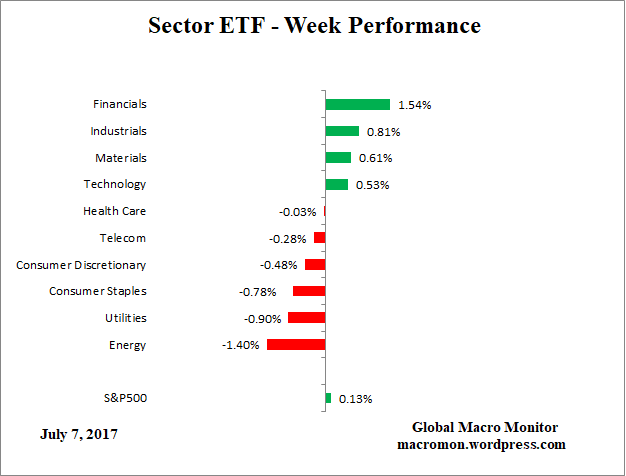
US Sector ETF Performance – July 7

ETF_DETF_WeekETF_YTD

Posted in Sector ETF Peformance, Uncategorized | Tagged , | Leave a comment

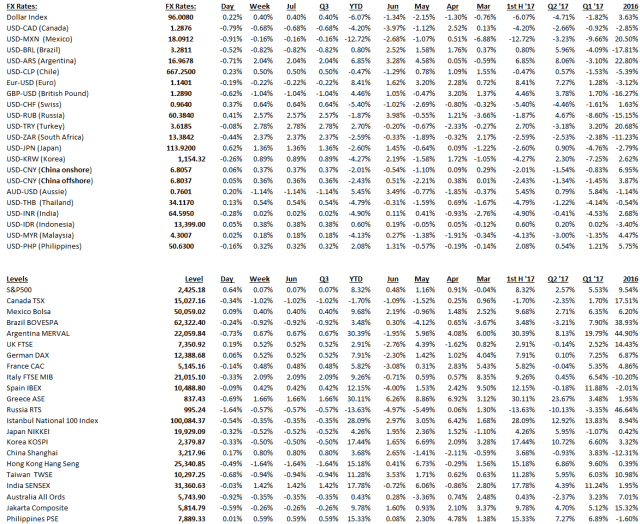
Global Risk Monitor – July 7

Click on table to enlarge and for better resolution

RiskMon_1RiskMon_2RiskMon_3

Posted in Daily Risk Monitor, Uncategorized | Tagged , , , , , | Leave a comment

Why Crude Oil Trades So Poorly

Crude oil is the new widow maker.  It trades heavier than a wet dawg in a New York thunderstorm.    Rallies have no legs and it seems the only bid these days are the shorts scrambling for cover.

ST_Crude Price.png

Note the recent lower highs and lower lows and stiff  resistance at the 50 and 200-day moving averages.

Technology Rapidly Changing Oil Industry

Maybe it because of the huge technological progress, which, has, for example,  driven the cost of the breakeven for some deep water drilling projects down 50 percent in the past few years.   Deep water projects, some of which, used to cost north of $100 per bbl elsewhere throughout the world have fallen to around $40–$50 per barrel in the Gulf of Mexico.   Absoulutely stunning!

OPEC is fighting the same forces that did “John Henry, the steel driving man” in.  And, for that matter, the same changes that have wiped out most of the floor traders on the NYSE.  Technology.

We came across this Foreign Affairs piece yesterday that absolutely floored us (be sure to click Foreign Affairs to read full article),

 The technology revolution has transformed one industry after another, from retail to manufacturing to transportation. Its most far-reaching effects, however, may be playing out in the unlikeliest of places: the traditional industries of oil, gas, and electricity.

…These technologies have helped drive oil prices down from an all-time high of $145 per barrel in July 2008 to less than a third of that today, and supply has become much more responsive to market conditions, undercutting the ability of OPEC, a group of the world’s major oil-exporting nations, to influence global oil prices.

…. As the price of oil tumbled from above $100 per barrel in early 2014 to below $50 per barrel in January 2015, many of these projects [deep water] stalled. By early 2016, companies had put on hold an estimated four million barrels per day of new oil output, 40 percent of it from deep-water sources.

…As drilling stalled, oil and gas operators, desperate to cut costs, began to rethink the complex systems they used.

…Today, thanks to these innovations, the average breakeven prices of new deep-water projects have fallen, to just $40–$50 per barrel in the Gulf of Mexico—an important global bellwether because it is one of the most responsive regions in the world to changes in market conditions. Even though oil prices remain low (and many in the industry expect them to stay low), investment is once again growing. Ten deep-water projects were approved for investment in 2016 and the first half of 2017 alone.  – Foreign Affairs

Technology only moves forward unless the Luddites take power, which given recent events can’t be entirely dismissed.   So, our guess is the long-term pressure on crude prices is lower.

The Middle East Mess

Shorter term,  however, we wouldn’t be surprised to see a “wag the dog” event in the Middle East and a price spike as there is currently no geopolitical risk premium in the crude price.  The Saudi-Iran conflict continues to heat up as they fight their  proxy wars across the region from Yemen to Syria.

Just yesterday, for example,  Iran took four Saudi sailors into custody and seized their naval vessel  after they entered Iran’s territorial waters in the Persian Gulf.     One stray missile into the side of an oil tanker in the Straights of Hormuz could send prices up $20 per bbl..  Certain emasculation of the leveraged shorts.   Suppliers would jump on those prices faster than a portfolio manager chasing a 7 percent yield on a 100-year Argentina bond, however.

Being short crude here is therefore not a sleep easy trade.   But, when is it ever an easy trade?

Conclusion

If the above is true, and we could be entirely wrong as articles such as these are not uncommon at bottoms,  the world and geopolitical forces that drive it are in for huge upheaval.

Breakeven_Crude Prices

Not only has the supply curve shifted way right it has become flatter or more elastic, that is sensitive to price moves.   The same is true for demand, which has shifted left in the west though it has increased in the emerging markets.   We wouldn’t bet on a huge spike in longer-term demand as technology — as in electric cars (hint Volvo) – continues to evolve at a rapid pace.    “In 2016, approximately 45 percent of the global oil demand was attributable to the road transportation sector.”

Oil Demand


Crude Prices_July8

Crude_Oil_July8.

Real Crude Prices

Finally,  it is important not to conflate crude oil’s relative price decline with a generalized global deflation.  It’s kind of frustrating to observe policy makers and market watchers exclude energy prices from the inflation indices when prices are rising and include them when prices are falling.  Easy money bias.

Maybe it’s time to sell those buggy whips.

Stay tuned, folks.

Posted in Crude Oil, Uncategorized | Tagged , , , | 17 Comments

Global Stock Markets Monthly Comovements

Interesting data table we put together on how the global stock indices move together on a monthly basis.  They’re ranked according to their monthly movement with S&P500.   That is the monthly return on each index has the same sign – positive or negative – as the S&P500.

The data show, for example,  Australia’s stock index tracks, by sign, the S&P500 on monthly basis 80.8 percent of the time.  Germany, 79.6 percent;  Canada, 78.1 percent.   China is the least correlated at  57.5 percent.

Note, we have also caclucated France’s comovement with Germany at 81.8 percent and Hong Kong with China at 62.9 percent, which is surprising but probably higher with a shorter-term more recent data series.

Also interesting to note that almost all stock market indices return a postive number on a monthly basis (first column) around 60 percent of the time.

The upshot?   Better get the direction on S&P500 right if you expect to make a positve return in foreign stock markets.   That is all things risk  are a beta play on the S&P500.

Stock Market Comovement_July7

Posted in Equities, Uncategorized | Tagged , | 2 Comments

QOTD: Ray Dalio

“…our responsibility now is to keep dancing but closer to the exit and with a sharp eye on the tea leaves.” – Ray Dalio, July 6, 2017

(QOTD = Quote of the Day)

Posted in Monetary Policy, Quote of the Day, Uncategorized | Tagged | 1 Comment

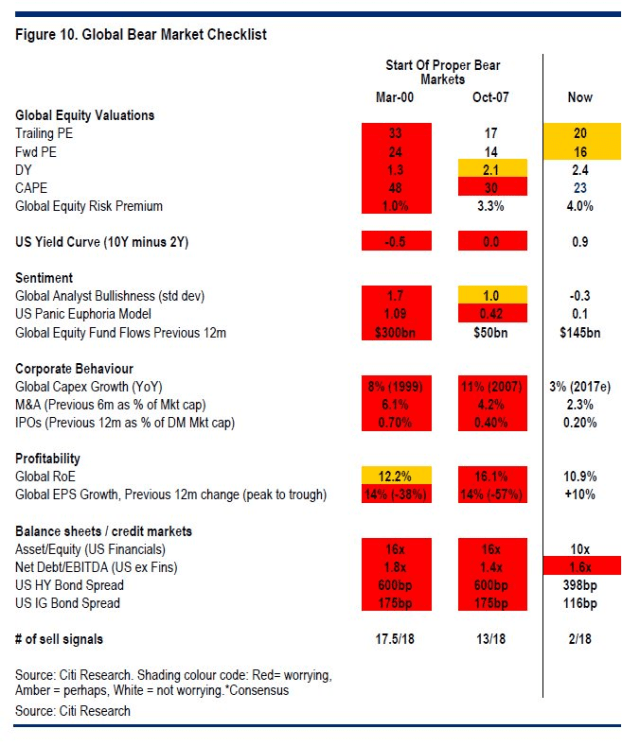
TOTD: Global Bear Market Checklist

Coutesy of Citibank.    Not yet.

Global Bear Market Checklist_July5
(TOTD = Table of the Day)

Posted in Equities, Uncategorized | Tagged , , | 1 Comment

Happy July 4th!

Happy 241st,  America.    America, Primus inter pares!   

Posted in Uncategorized, Video | Tagged , , , | Leave a comment