Did Jacques Chirac Wreck A Plan To Exile Saddam to Saudi?

File this one under, “What If.”

We have a very good source who tells us that the U.S. and the major European and Arab powers had a plan to exile Saddam Hussein to Saudi Arabia before the Iraq war began in March 2003.  Apparently,  Saddam was on board with the plan.  But the U.S. and other major powers had to show complete solidarity lest Saddam would sense disunity and misread it as a lack of will to take him out and thus back out of the deal.

Recall,  Hussein had a history of miscalculating and misreading the United States.  In a meeting with the U.S. ambassador in July 1990 ,  Saddam took the conversation as tacit approval for his invasion of Kuwait eight days later.

July 25, 1990 – Presidential Palace – Baghdad

U.S. Ambassador Glaspie – I have direct instructions from President Bush to improve our relations with Iraq. We have considerable sympathy for your quest for higher oil prices, the immediate cause of your confrontation with Kuwait. (pause) As you know, I lived here for years and admire your extraordinary efforts to rebuild your country. We know you need funds. We understand that, and our opinion is that you should have the opportunity to rebuild your country. (pause) We can see that you have deployed massive numbers of troops in the south. Normally that would be none of our business, but when this happens in the context of your threat s against Kuwait, then it would be reasonable for us to be concerned. For this reason, I have received an instruction to ask you, in the spirit of friendship – not confrontation – regarding your intentions: Why are your troops massed so very close to Kuwait’s borders?
–  July 25,  Eight days before the August 2, 1990 Iraqi Invasion of Kuwait

A big mistake and that was even before Twitter.

The Need To Show Political Unity
A recent article in Foreign Policy magazine put the need for unity among the big powers before the second Iraq war more eloquently,

Political unity among western democracies, can have an impact at least as great as the application of raw power on real-world outcomes. It is worth paying a high cost up front to get those perceptions right, because the consequences down the road can be severe.

…The idea was to create a credible threat of military force that would cause him to shut down programs and allow intrusive inspections.  — Kurt Volker,  FP

To the horror of this world leader,  he awoke one morning to see France’s President, Jacques Chirac,  on television announcing France would not support the war effort and vote against the second United Nations resolution.   Saddam sensed weakness that there would be no invasion and, as expected,  backed out of the deal.   Once again, miscalculating  and misreading the intentions of another Bush Administration in the United States.

Chirac’s Relationship With Saddam
Jacques Chirac always had a suspect relationship with Saddam Hussein.  Bush #43 called him Mr. Arab.

Statfor wrote in 2003,

Chirac and Hussein formed what Chirac called a close personal relationship. As the New York Times put it in a 1986 report about Chirac’s attempt to return to the premiership, the French official “has said many times that he is a personal friend of Saddam Hussein of Iraq.” In 1987, the Manchester Guardian Weekly quoted Chirac as saying that he was “truly fascinated by Saddam Hussein since 1974.” Whatever personal chemistry there might have been between the two leaders obviously remained in place a decade later, and clearly was not simply linked to the deals of 1974-75.

Politicians and businessmen move on; they don’t linger the way Chirac did. Partly because of the breadth of the relationship Chirac and Hussein had created in a relatively short period of time and the obvious warmth of their personal ties, there was intense speculation about the less visible aspects of the relationship. For example, one unsubstantiated rumor that still can be heard in places like Beirut was that Hussein helped to finance Chirac’s run for mayor of Paris in 1977, after he lost the French premiership.

Another, equally unsubstantiated rumor was that Hussein had skimmed funds from the huge amounts of money that were being moved around, and that he did so with Chirac’s full knowledge. There are endless rumors, all unproven and perhaps all scurrilous, about the relationship.

Some of these might have been moved by malice, but they also are powered by the unfathomability of the relationship and by Chirac’s willingness to publicly affirm it. It reached the point that Iranians referred to Chirac as “Shah-Iraq” and Israelis spoke of the Osirak reactor as “O-Chirac.”

Indeed, as recently as last week, a STRATFOR source in Lebanon reasserted these claims as if they were incontestable. Innuendo has become reality. Former French President Valery Giscard d’Estaing, who held office at the time of the negotiations with Iraq, said in 1984 that the deal “came out of an agreement that was not negotiated in Paris and therefore did not originate with the president of the republic.”  – Strafor,  Feb 2003

Maybe Mr. Chirac also miscalculated and misread President Bush #43.

Middle East Mess Solely the Bush Administration’s Fault
Nevertheless,  we are not trying to dismiss or place the blame of the Iraq war and the subsequent destabilization of the Middle East and the mess it made on Jacques Chirac or France, for that matter.   The blame lies solely,  and unequivocally, on the Cheney wing of the Bush Administration, in our opinion.

We are very confident in our source and  just thought we would throw it out there and maybe some young investigative reporter will pick it up and run with it.

We do like France’s new President.  The new Leader of the Free World, in our opinion.

An Aside:  Wag The Dog in the Middle East?
Interesting the U.S. ambassador mentioned the price of oil in her 1990 meeting with Saddam,

We have considerable sympathy for your quest for higher oil prices
Ambassador Glaspie

After the invasion of Kuwait, the average monthly price of oil rose from $17 per barrel in July 1990 to $36 per barrel in October.

With the Middle East now blowing up,  the price of oil in free fall,  and Saudi and Iran at each other’s throat, we wouldn’t be surprised to see a  major “wag the dog” event in the Persian Gulf sometime soon.  Makes us very nervous holding shorts in oil.

If the U.S. ambassador in 1990 was sympathetic to Iraq’s concerns over the oil price,  how much more is the State Department currently going to be with an “oil man” as  Secretary of State?

Posted in Crude Oil, Geopolitical, Uncategorized | Tagged , , , , | Leave a comment

Emerging Market Dollar Bonds: An Option Based Analysis

In my prior life I used to trade emerging market (EM) bonds and came up with the following analytical framework using options analysis to understand and teach the basic fundamental principles of how to value EM hard currency bonds.   The analysis is relatively crude and simplistic but a very powerful tool to internalize the understanding of valuing emerging market fixed-income securities.

The analysis is timely given Argentina’s recent sale of a 100-year sovereign bond.

Option Based Analytical Framework
Because the value of corporate securities is, in effect, a contingent claim on the firm’s value, options analysis can be applied to construct an alternative analytical framework to determine and understand relative value.  Equity is essentially the residual claim on the value of the firm after all liabilities have been paid.  If bankruptcy occurs, equity holders receive nothing.

The economic return to equity holders is therefore the maximum of zero, or the total value of the firm’s assets less all outstanding debt liabilities.  The equity claim is thus a call option on the value of the firm with the strike price equivalent to value of the outstanding debt.

Corporate Bonds As A Hybrid
In the event of bankruptcy, equity investors are off the hook if the value of the corporation falls below zero when liabilities exceed assets, but they lose the entire value of their claims on the firm, however.   The limited liability of a common stockholder therefore corresponds to the limited downside of a holder of a call option.

Using this framework, corporate bonds are then effectively a hybrid of a risk-free bond and a series of annual puts written on the value of the firm.  The strike price of the put is also equivalent the point at which the firm’s assets equal its debt outstanding.

If the value of the firm’s assets fall below its debt liabilities, the loss to the bondholder is similar to the loss of a writer of a put option.   The loss to the bond holder is  the difference between the liquidation value of the firm and value of the debt outstanding.  The bond’s credit spread over the comparable risk-free rate is equivalent to the annual option premium bondholders receive for writing the implied put.

Note this a very simplistic analytical framework and ignores many factors such as the firm’s capital structure, for example, but has very powerful conceptual value.  The same analysis can be applied to credit default swaps (CDS).

Application to Emerging Market Sovereign Bonds
The option-based framework can be extended to better understand the nature of sovereign risk, particularly transfer risk, inherent in emerging market hard currency bonds.   The option based analysis is modified, however, from a balance sheet perspective to a cash flow perspective.  Lack of clear international bankruptcy proceedings and access to the sovereign’s balance sheet limits the analysis to a flow (cash flow) versus stock (balance sheet) variables.

Emerging market dollar denominated sovereign bonds can similarly be viewed as a hybrid of a risk-free bond and a series of puts written on the level of the international reserves of the issuer country.   This assumes all risk factors, including political, economic, willingness to pay, and the global macro factors are reflected in the level of the country’s international reserve position.   Not an unrealistic assumption as material changes in these risk variables will  impact capital flows and the country’s reserve position.

Strike Price On International Reserves
The strike price of the put is the minimum level of reserves to cover the country’s debt service.  The credit spread on the emerging market bonds is therefore the option premium for writing the annual put on FX reserves.

As the reserve position declines, for example, and moves closer to the strike price, or minimum level of reserves, the put premium or credit spread should increase.  If reserves move below the minimum level, the loss to the bondholder is the same as the loss on the put, or difference between debt service actually paid and the contractual payment.

Conversely, as reserves rise to a debt sustainable level, the put moves further out-of-the-money and the options premium or credit spread declines.  The expected volatility of capital flows, the country’s foreign exchange reserve earnings,  and import volatility will also affect the premium value or credit spread.

The figure below shows the annual payoff of each put written on the value of the country’s foreign exchange reserves.   As reserves fall close to or below the minimum level for debt service, the put moves in-the-money.

EM Bond Put

Default
If the country defaults calculating the recovery value is much more difficult than in a corporate default as bondholders rarely have access to a balance sheet and a bankruptcy judge.   The workout is subject to good faith negotiations and the estimated debt servicing capacity of the country.    Fairly complicated.

We’ve done some back of the envelope calculations on a 10-year bond with a credit spread of 330 bps at issuance.  The present value of the credit spreads or “put option premiums” is about 30 percent of the value of the bond.

Large Increase In International Reserves
From the mid-1990’s to around 2014,  the world experienced a large increase in international reserves.   This was the result of three major factors.

World Reserves_RK


First was the rise of China as an export powerhouse and its massive build up of FX reserves.

Change in FX Regimes
Second,  after the Mexican peso and Asian Financial crises of the mid-to late 1990’s,  emerging market policy makers learned a hard lesson that running large current account deficits as the result of strengthening currencies could lead to a very destabilizing and costly balance of payments crisis.   Policy makers became very vigilant not to allow their currencies to become overvalued and intervened in their foreign exchange markets purchasing the dollars and thus increasing their reserve positions.

Third,  the U.S. began to run larger current account deficits and effectively monetized them though relatively easy monetary policy.  The result was an abundance of excess dollars in the international financial system, which found their way into the official accounts of foreign central banks.

Tight Spreads and High International Reserves
Using the above analysis makes it easier to understand why EM sovereign dollar bonds are trading so tight, or so wide, for that matter.   Just take a look at the following time series of the international reserve position of some of the major emerging market countries.

Reserves_China

.

Reserves_Brazil

.

Reserves_Mexico

.

Reserves_Russia

.

Reserves_Venezuela

Posted in Bonds, Uncategorized | Tagged , , , , , , , | Leave a comment

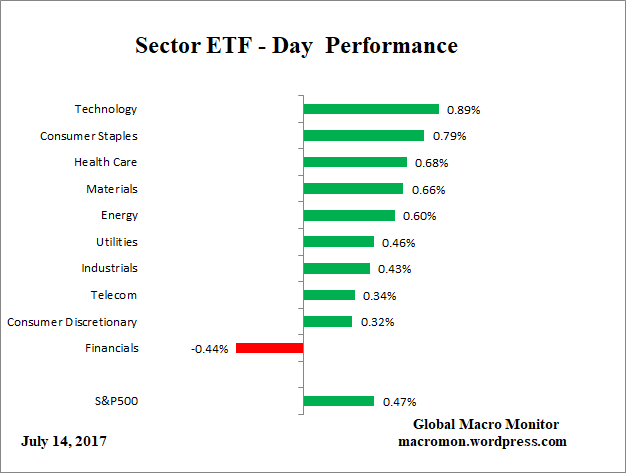
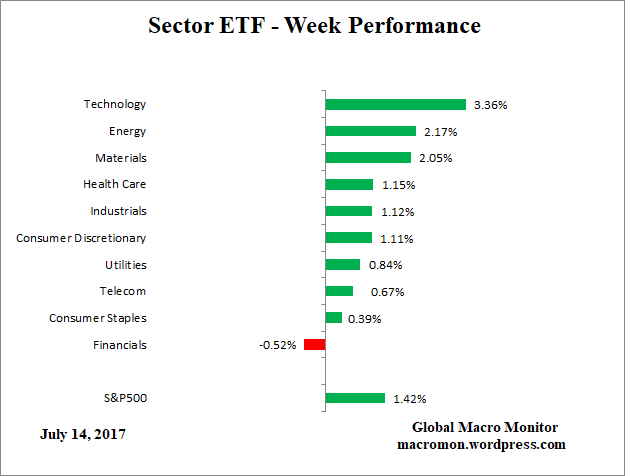
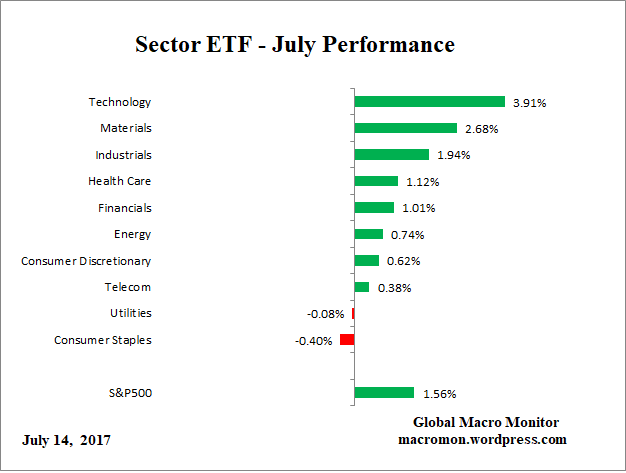
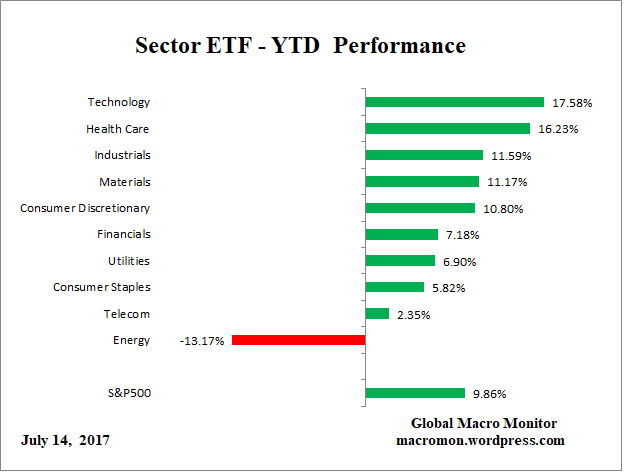
US Sector ETF Performance – June 16

ETF_DayETF_WeekETF_MonthETF_QETF_YTD

Posted in Sector ETF Peformance, Uncategorized | Tagged , | Leave a comment

Global Risk Monitor – June 16

Posted in Daily Risk Monitor, Uncategorized | Tagged , , , , , | Leave a comment

Happy Fathers Day! We’ve Got Some Wood to Chuck

The last words my father spoke to me before he died in 1996 was, [“Gregor], somebody is going to have to do something to help the poor.”

Fast forward to 2017.   Never has the wealth gap in America been so wide.  This creates the initial conditions for a very uncertain and potentially unstable and explosive political and economic future.

I just woke up, for example, to see these two articles juxatposed on my news aggregator.

Why does America have so many hungry kids? – CNN

Summer in the Hamptons: Oysters, Rosé, and Helicopter Noise?  – WSJ

One article is about how 13 million American children go to bed hungry every night and the other is about the 1 percenters, who are now taking helicopters to their Hampton summer homes to avoid traffic.   What in the hell is happening to our country?

Average wealth has increased over the past 50 years, but it has not grown equally for all groups. Between 1963 and 2013, families near the bottom of the wealth distribution (those at the 10th percentile) went from having no wealth on average to being about $2,000 in debt, those in the middle roughly doubled their wealth—mostly between 1963 and 1983, families near the top (at the 90th percentile) saw their wealth quadruple, and the wealth of those at the 99th percentile—in other words, those wealthier than 99 percent of all families—grew sixfold.  Urban Institute

The current data is much worse as the above doesn’t take into account the massive runup in asset prices over the past 3 1/2 years.

Philanthropic 1 Percenters, But……..
I know many 1 percenters who are great and generous people and give so much in an effort reduce poverty.   Paul Tudor Jones’ Robin Hood Foundation, for example, is God’s work.    Though they make a difference in many individual lives, these good works can only go so far and only make just a small dent in the problem of our vanishing middle class and increasing American poverty rate.

It’s the policies, Stupid!
The kumbaya moment Congress is now experiencing after the shooting of its Republican congressional members last week now needs to be translated into action.

Policy changes are imperative if we are going to really — first, we must decide if we want to — make a change.   It’s time to move away from the ugly and tired dialectic of “tax cuts for the rich and government help for the poor.”   Everything must change.

Creative public policy and a change of thinking are the only hope, comrades.

Here is one example,

The United States exports more food than any other country in the world. So why do families with children have trouble getting enough food in such a prosperous nation?

“The non-politcal answer, to me, is greed and government,” Stallings said.

“There’s too many government health restrictions that force restaurants to throw away food” instead of donating it to the needy. “It’s also greed: We’re not helping our neighbors.”   -Bryan Stallings,  CNN

Wow!  We trash 40 percent of the food we produce.

Lessons From The Godfather
Special interests will surely stand in the way of the much needed new policy thinking/making,  including from reforming education to allowing restaurants to donate their food to the needy, for example.   So how do we deal with them?

Take a lesson from the Godfather and mayor of Chicago, Rahm Emanuel, when he was Chief of Staff for President Obama and negotiating the bailout of the auto companies.   Some in the bailout group raised concerns about pushback from the United Auto Workers.

To which the Godfather replied,

F$*K the UAW  – Rahm Emanuel 

To which we say,

F$*K the Special Interests   – Global Macro Monitor

My God, we are talking about hungry children, for Pete’s sake.

Happy Father’s Day

Posted in Poverty, Uncategorized | Tagged , | 9 Comments

We Call B.S. On The ‘Bots Again!

Before hitting the hay we need to call a big B.S. on the bastard ‘bots from Rip (Off) City.    They screwed us again yesterday (June 14) in crude oil futures.

First, before we get into the trade,  a little background.

We have posted about our experiences of being ripped off by these “so-called” trading ‘bots, who prey and stalk the markets, looking to pick-off  traders through blatant market manipulation.   Flash crash, my arse.

We put on a short position in nattie Thursday night before driving back from Sacramento to the Bay Area. We checked the market at dinner and see its down about 1 percent, we feel happy and give high fives. Then we look at the position and we have none!

It was taken out (buy stop) as a Seek and Destroy Bot came in around around 9 pm, guns the market to the upside to take out all the buy stops of the short sellers, then turns around and guns it to the downside to destroy all sell stops of longs. Finally, moves the market back to where it was before all the nonsense began.  Not a bad day’s work for the robot.  – GMM, January 2017

But, this is the doozy:

Remember the AP Twitter hack in April 2013, where,

“Wall Street collided with social media on Tuesday, when a false tweet from a trusted news organization sent the US stock market into free fall.

The 143-point fall in the Dow Jones industrial average came after hackers sent a message from the Twitter feed of the Associated Press, saying the White House had been hit by two explosions and that Barack Obama was injured. The fake tweet, which was immediately corrected by Associated Press employees, caused a sensation on Twitter and in the stock market.”  – The Guardian

That one cost us big as our long stops were hit. – GMM, January 2017

Never heard a word after that ugly April day in 2013.   Why didn’t the SEC follow up on this or keep the public posted on their investigations?

Was it a Russian 400 pound hacker/day trader sitting on his bed in New Jersey parlaying the hack into an easy money short trade?   We have zero doubt it was “financial nefarious”  and the AP hack was done to manipulate the market.   Somebody made a ton of money,  some of it ours.

To be fair, perhaps the SEC did follow up and informed the public of its findings and we just missed it.

Wednesday’s Crude Oil Trade
As you know crude oil has been trading very ugly since OPEC announced the externsion of their production cuts, falling more than 10 percent from the May 25th recent high.

If the market can’t go up on an OPEC cut, we figure its time to get shorty crude oil.   Usually,  we don’t go into an inventory number with a sizable position, but given the ugly API inventory data on Tuesday and the strong downtrend,  we decide to keep the short on through EIA , which is released at 10:30 AM eastern.

About 10 seconds before the release the crude price gaps up $.50 taking out our buy stop and then immediately gaps down on the number.  It was too fast for a human to execute and was definitely a machine.

Check out Wednesday’s one minute price chart,

Crude_June15

Note the big spike up at just before 9:30 AM central.  It wasn’t a headfake as it took place just a few seconds before the data release.  We put the short back on about a $.70 lower from where the machine flogged us.   Expensive.  It cost us (both accounting and economic losses) around $5K.   Bastard ‘bots!

An aside,  crude now feels kind of sold out to us.

We’ll admit maybe some bad trading on our part — leaving a stop hanging out there before a data release — but this is TOTAL BULLSHIT.     Where in the hell is the CFTC and SEC?

No wonder the hoi polloi are starting to revolt.

Beware the “American Street.”

Long water cannons/short John Henry, the Steel Driving Man.

Posted in Crude Oil, Uncategorized | Tagged , , | 23 Comments

The New Bond Math

Don’t you just love his homework assignment?

Bond Math

Posted in Bonds, Uncategorized | Tagged , | Leave a comment

Reflexivity And Why The Fed Must Sell The Long End

The yield curve is flattening like a pancake.   Tightening cycles tend to do that.

Bond_Yield Curve

Curve_June13

Furthermore, the effective float of 10-year and longer U.S. notes and bonds is relatively small and greatly distorts the bond market signal.   We have written about this several times.

…how small the actual float of longer-term marketable U.S. Treasury securities is available to traders and investors. The data show the Fed owns about 35 percent of Treasury securities with maturities 10-years or longer. Note the data only include notes and bonds and excludes T-Bills.

The Fed’s holdings combined with foreign ownership of longer maturities — more than 1-year — exceeds 80 percent of marketable Treasuries outstanding. The Fed combined with just foreign official holdings, mainly, foreign central banks, is 65 percent of maturities longer than 1-year. Thus, almost 2/3rds of tradeable Treasuries longer than 1-year are held by entities with no sensitivity to market forces.  –  GMM, March 2017

Given the small float of tradeable Treasury notes and bonds,  the market is subject to both massive short squeezes if it gets too far offside and rapid ramps if traders algos try and game duration.

Information Positive Feedback Loop
Many in the market,  we fear, are being hoodwinked by the flattening yield curve, however.  It’s purely the result of technicals and not economic fundamentals.

Nevertheless,  some still look to the badly distorted bond market as a signal of the health of the economy and act accordingly.   Such as delaying capital spending;  becoming more risk averse;  and cutting back on consumption, for example.

A flatter yeld curve also makes bank lending less profitable.

This could thus lead to what George Soros calls “reflexivity“,  a feedback loop where the negative, but false, signal from the bond market actually causes an economic slowdown or leads to a recession.   So much for efficient markets.

Recall the famous line of one prominent market strategist during the dark days of the great recession,

“ We’re in a depression. That is what the bond market is telling us.”

Or the ubiquitous,  “what is the bond market telling us?”    Come on, man!

The Fed Needs To Start Selling Longer Dated Securities
It would, therefore,  behoove the Fed to sell some of its longer dated Treasury holdings in order to steepen the yield curve.

The following table shows the Federal Reserve’s holdings of U.S. Treasury securites and the total Treasury outstandings for each year.  This table does not include T-Bills.

If the Fed were to just let its balance sheet “run off” — that is not rollover maturing notes and bonds — it would cause additional pressure on short-term interest rates even as policy rates are rising.  It could also  potentially invert or further distort the front-end of the yield curve and destablize the money markets.

Looking at the data in 2018 and 2019  large maturities are coming due, of which, the Fed holds about 25 percent of the total of Treasuries maturing.

Rolling a portion of these maturities and selling longer-dated securities would probably cause less disruption in the market and be a more optimal strategy of reducing the Fed balance sheet.

Notes and Bonds_June13

Announcement Effect
Just announcing the fact the Fed was contemplating such a strategy of unloading longer dated Treasuries first would cause the yield curve to steepen.   The market would  begin to front run the Fed.  Bill Gross & Co. would kick into action and start “selling what the Fed wants to sell.”

And because there are so relatively few Treasuries outstanding with maturities longer than 10-years,  it is unlikely it would cause the bond market debacle, which many believe is coming.  The total stock of Treasury securities with maturities longer than 10-years is smaller than the combined market capitalization of just Apple, Google, and Amazon, for example.

If bonds become too oversold, the Fed could easily engineer a short squeeze to bring the yield curve back to where it desires.

Recall, the Fed losing control of the yield curve prior to the financial crisis to foreign central banks recyling capital flows back into the U.S. bond market is what Alan Greenspan singles out as the major cause of the housing bubble.   The Fed moved the funds rate up 425 bps and the 10-year and mortgage rates barely budged.

During the 2004-07 tightening cycle, the era of the Greenspan bond market conundrum, for example, the 10-year yield managed to rise only a maximum of 64 bps during the entire cycle from a beginning yield of 4.62 percent to a cycle high yield of 5.26 percent. This as Greenspan raised the fed funds rate by 4.25 percent, from 1.0 percent to 5.25 percent.  – GMM, March 2017

Risks
The major risk is that foreigners begin to sell.  But where will they go?

Spanish 10-years at 1.43 percent?  German 10-year bunds at 0.266 percent?  How about a 10-year Japanese JGB at 0.067 percent?    In fact,  low foreign yields and the ensuing portfolio effect is keeping the U.S. 10-year note well anchored below 2.60 percent and another factor distorting the yield curve.

Central banks could also be forced to sell some of their $4 trillion U.S. Treasury holdings if global currencies come under pressure via-a-vis the dollar.  To maintain currency stability, monetary authorities could be forced to intervene in their foreign exchange markets.

Such was the case with China over the past few years, which experienced a major bout of capital flight.  The PBOC suffered a loss of FX reserves close to a trillion dollars, some of which were held in U.S Treasuries.

Credit and Equity Markets
That is where we could have some short-term problems and overshooting.   But our sense, many are waiting to pounce on a sell-off in the spread and equity markets.   Too many pensions are underfunded and too many seniors are yield strarved.

Having some dry powder makes sense.    It’s coming and you will have to act fast.

Conclusion
A sustained spike in inflation?

Tilt!  Game over, comrades.


Posted in Bonds, Economics, Monetary Policy, Uncategorized | Tagged , , | 31 Comments

Of Course, There’s No Inflation. NOT!

Okay,  before the emails hit – it’s peak load pricing or a relative price increase.

There, satisfied?

Buyer pays $133K for two courtside tickets to Game 5 of NBA Finals

A person paid $133,000, including fees, for two floor seats to Game 5 of the NBA Finals at Oracle Arena to possibly see the Golden State Warriors win their second title in three years.

A team source said that a Warriors season-ticket holder sold the seats on the team’s Ticketmaster resale site on Sunday night. With buyer fees at 15 percent, the buyer paid more than $17,000 in fees alone for the pair of tickets.

While the face value of the specific tickets is unknown, some courtside seats for the Finals have a face value of $3,000 each, according to a document sent by the Warriors to fans during renewal time last year.

The average resale price on the team site for Game 5 is $1,731, which is almost 20 percent higher than last year’s Game 5 between the Warriors and the Cleveland Cavaliers ($1,444).

The site had two other big sales for the most prime seats in the arena — one pair was sold for $90,000, while another was sold for $82,000.   — USA Today

The above sure sounds like the mark of the top of something, no?   The Roaring ………… something.

Inflation in the Real World
Nevertheless,  just, today,  noticed the local grocery market increased the price of a two-liter bottle of soda by 10-20 percent in the past few weeks.

Who is the government kidding?   You and I know, first hand, the real inflation rate is running much higher than the official figures.

Where you drink champagne and it tastes just like cherry (COLA)
With all the baby boomers retiring the government and taxpayer, not to mention those on fixed incomes, are in deep doo-doo if  the “so-called” official inflation picks up and the cost of living adjustments (COLA) on social security payments begin to spike.

Expect more inflation data repression:  seasonal adustmentschanging consumption baskets;  and hedonic pricing adjustments.

The use of the word “hedonic” to describe this technique stems from the word’s Greek origin meaning “of or related to pleasure.” Economists approximate pleasure to the idea of utility – a measure of relative satisfaction from consumption of goods. In price index methodology, hedonic quality adjustment has come to mean the practice of decomposing an item into its constituent characteristics, obtaining estimates of the value of the utility derived from each characteristic, and using those value estimates to adjust prices when the quality of a good changes.  – BLS

Bond Market Predicting Deflation?
But, you say, the bond market is predicting deflation?   Complete Nonsense.  There is no signal from the bond markets.

QE Distortion
The intervention into the bond markets by central banks through quantitative easing (QE) in the big four sovereign bond markets – U.S., Japan, Eurozone, and UK – has created a structural shortage of risk-free instruments and distorted the most important price in the world — the yield on 10-year hard currency sovereign bonds. – GMM, March 2017

SS_Cola

With elderly conservative savers earning zero on their CDs and the social security COLA averaging only 1 percent over the past five years no wonder the economy feels so punk.   Definite deletarious impact on the demand of the senior set.

By the way,  how much copper does it take to write code for artificial intelligence or robotics software?   Just askin’.    The Times They Are A Changin’.

Posted in Demographics, Economics, Inflation/Deflation, Uncategorized | Tagged , | Leave a comment

The Pinball Wizards Romp!

Just to understand what high expectations we have for the Golden State Warriors in the Bay Area,  I am a little deflated because the Dubs didn’t go 16-0 in the playoffs.   Tough to live up to those expectations, no?  But, hey, I will take 16-1!

I can now definitively say,  “Kevin Durant (aka KD) is the best athlete in the world.”   Have you ever seen a 7-footer move the way he does?

Ever since I was a young boy,
I’ve followed basketball.
From ‘Frisco down to Oakland
The ‘Dubs can whip them all
But I ain’t seen nothing like them
In any roundball hall…

That Steph, KD, Dray and Klay kid
Sure play a mean b-ball!

They’re the Pinball Wizards
There has got to be a twist
The Pinball Wizards,
Love the sound of that three point swish!

.

Chron_Front Page.png

.

Posted in Sports, Uncategorized | Tagged , , | Leave a comment
