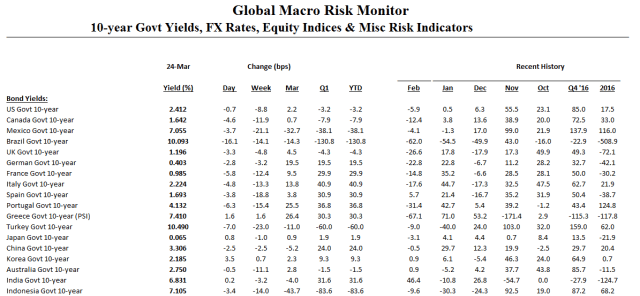
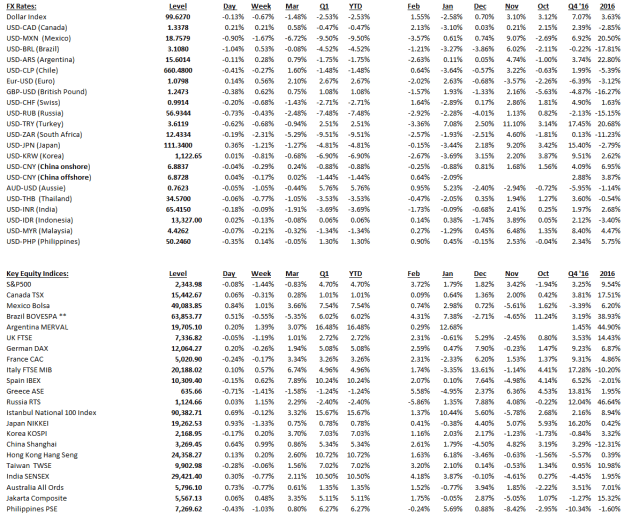
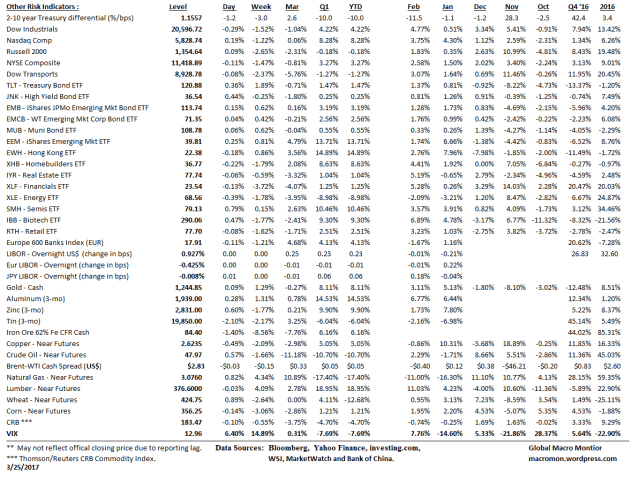
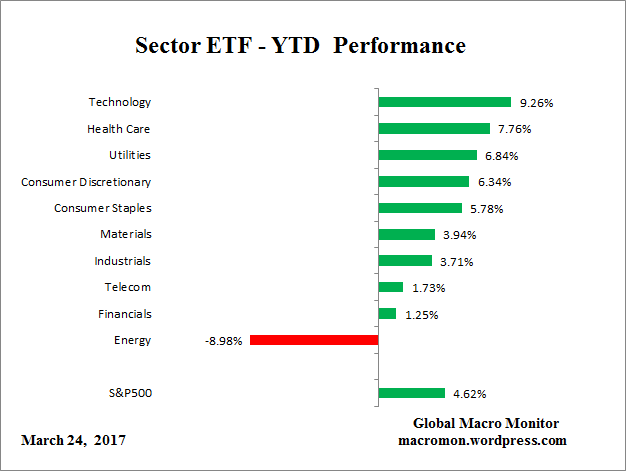
Click on table to enlarge and for better resolution
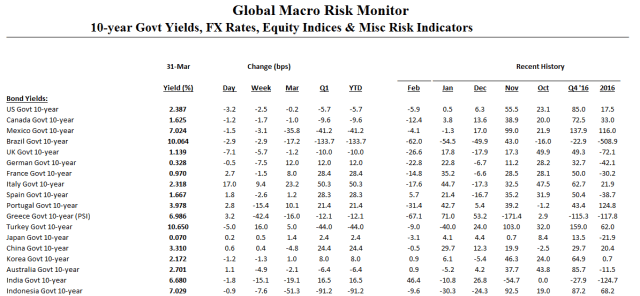
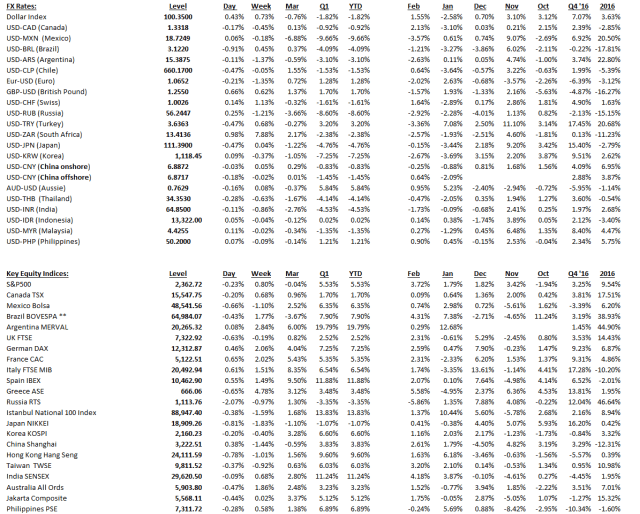

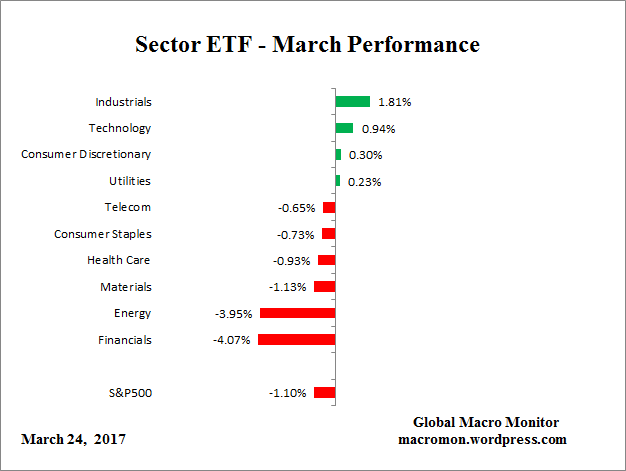
Click on table to enlarge and for better resolution
Nice follow-up quote from our last post on federal land holdings and assets. U.S. government praying for a land bubble? Just yanking your Markov chain.
At the peak of the real estate bubble in the late 1980s, the 1.32 square mile of Imperial Palace grounds in the center of Tokyo was said to be worth more than all the real estate in California. – CNBC
(QOTD = Quote of the Day)
We often hear the meme “the U.S. is the next Greece.” “The government is insolvent.” Complete nonsense.
We tend to focus too much on the right side of the government’s balance sheet and not the left side — the federal government’s assets. This is not to downplay the seriousness of the debt issues – current, future, and off-balance sheet obligations – and the need for a long-term viable debt solution.
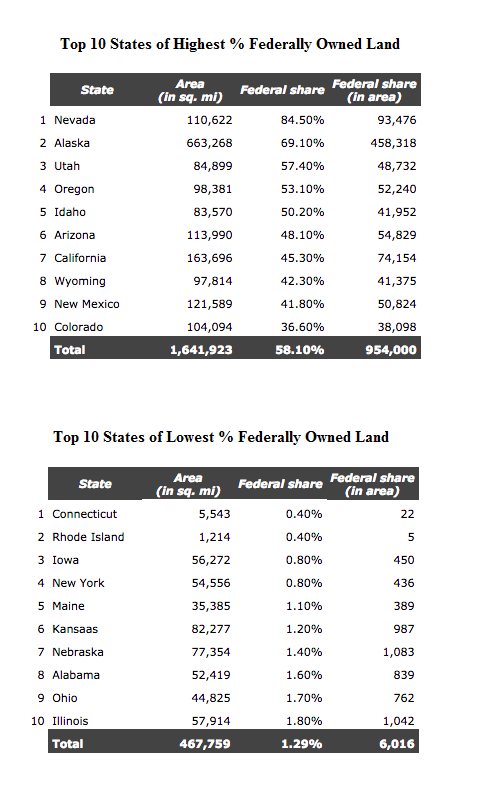
Just take a look at the chart and tables below, however, which we snagged from the Big Think, of how much land the federal government owns, especially in the west. Almost half of the land in California and more than 80 percent of Nevada. Stunning.
Then there are the mineral rights. Time magazine cites an International for Energy Research report that the U.S. government owns,
Oil and gas resources on and offshore worth $128 trillion
That is several multiples of the current national debt.
President Trump has even mentioned selling off the government assets to reduce debt. Marketwatch recently reported,
Which brings us to one of the president’s more intriguing ideas: why not sell off some of those rights and pay down part of the debt?
Candidate Trump sold this in his usual simplistic terms: I’m a real estate guy, I know how to make the deals. We pay down the debt while putting Americans back to work in the oil and gas industry. We become energy independent and screw the Middle East. What’s not to like? – Marketwatch
We did get some pushback on the feasibility of selling federal land and real assets as it is a very difficult political proposition. But that is not the point of this post. The markets implicitly understand the strength of U.S. G’s balance sheet, say, relative to Greece, for example.
What a great Ph.D. dissertation topic — measuring the U.S. government’s net worth by calculating the market value of all its assets.

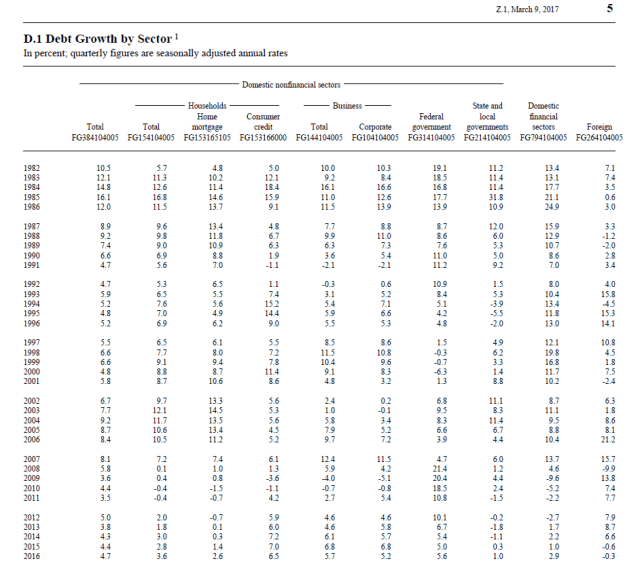
Look no further than the latest Flow of Funds data from the Federal Reserve Board to get a snapshot of what’s happened in the U.S. economy during the new millennium.
Because “credit is the mother’s milk of the economy” let’s focus on debt growth by each sector.
…credit is the mother’s milk of growth; without credit the economy cannot flourish. And credit cannot flow freely without a well-functioning financial system. – Mark Zandi
Reagan Keynesian Recovery
But, first, take a look at the credit binge during the Reagan expansion of the 1980’s. Double digit debt growth from 1982, when the economy began to emerge from a deep recession to 1986. Almost all sectors experienced rapid credit growth during this period.
Not to downplay the supply-side structural reform under Reagan, which we always support, but it sure looks like his economy was a classic debt-fueled Keynesian expansion. The data are undeniable.
An Aside: IMF and World Bank
Comprehensive economic policy during an economic crisis, either hyperinflation or a depression/deep recession, for example, consists of both stabilization and structural reform.
Traditionally, in emerging markets, the International Monetary Fund (IMF) is charged with stabilizing a country during an economic crisis through various macroeconomic policies, both fiscal and monetary. The World Bank then moves in with structural adjustment and reform policies and financing to “fix” the economy.
At least, that was the case when we were there in the mid-1980’s. Note, we worked at the World Bank in the mid-1980’s on Chile’s first structural adjustment loans. Add that to our work on Poland and we are proud to say we helped reform two of the best performing emerging market economies over the last 30 years. Economic superstars!
That’s our epithet.
W Bush’s Economy
Starting in 2000 notice the rapid expansion of mortgage debt, double digit growth from 2000 to 2006. This fueled the housing bubble and the use of home equity to finance consumption. Home equity as an ATM stimulated aggregate demand. The housing/credit bubble was instrumental helping the economy emerge from and avert a very severe recession brought on by the crash of the stock market, which began in early 2000. One bubble replaced by another more onerous, dangerous and debilitating housing/credit bubble.
The Great Recession
Notice, the collapse in household debt growth in 2008. The deleveraging of the consumer and business sector, coupled with state and local governments, led to a severe downturn in domestic demand and resulted in the great recession.
The federal government did exactly would it should do during a deep recession through a debt-fueled fiscal expansion. Annual debt growth of the federal government exceeded or came close to 20 percent from 2008-2010. The alternative do-nothing policy was a Great, Great, Great Depression. We can’t emphasize enough the word Great.
Yes, but debt rose several trillion dollars under Obama? Yadda, yadda, yadda!
Don’t get us wrong, we are the first to say, or scream, that the country needs a long-term structural plan to deal with our national and private debt obligations. Economic stimulus should be temporary and used only during downturns. Simpson-Bowles, anyone?
We give an A plus to the Obama policymakers for averting a catastrophic global depression. There is no doubt, at least in our minds, if not for their and the Fed’s bold stabilization policies, all of us would be living under martial law and probably under a freeway eating bark. Counterfactuals can’t be proven, but this, we are pretty certain.
President Obama, not so good on structural reform, however. Could have been better and probably constrained by the “do-nothing, obstructionist Congress.”
Enter Trump
The markets have high hopes for the Trump Administration introducing and implementing vast structural reforms in the economy. The new president inherits a relatively strong economy and won’t be distracted and busy trying to stabilize a collapsing economy as President Obama was at the beginning of his Administration.
This should allow him to focus on the needed reforms to get the economy back to a higher growth trajectory, especially given he has a ruling majority in Congress. No excuses.
Here’s to hoping they are the right policies.
The Administration can start by jettisoning the disastrous Border Adjustment Tax (BAT) idea, which will severely hurt President Trump base voters through higher inflation and job layoffs in our WalMart nation, in order to finance tax cuts for higher income earnings. Economic and political nonsense, in our opinion.
We are rooting for you, Gary Cohn.
The FT’s Neil Hume speaks to Jeremy Weir, chief executive of Trafigura – one of the world’s biggest oil traders – about the outlook for the market and the price of oil.
► Subscribe to the Financial Times on YouTube: http://bit.ly/FTimeSubs
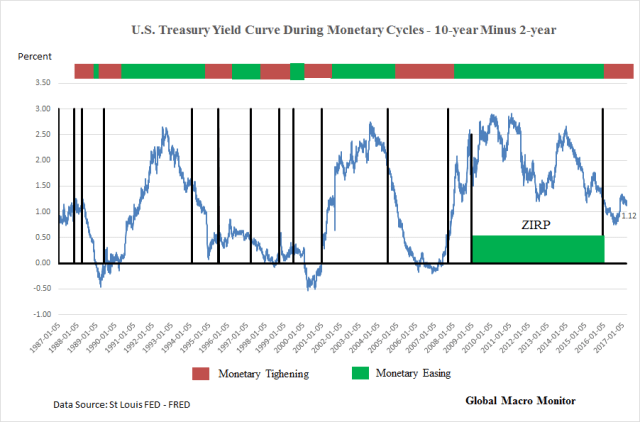
The 10-year minus 2-year yield spread closed today at 1.12 basis points, back to the election day low. All the steepening of the yield curve since the election day, widening out to 1.34 in December, has vanished.
We don’t think this reflects anything to do with a slowing global economy but is more a reflection of a broken bond market. Too many shorts and a structural shortage of risk-free bonds engineered by quantitative easing.
The following is a long-term chart and thus hard to recognize the short-term flattening.
Is it just us or do you feel the same political angst that seems to be pervasive throughout the country that we do? Things not only feel surreal but there seems to be a prevailing sense of eeriness haunting our political system.
Bonds are rocking, gold is flying, and stocks are stuttering. The markets smell something rotten.
Republicans have campaigned for 6 years to repeal Obamacare, yet when they control the House, Senate, and finally the White House they can’t even get a bill to House floor. A bill that only had 17 percent support in the polls, by the way. WTF?
Identity Politics
We are not really into identity politics, but maybe part of the strangeness in the air is that the country is made up of a 70 percent non-white males yet all or most those who hold the reins of power in Washington are white males. Tell us we are wrong?
Could this have something to do with gerrymandering?
Gerrymandering, the process of drawing distorted legislative districts to undermine democracy, is as old as our republic itself. Just as ancient: the Supreme Court’s unwillingness to get involved and determine a standard for when a partisan gerrymander has gone too far.
– Salon
Furthermore, given the pushback by the hoi polloi on the healthcare bill, Washington seems woefully out of step with the country on a governing philosophy,
Republican leaders made a fundamental mistake on health care over the last seven years: They imagined that the American people had a much more libertarian view than they in fact did. Americans generally aren’t in favor of denying health insurance — and, by extension, medical care — to their fellow citizens. And once Obamacare had become law and made insurance coverage much closer to universal, Americans weren’t interested in Congressional bills that erased that coverage. This support for health insurance isn’t the only way that American voters are anti-libertarian on health care, either. Polls show that voters, of both parties, support government-provided insurance, and not just bare-bones government plans. – NY Times
An Election Not Like Any Other
Probably more important, however, the November election was not one about ideas, policies, or an aspirational vision for the country. Rather it was steeped in the raw emotion of anger toward the establishment. Not to mention it involved the two most unpopular candidates in polling history.
The marginal voter in the swing states that threw the election to Donald Trump was finally fed up with a government they watched forget about them as their livelihood, careers, and entire towns were crushed by modernization, globalization, and free trade.
These are complicated issues and the government should have done more for those who lost out as the world moved away from them. We once had governments, on both sides of the aisle, who used to care about those hurt by free trade and modernization while the majority reaped its benefits.
Recall our story as a young graduate student:
After finishing up my Ph.D. comprehensive exams in economics and in between the dissertation, I interviewed at the White House, Council of Economic Advisors (CEA), as a junior economist. They had a program where the CEA would hire graduate students for one year who were in between their comp exams and the dissertation.
Ronald Reagan was President at the time and the day long interview took place in April 1986, just a few days after the U.S. bombed Muammar Gaddafi. That day, security on the White House grounds and in the Old Executive Office Building, where the Council is located, was intense. Secret Service, dressed in their black garb and flack jackets, everywhere.
Beryl Sprinkel was Chairman of the CEA and Michael Mussa was the real intellectual heavy weight of the CEA. The entire council was made up of “Chicago Boys,” not Chileans, but academics from the University of Chicago. Very free market thinking in everything.
Note, this was during a period in the economy when the trade sector was getting hammered by the strong dollar. The trade weighted U.S. dollar index had increased almost 30 percent since Reagan took office and was causing real hardship in the tradable goods sector.
So, the first question I was asked at the beginning of the interview was, “there is a bill in Congress to write the steelworkers, who have been displaced and lost their jobs through trade, a check for $100,000 [$221,000 in 2016 dollars]. What do you think of this bill?
I answered, “no, I think retraining and other polices may be more optimal”. They replied, “that’s what the Democrats think.” I didn’t get the job.
The Chicago boys think the individual can choose their future and retraining better than the government.
That $100,000 was real money and compensation back then, much more than what the government offers to the losers of free trade and globalization today. And, let’s get real, at the end of the day, it was an “effective bribe” to the steelworkers to allow the country to keep pursuing free trade policies.
The day long interview ended in Beryl Sprinkel’s office where he asked me, “[Gregor], can you make good charts? The President likes his charts.” Indeed, President Reagan did.
When I was leaving the Old Executive Office Building (OEOB) after the interview, I thought of taking a little tour of the White House grounds. I walked out of the east end of OEOB onto the White House grounds, probably no less than 100 feet from the Oval Office. I was met by a Secret Service officer in a black flack jacket carrying a high powered rifle, who asked what I was doing there. He booted me faster than a fighter jet. But, oh, so close to power!
So, concluding, I ask folks — whatever happened to that kind of thinking among the policymakers? That is, really compensating and taking care of the losers from free trade and globalization as we, the elites, enjoy the benefits of free trade and globalization in lower prices of goods and higher profit margins and stock prices? Tariffs and shrinking free trade and globalization are going to hurt all of us, including margins and stock prices.
Do you really wanna pay 30-50 percent higher prices at Costco and WalMart? That will cause a recession and stagnation faster than you can say snap! How about a surcharge on foreign goods at the cash register to help compensate and beef up the Trade Adjustment Assistance program and help those who have been harmed?
All of the above mysteries and riddles wrapped in the enigma that Russia hacked the presidential election.
So here we find ourselves, folks. Sur-fricking-real.
The new government, elected on a very narrowly defined populism, is managed by a bunch 0.1 percenters. In a NIMBY country with a fledgling philosophy of “I got mine, you got yours, let’s get more, and who cares about the rest.”
The election, which seems to be an eternity ago, now appears to have been a fluke. Don’t think the center can hold. Here’s to hoping we can limp to the next election.
Nah, we will get through this.
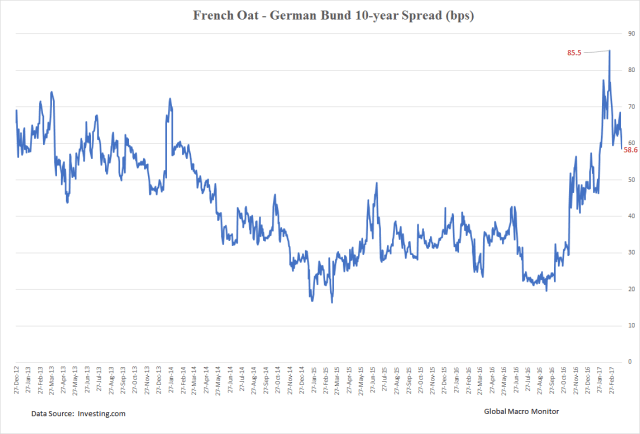
The Oat-Bund spread came in 8 bps last week probably on the back of a new poll showing the centrist. Emmanuel Macron, gaining ground.
Macron is opening it up in second round polling, 30 points ahead of Le Pen, but 43 percent of French still are undecided. W-T-F?
A Le Pen victory, though far behind in second round polling, poses an existential threat to modern Europe. A low probability, but high impact event. And probably why Euro stocks have really not taken off even as the economies improve and populism on the continent seems to be receding.
.
Click on table to enlarge and for better resolution