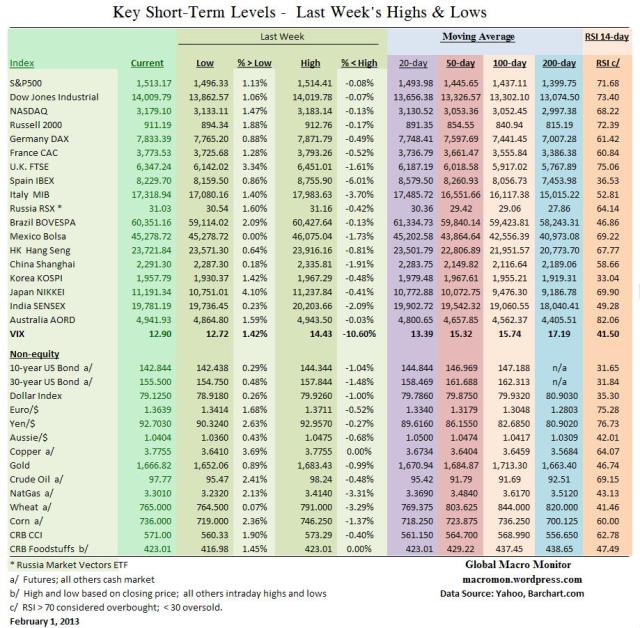
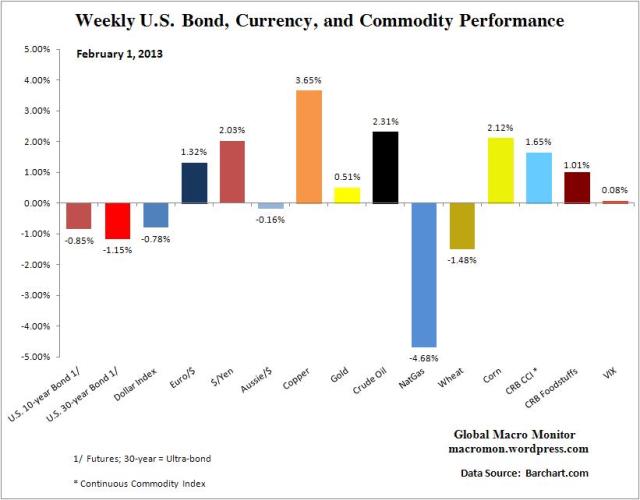
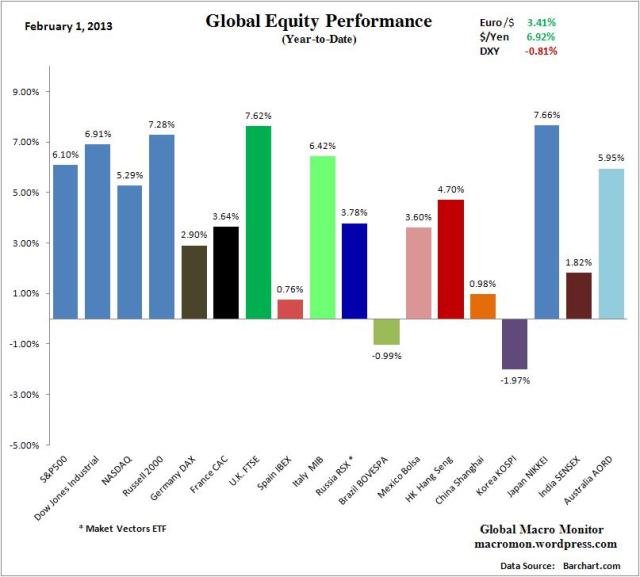
Week in Review

WIR_Key LevelsWIR_Equity_WeekWIR_Bond_WeekWIR_Equity_YTDWIR_Bond_YTD(click here if charts are not observable)

Posted in Week in Review | Tagged , , , , , , | 1 Comment

Weekend Lecture: Bend, Not Break – Ping Fu

This is a great story!

CEO of GeoMagic Ping Fu discusses her book – “Bend not Break: A Life in Two Worlds” with Google’s Chade-Meng Tan.

Feb1_Bend Not Break

***********************************************************

(click here if video is not observable)

Posted in Black Swan Watch, Lectures, Video | Tagged , , | Leave a comment

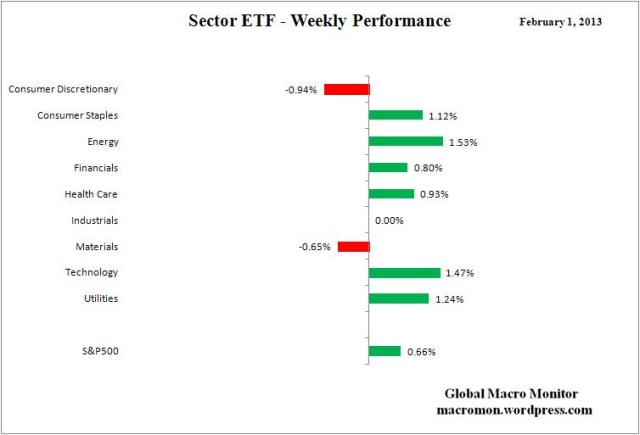
U.S. Equity Sector ETF Weekly Performance – February 1

Sector ETF_WeekSector ETF_YTDSector ETF_Technicals(click here if charts and table are not observable)

Posted in Sector ETF Peformance | Tagged , , , , , | 1 Comment

Weekly Eurozone Watch

Key Data Points
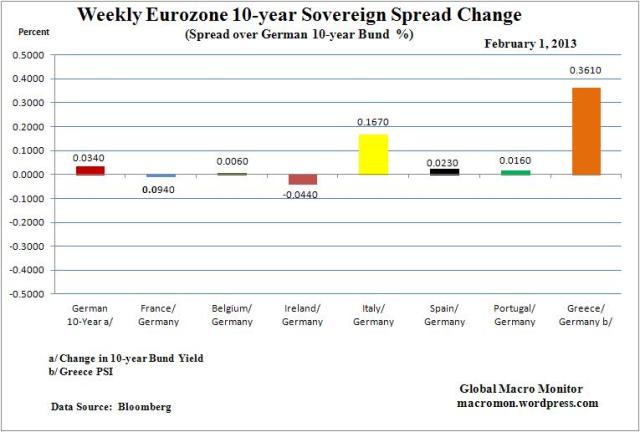
German 10-year Bund 3 bps higher;
France 1 bps tighter to the Bund;
Belgium 1 bp wider;
Ireland 4 bps tighter;
Italy 17 bps wider;
Spain 2 bps wider;
Portugal 2 bp wider;
Greece 36 bps wider;
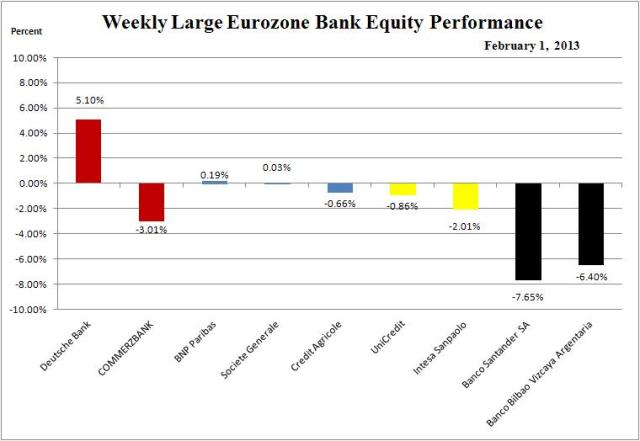
Large Eurozone banks weekly change, -7.0 to  5.0 percent;
Euro$ up  1.50 percent.

Comments
– Eurozone PMI rose to 47.9 from December’s 46.1 – 11-month high;
-The Netherlands nationalised SNS Reaal after a private rescue of the bank and insurance group collapsed;
-France’s manufacturing PMI fell to 42.9 in January, down from 44.6 in December and a 4-month low; –
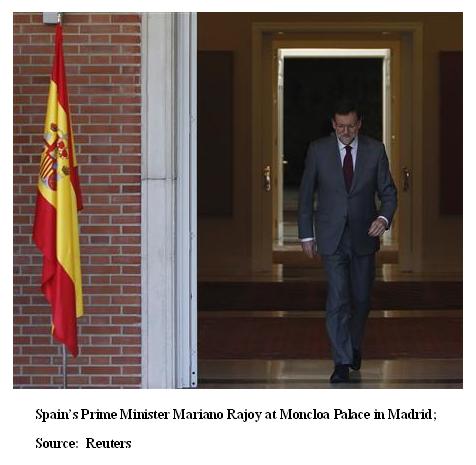
– Spanish Prime Minister Mariano Rajoy will address the nation on Saturday about corruption allegations.

It’s essential that the next long-term EU budget is devoted to boosting growth, jobs and social cohesion in Europe.
– Mario Monti, Italian Prime Minister

Feb1_Rajoy

**********************************************************

WEZ_Spread_WeekWEZ_Bank_WeekWEZ_Spread_YTDWEZ_Bank_YTDWEZ_YieldWEZ_Stock_IndexWEZ_EuroFX

(click here if charts are not observable)
Posted in Weekly Eurozone Watch | Tagged , , , , , | 1 Comment

U.S. Employment Situation – January 2013

The BLS reported this morning (see full report here),

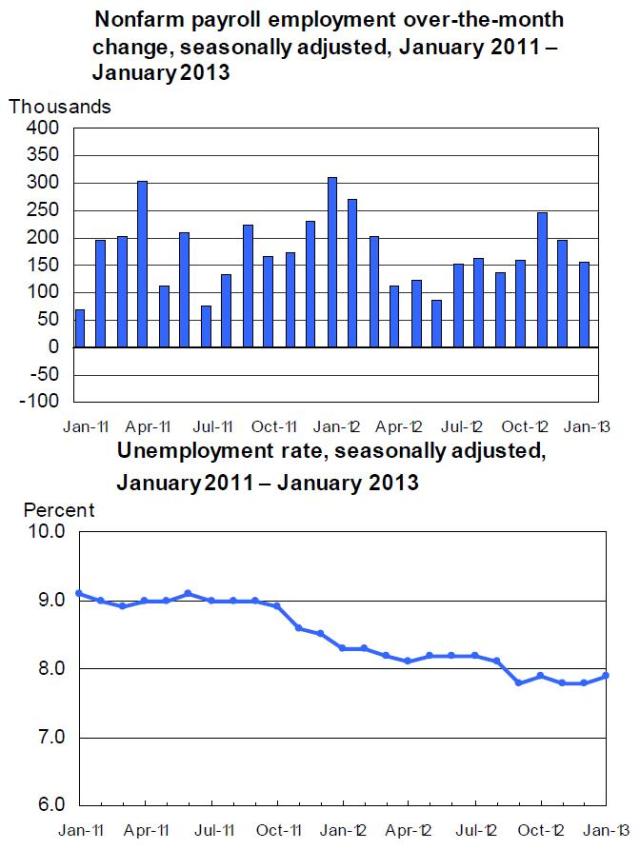
Total nonfarm payroll employment increased by 157,000 in January, and the unemployment rate was
essentially unchanged at 7.9 percent, the U.S. Bureau of Labor Statistics reported today. Retail trade, construction, health care, and wholesale trade added jobs over the month…

The change in total nonfarm payroll employment for November was revised from +161,000 to +247,000, and the change for December was revised from +155,000 to +196,000. Monthly revisions result from additional reports received from businesses since the last published estimates and the monthly recalculation of seasonal factors. The annual benchmark process also contributed to these revisions.

Feb1_BLS_Empolyment1Feb1_BLS_Employment2

(click here if charts are not observable)

Posted in Employment | Tagged , , , | 1 Comment

Happy Birthday, JR

One of our heroes and favorite Bruin.

(click here if video is not observable)

Posted in Video | Tagged | Leave a comment

The Big Mac Index – Buy India/Sell Norway

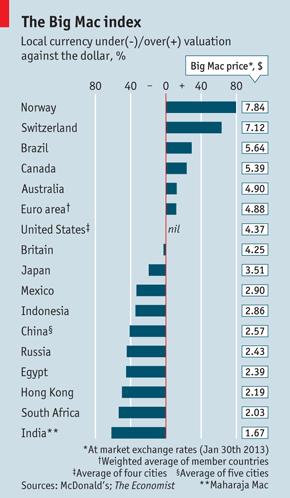
The Economist is out with their Big Mac Index of currency valuations.  The Big Mac index looks at foreign-exchange rates based on the theory of purchasing-power parity (PPP),  the notion prices/exchange rates should adjust over the long run, so tradable goods cost the same across countries.   Here’s their conclusion based on the latest data,

The Big Mac index suggests that currencies are particularly overvalued in Norway, Switzerland and Brazil (see chart). The continuing strength of the real is a big source of irritation to Brazil’s finance minister, Guido Mantega, who first trumpeted the phrase “currency wars” in 2010. Brazil battled back by introducing capital controls in the form of taxes on foreign purchases of Brazilian securities, but the currency remains overvalued. In December Brazil notched a record current-account deficit as its exports tumbled, contributing to a slide in the economy’s growth prospects. Switzerland handled its overcooked currency by pegging its franc to the euro in 2011. That halted the Swiss franc’s appreciation against the then-beleaguered single currency, although not against the dollar.

Currencies in much of the emerging world, including Russia, China, and India, are too cheap relative to the dollar on our gauge. Critics of burgernomics say that you would expect average prices to be cheaper in poor countries than in rich ones because labour costs are lower: PPP signals where exchange rates should head over the long run, as a country like China gets richer, not where prices should be right now. Even so, the perennially undervalued yuan has scarcely moved towards the Big Mac measure of fair value. That, many reckon, is down to meddling by the chefs at the People’s Bank of China, who are relying on export growth for sustenance: China posted a larger-than-expected $36.1 billion trade surplus in December, thanks to 14% growth in exports year-on-year.

Japan is the country that caused the most recent talk of currency battles. The new government’s plan to reflate the economy with fiscal and monetary stimulus has helped drive the value of the yen down in recent months. The Big Mac index put the yen close to fair value against the dollar in July; it is more than 19% undervalued now. That’s a tasty development for Japanese exporters but indigestible news for rivals.

Jan31_BigMacThis helps ‘splain why Brazilian equities trade so poorly.

(click here is chart is not observable)

Posted in Currency | Tagged , | 2 Comments

Slowing Russian growth sets up interest rate fight

(click here if video is not observable)

Posted in BRICs | Tagged , , , | Leave a comment

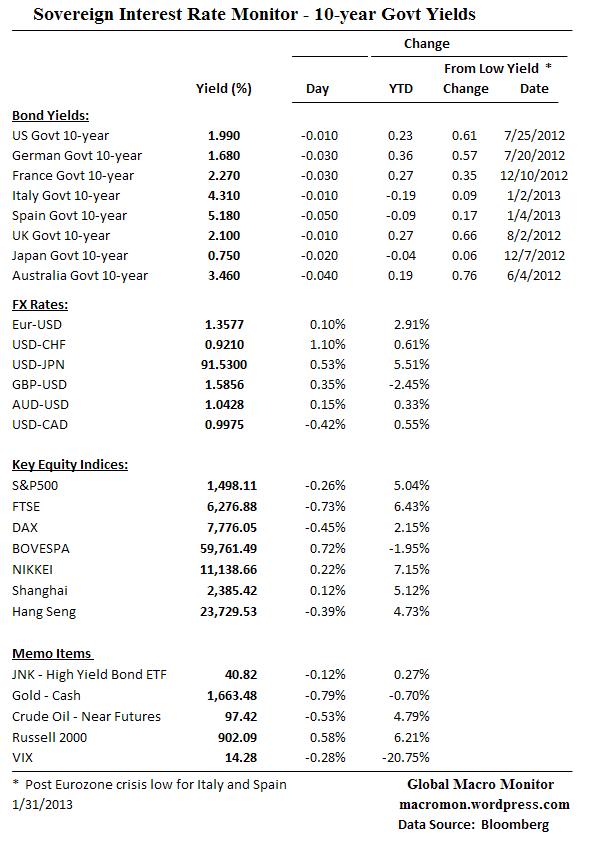
Daily Interest Rate Monitor – January 31

Interest Rate Monitor

(click here if table is not observable)

Posted in Interest Rates | Tagged , , , , , | 1 Comment

Who Owns the U.S. Treasury Market?

The 10-year Treasury bond yield traded at 2.03 percent today a level not seen since April 2012. We thought it’s a good time to revisit who are the major holders of U.S. Treasury securities.   Some of the data are subject to caveats – noisy as some categories calculated as residuals and group various holders together — and how they are presented should be viewed as good approximations.  

Click on the charts to enlarge and for better resolution.

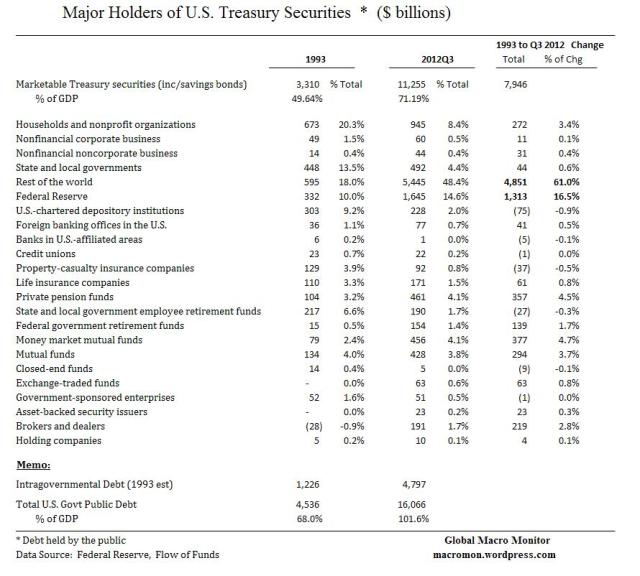
First, the total public debt of the U.S. government in Q3 2012 was $16.1 trillion (101.6 % of GDP), of which, $11.3 trillion (71.2% of GDP) was held by the public and $4.8 trillion by the government, such as the social security trust fund.   These data are reflected in the table below.

As of yesterday, current total U.S. public debt outstanding is $16.4 trillion, with $11.6 trillion held by the public and $4.9 trillion in intergovernmental holdings.

Chart 1 illustrates the profile of the debt.  For example, 63 percent of Treasury securities are in the form of notes that mature in one to ten years.

Jan30_Treasury_A

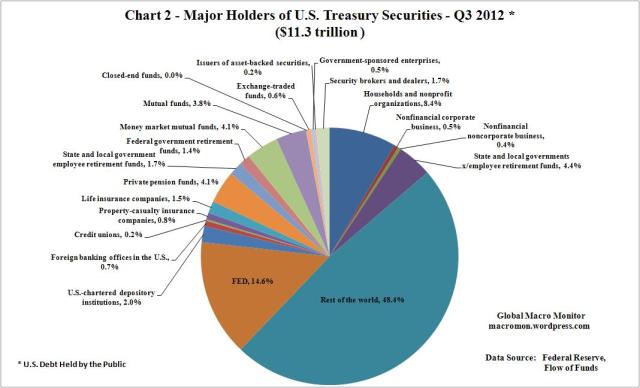
Chart 2 shows the major holders of U.S. Treasury securities at the end of Q3 2012.  Note that almost 50 percent is held by rest of the world and 14.6 percent held by the Fed.

Jan30_Treasury_1

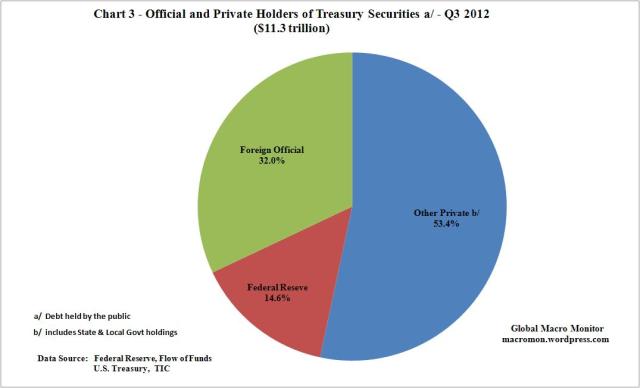
Chart 3 divides the holders into official and private.  More than 46 percent of the holders are foreign official, mainly central banks, and the Federal Reserve.   That is, almost half of Treasury holders are not driven primarily by market incentives.  Much of the accumulation by foreign central banks has been the result foreign exchange intervention to keep their currencies from appreciating.

Today’s Wall Street Journal has an article about the potential capital losses the Fed will incur if interest rates rise.    It is important that investors internalize that half of Treasury holders are policy driven and not driven by profits/losses during major market moves.   Furthermore, as a global currency war looms it unlikely that foreign central banks will be dumping Treasuries en masse though they may continue to diversify their foreign exchange holdings into other currencies.

Jan30_Treasury_2

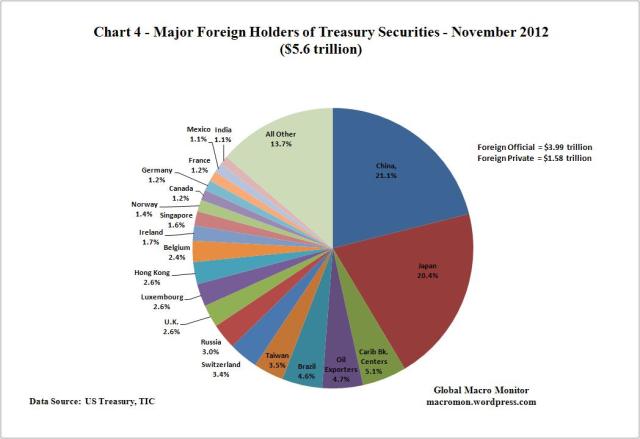
Chart 4 illustrates that almost half of the$5.6 trillion foreign holdings are from China and Japan.  Also note that more than 70 percent of Treasuries held by the rest of world are official holdings, i.e., central banks.

Jan30_Treasury_3

Finally, there is much talk today about how the bond market may be on the verge of a collapse similar to 1994.  We recall that during run up to the 1994 collapse everyone and their mother had leveraged yield curve plays on.

Not so today and the Fed’s monetary policy has made the bond market vigilante of the 1990’s extinct.  Not that they can’t be resurrected, but it is unlikely until the Fed steps out of the way.  It is our opinion,  the great “great rotation” will therefore result in a more orderly increase in rates.   Credit spreads may be a bit more volatile, however.

The table illustrates the profile of holders is much different than it was in 1994.   Households, which include hedge funds, now hold only 8 percent of the outstanding Treasuries versus around 20 percent in 1993.   Banks have gone from 9.2 percent to 2 percent.

The table also shows that 78 percent the almost $8 trillion increase in U.S. marketable Treasury debt from 1993 to Q3 2012 was taken down by the rest of the world and the Fed.  Stunning!

Jan30_Treasury_4

The “exorbitant privilege”  * of being the international reserve currency has driven a  massive amount of liquidity into the U.S. markets, which has:  1)  enabled the federal government to run large budget deficits;  2) supported the value of the dollar;  3) reduced inflation and increased real incomes;  4)  distorted U.S. interest rates;  and 5)  helped fuel the  stock market and housing bubble.

No end in sight until the world moves off or the current international monetary regime collapses.

 * For a great overview,  see Barry Eichengreen’s,  Exorbitant Privilege: The Rise and Fall of the Dollar and the Future of the International Monetary System.

(click here if charts and table are not observable)
Posted in Bonds, Fiscal Policy, Interest Rates, Sovereign Debt | Tagged , , | 8 Comments