The High Cost of a Bear Market in Truth

Posted in Uncategorized | 1 Comment

When Will the Economy Crack Under Tariffs?

Posted in Uncategorized | Leave a comment

The New BLS: (B)lowing (L)ots of (S)moke?

BLS is supposed to stand for Bureau of Labor Statistics, but after last Friday, it might well begin to mean “Blowing Lots of Smoke.”

That’s the message President Trump sent when he abruptly fired BLS Commissioner Dr. Erika McEntarfer for releasing a jobs report that showed only 73,000 new jobs in July, with prior month data revised downward. The decision, driven not by fraud but by frustration, has shattered a 150-year tradition of political independence in federal statistics.

The BLS, since its inception in 1884, has long been the gold standard for objective data, informing everything from Federal Reserve policy to grocery store hiring. But now, its credibility is on life support. Former BLS Commissioner William Beach stated flatly that the commissioner cannot rig the numbers, even if they wanted to. Data collection and analysis are firewalled from political interference, and for good reason.

Trump’s action drew immediate backlash from economists and statisticians alike. Larry Summers went nuclear, calling it “way beyond anything Nixon ever did,” and warning it smacks of authoritarianism. The Economic Policy Institute called it “economically dangerous,” arguing that reliable statistics are the bedrock of rational decision-making.

And if trust in numbers dies, what’s next? Maybe this vintage 1750s tobacco smoke enema kit, originally used to blow smoke into people’s rectums, will be issued as a standard analytical tool for BLS staff. 

It is surprising to us that the market hasn’t reacted more negatively as it prepares to internalize the idiom, “Blowing smoke up your ass.” 

Stay tuned. 

Coming soon to the BLS: hot air, inflated numbers, and the return of 18th-century medicine?

Historical Origin of the Idiom (Literal Roots)

  • Tobacco smoke enemas (literal usage): In the 18th century, medical practitioners in Europe, particularly England, used tobacco smoke enemas as a resuscitation method. They believed administering tobacco smoke via the rectum could stimulate the heart and warm the body, particularly for drowning victims.
    • Richard Mead (around 1745) was among the earliest Western physicians to recommend this method for reviving drowning victims.
    • By 1774, London’s doctors William Hawes and Thomas Cogan established an institution (later the Royal Humane Society) to resuscitate drowning victims — equipping riverbanks with apparatus for tobacco smoke enemas, functioning much like early defibrillators.
    • The practice eventually fell out of favor after around 1811 when researchers discovered nicotine’s toxicity, which exposed the dangers of such procedures.
  • Transition to figurative usage: The literal practice may have sown the seed for the idiom, but its leap into slang (meaning insincere flattery) didn’t emerge until much later, around the mid-20th century.

Cultural & Linguistic Context

  • Evolutions of slang:
    • The simpler phrase “blow smoke” had already been used since at least the 1940s to mean exaggerate, boast, or deceive.
    • The fuller phrase “blow smoke up someone’s ass” or “butt” emerged as an intensified, more visceral version—likely for rhetorical punch rather than direct reference to medical history.
  • Cultural flavor:
    • The coarse addition “up someone’s ass” sharpens the phrase’s impact; it turns ordinary deception into a vivid image of absurd, over-the-top flattery.
    • Though the literal medical practice was largely forgotten, its grotesque, memorably bizarre nature probably lingered in cultural memory making the idiom feel especially abrasive or brutally humorous.

Posted in Uncategorized | 1 Comment

Germany’s spending gamble | FT

Posted in Uncategorized | Leave a comment

The Big Mac Index: My Global Currency Reality Check

As an international economist earlier in my career, I long appreciated The Economist‘s Big Mac Index, a deceptively simple yet revealing tool for assessing purchasing power parity (PPP) and currency under or overvaluation. In the Economist’s latest iteration, the Index continues to spotlight the disparities between market exchange rates and what currencies should be worth based on the price of a McDonald’s Big Mac. At its core, the Big Mac Index compares the cost of the iconic burger across countries. If a Big Mac costs significantly less in one country than in the U.S. (when adjusted for exchange rates), that currency is likely undervalued—and vice versa.

Swissie Expensive

According to the recent update, the Swiss franc remains notably overvalued, while many Asian currencies, including the Chinese yuan and Japanese yen, appear undervalued. The dollar itself is still relatively strong, skewing valuations globally. The Big Mac Index, though informal, remains a useful shorthand for understanding real-world consumer purchasing power.

I remember a summer visit to Copenhagen, where a simple Big Mac meal cost me nearly $8 USD, while a Big Mac in the States was around $5 USD. It wasn’t just sticker shock; it was a vivid reminder of Denmark’s high cost of living and the krone’s strength. Contrast that with a later trip to Japan, where the same meal set me back just under $3 USD. The affordability wasn’t just a function of cheap labor or ingredients, but of broader macroeconomic factors, reflected, in part, in the undervalued yen.

My travels across Europe consistently reinforced the sense that Northern and Scandinavian countries carry a premium, while Southeast Asia offers incredible value. Interestingly, this subjective experience aligns neatly with the Big Mac Index’s latest findings. While no model is perfect, this burger-based barometer continues to serve up tasty insights into currency misalignment—and offers an amusingly edible way to experience macroeconomics firsthand.

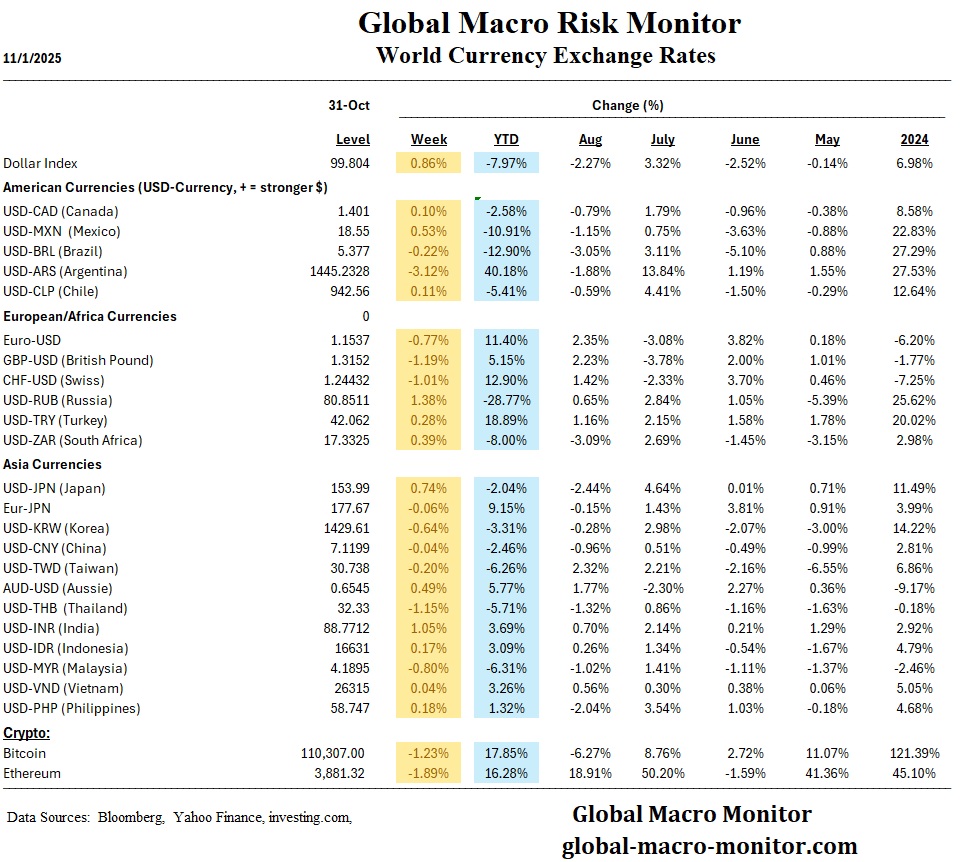
Just maybe the super-strong dollar, as reflected in the chart below, is contributing to America’s bilateral trade deficits.  You think? 


Posted in Uncategorized | Tagged , , , , | Leave a comment

Scopes, Faith, Science, & Stone Age: A Cautionary Tale of American Regression

One hundred years ago, on July 21, 1925, John T. Scopes was found guilty in a Tennessee courtroom for teaching evolution in violation of the state’s Butler Act. Known as the Scopes Monkey Trial, this legal spectacle pitted science, religion, and education against each other in a way that still resonates today. Though Scopes was convicted (a $100 fine later overturned), the trial became a pivotal moment in America’s struggle between modernism and traditionalism, illuminating a deep cultural rift that has never fully healed.

One hundred years later, it’s troubling to observe that the debate over scientific truth has not evolved; in fact, in many ways, it has regressed. We are witnessing a resurgence of anti-science sentiment across the United States, echoing the same ideological battles that occurred in Dayton, Tennessee, that summer.

From Evolution to Devolution – A Battle for Scientific Integrity

The Scopes Trial was never simply about one man or one lesson in biology. It was a staged confrontation, orchestrated in part by the ACLU, between progressive thinkers like Clarence Darrow and fundamentalists represented by William Jennings Bryan. The courtroom became a national forum where evolution, the Bible, and academic freedom collided.

Although Scopes lost, the trial galvanized public attention and eventually led to greater acceptance of evolutionary theory. The scientific community believed the battle had turned in their favor. Yet nearly a century later, this optimism feels misplaced.

Back to the Bible: Ten Commandments in Classrooms

In 2024, the Louisiana state legislature passed a law requiring the Ten Commandments to be posted in every public school classroom, reigniting the separation-of-church-and-state debate. Governor Jeff Landry, who signed the bill, argued it instills “moral clarity,” a veiled justification for promoting religious doctrine in public education.

Similar bills in Texas, Oklahoma, and Florida seek to reintroduce creationism or “intelligent design” into science curricula. These efforts disregard Supreme Court precedents (Edwards v. Aguillard, 1987) and defy decades of educational progress.

At the end of the day, this isn’t really about moral instruction. It’s an assault on secular education and feels like a strategic push toward theocratic governance.

Modern-Day Heresies: Vaccines, Viruses, and Flat Earths

During the COVID-19 pandemic, anti-vaccine movements surged, fueled by disinformation and distrust in scientific authority. Despite the overwhelming evidence of vaccine safety and efficacy, millions opted out, often citing conspiracy theories linking vaccines to government control, microchips, or infertility. This resistance led to preventable deaths and prolonged economic and social disruption.

Scientific researchers, particularly in climate science and public health, now report harassment, funding shortages, and censorship—a chilling atmosphere where truth must navigate political landmines.

Platforms like X (formerly Twitter), YouTube, and TikTok are awash with pseudoscience: from “flat earth” advocates to influencers claiming cancer is a “mindset.” This mass rejection of empirical evidence reflects a cultural rot, not just ignorance but a willful return to pre-Enlightenment thinking.

Stone Age Thinking in the Digital Age

The irony of our regression is stark. We are amid and on the eve of the most profound technological advances in history as AI achieves escape velocity (it helped in writing this post), and we now carry supercomputers in our pockets, yet some still deny the Earth is round. We sequence genomes in hours, yet distrust mRNA vaccines. Public discourse is increasingly favoring ideology over inquiry, belief over biology.

Like the fundamentalists of the Scopes era, today’s anti-science crusaders mask fear as faith. They seek control over the narrative, not through reasoned debate, but by banning books, rewriting curricula, and discrediting experts.

This is not merely political. It’s epistemological: a war on how we know what we know.

The Real Lesson from Dayton

The Scopes Trial was a warning, not a relic. It showed how quickly truth can become a casualty in cultural warfare. Today, the stakes are even higher. From climate collapse to global pandemics, the survival of civilization depends on our collective ability to think rationally, embrace science, and resist primitive instincts.

We must ask ourselves: Are we moving forward into a future of reason and progress, or stumbling backward into a symbolic Stone Age, where superstition reigns and ignorance is weaponized?

I will never forget the deep discomfort and near outrage I felt sitting in a church pew, listening to the preacher declare, “I’m not going to let science make a monkey out of me.”  In that moment, I realized I could never align myself with a version of faith that demanded that I reject the integrity of scientific understanding.

Faith and science need not be adversaries; in fact, they can, and should complement each other like two lenses bringing a complex world into clearer focus. Just as a person uses both a compass and a map to navigate a journey — one offering direction, the other providing context—faith can guide moral purpose while science explains natural phenomena. Believing in the value of human life, for example, doesn’t conflict with studying biology or medicine; it often inspires deeper care for the physical world. When we recognize that faith asks “why” and science asks “how,” we can allow both to enrich our understanding without demanding they speak the same language.

Let July 21 serve not only as a memory of a trial in Tennessee but as a mirror reflecting America’s uneasy relationship with truth. The verdict we render today, through our schools, votes, and voices, will shape whether history repeats itself or finally evolves.

Posted in Uncategorized | Tagged , , , , | 3 Comments

Tariffs and Toothpaste: The Inflation You Didn’t Expect

“This is a highly fluid situation and we’ll need to manage quantity decisions as we measure the price elasticity of impacted items,” underscoring how Walmart adjusts its inventory and pricing strategy based on customers’ sensitivity to price changes.” – John David Rainey,  Walmart CFO 

In a recent interview (see below), Walmart Chief Financial Officer John David Rainey explained the company’s adaptive pricing strategy amid escalating tariff pressures. Rainey made it clear that Walmart does not apply blanket price increases to all tariffed goods. Instead, the company uses economic fundamentals—particularly the concept of price elasticity of demand—to decide which products absorb costs and which products offset them through price increases.

Rainey stated:

“If you’re selling something that’s maybe a discretionary item for $300 and there’s a 50 or 100% tariff on that, it’s going to be more challenging to sell the same number of units.”

This comment reflects a textbook application of elasticity theory. If a product is price-sensitive (elastic), such as a discretionary good like electronics or seasonal apparel, a price increase due to tariffs could cause a sharp drop in sales. In such cases, Walmart is likely to absorb the cost increase to maintain volume.

Protecting the Profit Margin

However, as Rainey continued:

“We’re going to look across all categories of products and… maybe change prices on other products that might not have a tariff applied to them.”

This marks the strategic pivot. Walmart selectively raises prices on products with inelastic demand, such as household necessities and staple items, where consumers are less likely to reduce their quantity purchased despite modest price increases. These goods act as economic buffers to sustain profit margins without triggering a sharp decline in overall sales.

In summary, Walmart’s approach is not reactive but economically surgical: shield elastic goods from price hikes and strategically increase prices on inelastic, non-tariffed items. The CFO reinforced that this flexibility allows Walmart to protect its market share while managing margin pressures:

“We want to make sure that we’re maintaining the appropriate price points and the price gaps to our customers.”

Appendix – Understanding Price Elasticity of Demand (Econ 101)

Definition:
Price elasticity of demand (PED) measures the sensitivity of consumer demand to a change in price.

Equation:


Price Elasticity of Demand  % Change in Quantity Demanded/
                                                                            % Change in Price
         

  • Elastic demand (|PED| > 1): Demand drops significantly when prices rise.

  • Inelastic demand (|PED| < 1): Demand remains relatively steady despite price changes.

Application at Walmart:

  • For elastic goods (e.g., TVs, imported toys), Walmart partially absorbs tariff costs to avoid losing customers.

  • For inelastic goods (e.g., toothpaste, toilet paper), Walmart raises prices, knowing demand won’t drop significantly.

This allows the company to offset losses on tariffed items with margins on stable-demand goods—a cross-subsidization model powered by demand analytics.

Real-World Examples and Strategic Outcomes

Walmart’s elasticity-based pricing strategy shows how foundational economic theory can guide real-world decisions at scale. Consider these illustrative examples:

  • Imported Bluetooth speakers face a 50% tariff. Given their elastic demand, Walmart absorbs the cost and holds the price at $29.99 to avoid volume loss.

  • Laundry detergent, a non-tariffed good with inelastic demand, sees a subtle price increase from $9.49 to $9.89. The small uptick boosts margins with negligible impact on unit sales.

  • Pet food or vitamins, typically low-elasticity items, could also carry mild price increases to help Walmart maintain profitability across the broader product portfolio.

As Rainey noted,

“There might be some areas where we want to play offense… absorb some of that impact in the short term for the benefit long term.”

Walmart’s ability to integrate elasticity, inventory timing, and tariff forecasting exemplifies smart macroeconomic thinking in retail operations. It’s a strategy rooted in Econ 101, executed with Fortune 1 scale.

Go to 1:16 in the video. 

Posted in Uncategorized | Tagged , , , , | 3 Comments

Global Risk Monitor: Week in Review – July 11

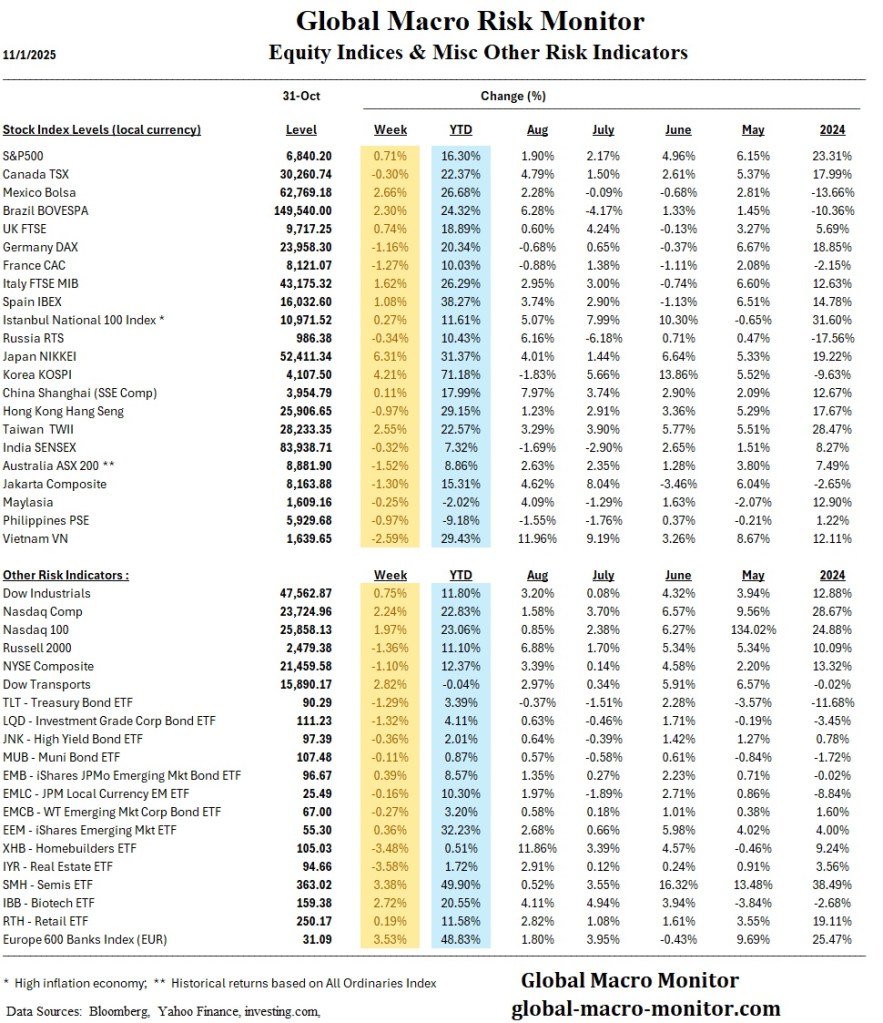
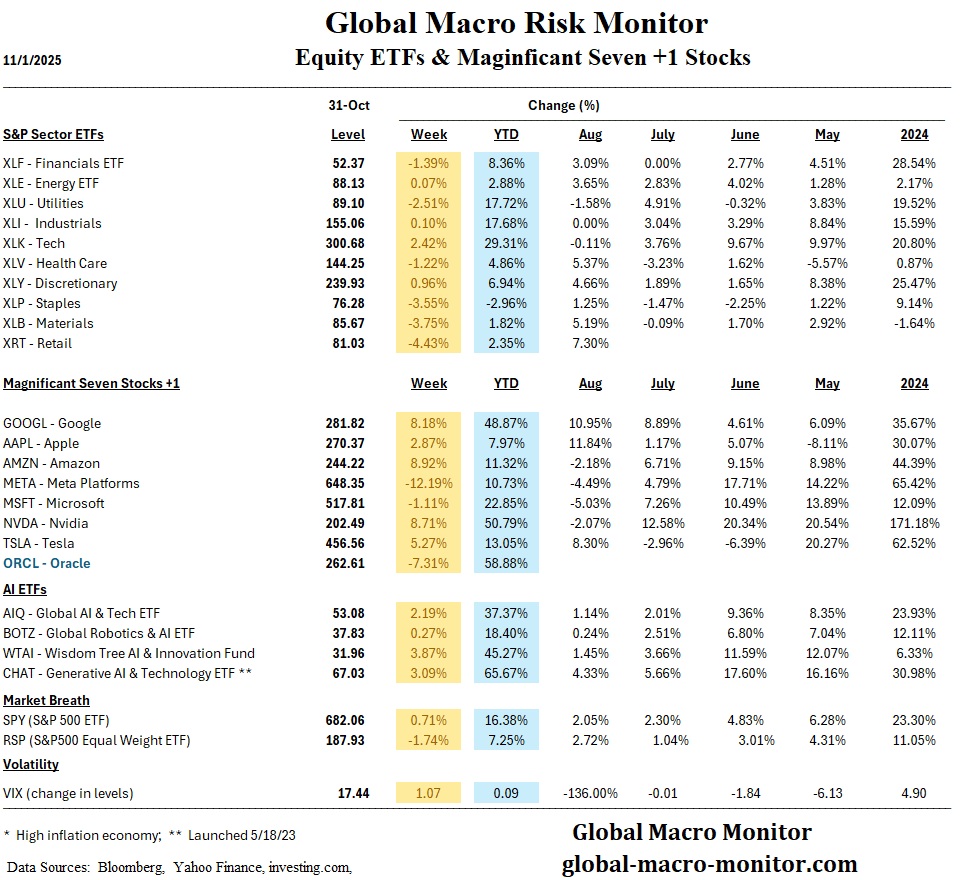
Markets wrapped up the week with a paradoxical sense of calm, even as trade tensions re-escalated on multiple fronts. At the center of the uncertainty is President Donald Trump’s hardline tariff rhetoric, including threats of sweeping new levies on the United States’ major trading partners. While markets continue to discount his threats as political theater, the cumulative weight of uncertainty is beginning to test investor patience, especially during the traditionally sluggish “Dog Days of Summer.” Artificial intelligence (AI) trends remain a bright spot for sentiment, but beneath the surface, warning signs are emerging.

Trump’s Renewed Tariff Push: Big Talk, Real Risks

In a sharp escalation, Trump announced unilateral tariff hikes—30% on the EU and Mexico, 50% on Brazil and copper products, and threats of a 200% pharmaceutical levy. The stated justification ranges from narcotics enforcement to trade imbalances, with timing set for August 1. According to Bloomberg, Trump’s “maximalist stance” has left U.S. trading partners scrambling, with some countries (like India) racing to finalize partial deals to avoid being swept up in the tariffs.

Despite the aggressive tone, markets appear to view the latest salvo as another bluff. Traders point to a pattern of bluster followed by walk-backs. Nonetheless, the barrage of tariff letters and the rapidly approaching deadline have rekindled fears of a disrupted global trade regime. As one European official stated, the administration’s “fits-and-starts” approach undermines predictability and stability, the two pillars essential for cross-border investment and supply chain resilience.

Muted Market Reaction: Complacency or Confidence?

While geopolitical rhetoric intensified, market volatility remained surprisingly subdued. Fidelity, Manulife, and Schwab all reported relative calm in U.S. equity indexes. The VIX actually backed up for the week.  The S&P 500 and Nasdaq continued to trade near record highs, buoyed by robust AI demand and resilient tech earnings. Yet the calm may be deceptive.

Charles Schwab’s weekly outlook noted that equity valuations remain historically elevated, and market breadth is narrowing again, another potential red flag. The latest leg of the rally has been disproportionately driven by a handful of tech giants, even as cyclical and value sectors lag. The fear is that a deterioration in macro fundamentals, such as renewed supply chain stress from tariffs, could derail the rally just as seasonal volume declines.

Trade Tensions Not Fully Priced In

Although U.S. growth remains supported by fiscal tailwinds, tariff uncertainty is starting to bite. EM Asia policymakers, in particular, are losing faith that trade deals will provide lasting clarity, and sentiment in Europe is dampened by intra-bloc political gridlock. Moreover, supply bottlenecks in global logistics remain unresolved, a risk exacerbated by tariff-driven inventory hoarding or re-routing.

While inflation in Latin America and Japan appears contained, China’s deflationary trends are complicating trade negotiations, especially as Trump’s protectionist pivot collides with Asia’s need for export recovery.


The AI Effect: Cushioning Sentiment for Now

Despite the macro clouds, the AI narrative continues to support risk appetite as investor positioning remains heavily skewed toward AI-linked assets. This thematic allocation may be shielding markets from near-term shocks, creating a perception of resilience that may not be sustainable if tariffs begin to impact input prices or corporate margins.


Conclusion

As markets wade deeper into summer, the surface calm belies an undercurrent of growing tension. Trump’s tariff revival is unlikely to deliver an immediate economic shock, but the cumulative uncertainty may begin to seep into corporate planning, consumer sentiment, and investor allocation. With AI momentum still masking fragility in other sectors, the coming weeks will test whether markets can continue to brush off policy volatility or whether the dog days will give way to a stormier season ahead. Portfolio managers would be wise to remain nimble, hedge trade-sensitive exposures, and monitor developments with vigilance as August 1 approaches.

Markets

  • U.S. equities showed mixed performance, with major indexes retreating modestly due to renewed tariff headlines and seasonal trading lulls during the summer.

  • Nvidia hit a $4 trillion market cap, helping offset declines in broader sectors.

  • Oil prices rebounded, climbing more than 3% following a sharp drop the previous week, signaling continued volatility in energy markets.

  • Bitcoin surpassed $118,000, highlighting investor appetite for risk assets amid policy uncertainty.

  • Market breadth remained narrow, as gains were concentrated in mega-cap technology stocks.


U.S. Market Analysis

  • President Trump’s tariff threats targeted key sectors, including copper (50% increase), soybeans (23%), and autos. The proposed hike on Brazilian tariffs to 50% signals a shift toward broader trade protectionism.

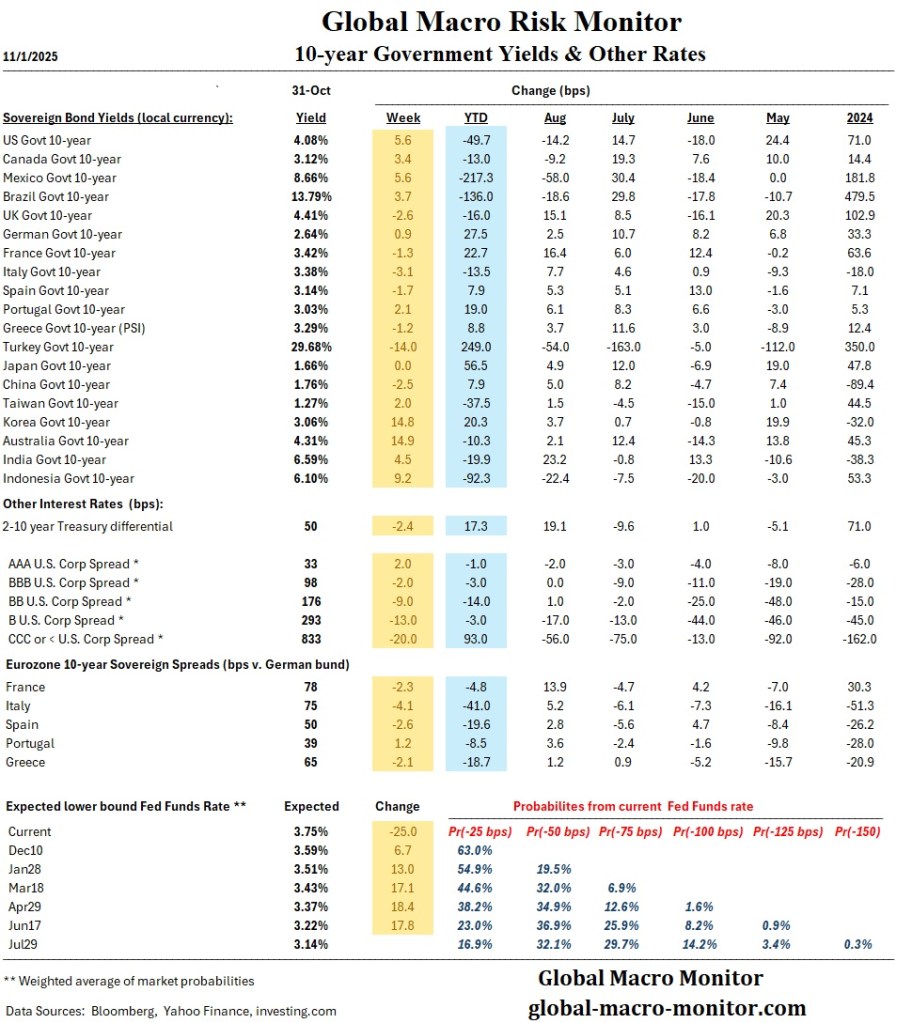
  • Fed minutes revealed a divergence in outlook, with most members supporting rate cuts, but the timing remains contested.

  • Treasury yields rose slightly, with strong investor demand for 10-year notes; corporate bonds underperformed Treasuries.

  • FOMC outlook indicates cautious optimism, tempered by trade and global uncertainty.


Global Market Analysis

  • Trade policy uncertainty intensified, as reciprocal tariffs and delayed negotiation timelines clouded visibility for multinational supply chains.

  • EU political tensions escalated, with disagreements over the next Multiannual Financial Framework (MFF) and national budgets, especially in France.

  • Japan saw positive wage and inflation trends, supported by accommodative monetary policy and resilience despite trade tensions.

  • China’s economy remains under deflationary pressure, as June PPI declined and CPI stayed low. Consumer confidence remains fragile.


Economics

  • U.S. data continues to show resilience, but early signs of softening are emerging in housing and employment metrics.

  • UK GDP contracted in May, yet second-quarter growth projections remain positive. Cooling in labor market conditions has been noted through alternative datasets.

  • Latin America saw benign inflation readings, especially in Brazil and Mexico, paving the way for continued monetary easing.

  • Emerging markets are grappling with policy response uncertainty, especially in Asia, where expectations for trade stabilization remain low.


Week Ahead (July 14–19)

Key U.S. Events

  • Economic Data:

    • Monday: CPI (Consumer Price Index)

    • Tuesday: PPI (Producer Price Index, Final Demand)

    • Wednesday: Industrial Production, Jobless Claims, EIA Petroleum Status Report

    • Thursday: Housing Starts, Philadelphia Fed Manufacturing Index

    • Friday: Consumer Sentiment (Preliminary)

  • Earnings Reports:

    • JPMorgan Chase, Wells Fargo, BlackRock, Johnson & Johnson, and Bank of America to report earnings.

Key Global Events

  • Eurozone: Continued debates on fiscal integration and tariff alignment within the bloc.

  • Japan: Corporate sentiment and trade data will be key, particularly under the yen’s depreciation.

  • China: Key employment and wage data expected; markets watching for any new stimulus signals.

Posted in Uncategorized | Tagged , , , , | 1 Comment

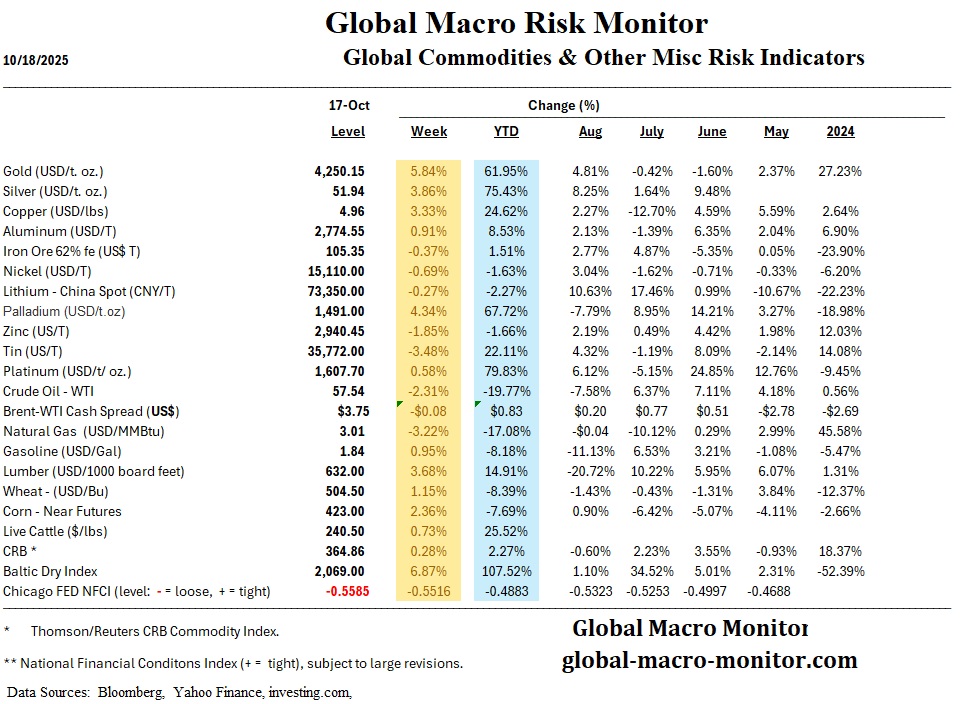
Gagging Dr. Copper and Distorting the Economy

…AI data centers are likely to require enormous amounts of copper to meet their capacity needs… – Barron’s, July 9, 2022

Back in September 2022, Global Macro Monitor made the call:

“If you are not buying copper hand-over-fist here, at $3.54 per lbs., you should be.  – Global Macro Monitor,  Sept 2022

Since then, copper has rallied nearly 70%, driven not just by fundamentals, but now by fear and politics.

Distortions Everywhere

The latest jolt? President Trump’s threat to impose a 50% tariff on imported copper. The result was the biggest one-day surge in copper prices ever recorded, with futures hitting an all-time high of $5.69 per pound. But this isn’t a signal of booming industrial activity—it’s a distortion of the copper market and a gag order on “Dr. Copper,” long considered a prominent leading indicator of economic health.

Trump’s tariff talk is reverberating across the economy. Copper is everywhere—wiring, plumbing, EVs, data centers, semiconductors, AI infrastructure, housing, and renewables. Tariffs would hit not just miners or traders, but every supply chain that touches electrification or digitization. The AI buildout, for example, could face serious cost overruns, delaying deployments that are core to U.S. tech competitiveness.

Meanwhile, housing could see another $10,000+ tacked on to already strained new home costs, compounding inflation in construction and further distorting the Fed’s policy response. All of this—on top of already tight domestic supply and years-long lead times for new mining projects.

Trump’s copper move doesn’t just lack strategy—it defies logic. It penalizes allies, clouds price signals, and undercuts the very sectors his administration claims to support. In short, Dr. Copper can no longer do its job, and that’s a dangerous sign.

This is not industrial policy. This is economic malpractice—inflicting uncertainty, inflation, and dysfunction on an economy already walking a tightrope.

The table is set.  TACOs or bread crumbs?   Stay tuned. 

Posted in Uncategorized | Tagged , , , , | 1 Comment

Nonlinear Thinking: AI Just Made My Latte

Since Global Macro Monitor launched, we’ve tracked the technologies we believed would reshape the world. Now that the future is no longer theoretical. We’re at the elbow of the exponential curve, where change accelerates beyond prediction—and it’s hitting the real economy in real time.

Case in point: I stopped at a San Francisco mall this week for a latte. The barista? A robot. No lines. No wages. No human hands. Just automation doing what used to be someone’s job.

This isn’t just about coffee. It’s a clear signal:

AI and automation are no longer edge cases—they’re embedded in daily life.

Tech Is and Will Eat the Economy

  • Labor markets will be upended.

  • Margins will expand or vanish, depending on your tech stack.

  • Maintaining a steady-state Aggregate Demand will be challenging as the labor market is disrupted. 

  • Monetary policy will chase a moving target.

Every industry is now a tech industry. Every investor must become a futurist. The old playbooks don’t work in an exponential world.

Adapt or Fade

You can’t sit this out. Embrace the new tech, or get left behind. The capital flows are shifting, and they’ll reward speed, not sentiment.

Posted in Uncategorized | 1 Comment