Week in Review

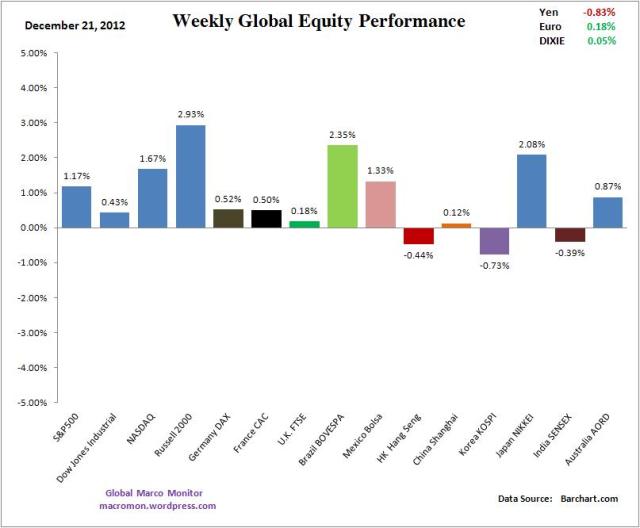
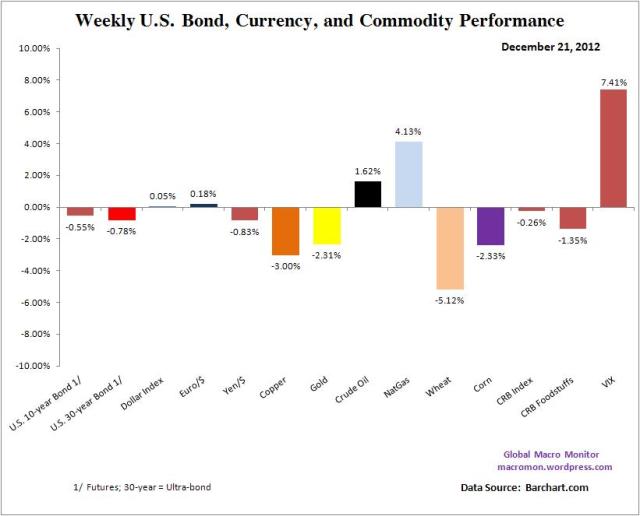
WIR_Key LevelsWIR_Equity_WeekWIR_Bond_WeekWIR_Equity_YTDWIR_Bond_YTD(click here if charts are not observable)
Posted in Week in Review | Tagged , , , , , | 1 Comment

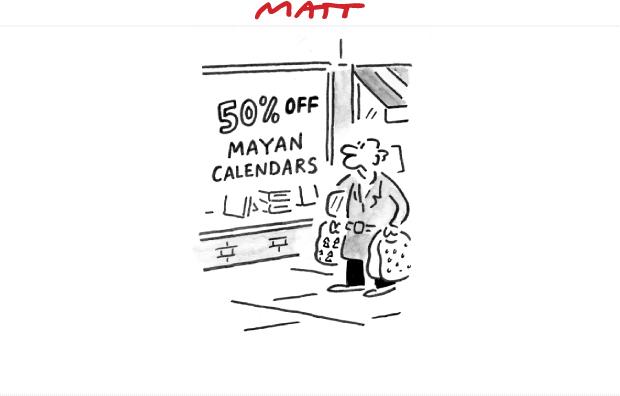
‘Toon of the Day: The End

Dec21_Toon of the Day

(click here if cartoon is not observable)

Posted in Cartoon of the Day | Tagged , , | Leave a comment

Weekend Lecture: The McWage Index

Good stuff from the London School of Economics and the “best labor economist in the world.”  It’s wonkish and the main target of the lecture are for economists.

Hope you have some time to give it a listen.

Click here for Power Point Presentation.

Recorded on 28 February 2012 in Sheikh Zayed Theatre, New Academic Building.

Real wages measure worker welfare and the cost of labour. After providing some historical background and the basis for their interpretation, Professor Ashenfelter reports the results of a decade long study of wage rates at McDonald’s restaurants in over 60 countries.

Orley Ashenfelter is Joseph Douglas Green 1895 Professor of Economics and director of the Industrial Relations Section at Princeton University.

(click here if video and chart are not observable)

Always suspected the Danes were richer than US.  How ’bout the Irish – 60 percent higher McWage than the US!

Dec21_McWage

Posted in Video | Tagged , , , | 2 Comments

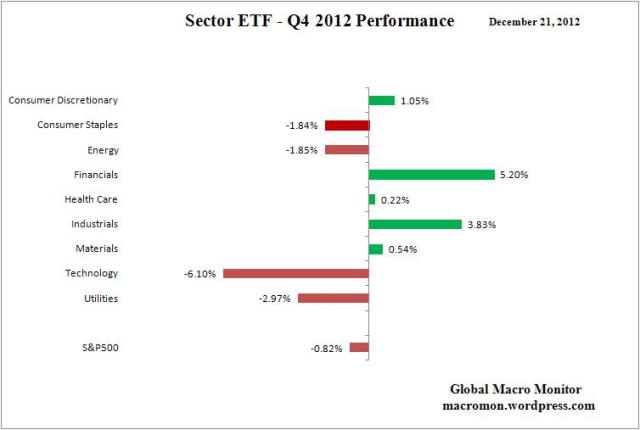
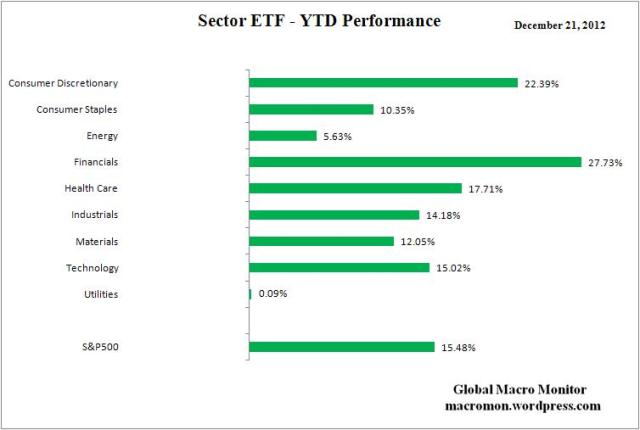
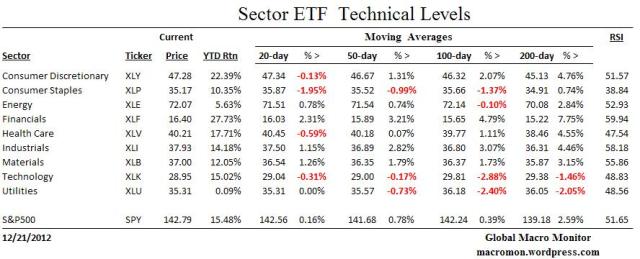
U.S. Equity Sector ETF Performance

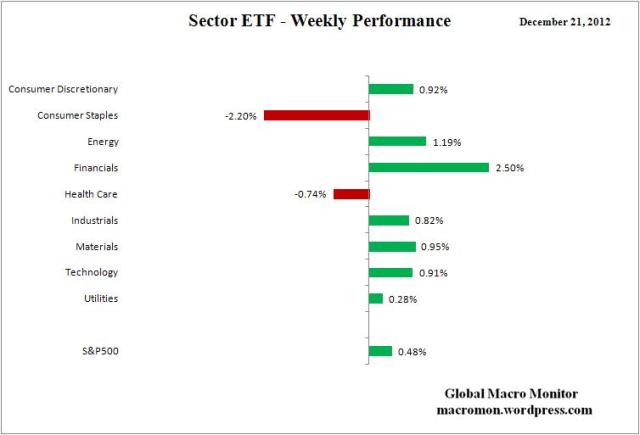
ETF_WeekETF_QuarterETF_YTDEFT_Technicals(click here if charts and table are not observable)

Posted in Sector ETF Peformance | Tagged , , , , | 2 Comments

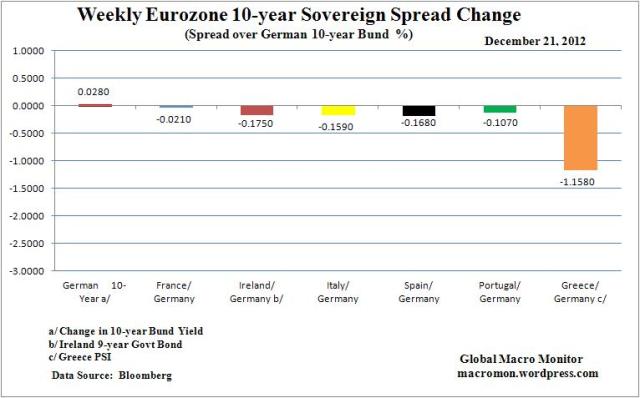
Weekly Eurozone Watch

Key Data Points
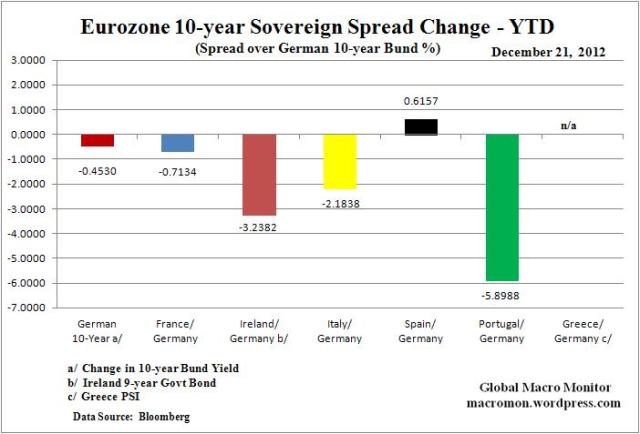
German 10-year Bund 3bps lower;
France 2 bps tighter to the Bund;
Ireland 18 bps tighter;
Italy 16 bps tighter;
Spain 17 bps tighter;
Portugal 11 bp tighter;
Greece 116 bps tighter;
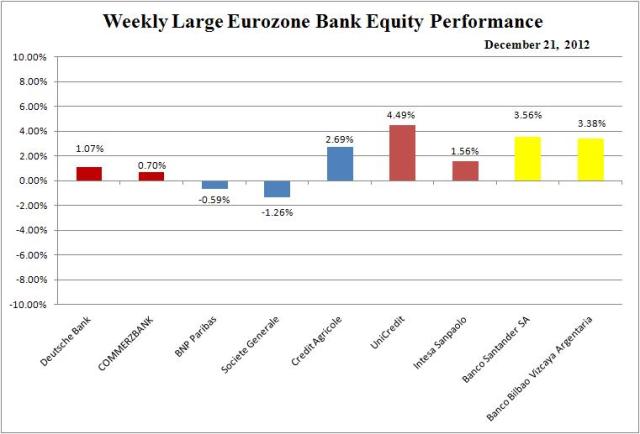
Large Eurozone banks up  -1.0 to 5.0 percent higher;
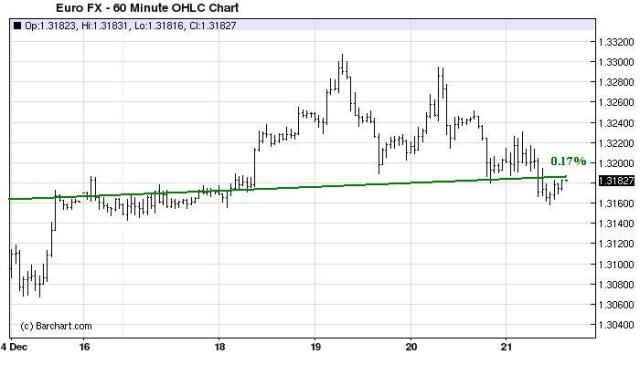
Euro$ up 0.17 percent.

Comments
– Italy, Portugal, and Greece 10-year yields at lowest weekly close of the year;
– Greece was upgraded five notches to B- by Standard & Poor’s;
-Ryanair said it’s opening its first “Greek base” on the Crete city of Chania;
Handelsblatt, the German financial newspaper, named Greek prime minister Antonis Samaras as its politician of the year in Europe;
-The Italian parliament passed Mario Monti’s 2013 budget;
– Mario Monti resigned as Italy’s Prime Minister paving way for February elections;
-Spain’s parliament approved 2013 budget, cutting the deficit to 4.5% of GDP from 6.3% this year;
-Finland slashed its forecast for growth in 2013 to just 0.5% from 1.0%;
-Cyprus was downgraded by S&P Cyprus’ to junk status, two notches to CCC+.

Source:  Guardian and Telegraph

Dec21_Cyprus Haircut

Spain has made dramatic strides in cutting labour costs and reviving exports since the debt crisis erupted, turning the country into the new poster-child of Europe’s austerity regime.

Fresh data from the OECD show that Spain has narrowed the gap in “unit labour costs” with Germany by 5.5pc over the past year alone. It has clawed back 4.6pc against France and 6.6pc against Austria since late 2011, as it slashes pay and pursues a scorched-earth policy of “internal devaluation”.

Ambrose Evans-Pritchard

WEW_Spread_WeekWEW_Bank_WeekWEW_Spread_YTD WEW_Bank_YTD

WEZ_YieldsWEW_EuroFX(click here if charts are not observable)

Posted in Weekly Eurozone Watch | Tagged , , , , , | 2 Comments

Picture of the Day: End of the World

Click picture to enlarge.

Dec21_End of the World(click here if picture is not observable)

Posted in Picture of the Day | Tagged , , , | Leave a comment

Feliz Navidad! Not!

Leave it to the pols to ruin Christmas.   Now it’s either a purely Democratic cliff bill or nuttin’, honey.    Good luck passing the debt ceiling.

The House Republican Conference turned its back on Speaker John Boehner Thursday, forcing GOP leadership to abandon its plan to extend Bush-era tax breaks for income under $1 million.

After a full day of heavy arm-twisting, House Republican leaders were unable to cobble together enough support from 217 of their 241 members for Boehner’s (R-Ohio) “Plan B” proposal, even after Majority Leader Eric Cantor (R-Va.) assured its passage. Democrats vowed not to support the measure.

Politico

Now the market gets to vote.  Looks like the “market whip” is going to have to soften up the pols up a bit and herd some cats to get a deal done.

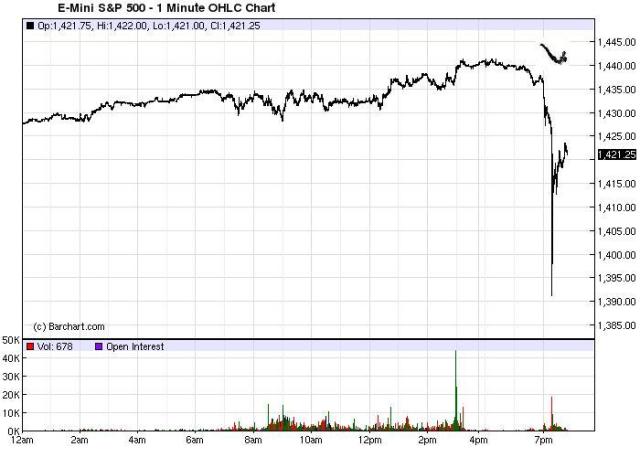
S&P500 e-minis are doing the Mayan Swan Dive in Globex.  Maybe the world does end for the levered longs tomorrow.

Dec20_EMini(click here if chart is not observable)

Posted in Fiscal Cliff Monitor, Fiscal Policy | Tagged , , | Leave a comment

Gold is no hedge for Apple

A friend of GMac Monitor tweets on our last post on gold:  “so gold is no short-term hedge for Apple?”

When in doubt go to the charts…

Dec_Apple and Gold

Short answer.  Nope!

Didn’t the Mayans write about this correlation?  Or was it causation?

(click here if chart is no observable)

Posted in Apple, Gold | Tagged , , | 1 Comment

Gold Breaks 200-day Moving Average

The precious metals continue to trade not so precious.

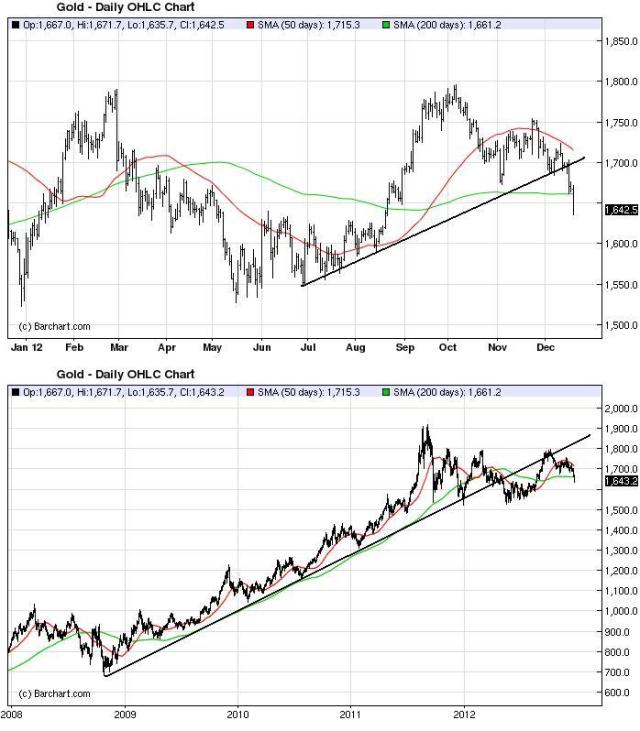
Gold broke its 200-day moving average today.  The yellow metal seems to be suffering the same fate as Apple going into year-end.   Some investors are too long and the perception of fundamentals and thus the premise of holding gold is in question.

Gold is not behaving the way it should.  That is, rising as central banks expand, or threaten to expand, their balance sheets.  We’ve lost a lot of money this year on that trade.

Last week we posted a piece by Mark Dow about how the dynamics in gold’s price action have been changing.  He’s updated his ideas,

Despite all the talk about safe haven status in recent years, PMs have had a strong positive correlation with stocks and risky assets more generally. Their correlation with the dollar, of course, has been strongly negative. Less intuitively, the impulse correlation of PMs to treasury yields has been positive, even though low levels of yield (more precisely, real rates) is an important driver of higher PM prices.

These correlations have flipped in the last few days in a way that is apparent to everyone. The decline in gold and silver in the face of a strong bid to risky assets will now likely force people to reconsider their investment hypothesis for holding them. Big events and correlations that change signs often do. Specifically, a lot of big macro tourists hold large PM positions, and what I believe we are seeing is some of them starting to hit the bid. It is also possible that some of them are also facing redemptions, since those clinging hardest to their PM positions are also those most likely to have been working under the wrong economic assumptions and underperforming all year. So, the year-end dynamic may be exacerbating the pressure we are currently seeing

On the technical side, though I am not, ahem, a master technician, it is apparent that gold and silver yesterday broke medium-term trend lines. But I actually don’t think that is unusually significant. As I said before, PMs are notoriously tricky to trade on a short-term basis. I’m sure even the best technicians have great war stories about being fooled by gold and silver. What I think is hugely significant is the 1600 level on gold (Feb 2013 contract). If it breaks below that level I think the warning flare goes up for everyone to see. Gold has rebounded from strong corrections before and may well rebound from this one. But I have a strong sense that if we get below 1600, it will matter in a way it hasn’t in many years, and all (gold) bets will be (taken) off.

Good stuff.

Gold looks broken here and needs a big flush, in our opinion.    The May low of $1527.5o looms as must hold support.

Dec20_Gold(click here if charts are not observable)
Posted in Uncategorized | 1 Comment

Repressed Fear

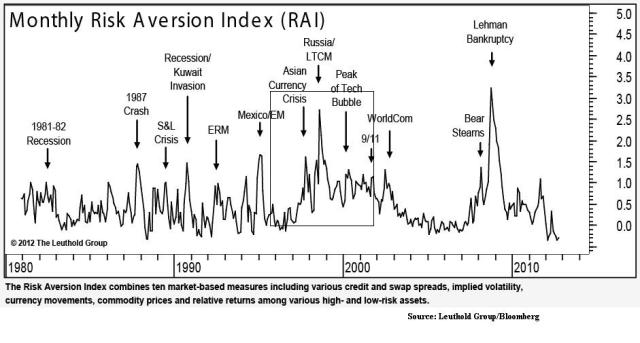
This nice chart comes to us from the  Leuthold Group via Bloomberg.   It illustrates that market fear or risk aversion is at its lowest levels since the 1980’s!  Yikes!

The Leuthold Group constructs their Risk Aversion Index (RAI) with a combination of market based indicators,  including credit and swap spreads, implied vol, currency moves, and commodity prices.   No doubt quantitative easing is  repressing market fear.

They also note that periods of low risk aversion tend to run longer than streaks of elevated risk aversion.   How long this time?   We don’t know but we’re going to think long and hard over the holiday about the potential macro swans in 2013.

Here’s are eight starting thoughts we will contemplating and researching:

1)  Japan pushes too hard with fiscal and monetary easing and tips over into a debt and currency crisis;  2)  markets begin to fret over France and Italy;  3)  the U.K. starts to have trouble and doubts increase over its debt sustainability;  4)  inflation begins to creep up calling into question the sustainability of global quantitative easing due to the rise of stagflation;  5) increased political instability caused by stubbornly high unemployment;  6)  the U.S. can’t get it together politically to implement the necessary structural economic and fiscal reforms;  7)  China’s financial and credit problems surface and create panic in the local financial markets;   and 8)  geopolitical tensions in Asia get hot.

How will these affect our trading?  We’ll go with the trend, keep them on our radar and try to find cheap avenues to express or hedge the swan events.

Dec20_RiskAversion(click here if chart is not observable)

Posted in Equities, Fiscal Cliff Monitor, Fiscal Policy, Monetary Policy | Tagged , | 1 Comment