Usain Bolt vs. Gravity

(click here if video is not observable)
Posted in Sports | Tagged , | Leave a comment

10-year T-Bond Yield & Apple’s Gravestone Doji

Not much for you today, folks.

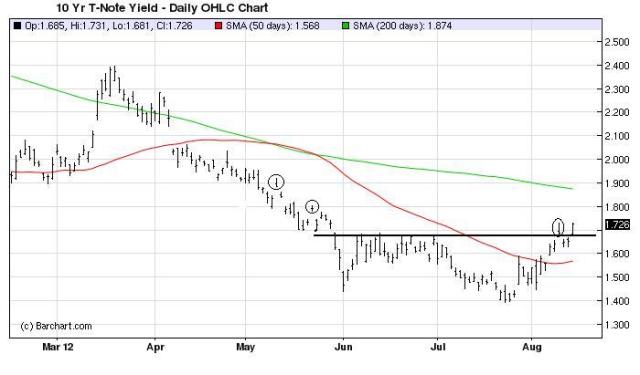
The only notable things that caught our attention was the 10-year Treasury yield closing above resistance thus negating what could have been a short-term island top in yields, a common chart pattern in the bond market and interest rates.

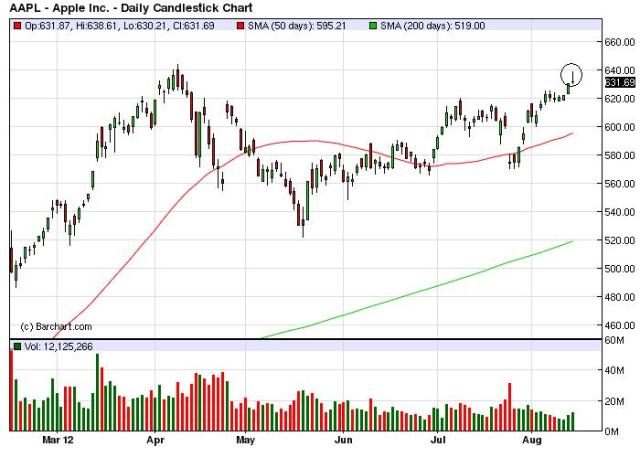
Also of note,  Apple couldn’t hold an almost $9 gain and closed near its low, but still up a few bucks on the day.  The daily price action hammered out a gravestone doji, which should be monitored.

On the other hand, today’s price action could have been just noise.   Stay tuned.
(click here if charts are not observable)

Posted in Apple, Bonds | Tagged , , , | Leave a comment

Apple – A Chip Shot From An All-time High

Feels like old times.

Apple moving up even as the overall market is flat to lower.   The stock is just a chip shot away from its April 1oth all-time high of $644.    It’s also going to be nice to receive the first $2.65 divie paid on August 15th.

(click here if chart is not observable)

Posted in Apple | Tagged , , | Leave a comment

Jobs 2012: Government Jobs Exceed Goods-Producing Jobs

We’re starting a new series titled, Jobs 2012, which will drill down into the employment and jobs data. We’ll analyze what kind of jobs are being created and lost in the current recovery, look at short and long-term trends, and the overall structure of the U.S. labor force.   We feel the series is timely as jobs are the most important issue for voters in this Presidential election according to a recent Gallup poll.

(click here to view prior posts on the jobs market)

Our first post of Jobs 2012 is a big picture view of the U.S. labor market.   We’ve analyzed and charted the latest data from the Bureau of Labor Statistics (BLS) showing trends in the three major sectors of the jobs market:  1) Private goods-producing; 2) Private service-providing; and 3) Total government jobs.

We were surprised at what we found.

First, recognized by Iacono Research in 2010,  total government jobs at the federal, state, and local level, now exceed total employment in the private goods-producing sector,  including manufacturing, construction, mining and logging, which also includes oil and gas extraction.  We didn’t expect this.

Really? More government jobs than goods-producing jobs?  In the United States?

This is one data point, in our opinion, that embodies the U.S. zombie-like economic recovery and fiscal problems that the state and local governments are now experiencing.  It also helps explain the record level corporate profit margins.

We love our public sector employees,  but also recognize wealth and sustainable demand are created in the private sector.  Without asset inflation the conventional economic wisdom seems to be moving toward the view that quality goods-producing jobs are essential for a better economic future.

For example, if the house of a lower paid service worker, such as a retail clerk at Wal-Mart, is not appreciating on an annual basis,  it’s difficult for the global economy to generate the wealth induced aggregate demand to absorb the capacity it built out during the bubble.  Ask China.

Click here for an interesting (wonkish) piece on the rise of low paid service jobs and polarization of the U.S. labor market

Second, the trend toward a service-providing labor force began just after WWII and is hardly new though it did accelerate after the bursting of the dot.com bubble when corporations were caught with excess capacity.  The percentage of private goods-producing jobs of total nonfarm employment, for example,  peaked in 1943 at 44 percent during the wartime economy and has since been in a secular decline and now less than 14 percent in 2012.

The falling cost of automation, globalization, relative wages, productivity increases, consumer/worker preferences, the rise of the internet, and political forces, are just a few of the many causes of the shift to service jobs, which now make up almost 70 percent of nonfarm payrolls.

The causes and solutions for the weak U.S. jobs market are topics for Ph.D dissertations, beyond our pay grade,  and the scope of this simple post.   We’ll let the President and Governor Romney slug it out on how they plan to fix it.

More to come.   Stay tuned.

(click here if charts are not observable)

Posted in Employment | Tagged , , , | 4 Comments

Nonlinear Thinking: Summer Olympics, 2020

Great Olympics!

Excellent  job by the Brits pulling off a stunning two weeks of sport and games.   Cheers to David and Boris! 

Here’s something to think about until Rio via an interesting piece in Popular Science about how technology may change the future of the Olympics.

HOLOGRAPHIC OBSTACLES

About 100 riders are injured in eventing falls every year, and when a multimillion-dollar horse goes down, even a minor injury like a twisted ankle can end its career. Computerized bases on the ground could project holographic obstacles, such as four-foot fences and 15-foot-wide pools, in place of dangerous physical objects. Line-of-sight infrared beams could monitor the edges of the obstacles; if the horse breaks the beam, the system would instantly alert the judges—and the crowd—to the fault.

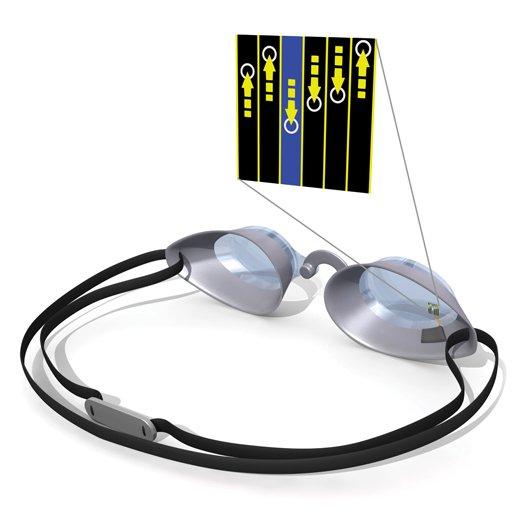
HEAD-UP GOGGLES

Swimmers are often unaware of their standing in a race until it’s over. Goggles with an integrated head-up display could broadcast a live view of the competition and help racers to better pace themselves. Waterproofed with an invisible layer of hydrophobic nanoparticles, a technique currently used on cellphones and other gadgets, a small computer tucked in the lower right-hand corner of the goggles would gather position information from other wired racers over Bluetooth and display it on a quarter-inch LCD.

Wait there’s more.

SMART LANDING PADS

Scoring the exact length of a long or triple jump can be imprecise and time-consuming. Athletes land in a sand pit, where they make several marks; officials must locate the mark closest to the takeoff line before they can measure. Researchers at Arizona State University have developed a 2,016-pressure-sensor array to map where an athlete hits the ground. Placed underneath the sand in the landing pit, a dozen or so of the mats could record the exact point of touchdown, and a computer could automatically calculate the length of the jump.

AUTOMATIC GOAL KEEPER

In a low-scoring game like soccer, one bad goal call can do a lot of damage. A reversed call in a match against Germany, for example, cost the U.K. a potentially pivotal goal in the 2010 World Cup. To help refs, who may not always have a clear view of both the ball and net, German research institution Fraunhofer has developed an automated goal-tracking system. Actuators around the net generate a magnetic field across the face of the goal. When the ball passes through that field, a chip embedded in the ball sends a signal to the ref’s watch within one tenth of a second.

RETRACTABLE DIVING BOARD

On a good day, a diver’s head misses the board by a couple of inches. On a bad day, the two collide, as happened to American Chelsea Davis in the 2005 World Championships (she suffered a broken nose and needed several stitches) and, most famously, Greg Louganis in the 1988 Olympics. A hydraulic springboard could make diving safer. In the one second a typical diver is airborne above the plane of the board, it could retract as much as three feet. An accelerometer would sense each takeoff and initiate the movement.

(click here if photos are not observable)

Posted in Sports | Tagged , , , , , | 1 Comment

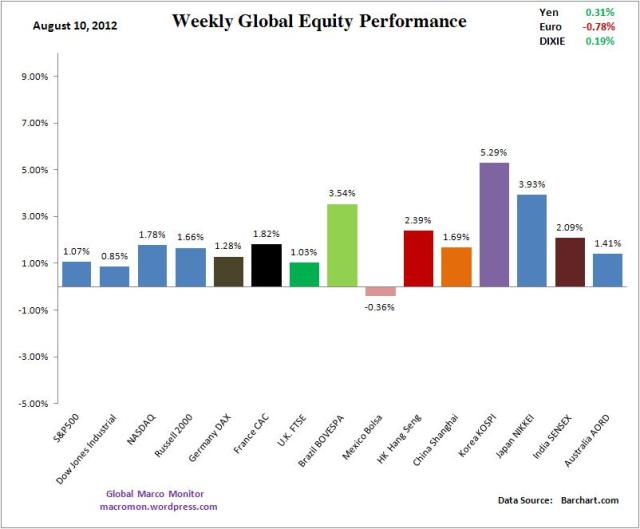
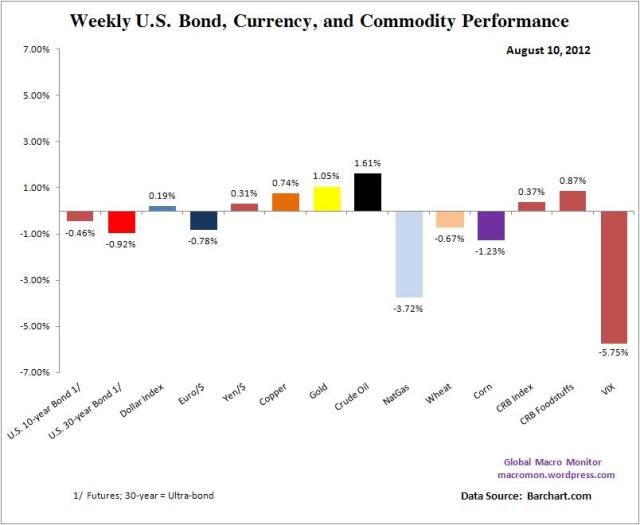
Week in Review: Asia’s Big Bounce

(click here if charts are not observable)

Posted in Week in Review | Tagged , , , , , , , , , | Leave a comment

Global Trend Indicators

(click here if tables are not observable)

Posted in Global Trend Indicators | Tagged , , , , | 5 Comments

Must See Movies

We’re definitely checking this out over the weekend.

(click here if video is not observable)

Posted in General Interest | Tagged | Leave a comment

Weekly Eurozone Watch

Key Data Points
German 10-year bund 4 bps lower;
Italy 10-year 11 bps tighter to the Bund;
Spain 10  bps wider;
Portugal 96 tighter;
Greece 92 bps tighter;
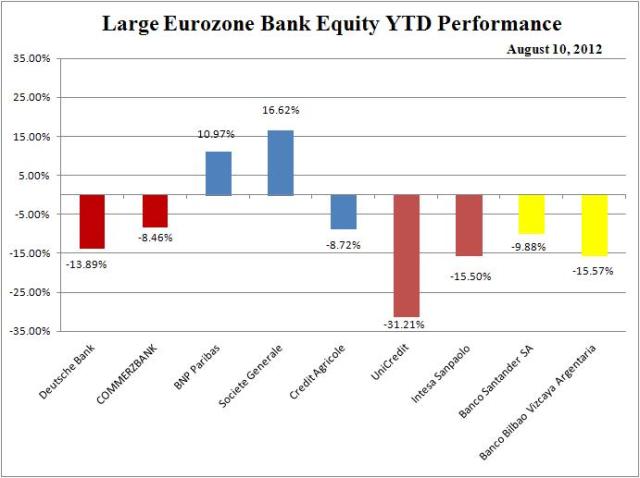
Large Eurozone banks continue their ramp;
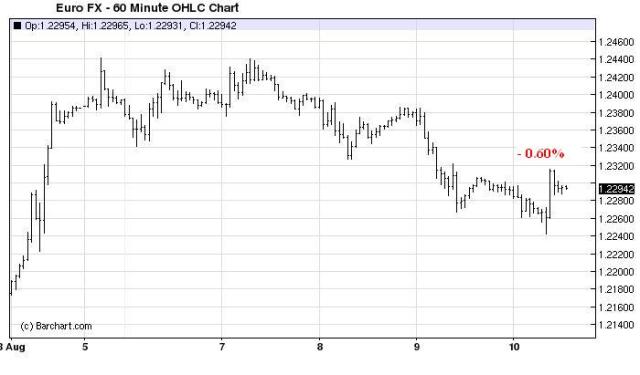
Euro$ down 0.60 percent;

Comment
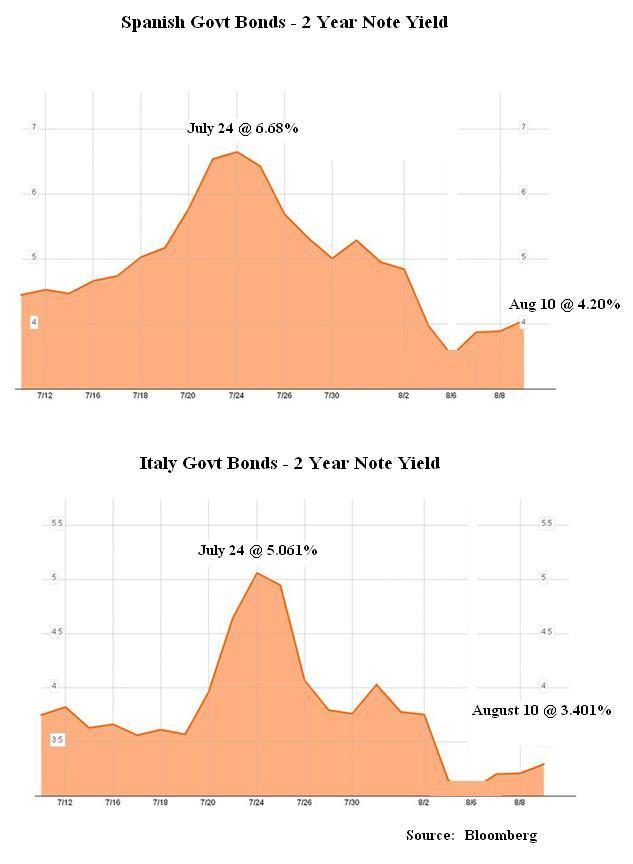
Relatively boring week as Euros out on holiday and at the Olympics.  The big moves over the past few weeks have been in Spanish and Italian 2-year yields.  The shorts fear that is where the liquidity breathing Draghi will show up.

(click here if charts are not observable)

Posted in Weekly Eurozone Watch | Tagged , , , , , , , | 1 Comment

Lightning Strikes Twice

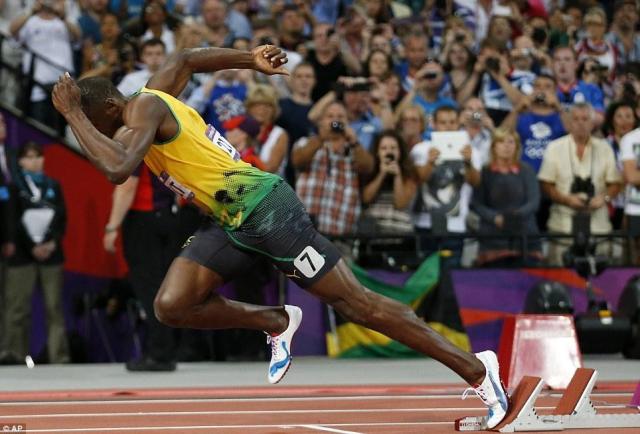
What a stud.  Complete Usainity!

(click here if picture is not observable)

Posted in Sports | Tagged , | Leave a comment