Air China: Hardly Landed or Landed Hard?

Take a look at Amrbose Evans-Pritchard’s  latest piece on the Chinese economy.  He quotes Charles Dumas of Lombard Street Research,

“The hard landing has happened,” said Charles Dumas from Lombard Street Research. “We don’t believe official data. We think GDP slowed to a 1pc rate in the second quarter”…

“This was the moment when stimulus was supposed to bite. It didn’t,” said Global Insight. Critics say Beijing let the property boom go too far and then hit the brakes too hard last year. Monetary tightening led to a contraction in real M1 money. The delayed effects kicked in this year just as Europe fell back into recession and the US slowed abruptly.

The Politburo has thrown all engines into reverse throttle. The reserve asset requirement for banks has been cut and regions have been given the green light for another blitz of eye-watering stimulus financed by credit from state banks. Wei Yao from Societe Generale said: “The bottoming-out process is taking even longer than we anticipated. The easing policies announced so far have not fully passed through to the real economy.

Reflating the credit bubble and building a few more ghost cities in order to reignite growth may be easier in a state-controlled economy than it is, say,  in the U.S.,  but surely it won’t be an easy task even for the Chinese.

As is Europe, the China question is going to be around for the medium term and will have an outsized  impact on the trajectory of risk assets over the next few years.   Of course, interrupted by counter trend moves such as markets getting to lathered up over quantitative easing and directed credit expansion or even bouts of excessive pessimism.   The key will be to filter out the noise and focus on the fundamentals that determine the trend.   Not an easy task, but essential for survival.

It’s also interesting, and Evans-Pritchard makes the point in his piece, that policymakers in China now have to worry about capital flight as they weaken the currency to stimulate growth.

China Securities Journal confirmed this week that Beijing is steering the currency lower to cushion the shock. “The renminbi has entered a period of depreciation,” it said, adding that this could cause short-term capital outflows – running at $110bn in the second quarter – but the overall effect will be “beneficial, by enhancing exports.”

The policy risks a serious confrontation with Washington. “If they do the same old thing and slam down a few more roads to the Gobi desert they will end up with stagflation. They need Thatcherism to get out of this,” said Mr Dumas.

AHH!  Cheaper goods at Costco and WalMart!

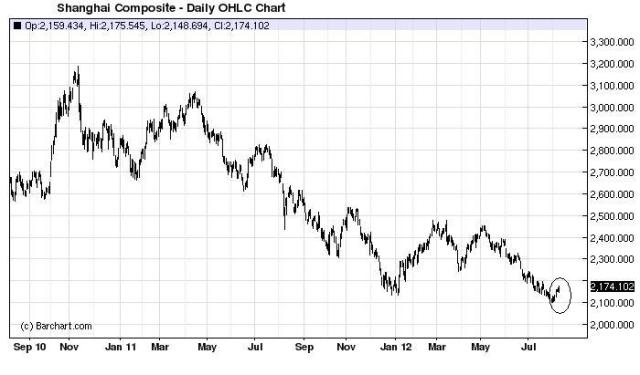
Note the bounce in the Shanghai over the past few days.  It’s still got a lot of work to do to reverse the downtrend.
(click here if chart is not observable)
Posted in China | Tagged , , , | 3 Comments

Nonlinear Thinking: Earthworm Robots

Logic will get you from A to B. Imagination will take you everywhere. – Albert Einstein.

The boys and girls at MIT, Harvard, and Seoul National University  are keeping busy.  This is truly amazing.   Here’s to imagination getting you from point A to B and places and spaces less traveled!

Earthworms creep along the ground by alternately squeezing and stretching muscles along the length of their bodies, inching forward with each wave of contractions. Snails and sea cucumbers also use this mechanism, called peristalsis, to get around, and our own gastrointestinal tracts operate by a similar action, squeezing muscles along the esophagus to push food to the stomach.

Now researchers at MIT, Harvard University and Seoul National University have engineered a soft autonomous robot that moves via peristalsis, crawling across surfaces by contracting segments of its body, much like an earthworm. The robot, made almost entirely of soft materials, is remarkably resilient: Even when stepped upon or bludgeoned with a hammer, the robot is able to inch away, unscathed.

(click here if video is not observable)

Posted in Innovation, Nonlinear Thinking, Technology | Tagged , , , | Leave a comment

Bonds Away?

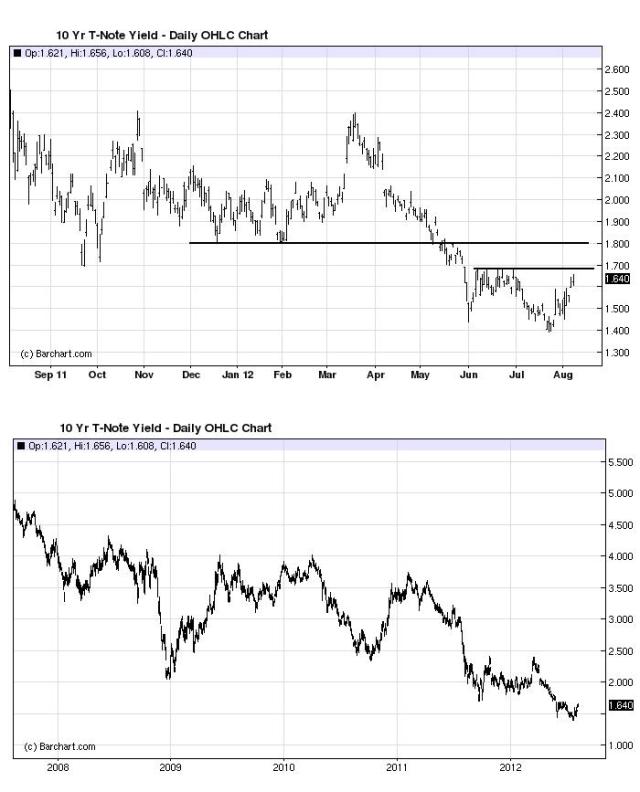
The 10-year Treasury yield is starting to bump up against some key resistance levels around 1.68-1.70 percent.   Can’t tell you what it means in these  squirrelly markets, but it is confirmation of the rally in equities.

We’re waiting for the day when the Fed has its Donnybrook with the bond market.  Thus far the central bank has been flying with the tailwinds of the fear trade helping keep interest rates at record lows.

Keep it on your radar.

(click here if chart is not observable)
Posted in Bonds | Tagged , , | Leave a comment

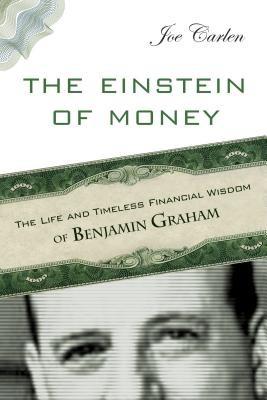
The Einstein of Money

Roger Lowenstein  has a nice review in the WSJ of Joe Carlen’s latest book,  The Einstein of Money,  about the life and times of the great value investor, Benjamin Graham.    Mr. Graham’s youngest son is a friend of this blog.

Money quotes from Mr. Lowenstein:

– The notion that the prices of stocks and bonds bear a sane relationship to their underlying value is not, at present, in high regard. Wall Street is widely said to be a betting parlor, if not an adjunct of the underworld. Its repute was even worse when Benjamin Graham published “Security Analysis,” an investment manual that urged investors to calmly dissect securities and then plunge into issues trading at a sizable discount to intrinsic value. Stocks at a discount, Graham wrote, offered a “margin of safety”—a cushion that would protect the investor from loss and, in time, assure him of a reasonable gain.

– Most famously, Graham liberated the ordinary investor from the tyranny of feeling enslaved to the market’s gyrations. In “The Intelligent Investor,” aimed at the lay reader and published in 1949, Graham wrote that the investor in stocks was like the partial owner of a business with a mercurial partner, whom Graham dubbed “Mr. Market.” “Every day he tells you what he thinks your interest is worth.” Some days Mr. Market goes overboard with enthusiasm; on others he is downright depressive. The trick is to invest only when Mr. Market offers a margin for safety—in the belief that, over the long haul, prices will revert to their intrinsic worth. “The Intelligent Investor” became a perennial favorite and, incredibly, remains among the 300 best-selling books on Amazon today (roughly on a par with “Nineteen Eighty-Four” and way ahead of “Shane,” published the same year).

– It is enough to say that, warts and all, Graham was a kind-hearted genius who articulated the cardinal distinction between investing and speculation. As Mr. Carlen underlines: “He formulated a sound system for investment, which . . . can still be productively and profitably applied seven decades after its inception.”

We just ordered a copy.   Hat tip King David!

(click here if picture is not observable)

Posted in General Interest | Tagged , , | 1 Comment

PetroBlahs

This dog has hurt us big time over the years.

So much for state-directed capitalism and one reason, in our opinion, why the markets are shitting BRICs!

Back in 2008 Goldman Sachs listed Petrobras’ share price at $60, now-a-days it commands $20 a share, and we expect that price to fall further in the coming days. The Brazilian oil giant just is not what it was.

Investors are mostly scared by the simple fact that Petrobras does not exist to make a profit for them, but rather to serve the nation in whatever way the Brazilian government sees fit. Following a multi-billion dollar secondary share offering a few years ago and government intervention capping fuel prices and therefore profit, investors are worried that the government is trying to ever increase its control in the company. 
– OilPrice.com

(click here if chart is not observable)

Posted in BRICs | Tagged , , | Leave a comment

Enter the Draghi (Plan)

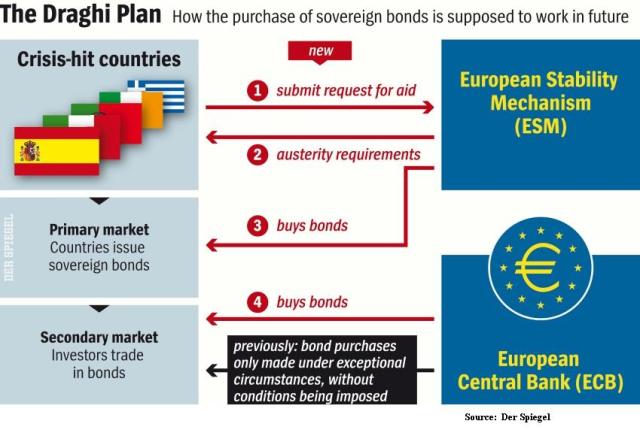
The only thing new in the “Draghi Plan”, as far as we can see,  is the potential big bazooka #4  — unsterilized (?) purchases of periphery bonds by the  ECB.

Still,  though, countries will have to submit to conditionality — fiscal consolidation, and structural adjustment.  That is,  austerity.   Is that  politically doable in Italy?   A Kiss of Death?

Furthermore, will the Germans allow debt monetization on a grand scale?

In his Bloomberg opinion piece former chief economist of the IMF, Simon Johnson,  doesn’t think so,

More likely, a shift in ECB policies would make the European situation uglier. For one, Draghi would essentially be conceding fiscal dominance, demonstrating that if governments run budget deficits, they can count on the central bank to finance them. More important, the political consequences could be dire if the ECB actually succeeded in stoking German inflation and weakening the euro.

Inflation is unpopular and very unfair. People who think that higher inflation would somehow help the poor and hard pressed in the European Union should study economic history more carefully. It could lead the Germans to question the viability of the euro, increasing the risk that the currency will break apart for political reasons. The Germans didn’t turn over their monetary sovereignty to the ECB to facilitate bailouts of irresponsible governments and the crazed banks that funded real- estate bubbles. Throwing greater fiscal transfers from Germany into the mix will serve only to worsen the situation.

Perhaps Draghi is planning the same game with fiscal authorities that the Banca d’Italia used to play with Italian politicians in the 1980s and early 1990s — keep interest rates low enough to prevent fiscal collapse, yet high enough to keep fiscal prudence as a priority. Make no mistake about it, inflation or not, this is a strategy of high real interest rates.

We’re not as lathered up on the Draghi Plan as the markets seem to be.

(click here if chart is not observable)
Posted in ECB, Euro, Italian Yields, PIIGS, Sovereign Debt, Sovereign Risk, Spain | Tagged , , , , | Leave a comment

The Times They Are a-Changin’

One in five people reach for their phone as a 21st Century replacement for the post-coital cigarette, according to a recent report from mobile security company LookOut. It’s just one more extreme example of how the smartphone has become a third wheel in relationships, says Ursula Ofman, a New York-based therapist. “People find all sorts of ways to get back to their own personal space, she says. “But clearly it’s a problem if someone wants to check their iPhone in the bedroom.”   – MarketWatch

Posted in Apple, General Interest | Tagged , | Leave a comment

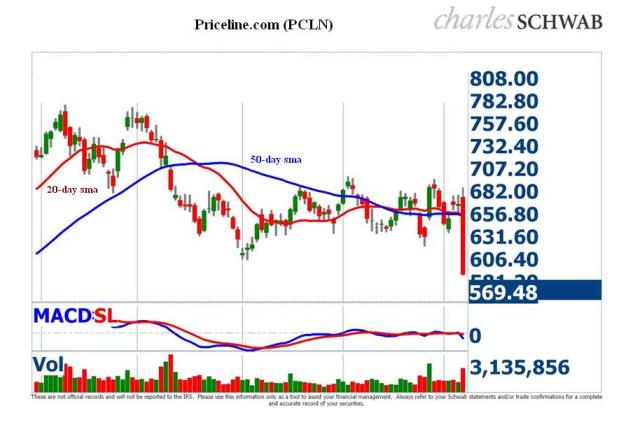
Priceline down a hundo in AH

Take a look at this daily bar (including AH trading) . Glad we’re not drinking there.

Priceline.com has fallen down the elevator shaft, dropping over $100, or about 16 percent,  in after hours after missing earnings and guiding lower.   The market has no mercy.

Just an aside,  today’s weakness in Apple and Google was notable in an up market.  When the generals lag,  we get nervous, or, should we say, more nervous ‘cuz we’re always nervous.

The market feels a bit tired here and couldn’t close near its high again today.

(click here if chart is not observable)
Posted in Apple, Earnings, Equities | Tagged , , | Leave a comment

Factoid of the Day: The New Energy Hogs

A single Google search takes about as much power as turning on a 60 watt light bulb for 17 seconds, and server farms now use at least 1.5 percent of the world’s electricity.    –  Popular Science

Posted in Energy, Technology | Tagged , , | 3 Comments

China: The SIC BRIC

Great Ted talk titled,  Behind the Great Firewall of China.  China has 500 million internet users so it’s worth a listen.

Michael Anti (aka Jing Zhao) has been blogging from China for 12 years. Despite the control the central government has over the Internet — “All the servers are in Beijing” — he says that hundreds of millions of microbloggers are in fact creating the first national public sphere in the country’s history, and shifting the balance of power in unexpected ways.

(click here if video is not observable)

Posted in China, Technology | Tagged , , , , | Leave a comment
