Masters Week: Phil for Four

You have to admire Phil for not giving up after his horrendous opening round on Thursday that put him 7 behind the lead.  We’ll never forget his post round interview on Thursday as a guy determined not to let a bad day get him down and fully confident that he’d be there on Sunday.   He’s there.  The legend grows.

Click here for today’s highlights.

Though one stroke back it looks like William Hill has all but given Phil the Green Jacket.  Here are the latest odds:

Mickelson      6/4
Hanson          7/2
Oosthuizen  11/2
B. Watson     8/1
Westwood  16/1
Kucher       16/1
Manhan     25/1
Harington 28/1
Stenson    40/1
Mcllroy    100/1

Did you know the only professional golfers who are members of Augusta are Jack Nicklaus, Arnold Palmer and John Harris?

Here are some more interesting little known facts about the Masters from David Owen’s The Making Of The Masters courtesy courtesy of Golf Digest:

1)  “The Masters” was coined by Clifford Roberts in 1938 (used starting in 1939), though Bobby Jones was never a fan — referencing to the tournament as late as 1963 as “the so-called Masters.”

2) The building of Augusta National almost never happened, and it remained an economic burden through World War II: Founded at the beginning of the Great Depression, the original business plan called for 1,800 members, but when the first Masters was held in 1934, the club only had 76 paying members. The club couldn’t afford to pay the first winner, Horton Smith (pictured), or any of the top finishers until 17 members chipped in for the purse. In 1946, the delivery of the winner’s plaque to Herman Keiser was delayed to give time for the club and its members to pay for the silver.

3) Famed golf course architect and Augusta designer Alister MacKenzie died before the grass had been planted — never playing or seeing the course in its finished form.

4) Jones and Roberts originally petitioned the USGA to host the 1934 US Open, and only after it was rejected did they decide to host their own annual tournament — which the PGA officially listed unnamed for the first time in a brief note in their 1934 schedule as one of “four tournaments already scheduled for the spring season at… Augusta National Golf Course, March 22, 23, 24 and 25 … Details of these events will be given once completed.”

5) Augusta originally planned to have a 19th hole, at the request of Bobby Jones. The idea was to have an extra hole so a losing golfer could have an another opportunity to win back his money in a game of double or nothing. It was to be 90-yards long, uphill towards the clubhouse between the 9th and 18th greens. The idea was dropped partly because of economic reasons and partly because it would impede the view to the 18th green for patrons watching the Masters.

6) In 1937 Augusta played host to the first PGA Seniors Championship and played a decisive role in creating what is now the Champions Tour. The seniors division of the PGA was established at a meeting of aged professionals held at an Augusta hotel, and the course held the tournament for two years — the winners being Jock Hutchison and Fred McLeod respectively — before it found a sponsor and moved to Florida.

 7) While now just as iconic as the tournament itself, the green jacket awarded to the Masters winner was originally intended to be an “usher’s coat,” so to speak. In 1937, members of the club decided to wear green jackets during the tournament so that fans in attendance could easily spot them if they needed to ask questions.

 8) Inspired by the building of the Baseball Hall of Fame, Jones, and Roberts especially, looked to build a golf hall of fame at Augusta, featuring a full miniature version of Augusta, a movie wing, replicas of the books in the library and a driving range. The plan was scrapped because of the start of World War II.

9) Despite attempts to keep the club open during World War II, Augusta was forced to close in October of 1942. To make money, they used the land to raise cattle and turkey. Toward the end of 1943 Augusta housed over 200 cattle and 1,400 turkeys. The turkeys turned a profit, but with a ceiling on the price of turkey, the high cost of beef, and the cost of repairing the course after the animals grazing made the project a make-even at best endeavor. The course reopened again on Dec 23, 1944.

10) The Masters was the first tournament to host a 72-hole competition over four days. It was the first to have room to park thousands of cars. It was the first to offer free daily pairing sheets instead of a program. It was the first tournament to be covered nationwide on radio. It was the first to use bleachers. It was the first to use rope galleries, and the first to use private detectives to handle ticket sales and security. It developed the first on-course scoreboard. And it was the first to use the over/under par system we generally use today.

 11) Roberts also directed CBS television crews to show updates of the score by using the scoreboard instead of having the announcers verbalize the leader board. This also had a hand in permanently implementing the over/under system, largely in part because showing the scores in red and green could not be differentiated on black and white televisions.

(click here if picture and video are  not observable)

Posted in Sports | Tagged , , , | Leave a comment

Nonlinear Thinking: The Future of the Auto Industry?

George Jetson and Elroy have arrived!

(click here if video is not observable)

Posted in Nonlinear Thinking | Tagged , | Leave a comment

Masters Week: Boom Boom!

Tomorrow is moving day and it will be interesting.

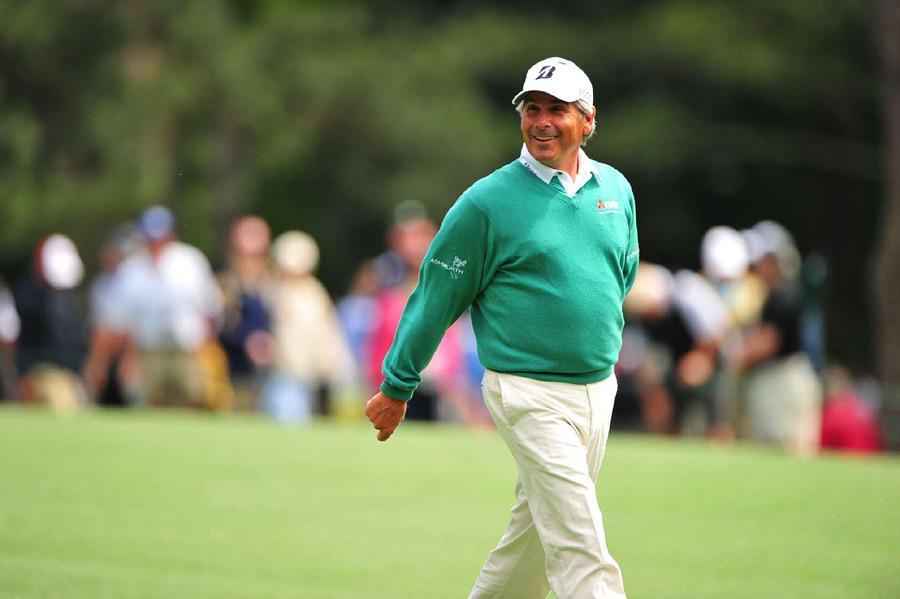
As Phil said after his round the traffic jam on leaderboard will continue unless the course or conditions toughen up.  No player has broken away from the pack as sixteen golfers are within 3 shots of co-leaders,  Fred ‘Boom Boom” Couple and Jason Dufner.  Click here for today’s highlights.

Now for some great stats and photos of Boom Boom, the Baby Bull, and Bubba courtesy of Golf.com,

1) The 642 players who have made the cut at the Masters since 1997 have averaged just 3.26 three-putts for the 72-hole tournament. The last 13 champions have averaged 2.15 three-putts, with Tiger Woods in 1997 and Jose Maria Olazabal in 1999 going all 72 holes without a single three-putt. The most by a winner was Zach Johnson (pictured) with 6 three-putts in 2007.

2) It’s a common perception that Masters champions have to overpower the par 5s. Since 1997, that has been true for Tiger Woods, Vijay Singh, Phil Mickelson, Trevor Immelman and Angel Cabrera. But Mark O’Meara won in 1998 as the 31st-longest driver, averaging 266.6 yards. Jose Maria Olazabal averaged just 239.8 yards per drive in 1999, second-to-last in the field. In 2003, Mike Weir (pictured) averaged 271.2 yards, 39th, and Zach Johnson in 2007 averaged 265.0 yards — only three players were shorter. But he was still 11 under on the par 5s.

3) In the history of the Masters, 16 champions have won a second major in the same year. Since 1997, it has happened three times — in 1998 Mark O’Meara won the British Open, in 2002 Tiger Woods won the U.S. Open, and in 2005 Woods won the British Open.

(click here if pictures and video are not observable)

Posted in Sports | Tagged , , , , | Leave a comment

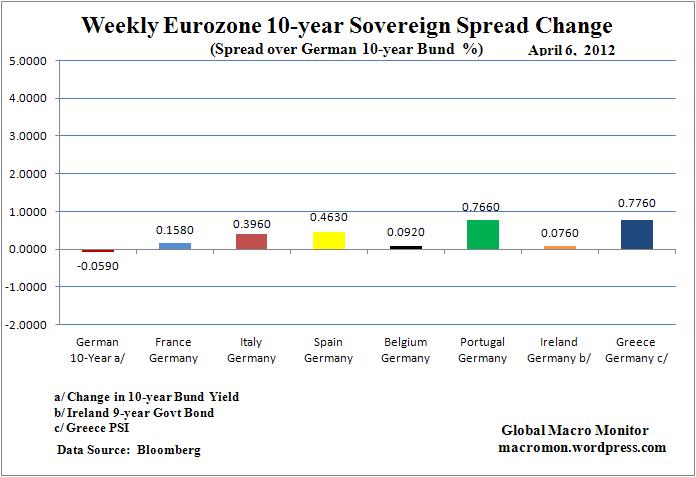
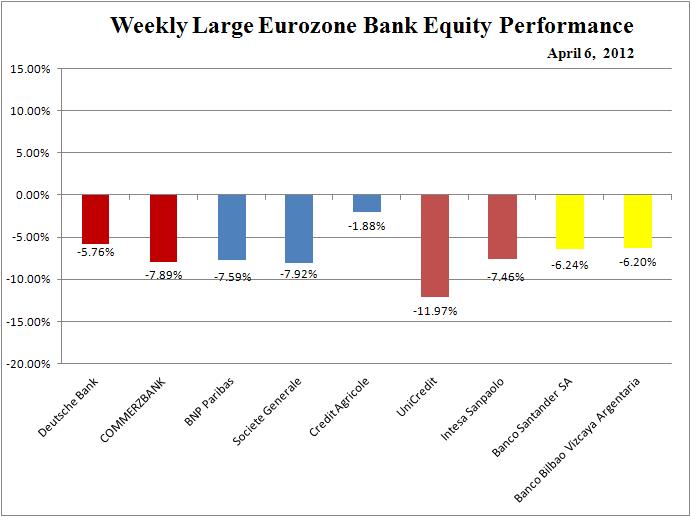
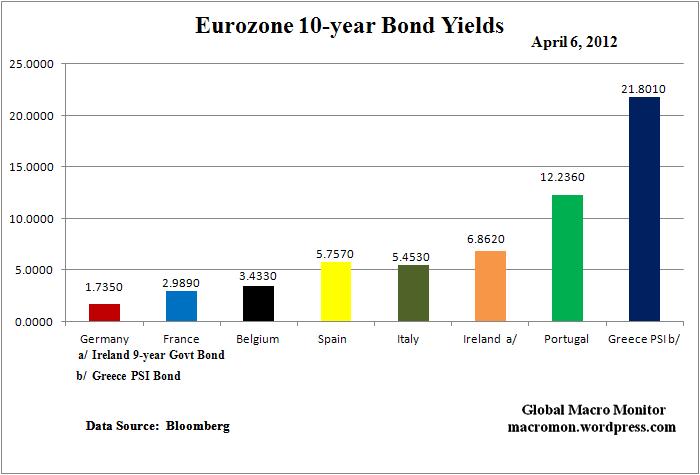
Weekly Eurozone Watch: Spreads Blow Out, Banks Tank

(click here if charts are not observable)

Posted in Weekly Eurozone Watch | Tagged , , , , , , , | Leave a comment

U.S. Employment Situation – March 2012

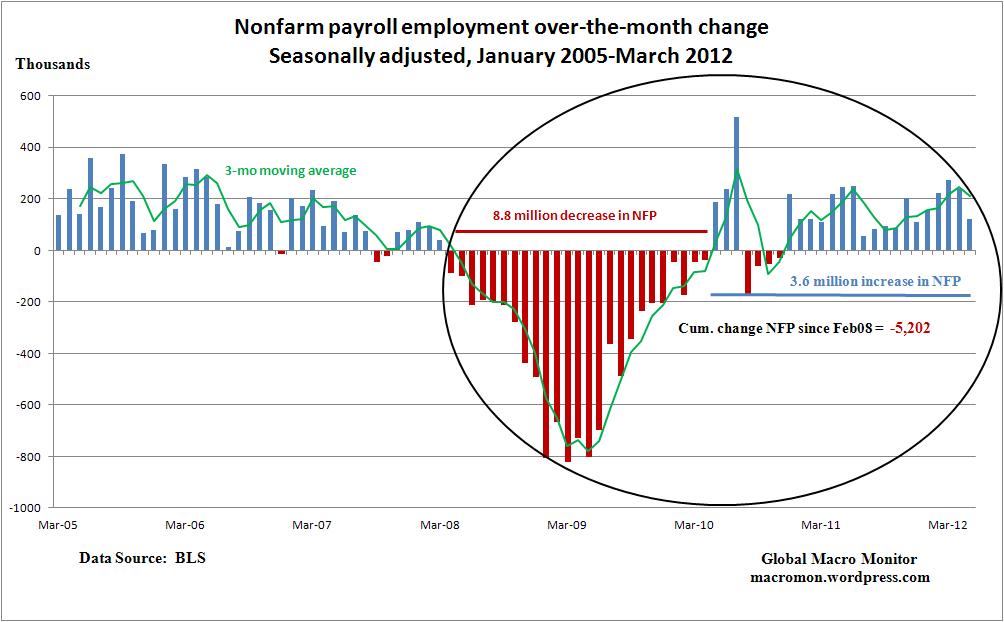
Nonfarm payrolls disappointed in March, posting a 120K increase.   Retail took a huge hit, losing 34K jobs and the construction industry, traditionally the lead driver out of recession, has yet to gain any real traction in creating jobs.

The BLS release notes,

Nonfarm payroll employment rose by 120,000 in March, and the unemployment rate was little changed at 8.2 percent, the U.S. Bureau of Labor Statistics reported today. Employment rose in manufacturing, food services and drinking places, and health care, but was down in retail trade.

The economy has a long way to go in recovering the 8.8 million jobs lost during the financial/economic crisis.  Even with the 3.6 million gain in NFP since March 2010,  cumulative job creation since February 2008 is still a hugely negative 5.2 million.   Moving in the right direction, yes,  but not even close to claiming victory.

(click here if charts are not observable)

Posted in Employment | Tagged , , , , , | 1 Comment

Masters Week: Westie!

Lee Westwood shot 5 under par today to take a one shot lead in the first round of the 2012 Masters.   Our man, Adam Scott, was 4 over par after the first seven holes but managed to settle down to finish at 3 over and is still in it.  We’re not cutting our Adam Scott position just yet but won’t cry if Westie holds on to win his first major.   Love that guy!

Click here for today’s highlights.

We were surprised at the way Augusta National set up the course year.   Check it out, courtesy of the BBC!  😉     The new IBM commercial airing this year is also pretty cool.

(click here if videos are not observable)

Posted in General Interest, Sports | Tagged , , , , , | Leave a comment

Energy’s Grand Divergence

Take a look at the long-term charts of crude oil and natural gas.  The historical oil-to-gas price ratio had ranged from 6:1 to 10:1 before the economic crisis.  Since one barrel of oil contains the energy equivalent of the 5.825 million BTU of natural gas, an implied BTU arbitrage kept this relationship in check.

Spot natural gas traded as low 1.905 earlier in the week implying an energy equivalent price of a barrel of crude oil of $11.10.  Spot crude closed at $105.23 on the same day.

Such a sustained divergence caused by new extraction technologies, such as fracking, is sparking the next “new big thing” as industries evolve to arbitrage the energy content of both fuels.  The market sniffs this and the reason the stocks of Westport Innovations,  Clean Energy Fuels, and Cheniere Energy have been flying.

(click here if chart is not observable)

Posted in Crude Oil, Energy, Innovation | Tagged , , , , , , | 2 Comments

Masters Week: “This Guy Is Pretty Good”

“He’s picked out a landing spot which is a good 25 feet above the hole……..Well, here it comes…… Oh my goodness!… Oh wow!… In your life have you seen anything so good!”

(click here if video is not observable)

Posted in Sports | Tagged , , , , | 1 Comment

Markets Want More FED “Crack” – Harry Dent

Harry Dent does a pretty good job in ‘splaining today’s risk sell-off, in our opinion.

We’re beginning to sense, however, the markets are awakening to the fact the U.S. government is going to have a funding problem. As the world contemplates a fading FED bid for U.S. government debt, who, may we ask, will step up to buy Treasuries and fund the U.S. budget deficit at such repressed and negative real interest rates?

Foreign capital flows? China and Japan’s current account surplus’ are shrinking, which, by the way, is having a negative impact on gold.

Petrodollars? Possibly, but oil has to remain elevated, which is risk negative.

Flight to quality? Could be, but doesn’t that require a negative story for risk assets?

Interestingly the 10-year bond rate moved only 4 bps lower with such a relatively large equity sell-off. Some traders conclude this is a good sign for Mr. Risk. Maybe, but keep our alternative scenario on the radar. Higher or stubborn interest rates and lower equity prices will be the indicator species to confirm our worries.

The Treasury market needs to reprice to levels, which reflect and incorporate inflationary, credit, and FX risks, making it an attractive asset class to sane investors. The Congress and Administration better get busy in dealing with the country’s structural budget and debt problems or Mr. Market will force the issue.

This doesn’t mean balancing the budget overnight but, at the very least, starting to focus on the political untouchables, such as Medicare, public pensions, and the solvency of Social Security.

We leave you with these three thoughts: 1) Greece is not a one-off but a symptom of a wider global sovereign debt and fiscal crisis, which will manifest in other countries, even those with independent central banks; 2) “confidence is a very fragile thing”; and 3) “in economics, things take longer to happen than you think they will, and then they happen faster than you thought they could.”

(click here if video is not observable) 

Vodpod videos no longer available.

Posted in Black Swan Watch, Budget Deficit, Gold, Japan, Monetary Policy, Sovereign Debt, Sovereign Risk | Tagged , , , , , , | Leave a comment

Masters Week: The Cost of Hitting Driver

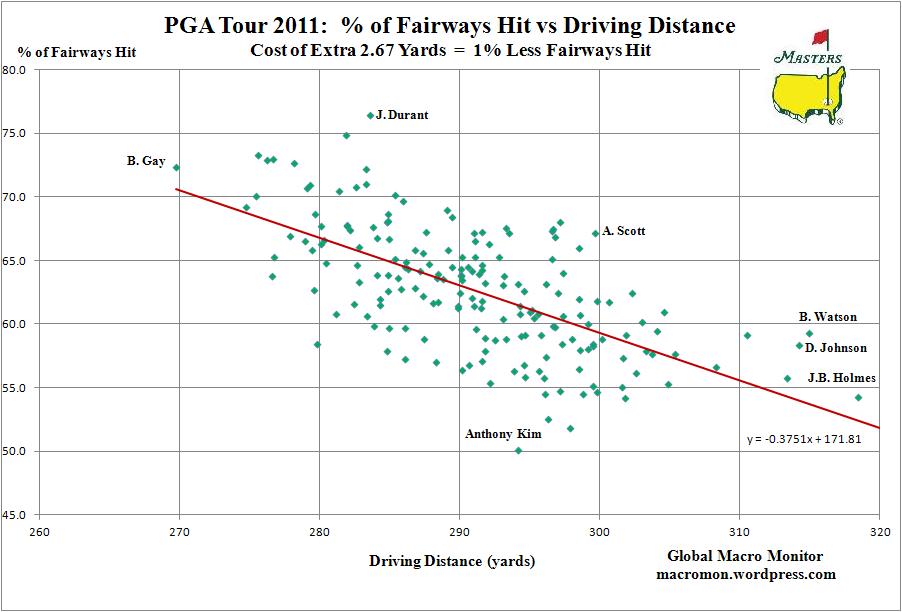
Here’s a little golf economics.   After all, economics is just the study of how people make choices at the micro or macro level.  This includes the analysis of how professional golfers make the choice to either step on their driver for extra distance or to throttle it back with hope of hitting more fairways.

To quantify the trade-off of driving distance versus accuracy we use the 2011 PGA Tour data of percentage of fairways hit and driving distance.    Intuitively,  and experience tells us, there’s a trade-off of bombing a 300 yard drive and the probability of hitting the fairway.  A good friend always reminds us of this when we pull out driver and gird ourselves to grip it and rip it, “the woods are full of long hitters.”

The data confirms our suspicions and is illustrated in the chart below.

To better understand the distance versus accuracy trade-off, let’s assume a fictional player,  Mr.  PG A. Tour.  Mr. Tour’s stats are equivalent to the average of the all 186 PGA Tour players ranked by driving distance and accuracy last year.

Mr. Tour enters the Masters and now has to decide how often he hits driver or pulls out, say, a 7-iron, which will insure he hits 100% of the fairways with an average driving distance of 171.81 yards.

Crunching the numbers, which is reflected in the red trend line,  shows that, on average, for every additional 27 yards of distance off the tee, Mr. Tour will hit 10 percent less fairways!    That is,  he can choose to hit a 7-iron and average 172 yards off the tee and be in the fairway 100 percent of the time or hit a driver 300 yards and hit only 59 percent of the fairways.   

So there you have it, folks,  the woods are full of long hitters!   J.B. Holmes, the number one in driving distance on the 2011 PGA Tour,  for example,  hit the fairway only 54 percent of the time.  Whereas,  Brain Gay, the shortest in driving distance hit 72 percent of the fairways.

Our take away for the Masters?  Adam Scott is an outlier and his numbers look good to us, averaging 300 yards off the tee and hitting the fairway 67 percent of the time.   Furthermore, his new caddie,  Steve Williams,  who has won three times with Tiger at Augusta, should give him added confidence this week.   At 35:1, he’s our man and pick to don the Green Jacket this Easter Sunday in Augusta!

(click here if chart is not observable)

Posted in Sports | Tagged , , , , , , | 3 Comments