Nonlinear Thinking: The Future of Medical Services

This is one of the most potentially transformative,  disruptive, and exciting technologies we’ve come across in some time. 

Qualcomm has teamed up with the X PRIZE Foundation to promote innovation and integration of precision diagnostic technologies.   They’re offering $10 million in prize money to the team of entreprenuers who create a mobile device which is easy for individuals to use and is capable of capturing key health metrics and diagnosing a set of 15 diseases

Qualcomm further defines the concept and competition on their website,

Advances in fields such as artificial intelligence, wireless sensing, imaging diagnostics, lab-on-a-chip, and molecular biology will enable better choices in when, where, and how individuals receive care, thus making healthcare more convenient, affordable, and accessible. The winner will be the team whose technology most accurately diagnoses a set of diseases independent of a healthcare professional or facility, and that provides the best consumer user experience with their device.

The Prize: Empowering Personal Healthcare

As envisioned for this competition, the device will be a tool capable of capturing key health metrics and diagnosing a set of 15 diseases. Metrics for health could include such elements as blood pressure, respiratory rate, and temperature. Ultimately, this tool will collect large volumes of data from ongoing measurement of health states through a combination of wireless sensors, imaging technologies, and portable, non-invasive laboratory replacements.

Given that each team will take its own approach to design and functionality, the device’s physical appearance and functionality may vary immensely from team to team. Indeed, the only stated limit on form is that the mass of its components together must be no greater than five pounds. But because an important part of the qualifying round will be evaluating consumer experience in using it, the limitations set by this competition will force teams to make choices. Teams will have to consider tradeoffs amongst weight, functionality, power requirements, battery life, screen resolution, AI engine location, diagnosis capability, end consumer cost, and so on.

Beyond the weight requirement, there is no limit as to how many discrete components constitute a viable solution. For example, teams may use sensors that are attached to a phone-like control unit, fastened individually to the consumer, or kept apart and reserved for occasional use or home monitoring. Similarly, teams may create a tool that has a large screen, a small screen, or perhaps even no screen (audio only). Systems must include a way for consumers to store and share their information, which must be accessible remotely via the Internet. Additionally, teams are expected to follow guidelines and protocols that help ensure that consumer safety is held in the highest regard. This includes avoiding harm from electrical energy, thermal energy, chemical exposures, needles, lancets, and infection.

Think about the far reaching impact such a device will have on the economy and society at large.  We have no doubt that Dr. iPad will be making house calls in the next few years.  Simply amazing!

(click here if videos are not observable)
Posted in Apple, Nonlinear Thinking | Tagged , , , | 2 Comments

Rajoy seeks to calm investor nerves in Spain

(click here if video is not observable)

Posted in Euro, PIIGS, Sovereign Debt, Sovereign Risk | Tagged , , | Leave a comment

TR50: The 50 Most Innovative Companies (21-25)

Here are 21-25 of MIT’s Technology Review’s 50 Most Innovative Companies in 2011.  We’re posting in increments of five every few days as not to overwhelm you with info and required reading.

Click here for 1-5 of TR’s most innovative companies of 2011;
Click here for 6-10 of TR’s most innovative companies of 2011;
Click here for 11-15 of TR’s most innovative companies of 2011;
Click here for 16-20 of TR’s most innovative companies of 2011.

Technology Review uses the following criteria to choose the most innovative companies,

What is a TR50 company?   It is a business whose innovations force other businesses to alter their strategic course. TR50 members are nominated by Technology Review’s editors, who look for companies that over the last year have demonstrated original and valuable technology, are bringing that technology to market at a significant scale, and are clearly influencing their competitors.

21)   Healthpoint Services
Why:
It is using telemedicine techniques to deliver health care to rural India.
Key innovation:
Its network of eight centers brings advanced telemedicine systems to patients.

22)  IBM
Why: 
Its flexible artificial-­intelligence systems have the potential to assist people in many areas, such as health care.
Key innovation:
  Watson, which demonstrated its capability by beating skilled human quiz-show players, learned by automatically digesting text from books and websites, an ability that could be adapted to any area of knowledge.

23)   Integrated Diagnostics
Why:
By reducing the cost of diagnostic tests, it has allowed the monitoring of more disease markers.
Key innovation:
Its synthetic antibodies replace more expensive antibodies widely used in diagnostics.

24)   Intel
Why:
Has reinvented ­transistor architecture as it continues to shrink the size of devices on a chip.
Key innovation:
Its 3-D transistors will be used in a new generation of 22-nanometer chips.

25)   LanzaTech
Why:
Makes fuel and chemicals from the carbon monoxide produced by processes such as steelmaking.
Key innovation:
Genetically engineered organisms turn the gas into ethanol and other useful chemicals.

TR – (1-5)
TR – (6-10)
TR – (11-15)
TR – (16-20)

Posted in Innovation, Technology | Tagged , | Leave a comment

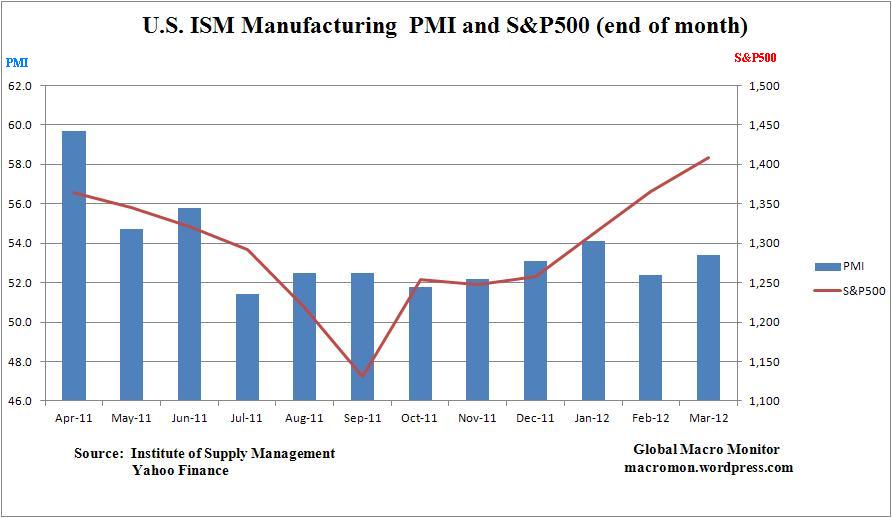
U.S. Manufacturing Surprises to the Upside

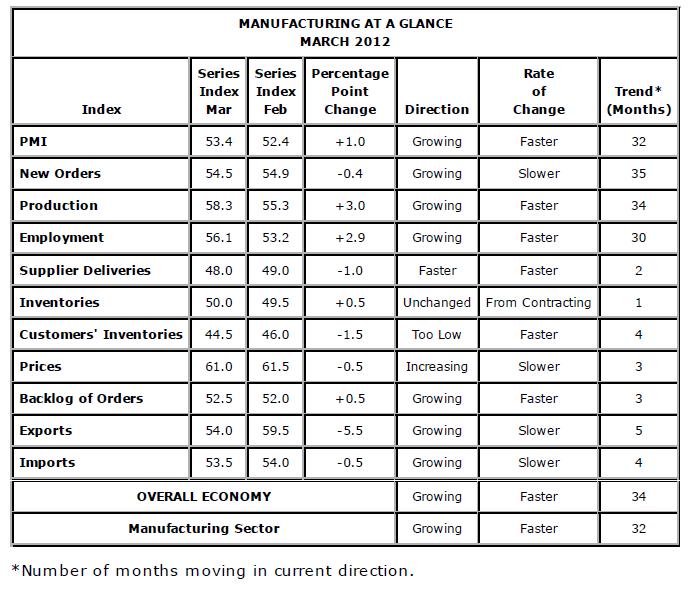
The Institute for Supply Management (ISM), the US purchasing managers’ index (PMI) for March increased to 53.4 from 52.4 in February, beating expectations of 53.  It’s the 32nd consecutive month that the index has been at least 50.

The ISM notes,

A PMI in excess of 42.6 percent, over a period of time, generally indicates an expansion of the overall economy. Therefore, the PMI indicates growth for the 34th consecutive month in the overall economy, as well as expansion in the manufacturing sector for the 32nd consecutive month. Holcomb stated, “The past relationship between the PMI and the overall economy indicates that the average PMI for January through March (53.3 percent) corresponds to a 3.6 percent increase in real gross domestic product (GDP). In addition, if the PMI for March (53.4 percent) is annualized, it corresponds to a 3.7 percent increase in real GDP annually.”

Party on,  Garth!

(click here if table and chart are not observable)

Posted in Economics, PMIs | Tagged , , | 2 Comments

Masters Week: Some History

Some great video footage of the Masters Golf Tournament narrated by Alistair Cooke.

Be patient with video quality.  Remember, they were back in the days of the shoulder of the technological innovation curve.

(click here if videos are not observable)
Posted in Sports, Video | Tagged , , | Leave a comment

Dr. Copper Breaks Out…

…of its pennant or descending triangle formation,  depending on how fat you draw the trend lines.   We’re still not convinced until it closes above the February 3.9950 high.   Nevertheless, the markets want to believe and confirmation from the good doctor helps stir the animal spirits that drive risk markets.

(click here if chart is not observable)

Posted in Commodities, Equities | Tagged , | Leave a comment

Good Perspective on China’s Dueling PMIs

Good stuff at European CNBC this morning.  The markets had their doubts on China’s conflicting PMIs early this morning, especially after the Eurozone PMI confirmed weakness.   Didn’t last long, however, after U.S. ISM manufacturing came in better than expected, boosting the S&P500, which closed at a post-crash high, led, of course, by Apple.

Fenby’s says the PBOC thinks had a great year in 2011 in slowing the economy.

Chris Patten, the last British governorof Hong Kong,  praises Fenby’s new book about China’s economy,  Tiger Head, Snake Tails.   Click here for Patten’s review in the FT.

Jonathan Fenby, head of China research at Trusted Sources, told CNBC, “small companies in China are under a lot of pressure there is no doubt, it is access to credit but is also that wages are going up and the minimum wage in China is being increased by 20 percent a year.”

(click here if video is not observable)

Vodpod videos no longer available.

Fenby on China, posted with vodpod
Posted in Black Swan Watch, China | Tagged , , , , , , , | 1 Comment

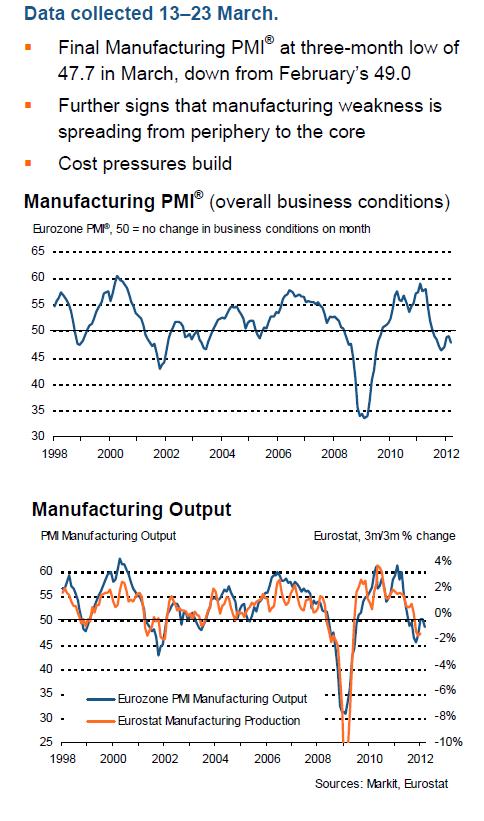
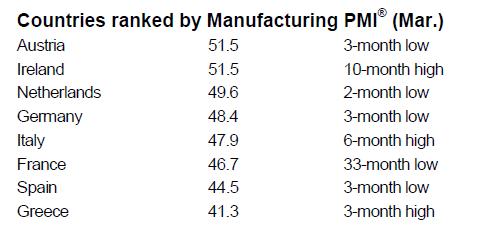
Eurozone manufacturing slump worsens in March – Markit

(click here if charts are not observable)

Posted in Economics, Euro, Manufacturing, PMIs | Tagged | Leave a comment

Masters Week: What Drives the Prize Money?

It’s one of our favorite times of the year.  Masters Week!

The first of golf’s four major tournaments will tee it up on Thursday in Augusta and we’ll be posting some  factoids, data, video and Masters trivia.

We start with some  interesting data on how the winners paycheck has evolved since Horton Smith won the first Masters in 1934 taking home a paycheck of $1,500, which in today’s dollars is equivalent to $25.5K.   Stunning to think that Ben Hogan’s winnings for his 1951 victory, even after adjusting for inflation — $26.5K — was less than what a Wall Street administrative assistant takes home today as an annual bonus.   Guess the country had different priorities back in the early 1950’s, no?

Jack Nicklaus’  17 under par victory in 1965 pocketed him only $145K (2012 dollars) compared to the this year’s winner’s share of $1.5 million.   You think these guys feel they played in the wrong era?

Also take a look at the chart.  It seems to us the real growth in the Masters winning purse has taken place during equity bull markets.  This makes sense as ultimately the corporate sponsors foot the bill and feel more flush as their stocks are rising, or, should we say are flush causing their stocks to rise.

Conversely,  the data also seem to suggest inflation and bear markets have picked the pockets of those who have donned the Green Jacket.    Don’t they say inflation is the cruelest tax!

(click here if table and chart are not observable)

Posted in General Interest, Sports | Tagged , , , , | 1 Comment

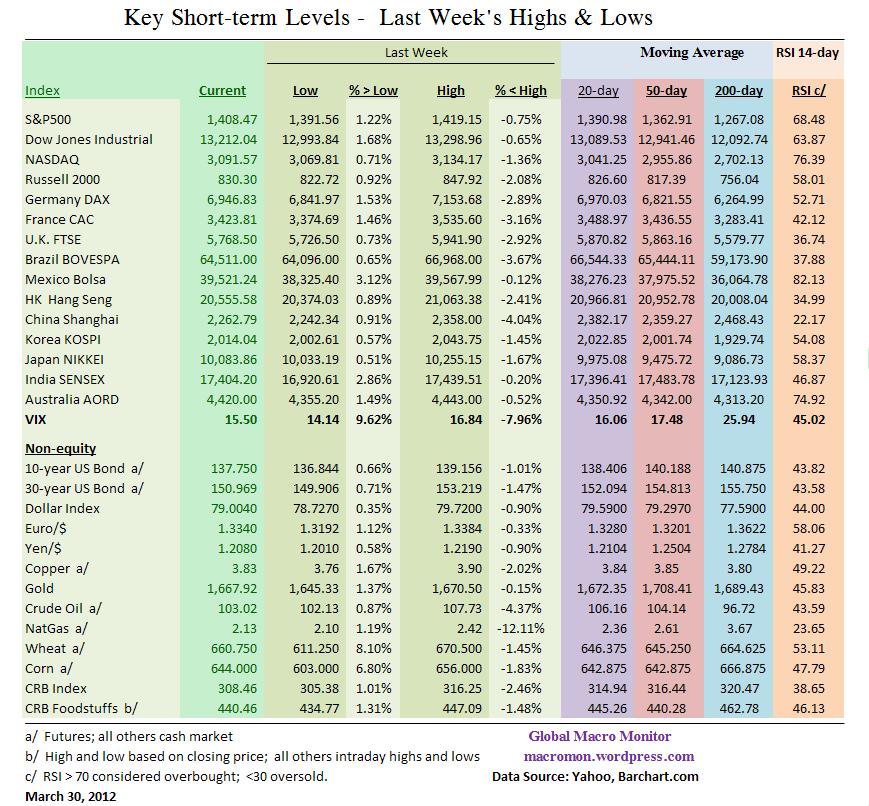
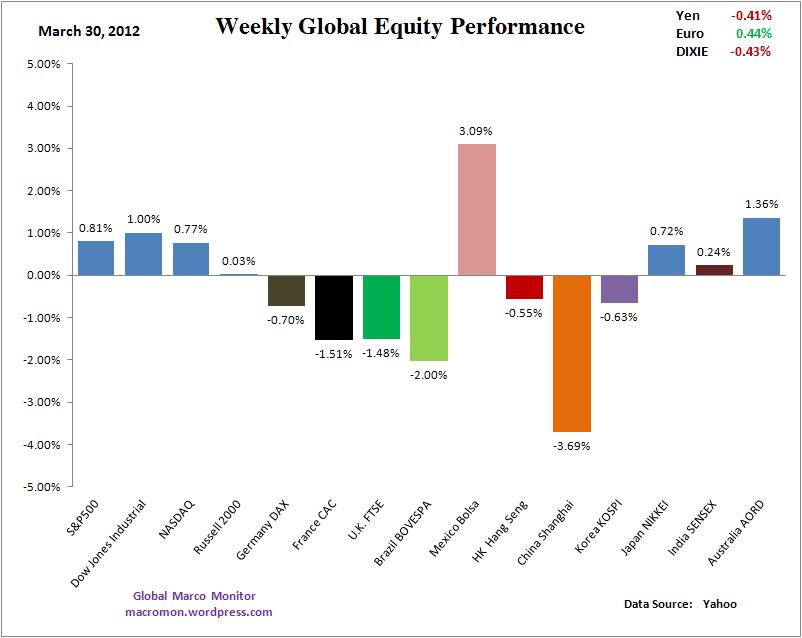
Week in Review

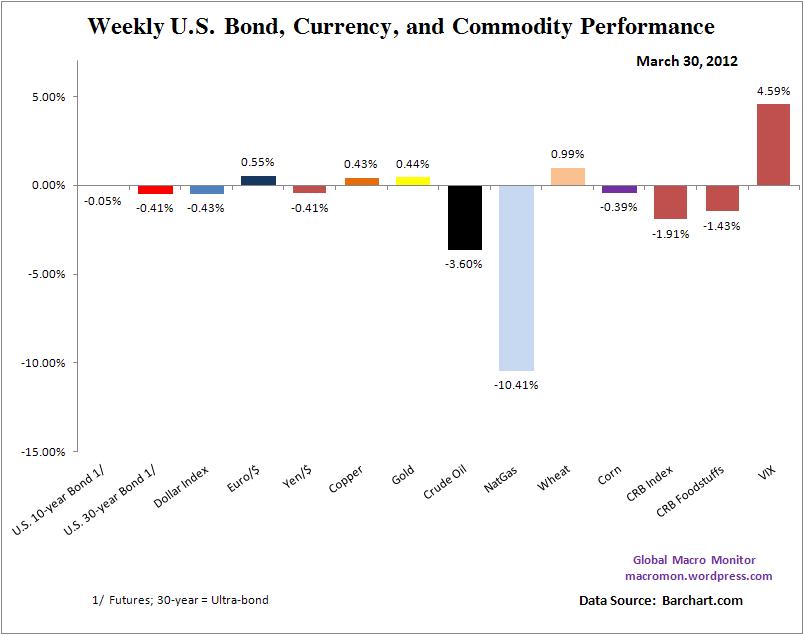
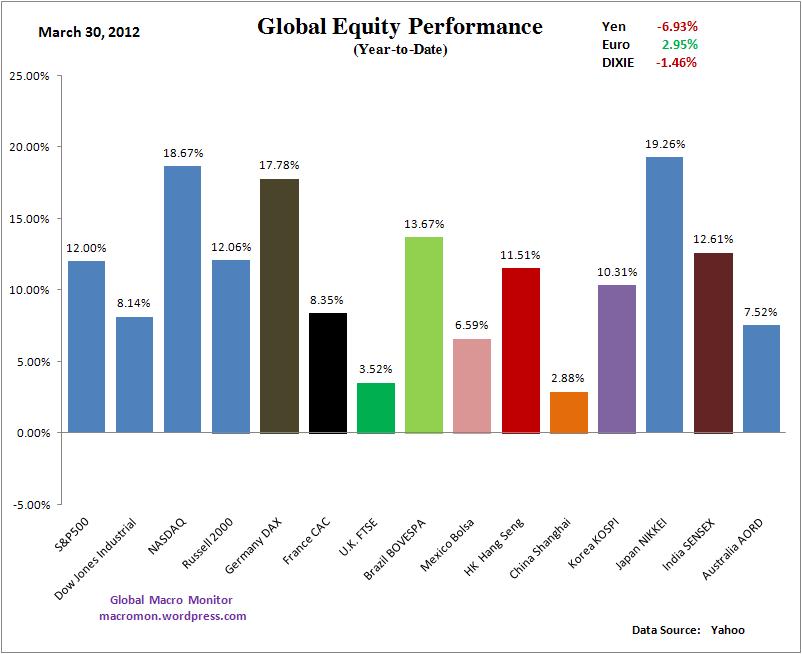
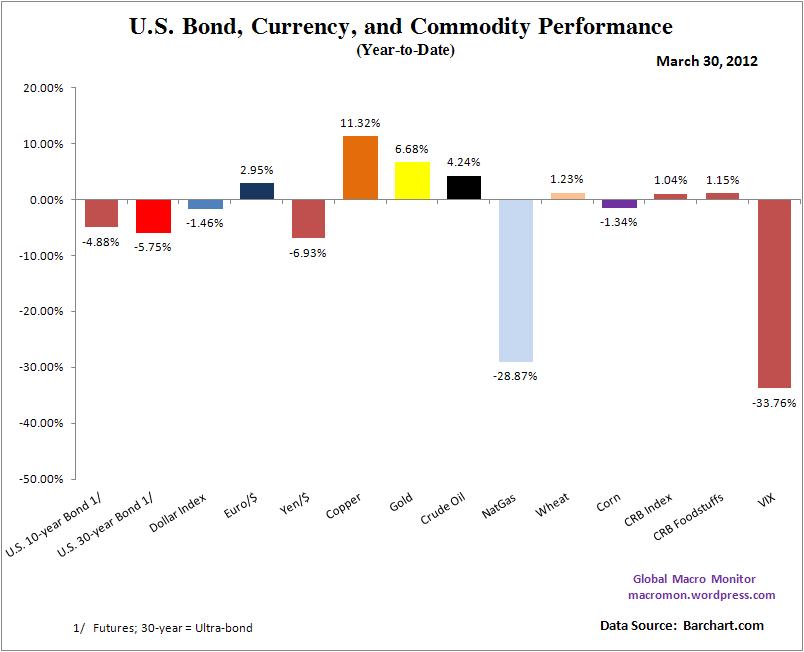
(click here if charts are not observable)

Posted in Week in Review | Tagged , , , , , , , | 1 Comment