Greece’s Human Capital Flight

(click here if video is not observable)

Posted in Black Swan Watch, Employment, Euro, PIIGS, Policy, Sovereign Debt | Tagged , , , | 2 Comments

Global Trend Indicators

(click here if tables are not observable)

Posted in Global Trend Indicators | Tagged , , , , , , , | 2 Comments

Stratfor: Mexico’s Presidential Election

(click here if video is not observable)
Posted in Geopolitical, Politics | Tagged , | Leave a comment

China’s Dueling PMIs: Official Expands, HSBC Contracts

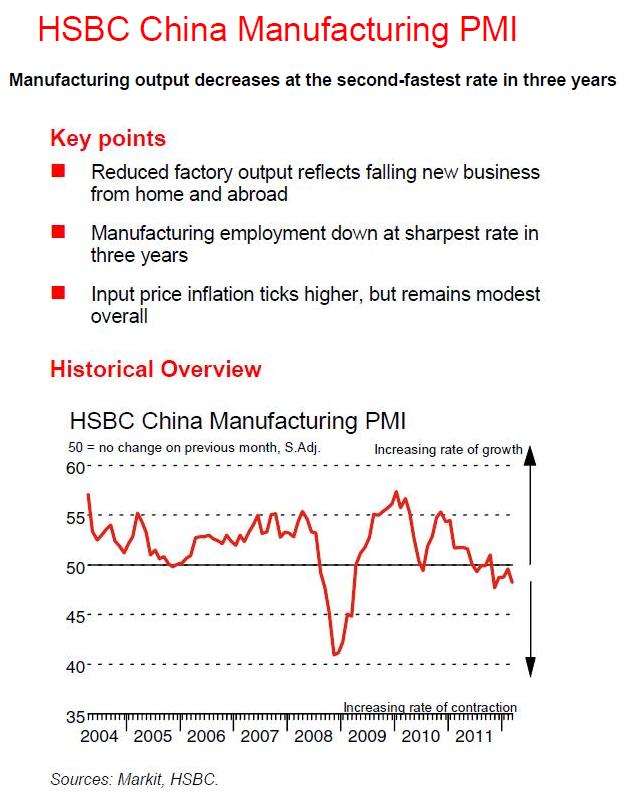
The markets must make a choice on Monday as to what China Purchasing Managers’ Index — official or the HSBC — they want to focus on and believe.

The official data released  today by National Bureau of Statistics shows the Purchasing Managers’ Index (PMI)  expanding to an 11-month high of 53.1 in March from 51 in February, beating forecasts of 50.5.

The HSBC PMI was also released today and came in very weak at 48.3 in March, down from 49.6 and the fifth successive month-on-month deterioration in manufacturing.  The report notes for the first quarter as a whole, the index averaged its lowest reading since Q1 2009.

We’re not China specialists but we assume the HSBC seasonally adjusts the data and apparently gives more weight to trends in the export sector.   Zhang Liqun, a researcher with the Development Research Centre of the State Council did seem to recognize the conflict with official data,

We would need to analyze the discrepancy between the PMI and the actual state of the economy.

We do know which data the market cheerleaders will be looking at and touting the no hard landing mantra,  but many were also expecting or hopeful of more monetary easing over out of China this weekend,  which the official data just doesn’t seem to confirm and give the PBOC cover.

Thus, with China’s growth prospects, at best, ambiguous if the official data can be trusted at all, coupled with no monetary move,  shouldn’t markets be disappointed on Monday? Are they not efficient?    Or is this just our confirmation bias because we’re closet China panda bears?

What we have to get right as traders is not how we view the data, but how we think the market will perceive the data.   The Keynesian beauty contest.  That’s what makes this business so difficult.  Stay tuned.

(click here if chart is not observable)

Posted in Black Swan Watch, BRICs, China | Tagged , , , | 3 Comments

Happy New Year, Fools!

It seems nobody knows for sure the true origins of why we do the things we do on April Fools’ Day.   We’re commoners so we’ll go with the commonly held view that the April 1st informal holiday has its origin in the change from the Julian to the Gregorian calendar in 1582.

Here is some great history from HubPages and a BBC report (see video)  voted as the greatest April Fools prank/joke of all-time!  Spaghetti grown on trees?  Yummy!

April Fools’ Day, aka All Fools’ Day, is observed in many countries throughout the world on April 1 as a day of practical jokes, harmless pranks, hoaxes and just all around tomfoolery. However its origin remains a mystery.

Traditionally the most common theory is it originated in the 1500s when parts of Europe, particularly France, began using the Gregorian calendar in 1582 by edit of Pope Gregory XIII to replace the long-established Julian calendar. The Julian calendar observed New Year’s Day on or around April 1 which coincided with the vernal equinox which signifies the beginning of spring. The Gregorian calendar which is still in use today designated January 1 to be New Year’s Day. As the new calendar began to be adopted throughout Europe many of the populace, particularly rural peasants, refused to accept the new date, or did not learn about it, and continued to celebrate New Year’s Day on April 1. These traditionalist holdouts began to be mocked as fools and were taunted by pranks such as sending them on “fool’s errands” or trying to trick them into believing something false.

The problem with this theory is there are records of April Fools’ being practiced prior to that period of time though the records are quite ambiguous to truly pinpoint an origin. Many of the ancient cultures had springtime festivals to celebrate the end of winter and the return of spring. These festivals were called “renewal festivals” by anthropologists. Though these festivals had different references with many of them based on mythology and not all of them were in the springtime they all were celebrations of merriment and frivolities. There is no true connection between these festivals and April Fools’ though April Fools’ Day may have been derived from these festivals.

Ancient festivals with possible correlations to April Fools’ Day
The Romans had two festivals similar to April Fools’ in custom. The festival of Hilaria held in late March near the time of April Fools Day was to celebrate the resurrection of Attis, son of the Great Mother Cybele. This festival was renowned by its donning of disguises and high-spirited merrymaking. The Roman winter festival of Saturnalia observed at the end of December later transformed into a January 1 New Year’s Day celebration had similar playful indulgences.

Later in medieval times other similar festivals evolved. The northern Europeans observed an ancient springtime festival to honor Lud, a Celtic god of humor. This festival obviously was dedicated to humor and whimsical antics. Another renowned medieval festival known as Festus Fatuorum (Feast of Fools) was the successor to the Roman Saturnalia. It was regularly celebrated by the clergy and laity from the fifth century until the sixteenth century. On this day celebrants elected a Lord of Misrule and parodied church rituals, often in extremely blasphemous ways. The Church condemned the custom, but had little luck eradicating it despite frequent decrees forbidding it.

All these various festivals have similar traits with April Fools’ Day and could very well have contributed to its origin. A few of the countries participating in the April Fools’ Day celebration claim the rights of origin and have their own unique rituals.

In France, they claim origin based upon the calendar change made in 1582 as discussed earlier. They believe the custom originated when King Charles IX proclaimed the Gregorian calendar to be the official calendar of France which brought about the contagion surrounding April 1 which was no longer New Year’s Day. It soon became April Fools Day according to their theory, despite the flaws in the concept. As the custom evolved the day became known as Poisson d’‘Avril (literally translated “April’s fish”). This allegedly came about as a result of the abundance of fish found in the French streams and rivers during early April when the young fish had just hatched. Legend has it these young fish were easy to fool with a hook and lure. It soon became customary to fool people on April 1, as a way of celebrating the abundance of foolish fish. Part of the tradition is the practice of trying to attach a paper fish to the victim’s back without being noticed.

In Great Britain, the folklore links April Fool’s Day to Gotham, the legendary town of fools located in Nottinghamshire. The inhabitants of this town staged a ruse of having the appearance that everyone in the town was a lunatic to fool the king. April Fool’s Day was then established to commemorate their trickery. Great Britain along with their former colonies, unlike the rest of the world, celebrates April Fool’s Day only till noon. Any tricks or jokes perpetrated after that time, the perpetrator will be taunted the “April Fool”.

A scholar from Boston proposes a theory
Finally in 1983 Joseph Boskin, a professor of history at Boston University, derived a story explaining the origin of April Fool’s Day. The story contends the practice began during the reign of Constantine when a group of court jesters and fools told the Roman emperor that they could do a better job of running the empire. Amused by the notion, Constantine allowed a jester named Kugel to be king for one day. During his 24 hour reign Kugel passed an edict calling for absurdity on that day and the custom became an annual event. This story was generally accepted and published in many newspapers released by the Associated Press. There was only one flaw in the story. Boskin had made the story up. It took a couple of weeks for the Associated Press to realize they had been duped by an April Fools’ joke themselves.

The Best April Fools media hoax of all time
One of the greatest media-generated hoaxes of all time was perpetrated on April 1, 1957 from a news report by Richard Dimbleby which aired on BBC British Television’s news program Panorama. The report gave an account that Switzerland was experiencing a bumper spaghetti harvest that year thanks to favorable weather conditions and the elimination of the dreaded “spaghetti weevil“. The report was so convincing with the staged video footage of happy peasants plucking strands of pasta from the trees that more than 250 viewers jammed the BBC switchboard wanting more information on the spaghetti harvest. These were serious inquiries ranging from wanting to know where to buy spaghetti plants and where to go to watch the harvest.

(click here if video is not observable)

Posted in General Interest | Tagged , | 1 Comment

What the ‘frack is ‘fracking’? – GPS

Good stuff from Fareed Zakaria’s GPS blog.  He argues that the rise of “shale gas is shaping up to be the biggest shift in energy in generations”  and,

More important, the United States has become the world’s low-cost producer of natural gas. That fact is already changing the future of U.S. manufacturing. Companies such as Dow Chemical and Westlake Chemical are finding that low U.S. energy costs can mitigate the lower cost of labor in Asia – making it economical to keep and even build manufacturing facilities in the United States.

Click on graphics to enlarge and better resolution.

(click here if graphics are not observable)

Posted in Commodities, Energy, Geopolitical | Tagged , , , | 1 Comment

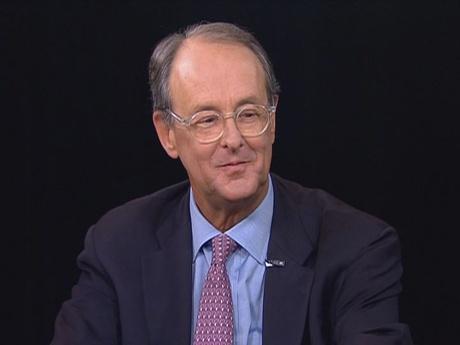
Charlie Rose: Erskine Bowles and Alan Simpson

Excellent discussion on the U.S. fiscal crisis with Erskine Bowles and Alan Simpson.  They were co-chairs of the National Commission on Fiscal Responsibility and Reform, commissioned by President Obama in 2010 to identify “…policies to improve the fiscal situation in the medium term and to achieve fiscal sustainability over the long run.”     Their final report and recommendations were eventually ignored by the White House and Congress — both parties.

Charlie cuts to an excerpt from a recent interview with former Reagan Chief of Staff and Treasury Secretary, and Bush #41  and Secretary of State,  James Baker,

…without the dollar as the reserve currency,  we [U.S.] would be Greece….(13:30 minutes)

This fits one of our worst case Black Swan scenarios where the sovereign debt/funding crisis spreads into some of the larger European countries, skips to Japan,  and then finally comes to the U.S. shores.    Maybe a low probability, but a very impact event.

We’ve given up hope on the Washington politicos, including President Obama,  to tackle the country’s structural deficit and skyrocketing debt, which is being funded and enabled by an incredibly irresponsible monetary policy, in our opinion.   The day of reckoning will come and the markets will eventually force the government’s hand.

This is an excellent discussion and well worth your time.

Click here for full interview.

 (click here if picture is not observable)

Posted in Black Swan Watch, Bonds, Budget Deficit, Economics, Interviews, Politics, Sovereign Risk, State and Local Government | Tagged , , , | 1 Comment

Real Pain in Greece

This chart of Greece retail sales comes to us from Reuters via the Zahari blog in Athens.   It encapsulates the economic collapse that is taking place in Greece.  We seriously doubt the U.S. or most of the core of Europe could take this kind of pain without the political rivets popping and social order breaking down.   Godspeed,  Greece.

(click here if chart is not observable)

Posted in Black Swan Watch, Euro, PIIGS, Politics, Sovereign Debt, Sovereign Risk | Tagged , , | Leave a comment

Building the New World Order: BRIC By BRICS

(click here if video is not observable)

Posted in BRICs, Geopolitical | Tagged , , , , , , | Leave a comment

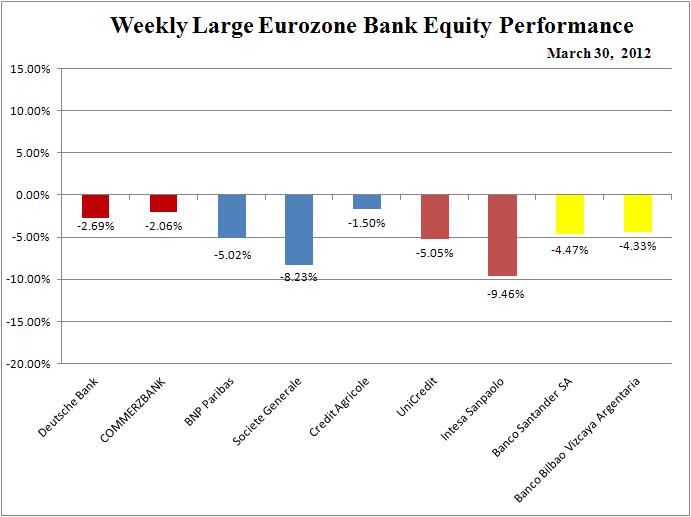
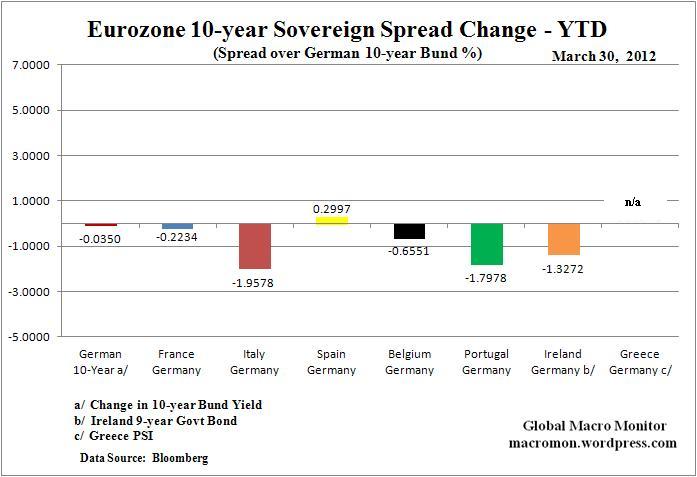
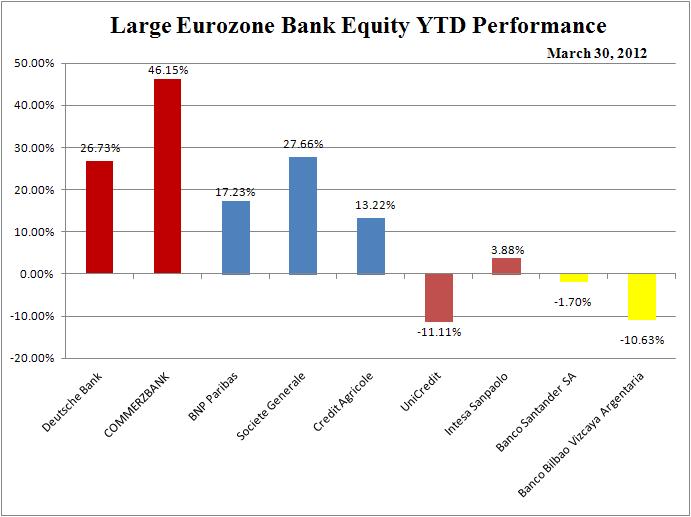
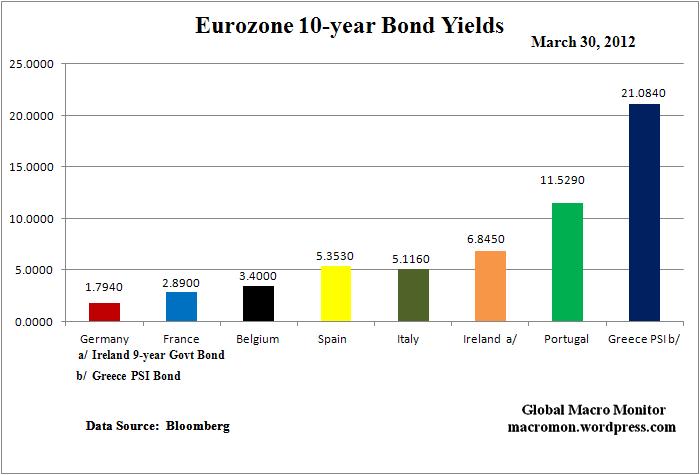
Weekly Eurozone Watch – LTRO Anesthesia Wearing Off

(click here if charts are not observable)

Posted in Weekly Eurozone Watch | Tagged , , , , | Leave a comment