Claims of fraud in Russia’s presidential election

(click here if video is not observable)
Posted in BRICs, Politics | Tagged , | Leave a comment

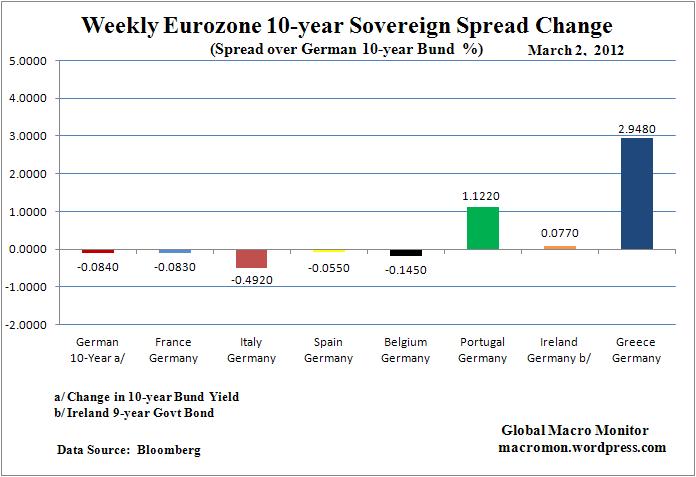
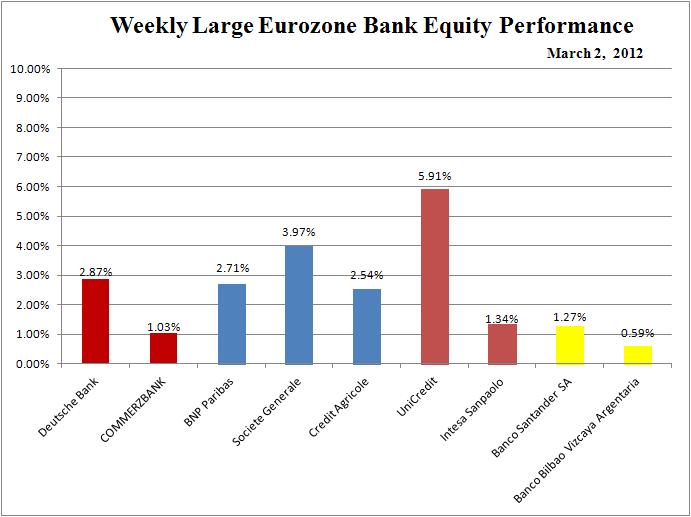
Weekly Eurozone Watch

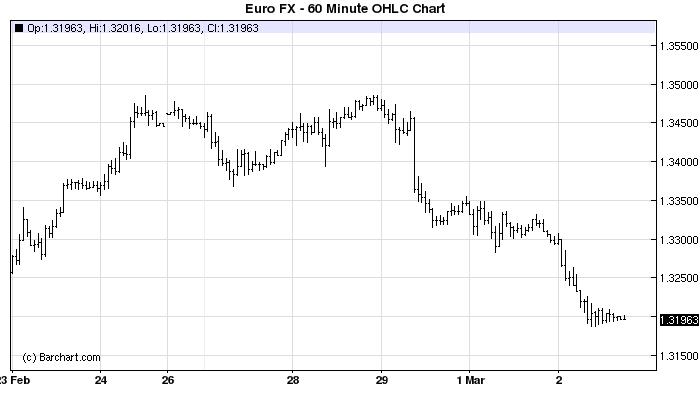
(click here if charts are not observable)

Posted in Weekly Eurozone Watch | Tagged , , , , , , | Leave a comment

The New Normal

You know what’s coming once the markets get comfortable with the new normal reflected in this great photo of Ernest Hemingway.   That said,  rather than clearing our desk for the weekend we’re gonna hit the links.

Have a great weekend!

                           Ernest Hemingway “kicking the can down the road”

(click here if picture is not observable)

Posted in General Interest | Tagged , | 3 Comments

“Rent Control” Misnomer

A friend of the Global Macro Monitor corrects us on our post, Fed’s “Rent Control” Policies Starting to Distort,

The fact that the fed is fiddling with the yield curve disguises the equilibrium price of LT debt. The way the fed is fiddling with the yield curve is fundamentally different from price control. The difference is that the fed is manipulating supply to achieve a price target.

Correct.  Rather than suppressing rates through a legal mandate, such as rent control, the Fed pegs long-term rates through intervention similar to monetary policy under a fixed-exchange rate regime.  Fortunately, the Fed has not targeted a specific long-term interest rate and thus has no “line in the sand” to defend x/ its reputation.

Nonetheless,  the conclusion stands that the yield curve is distorted, does not reflect true information about economic fundamentals, and suppresses the supply of long-term loanable funds.

Keep those comments, corrections, and criticisms coming.  This is “open source macro,” folks.

Posted in Monetary Policy | Tagged , | Leave a comment

Nonlinear Thinking: Printing Muscle

If this doesn’t blow your mind,  nuttin’ will.

Technology Review writes,

In a small clean room tucked into the back of San Diego–based startup Organovo, Chirag Khatiwala is building a thin layer of human skeletal muscle. He inserts a cartridge of specially prepared muscle cells into a 3-D printer, which then deposits them in uniform, closely spaced lines in a petri dish. This arrangement allows the cells to grow and interact until they form working muscle tissue that is nearly indistinguishable from something removed from a human subject.

The technology could fill a critical need. Many potential drugs that seem promising when tested in cell cultures or animals fail in clinical trials because cultures and animals are very different from human tissue. Because Organovo’s product is so similar to human tissue, it could help researchers identify drugs that will fail long before they reach clinical trials, potentially saving drug companies billions of dollars. So far, Organovo has built tissue of several types, including cardiac muscle, lung, and blood vessels.

Unlike some experimental approaches that have used ink-jet printers to deposit cells, Organovo’s technology enables cells to interact with each other much the way they do in the body. They are packed tightly together and incubated, prompting them to adhere to each other and trade chemical signals. When they’re printed, the cells are kept bunched together in a paste that helps them grow, migrate, and align themselves properly. ­Muscle cells, for example, orient themselves in the same direction to create tissue that can contract.

So far, Organovo has made only small pieces of tissue, but its ultimate goal is to use its 3-D printer to make complete organs for transplants. Because the organs would be printed from a patient’s own cells, there would be less danger of rejection.

(click here if video is not observable)

Posted in Nonlinear Thinking | Tagged , , | 3 Comments

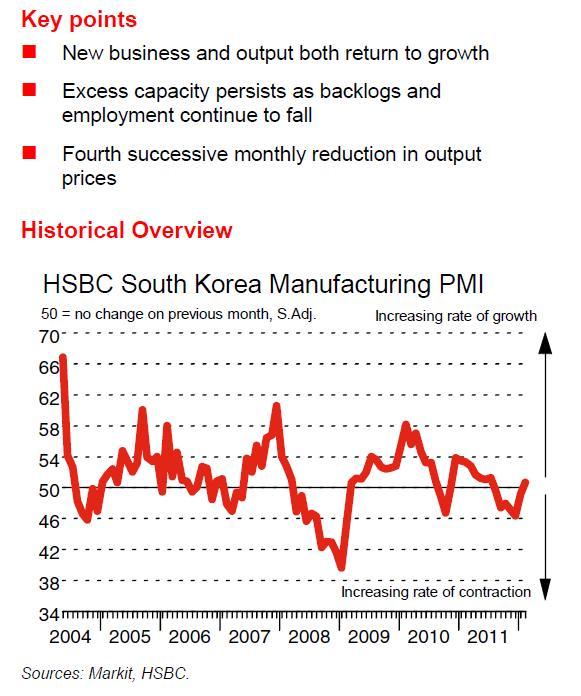
Korea PMI Expands After 7-Month Contraction

From Markit,

Commenting on the South Korea Manufacturing PMI® survey, Ronald Man, Economist at HSBC in Asia said:
“At last, manufacturing conditions in Korea have improved. More importantly for policy makers, new orders have picked up, which suggests that demand for Korean goods are stabilising. But caution is warranted as new business has yet to translate into higher employment. In turn, the outlook for domestic demand and first quarter GDP growth remains weak.”

(click here if chart is not observable)

Posted in Economics, Manufacturing | Tagged , , | Leave a comment

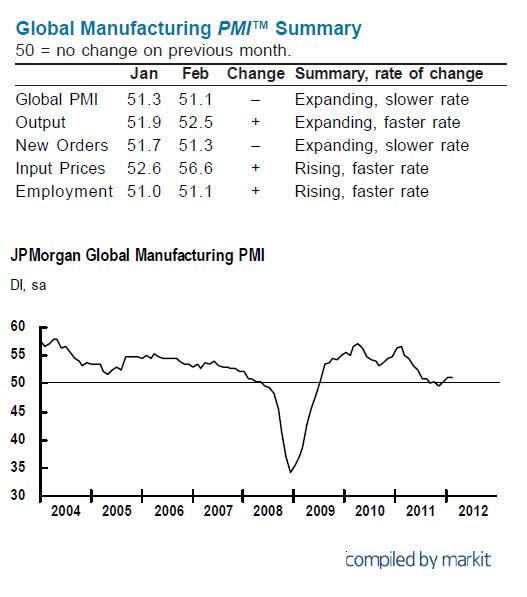
Global PMI Little Changed @ 51.1, Costs Accelerate

From today’s Markit release,

The JPMorgan Global Manufacturing PMI™ broadly held its ground at 51.1 in February, little-changed from 51.3 in January, to signal an improvement in operating conditions for the third straight month. Levels of output, new orders and employment all moved higher…

The highest PMI output indices were posted by Denmark, South Africa, India and the US. Among the larger manufacturing nations, growth was registered in China, Japan, Germany and the UK.

The weakest performances were mainly seen at the
periphery of the euro area. The downturn in Greece took a marked turn for the worse, with production and new orders both falling at survey record rates. Italy and Spain also saw faster declines in output than one month ago. Meanwhile, output in Turkey fell back into contraction…

Cost inflationary pressures picked up sharply in February, with the rate of increase reaching a five-month peak. Part of the latest rise reflected higher oil prices and associated increases in the costs of by-products, energy and transport.

Developed markets were generally more exposed to these cost pressures than emerging markets. Rates of increase surged higher in the US, the Eurozone and the UK. India also saw a sharp increase in costs.

(click here if chart is not observable)

Posted in Economics, Manufacturing | Tagged , , | Leave a comment

Chart Trioka

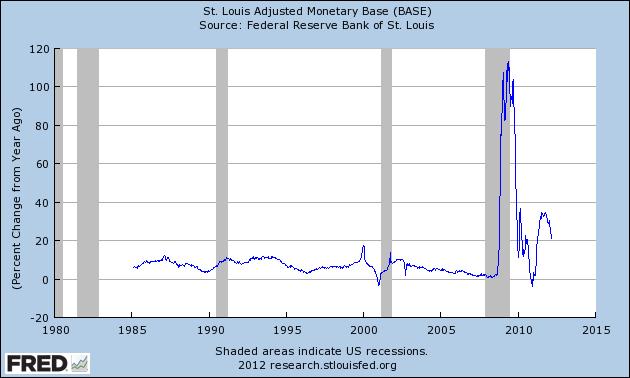
We’re keeping these three charts on our radar over the next year.

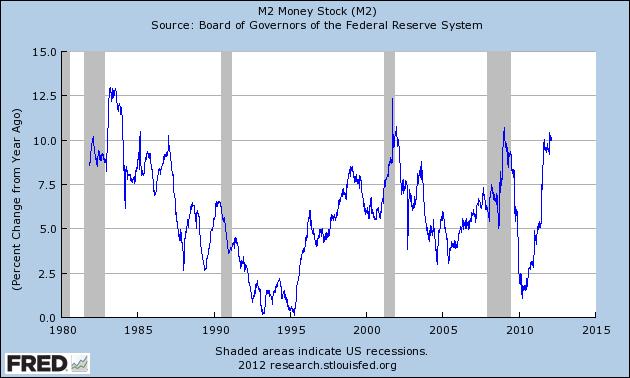
With a heavily spiked punch bowl,  we suspect U.S. monetary policymakers will be a little nervous if they start to see bank credit accelerate and a rapid expansion of the monetary aggregates.   In fact, we wouldn’t be surprised to see the money supply figures back on the front pages of the Wall Street Journal sometime soon.

At the end of the day,  monetary policy is a black box and subject to “long and variable lags.”   Nobody knows precisely how, when, and where central bank liquidity injections and interest rate moves affect the overall economy.  This is even more true with the rise and fall of the shadow banking system and further complicated by the massive increase in central bank foreign exchange reserves over the last decade.

Even defining and measuring money is, at best, ambiguous.

(click here if chart is not observable)

Posted in Economics, Inflation/Deflation, Monetary Policy | Tagged , , , | Leave a comment

Is the Correction Camp Too Crowded?

We posted yesterday that the S&P500 was set up for a pullback after carving out an outside day (higher high and lower low than previous day) at strong resistance and looked for follow through selling today.   Didn’t happen.

In fact, the S&P500 followed yesterday’s outside day with an inside day with today’s high/low lower/higher than yesterday’s.  This reflects a lack of sellers and nervous buyers.

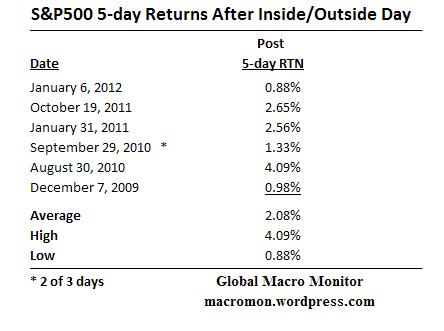
An inside day following an outside day is a relatively rare three-day pattern and has initially happened on six times since the current bull market began on March 6, 2009.    In every case, the post 5-day return on the S&P500 was positive, averaging 2.08 percent.

Today’s pattern and run up looks very similar to the one made on January 31, 2011.   The S&P500 rallied 22 percent in 108 trading days from the August 26, 2010 low into the inside/outside three-day pattern.  It added another 4.4 percent in the next 14 trading days before correcting.

As of today’s close, the S&P500 is up 25 percent in the 1o3 trading days since the October 4th low.    The market does feel like it lacks sellers and needs a real catalyst to knock it down, in our opinion.   Interestingly, there are 13 trading days to the March 20th Greek bond maturity, which could suffer complications and provide the catalyst for a global equity correction.

Like many — maybe too many – we remain cautious and do look for a pullback after such a big move but do respect the trend and history.

Good luck out there!

(click here if charts are not observable)

Posted in Charts, Equities | Tagged , , , | 4 Comments

EU leaders seek austerity growth balance

(click here if video is not observable)
Posted in Black Swan Watch, Euro, Sovereign Debt, Sovereign Risk, Video | Tagged , | Leave a comment