
Could this be part of the reason the Shanghai was the only major index we track that was down last week?
(click here if video is not observable)
Could this be part of the reason the Shanghai was the only major index we track that was down last week?
(click here if video is not observable)
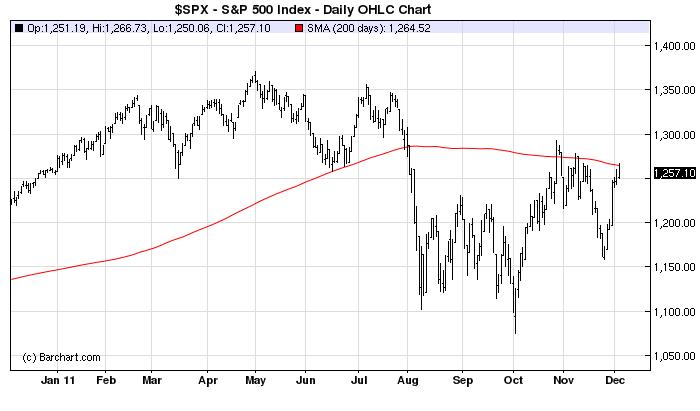
Looked like today could be the day the S&P500 broke through and closed above its 200-day. That is, before the tape bomb out of the S&P putting most of the ‘Zone countries on negative watch for a credit downgrade. Let’s see how this plays out in in Europe tomorrow and whether the hardliners in Germany say, “… told you so!'”
The chart of S&P500 shows why the 200-day moving average matters and should be monitored.
 (click here if chart is not observable)
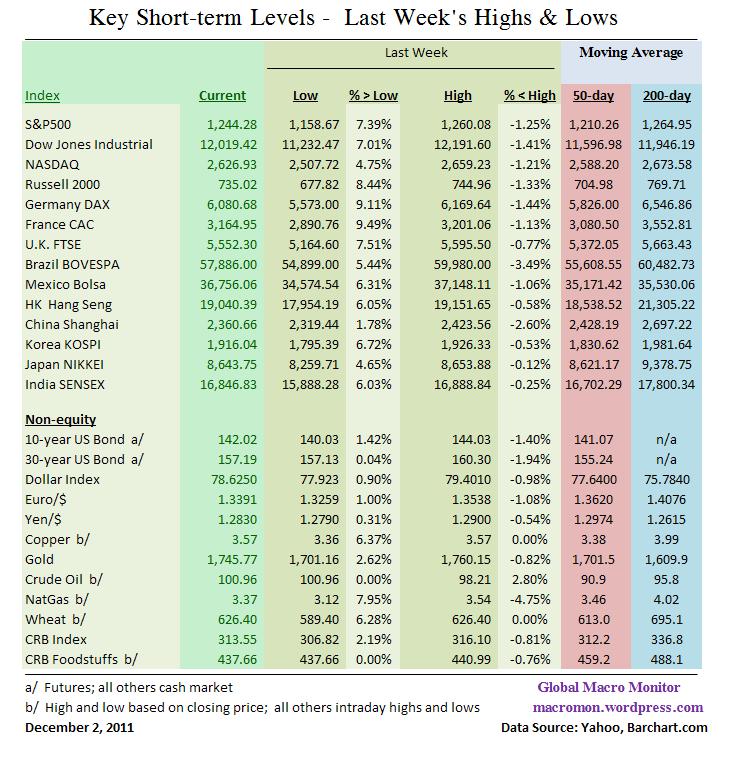

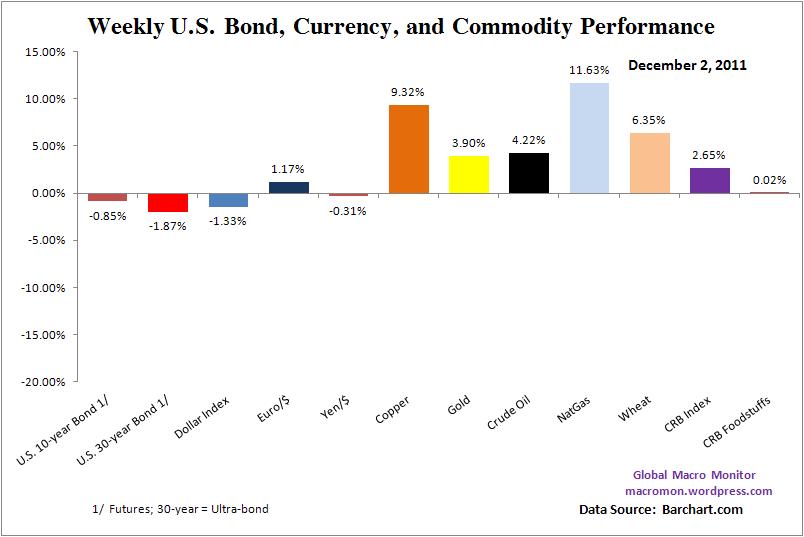
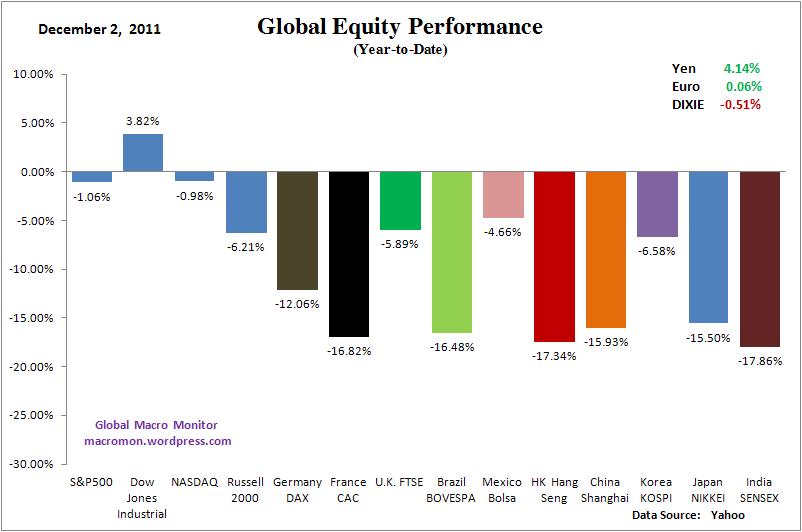
 (click here if charts are not observable)
While the FT reports Italy’s new technocratic government has approved tough austerity measures and economic reforms, the country’s unions seem to be balking at the tough medicine. Italy needs lots of deflation relative to other countries to become competitive and doesn’t have the ability to adjust relative prices through the exchange rate without an independent currency. The real test, which will be political and drawn out, is about to begin.
(click here if video is not observable)

 (click here if tables are not observable)
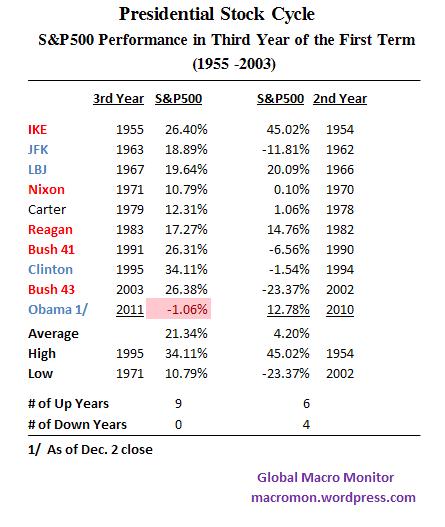
The Global Macro Monitor posted several pieces earlier in the year about the Presidential Stock Cycle. See here, here, and here. The third year of a first term President is the strongest year in the cycle. The table illustrates that if the S&P500 doesn’t close at 1257.64 (closed Friday at 1244.28) or higher, President Obama will be the first post-war “Investor in Chief” to have a S&P500 down year in the third year of his first term.
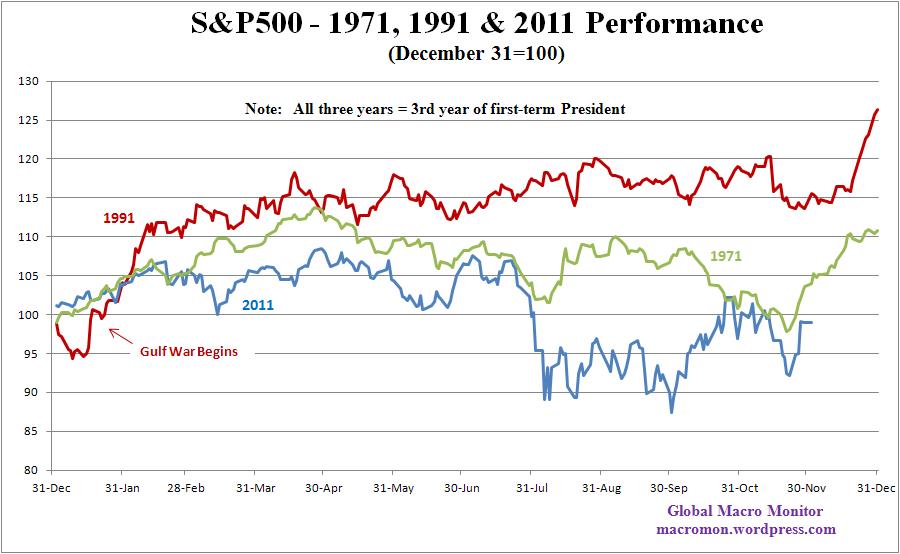
 It’s also beginning to feel a lot like 1971. We had thought earlier in the year the market would trade more like 1991, also a year of macro swans, including a major credit crunch and the first gulf war. After trading up early that year, the market moved in a relatively tight range and ramped hard at the end of the year, 10.5 percent in last 14 trading days. We also thought the volatility band would expand this year, but not as much as it has.
Bespoke had a great piece out last week showing that since August 1st the S&P500 has had eight declines of 5 percent or more and eight advances of 5 percent or more. Contrast that to several stretches in the 1990’s where the S&P500 went more than a year without a rally or decline of 5 percent.
The S&P500 now appears to be tracking the 1971 analog, also the third year of a first term President. Ironically, 1971 was a year of similar currency turmoil as President Nixon officially ended the gold standard and the Breton Woods international monetary system in the middle of August. The IMF was also at the center of the global volatility.
During the massive run on gold, then Treasury Secretary John Connally and Under Secretary for Monetary Affairs Paul Volcker advised President Nixon to let the dollar float, effectively rendering the greenback a full blown fiat currency. This caused panic in the global markets until other countries let their currencies go.
History is rhyming now with the current Euro and sovereign debt crisis.
Let’s also hope Santa brings us a similar December ramp in the S&P500 as he did in 1971 and 1991. The results of the EU summit at the end of the week and the stability of money demand in the Euro core if the ECB chooses to monetize will, in our opinion, largely determine if Santa Claus or the Grinch shows up this December. We’ll worry about 1972 2012 when we get there.
This is our best guess, which often diverges from reality as it unfolds. And that, folks, partially explains why markets are so volatile as they move from perception to reality and back to perception.
Stay tuned.
 (click here if charts are not observable)
Great ‘toon from the Economist which we hope motivates the Eurocrats to get something done. The U.S., U.K, and Japan should not be so smug and take warning as the Four Horsemen of the debt apocalypse will be coming their way if they don’t get their fiscal house in order.
We’re going to come up with a Four Horsemen watch for Europe similar to our exercise during the U.S. government credit downgrade. Any suggestions and what indicators they should be? France-Germany bond spread? European Bank Equity Index? Euro/dollar? Italian/Spain-Germany bond spread? German bond yields?
 Money quote from the Economist piece:
Europe needs an all-encompassing deal to save itself. The crisis is now about the survival of the euro, so it requires a big response; nobody will be spared if the euro collapses. A sensible compromise would be to impose greater discipline now, in exchange for the eventual introduction of conditional Eurobonds. A paper by the Brussels-based think-tank Bruegel adds the need for a euro-zone finance ministry, with power to raise its own taxes and to oversee the banking system.
With time running short, an all-encompassing deal might take too long to negotiate. That said, a limited German-style treaty would also take time. A balanced deal is more likely to be accepted by voters, in both creditor and debtor states, and to assuage markets. It may need to be done in phases. In the short term, it must be enough to free the ECB to intervene without limit, by assuaging fears of moral hazard. In the long term it needs to signal to investors that the euro’s problems are being fixed for good. Only then might the apocalypse be cheated.
(click here if cartoon is not observable)
Not all gov spending is bad and here’s an example in Greece, where spending is being prioritized and will provide a nice return on investment not mention the positive exeternalities (econo speak for side benefits) for world culture. We didn’t know tourism is one sixth of the Greek economy as reported in the video.
Sure, the government can privatize their ancient treasures to pay off their debt to Deustche Bank and BNP, and all the children of the world can become software engineers, and all monkeys can fly. Get real.
(click here if video is not observable)

Here’s what the BLS had to say about this morning’s employment report:
In November, nonfarm payroll employment rose by 120,000. Employment continued to trend up in retail trade, leisure and hospitality, professional and business services, and health care. Government employment continued to trend down.
The increase in total nonfarm payroll employment in November (120,000) was in line with the average gain for the prior 12 months (+131,000). The private sector added 140,000 jobs, as employment rose in a number of service-providing industries.
Employment in retail trade rose by 50,000 in November, with much of the increase occurring in clothing and clothing accessories stores and in electronics and appliance stores. Since reaching an employment trough in December 2009, retailers have added an average of 14,000 jobs per month.
Employment in professional and business services continued to trend up in November (+33,000). Modest job gains continued in temporary help services.
Health care employment (part of education and health services) continued to rise in November (+17,000). Over the past 12 months, health care has added an average of 27,000 jobs per month.
Employment in leisure and hospitality continued to trend up in November (+22,000). In the last 12 months, leisure and hospitality added 253,000 jobs, largely driven by employment increases in food services and drinking places.
Construction employment showed little movement in November. Employment in the industry has shown little change, on net, since early 2010.
Government employment continued to trend down in November, with a decline in the U.S. Postal Service. Employment in both state government and local government has been trending down since the second half of 2008.
(click here if chart is not observable)
Not enough, surely some of it engineered, but moving in the right direction. Some of the move has been the rise in the German 10-year yield. Look at the big move in France-Germany, now below 100 bps. The big Cen Bank move yesterday lessens the risk of the French sovereign having to backstop their banking system.
Let’s hope the respite doesn’t cause complacency among the Eurocrats, however. Their modus operendi seems to be: meet and discuss, wait for a crisis, generate a massive short squeeze, meet and discuss, wait for the next crisis, generate a massive short squeeze, meet and discuss, wait for the next crisis……….
The problem is time has run out and it’s now suddden death. Or to put it in more European terms, the Eurocrats are down to their last penalty kick and behind by a point. Come on, Merkozy!
 (click here if charts are not observable)


