It’s Beginning to Look A Lot Like…1971

The Global Macro Monitor posted several pieces earlier in the year about the Presidential Stock Cycle.  See here, here, and here.   The third year of a first term President is the strongest year in the cycle.  The table illustrates that if the S&P500 doesn’t close at 1257.64 (closed today at 1246.96) or higher,  President Obama will be the first post-war “Investor in Chief” to  have a S&P500  down year in the third year of his first term.

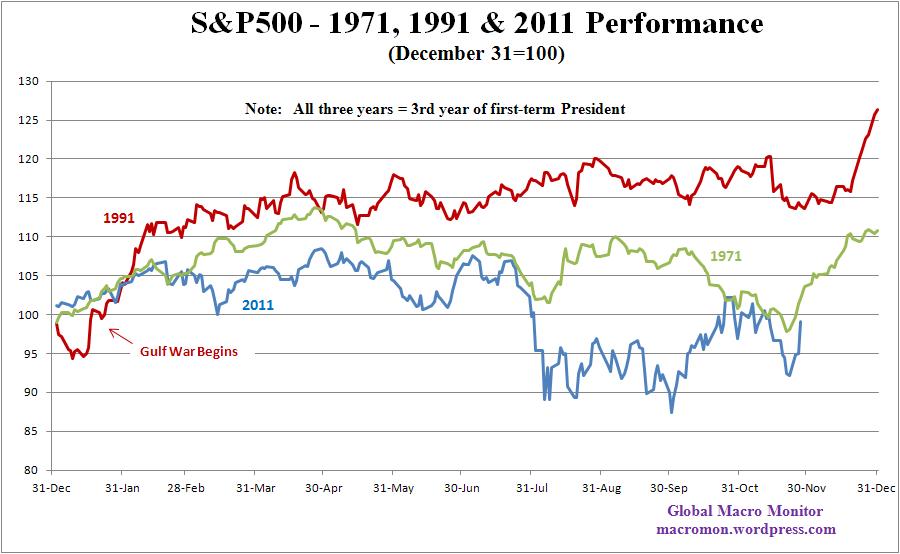
It’s also beginning to feel a lot like 1971.   We had thought earlier in the year the market would trade more like 1991, also a year of macro swans, including a major credit crunch and the first gulf war.   After trading up early that year, the market moved in a relatively tight range and ramped hard at the end of the year, 10.5 percent in last 14 trading days.  We thought the volatility band would expand this year, but not as much as it did.

The S&P500 now appears to be tracking the 1971 analog, also the third year of a first term President.  Ironically, 1971 was also a year of similar currency turmoil as President Nixon officially ended the gold standard and the Breton Woods international monetary system in the middle of August.

During a massive run on gold, then Treasury Secretary John Connally and Under Secretary for Monetary Affairs Paul Volcker advised the President to let the dollar float, effectively making it a fiat currency.  This caused panic in the global markets until other countries let their currencies go.

History is rhyming here with our own Euro crisis and sovereign debt crisis.

Let’s also hope Santa brings us a similar December ramp in the S&P500 as he did in 1971 and 1991.   Stay tuned.
(click here if chart is not observable)

Posted in Equities, Euro | Tagged , , , , | 3 Comments

NUTCRACKER!

Wow!  That was some move.

Take a look at FAZ, the triple short financial, down 17.5 percent on the day!  Every trader and their mother were getting long that after last night’s close on the S&P downgrade of the banks.

You may be able to take on the Fed, but you can’t  fight the Fed, the ECB, the Bank of Japan, the Swiss National Bank,  the Bank of England,  and the Bank of Canada.   And, yes, the People’s Bank of China.  We also doubt Frau Merkel will leave them all out there to hang.   We suspect the EU is cooking up something that could surprise the market.  We cry uncle.

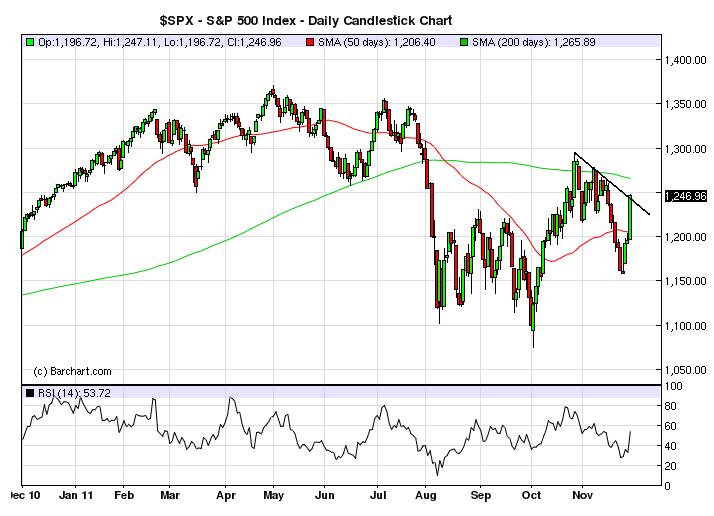
Even after the big moves of the last couple of days, the S&P 500 is only back to where it was just a few weeks ago.   We’re bearish on the macro picture, but who isn’t?  More important, who is fully invested?  Remember, the S&P5oo rallied 20 percent in 17 trading days in October with all the same ugly macro bears.

It looks like Santa Claus is coming to town.   Maybe we get a little consolidation over the next few days and then the next test for the S&P is 1257, the breakeven for the year,  1265.89, the 200-day moving average, and then the October 27 high of 1292.66.    Always can be wrong and always with a stop.

(click here if chart is not observable)
Posted in Equities | Tagged , , | 1 Comment

Oats-Bunds Tighter

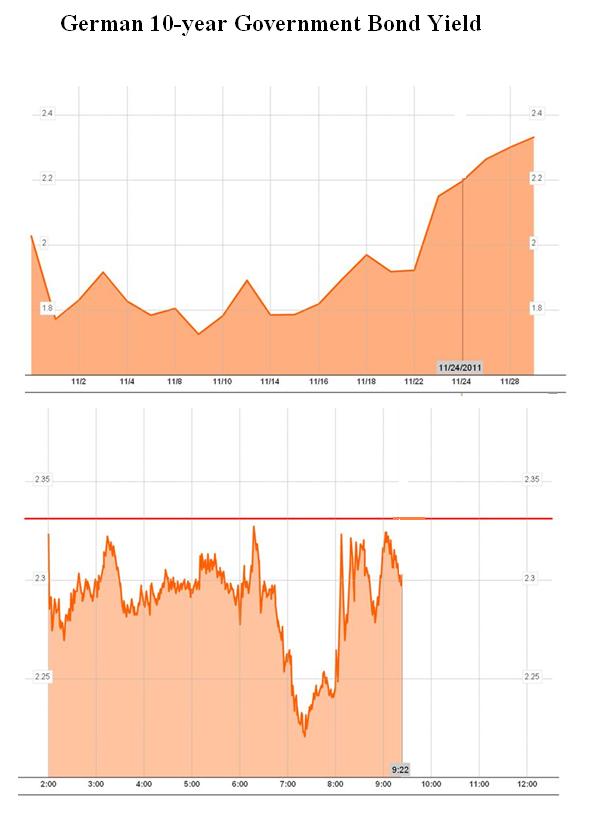
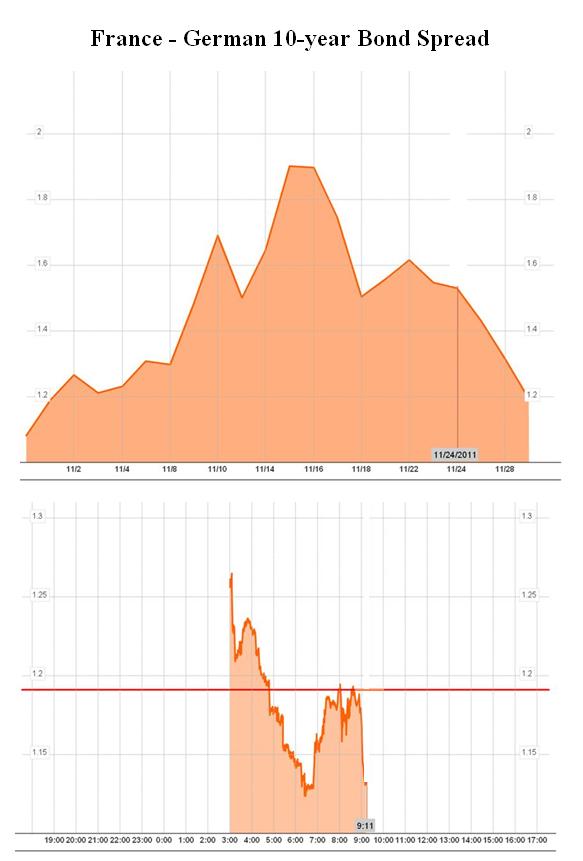
In case you haven’t noticed the France 10-year bond spread over German 10-years has come in big over the past few weeks.  Granted some of it is attributed to the rise in German bond yields, but tighter, nonetheless.

(click here if charts are not observable)

Posted in Black Swan Watch, Dollar, Euro, Sovereign Debt, Sovereign Risk | Tagged , , | Leave a comment

Is this Gold’s Moment?

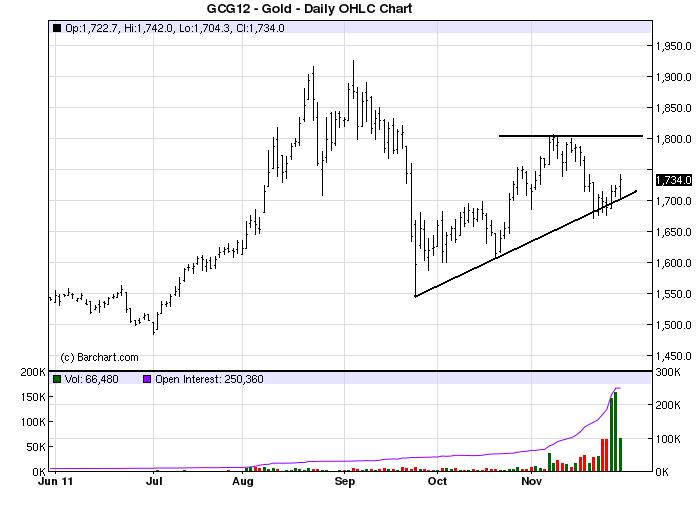
China’s move on reserve requirement and the global central bank liquidity facility should give a power boost to gold, in our opinion.  This really smells like the global Cen Banks are going all, and we mean ALL IN.  In fact, a joint central bank/IMF facility to fund Europe wouldn’t even surprise us.

This could be the catalyst for a quick move up to resistance at $1,800 and new highs shortly thereafter.   It’s important the $1806.60 high in the Feb12 futures is taken out in  fairly short order to negate the formation of a potential  H&S pattern.  Always with a stop.   Stay tuned.

(click here if chart is not observable)
Posted in Black Swan Watch, Gold, Sovereign Risk, State and Local Government | Tagged , , | 2 Comments

Patriotic Italians urged to buy bonds

(click here if video is not observable)

Posted in Black Swan Watch, Currency, Euro, PIIGS, Sovereign Debt, Sovereign Risk | Tagged , , | Leave a comment

Good Day to Be Short the Shorts

Today was a good day to be short the shorts —  long the most heavily shorted stocks.  Big move in First Solar, the most heavily shorted stock in the S&P500, up 10.52%   We have our doubts about this bounce.   If we doubt our doubt about the bounce, that is, lack confidence in our lack of confidence in the market, does that mean we believe the market will go up?  And there’s the rub, folks,  and epitomizes the character of this wicked market.   Keep a tight one.

Click here for background on the table and here if table is not observable.

Posted in Equities | Tagged , , , | 1 Comment

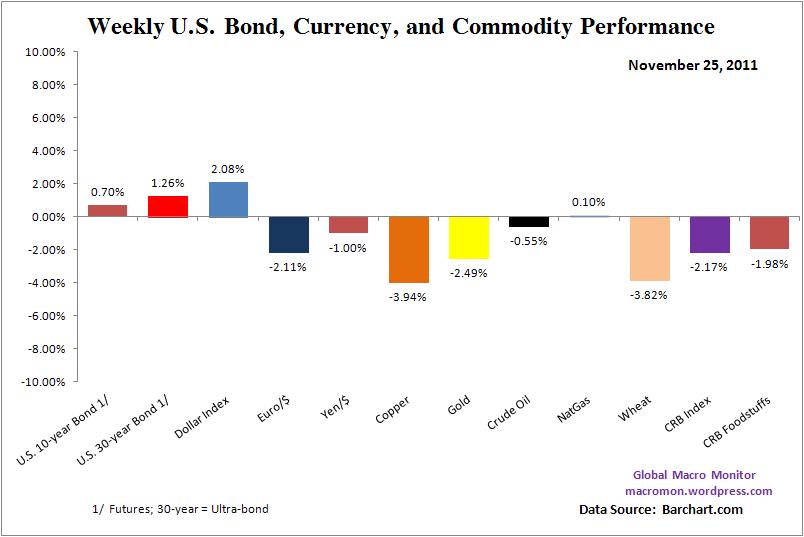
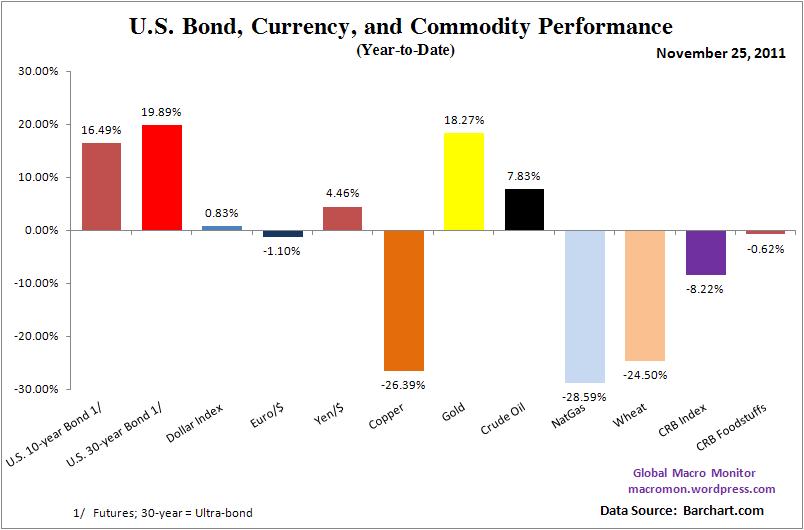
Week in Review: Dollar Index Now Up for the Year

(click here if charts are not observable)

Posted in Week in Review | Tagged , , , , , , , , , | Leave a comment

The Cult of Putin

(click here if video is not observable)

Posted in BRICs, General Interest, Politics, Video | Tagged , | Leave a comment

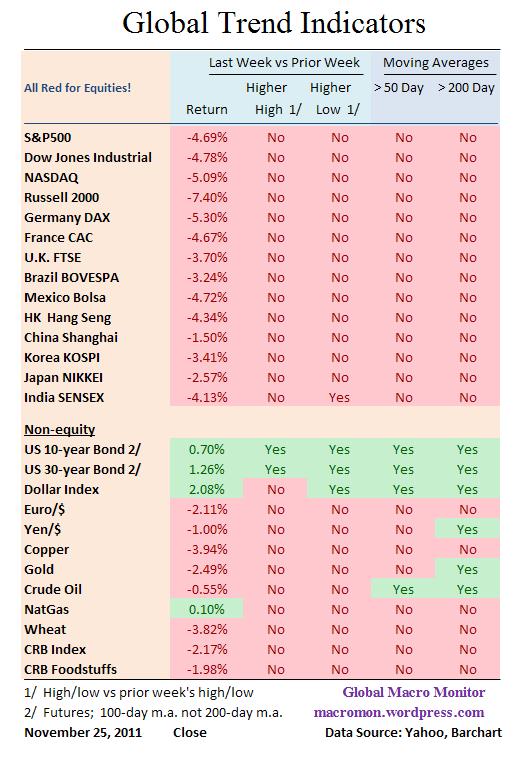
Global Trend Indicators

(click here if tables are not observable)

Posted in Global Trend Indicators | Tagged , , , , , , , | Leave a comment

Euro Fracture: It’s the Politics, Stupid!

Politics has been and will be the constraint on the latest iteration of Bailout Europe 4.0.  We at the Global Macro Monitor really want to see Europe make it, for markets to rally, and for all to make money.

But the latest bailout announcement/rumor, which includes a Euro 600 billion loan facility from the IMF, which, by the way, exceeds the Fund’s total lending capacity, currently around $400 billion, doesn’t pass the political smell test.   There are also rumors swirling of a Eurobond.   As usual, the news has sparked a nut cracking short covering rally with S&P futures up over 25 points.

We see several political reality checks on the latest deal rumor because at the end of the day any large sovereign bailout is also a bailout of the major European banks.   The public doesn’t want to hear about global systemic risk and we expect huge political pushback on this one.  Imagine how this will play in the U.S. Presidential election as the Republican candidates are already on record, no bailout of Europe.   Mitt Romney stated in a recent debate,  “Europe is able to take care of their own problems.”

We see three major political constraints on the latest rumors:

1)      79 percent of Germans oppose a Eurobond;
2)      Occupy _______ , which reflects global public opinion, will not be happy if taxpayers have to contribute more funds to the IMF to bailout European financial institutions, mainly French and German banks;
3)      Italians will not be happy with severe austerity imposed by the IMF, which will require massive labor reforms, including cutting pensions and wages;

The financial rivets are popping and the latest rumors of new deals could buy some valuable time.  But we’re beginning to believe it’s too late for Euro as we know it.

Maybe because there is no magic solution — x/ hyperinflation — as the true end game will be debt restructuring and the allocation of losses to those who caused the crisis in the first place — i.e.,  the sovereign borrowers and private lenders —  as it should be, no?   Reality is setting in and Europe is running out of illusions, delusions, and quick fix short squeezes.

We’re also beginning to conclude the best solution is that the less indebted core countries leave the Euro for a new common currency of their own – a northern Euro.  This would allow the old/southern Euro with the highly indebted periphery to depreciate significantly, increasing the competitiveness of each country and effectively deflating their stock of debt in real terms.   If Greece were to return to the drachma, their debt ratios would probably increase at least threefold and the recovery value of the bonds would likely fall to less than 5 cents on the Euro, if that.

The U.S., U.K, and Japan should also view what is happening in Europe as their Sputnik moment and motivation to get their own fiscal house in order.  There is no doubt, at least in our mind, a version is coming soon to each of these countries.  Sovereign risk is all about confidence and the lesson of the European crisis is that confidence is fickle and fleeting, here today, gone tomorrow.  Nobody knows the tipping point.

Watch to see if this rally has legs, which we doubt it will.  Our sense is the Europeans will view it as a gift of the Magi and use it to exit.    Stay tuned.

Posted in Black Swan Watch, Euro, PIIGS, Sovereign Debt, Sovereign Risk | Tagged , , | 3 Comments