Surprising Global Demographic Trends

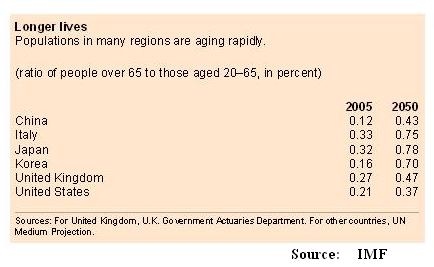
Digging through some old IMF publications last night we came across this little nugget of data on global demographic trends that really caught us by surprise.   When most think about Asia x/Japan they picture a young dynamic growing population ready to take on the next century, no?   Not so fast.
Here’s the IMF,

Two fundamental demographic trends are at work in the world. In countries that are achieving reasonable economic success and are free from the extreme effects of AIDS, life expectancy is increasing, possibly without limit. And in all economically successful economies, irrespective of apparent cultural differences, fertility rates have fallen or are falling to replacement level and, in many cases, well below. The United Nations medium projections suggest that, within 15 years, the total fertility rate will be about 2.0 or fewer children per woman in countries as diverse as Brazil, Iran, and Turkey. (A birth rate of a little more than 2.0 is required to ensure that each generation is at least as large as that of its parents, with the required increment above 2.0 driven by the proportion of children who die before reaching child-bearing age.)

A similar trend is seen in the economically successful states of southern India and in China, whose fertility rate, at 1.74, is well below replacement level. That trend, of course, partly reflects the one-child policy, but low fertility rates in Hong Kong SAR, Singapore, and Taiwan suggest that the Chinese policy has simply brought forward an otherwise naturally occurring phenomenon. Indeed, the East Asian pattern suggests that, as China becomes more prosperous, its fertility rate could fall further.

Longer lives and lower fertility rates are dramatically increasing the proportion of the population above the ages we typically associate with retirement (see table). In the United Kingdom, the ratio of people older than 65 to those between the ages of 20 and 65 will almost double between now and 2050. In Korea, that ratio could increase more than four times.

Now let’s figure out how to position for the demographic changes.  Maybe it’s too long term of a focus today’s markets, which flip from headline to headline.

(click here if table is not observable)

Posted in China, Demographics, Economics, General Interest, Japan | Tagged , , , | 1 Comment

How Much Does the Internet Weigh?

Here’s a little diversion from the Euro tape bombs.

(click here if video is not observable)

Posted in General Interest, Technology | Tagged , | Leave a comment

Super Mario’s Rate Cut

We like this guy.

(click here if video is not observable)

Posted in Euro, Monetary Policy, Sovereign Debt, Sovereign Risk | Tagged , , , | Leave a comment

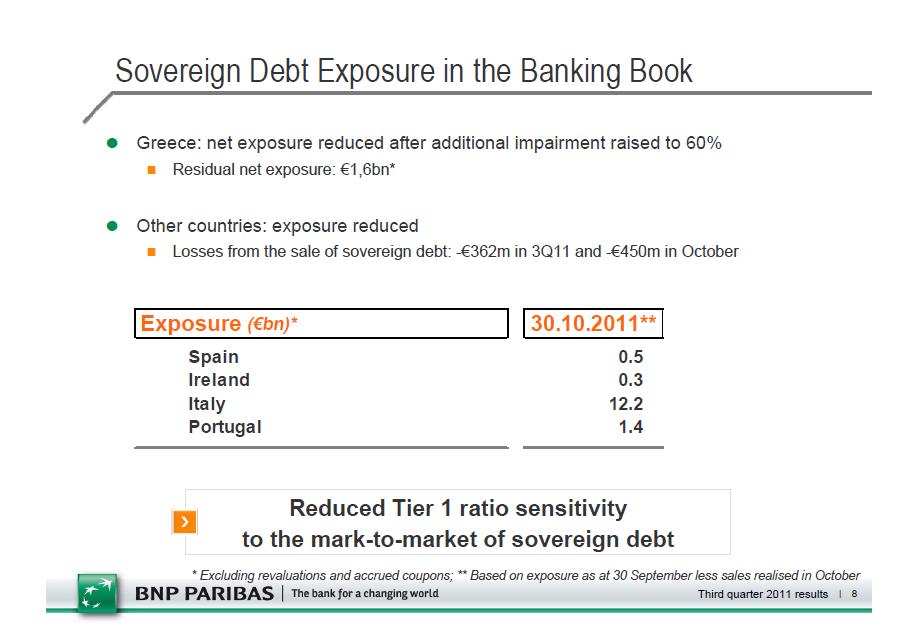
BNP Paribas Increases Reserves on Greece Exposure to 60%

BNP Pariabas,  Europe’s largest bank in terms of total assets,  took a €2.1 billion hit to earnings after increasing reserves on its Greece exposure to 60 percent,  up from 21 percent last quarter.  The European banks are finally getting serious, though if Greece leaves the Euro, 60% will fall far short of the ultimate recovery value — less than 40 cents — for the sovereign’s  euro denominated bonds.

This is going to put pressure on other European banks to reserve or effectively write down their Greece exposure to 40 cents.    Buckle up.

(click here if charts are not observable)

Posted in Black Swan Watch, Equities, Euro, PIIGS, Policy, Politics, Sovereign Debt, Sovereign Risk | Tagged , , , | Leave a comment

Eurozone Manufacturing Continues to Slide

In case you missed this yesterday.

(click here if chart is not observable)

Posted in Economics, Euro | Tagged , | Leave a comment

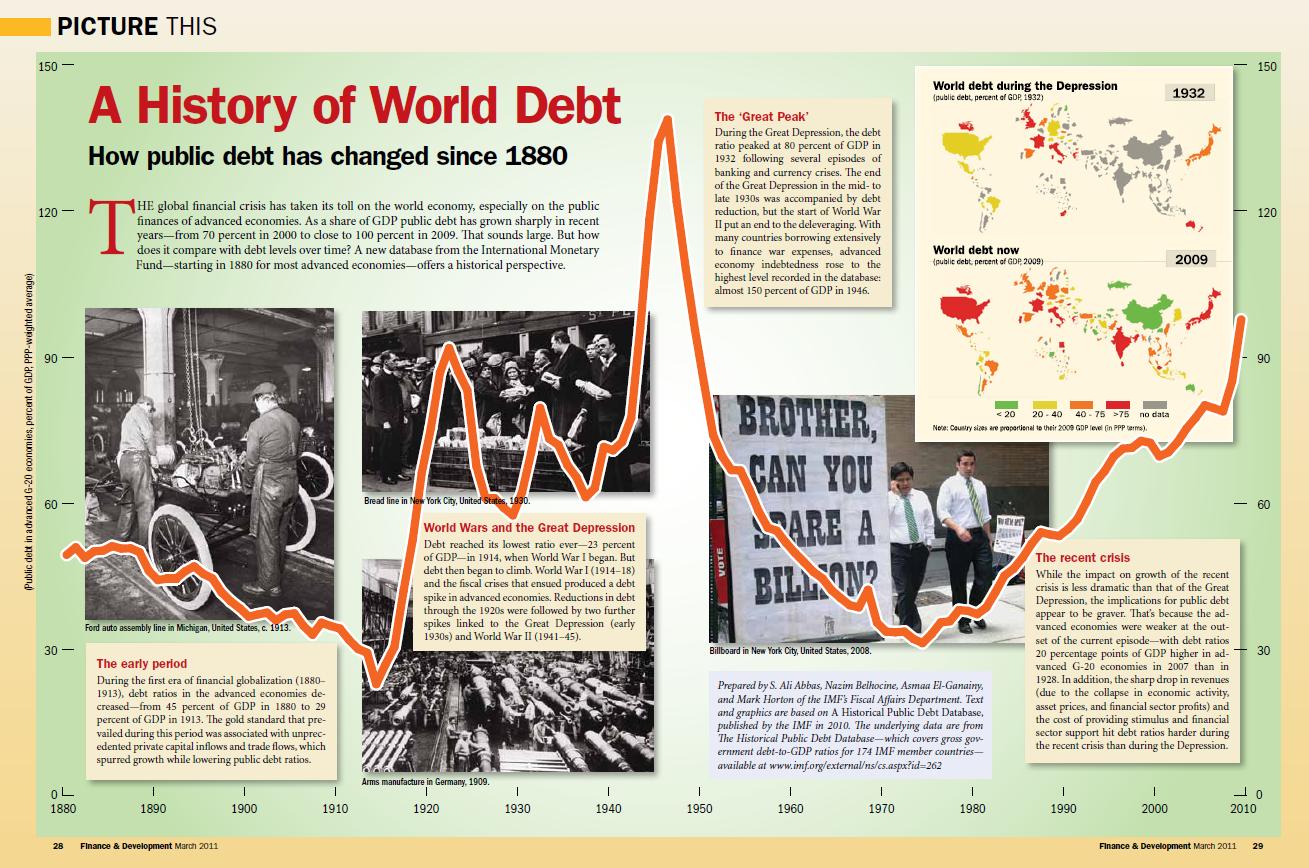
A History of World Debt

Great infographic from the IMF on the history of world debt.   The line chart shows G20 public debt as % of GDP from 1880 to 2010.  Click on graphic to enlarge. 

(click here if graphic is not observable)

Posted in Charts, General Interest, Sovereign Debt, Sovereign Risk | Tagged , | Leave a comment

Papandreou punt turns drama into crisis

(click here if video is not observable)

Posted in Black Swan Watch, Euro, PIIGS, Politics, Sovereign Debt, Sovereign Risk | Tagged , , | Leave a comment

Why the sovereign debt crisis is only in the third inning

And the heavy hitters have yet to be tested.  Click table to enlarge.

(click here if table is not observable)
Posted in Black Swan Watch, Budget Deficit, Sovereign Debt, Sovereign Risk | Tagged , , | Leave a comment

Fareed: Niall Ferguson and Jeff Sachs Square Off on OWS

Nice rumble between Sachs and Ferguson.  Well worth your time.

(click here if video is not observable)

Posted in Black Swan Watch, Economics, Employment, Geopolitical, Policy, Politics, Video, Whales | Tagged , , , | 2 Comments

One Factor Behind the High U.S. Unemployment Rate

The following chart is the most recent sixty-five-nation Program for International Student Assessment (PISA), which shows the United States came in 15th in reading, 23rd in math and 31st in science.  This is one of the factors driving the high U.S. unemployment rate, much of which is structural, in our opinion.

We can argue about the lack of aggregate demand (AD) driving unemployment.  But how much AD over the past two decades was fake?   First a stock market bubble created fake and temporary wealth, which drove consumption and business investment via I.T spending.,  i.e., aggregate demand.  Then a massive housing bubble created fake and temporary wealth, which drove consumption via the housing ATM and investment via residential investment, i.e., aggregate demand.   Haven’t the economists and academics learned the lesson of history?

If the U.S. is going to pull out of its current funk it better focus on the structural forces driving the decline.  Does it want a nation of low paid retail clerks or engineers?

The government’s game plan?   More stimulus and quantitative easing in an attempt to generate more fake aggregate demand.   Until we become Greece, but without the deflation.

                          (click here if table is not observable)

Posted in Budget Deficit, Economics, Employment | Tagged , , , | 1 Comment