Occupy Wall Street and the Nobel Peace Prize

Tomorrow’s announcement of the Nobel Peace Prize could give the OWS movement a mega shot of caffeine Red Bull (great pun!).    The Washington Post confirms our priors,

Leading Nobel-guesser Kristian Berg Harpviken, the director of the Peace Research Institute in Oslo, also doubted that the EU would get the prize.

His top picks are Egyptian activists Israa Abdel Fattah, Ahmed Maher and the April 6 Youth Movement, a pro-democracy Facebook group they co-founded in 2008.

He also suggested Wael Ghonim, a marketing executive for Google, for re-energizing the protests on Cairo’s Tahrir Square after the ouster of President Hosni Mubarak, and Tunisian blogger Lina Ben Mhenni who started criticizing the Tunisian regime before the uprising began in December.

Imagine the connection each of the protestors’ will feel if “one of their own” takes the prize.  Talk about emboldening a movement!

We posted on March 1st during the Egyptian revolt and eve of the Arab Spring,

It is also time to connect some dots.  What we are witnessing in the Middle East where the young, who have little or no political voice and a not so bright future are throwing off their autocratic gerontocracies at an incredible pace.   Something similar will manifest here and the rest of the aging west, though probably in different way, when younger generations realize the consequences of being saddled with a massive debt and declining public services as the tax revenues are diverted to debt service and retirement benefits.   Not to mention the world full of carbon they have inherited.

They to, like their Facebook brethren in the Middle East, will revolt and throw off the gerontocracy that will control the political system as baby boomers age, which over taxes them to pay the debt used to finance the excessive consumption and current retirement benefits of their parents and/or grandparents generation.It doesn’t take a C.I.A. analyst with a Ph.D. to realize the potential for political blowback when one generation is rendered into servitude due to the excesses of another.   Or does it?

Fast forward eight months and here we are.  As Zerohedge quotes Art Cashin it’s hard to decipher a unified demand or voice of the OWS movement,

The Occupy Wall Street protest is reminiscent of the scene in the 1953 film “The Wild One” where a young woman asks a motorcycle gang leader played by Marlon Brando, “Hey Johnny, what are you rebelling against?”

Brando deadpans, “Whaddya got?”

Maybe that’s the point.  The younger generation feels angry and ripped off by the boomer gerontocracy, who consumed it forward and left their generation to pay the bills.  And, paying they are.   It is stunning to encounter so many college grads working, if they’re lucky, as waiters or folding towels in health clubs.

They speak of the top 1 percent (income earners) and the banks as the “bad guys.”  Our sense, however, it’s the genesis of the  Clash of Generations,  American style.

By the way, check out which of the cohort groups who are getting screwed.   Let’s not forget boomer friends we depend on the younger generation to take care of us in our unproductive golden years.   Think Sparta.

(click here if chart is not observable)

Posted in Black Swan Watch, Demographics | Tagged , | Leave a comment

Europe’s Bank Problem

Another informative chart from the IMF showing the fundamental problem in Europe’s banking system –  excessive leverage and dependence on wholesale funding.  Add to that  overexposure to highly indebted sovereigns with deteriorating credit fundamentals.    It also illustrates why the German DAX and French CAC stock indices have been hammered over the summer and are two of the worst performing markets this year.


The arrows indicate the direction of the data points from 2007-2010.  It also illustrates how the U.S.  and U.K. got religion about strengthening their banking systems after the financial crisis.

How did the Euro banks get so levered up?   The London Banker explains it best:

A primary fallacy of the Basel Accord is that OECD government debt is risk free and requires no bank reserves. Better yet, the banks can count the government debt they hold as Tier 1 capital, reserving against other debt assets. The Basel Accords assume all OECD government debt is a cash proxy, being liquid in all market conditions…

Roughly, the risk weights of the main asset classes under Basel I were:
– zero for Zone A (EEA and OECD) government debt of all maturities and Zone B (non-OECD) government debt of less than one year;
– 20 percent for Zone A inter-bank obligations and public sector entity debt (e.g. Fannie Mae, Freddie Mac, et al.);
– 50 percent for fully secured mortgage debt;
– 100 percent for all corporate debt…

With Basel II they could reduce capital even further by writing each other a daisy chain of credit default swaps for all categories of exposure…

OECD government debt is zero risk weighted and accounts for a disproportionate bulk of Tier 1 capital of major banks. A default by any EEA or OECD government will force banks and central banks to recognise that government debt has inherent risk like all other debt. This would force recognition of a positive risk weighting, and bring into question the assumption that government debt can be counted as a cash-proxy in Tier 1 reserves. The illiquidity of impaired or defaulted government debt would undermine its role as a Tier 1 reserve asset in bank capital models…

If any OECD state were to default there would be very serious implications:
– The Basel Accord zero risk weight of government debt would be proved fanciful;
– The assumption of government debt as a liquid asset suitable for bank Tier 1 reserves to meet unanticipated and sudden cash demands will become unsustainable;
– Banks would be forced to recapitalise at much higher levels, forcing even sharper deleveraging and contraction of lending;
– Governments would lose the captive, uncritical investor base they have relied on to finance excess public expenditure for the past 30 years;
– Central banks could be forced to suddenly monetise even more government debt if required to meet the cash demands of a run on their undercapitalised banks.

Merkel & Co. finally seem to get it.  Exit Trichet, enter Super Mario.  It’s going to get interesting.

(click here if chart is not observable)

Posted in Black Swan Watch, Euro, Global Stock Performance, Global Trend Indicators, PIIGS, Sovereign Debt, Sovereign Risk | Tagged , , | 3 Comments

God Bless Steve Jobs

One of the greatest ever.  Let’s honor him with a burst of innovation the world has never seen.  Our prayers go out to his family.   R.I.P,  great one.

(click here is video is not observable)

Posted in Apple | Tagged , | 4 Comments

Can the S&P500 Clear the Red Zone?

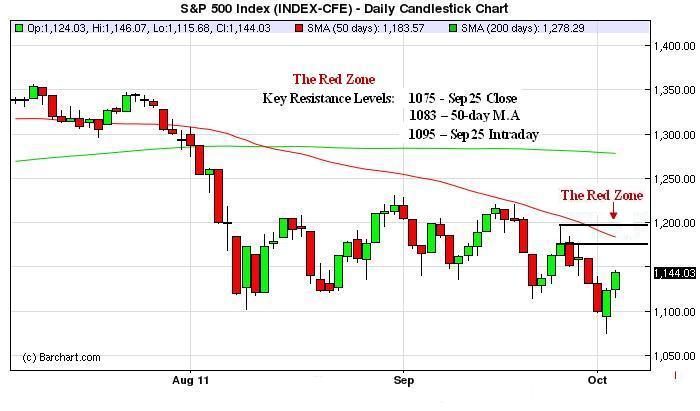
Some rally!  Almost 70 S&P points or 6.4 percent from yesterday’s low to today’s close.  Makes us feel we’re back in the 1990’s trading Brazilian and Russian defaulted sovereign debt.   So where to now?

The next 60 points are going to be much harder as the S&P500 has to clear the “red zone” — 1175 to 1195 — which will be full of 300 pound Bear linebackers, who can bench press  400 lbs..  Yikes!   Halfway into the zone is the 50-day moving average at around 1183, which will also be stiff resistance.

Now that the bulls are on offense, however,  here’s what we think it will take for the next 60 yard [point] gain:

1)  The Shanghai (closed this week) and Heng Sang will need to confirm this move;

2)  No fumbles from the Eurozone backfield.  European banks need to continue to rally and the Eurocrats have to give the impression they’re moving toward a comprehensive debt solution.   The bank recap will have to done as not to adversely affect the sovereign credit of the home governments;

3) No big penalties from the U.S. data.  A significant economic slowdown has been priced, in our opinion, but not a recession nor a -1ooK jobs report. Earnings and guidance will also be key and are priced for a 5-yard off-side setback, but not a 15-yard unsportsmanlike conduct penalty — i.e, big miss and large downward revisions.

4) No team infighting.  No Fugly politics in the U.S. and Europe.  No demonstrations turning into riots.   Peace, love, soap!   

There will be setbacks and quarterback sacks, however, but the bulls are hungry and know time is running out in the 4th quarter.  They need performance to get paid.  If they can clear the red zone at 1295, we sense performance panic can generate a further rally to 1260, which will move the S&P500 into green for the year.   We’ll focus on the Dick Butkus and Michael Singletary at 1230 when we get there.    Now let’s hope the backfield of Merkel and Sarkozy can hold onto the football.

A smart bull is like Cub fan who never gives up hope, but never bets the ranch.   The bulls lose the ball again at 1101 and the season at 1075.   Enjoy the game!

(click here if chart is not observable)

Posted in Equities, Euro | Tagged , , , , | 5 Comments

Why Moody’s cut Italy’s credit rating

(click here if chart is not observable)

Posted in Black Swan Watch, PIIGS, Sovereign Debt, Sovereign Risk | Tagged , , , | Leave a comment

China Notes from the Yum! Brands Earnings Call

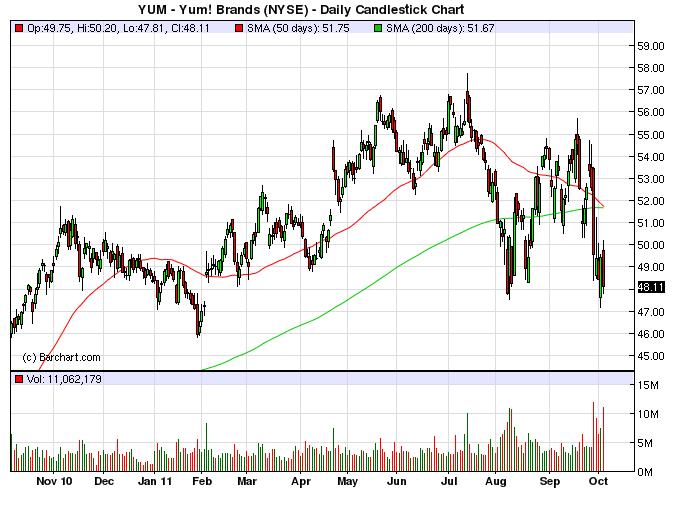
Today’s Yum! Brands’ earnings conference call was dominated by China.  Management talked a lot about commodity inflation running around 8 percent and 20% labor inflation, which they do not yet see abating.   This doesn’t square with the August official inflation rate of 6.2 percent.  A China hard landing scenario is now on traders’ radar and needs to be closely monitored.  The stock closed down 2.7 percent. 

THIRD-QUARTER HIGHLIGHTS

  • Operating profit grew 7% in China and 3% at Yum! Restaurants International (“YRI”), prior to foreign currency translation. Operating profit declined 16% in the U.S.
  • Foreign currency translation positively impacted operating profit by $32 million.
  • Worldwide system sales grew 6%, prior to foreign currency translation, including 29% in China and 8% at YRI. System sales in the U.S. declined 3%.
  • Strong international development continued with 331 new restaurants opened, including 138 new units in China. We are now expecting to open a record 600 new units in China this year. Additionally, we expect to open 900 new units in YRI.
  • Same-store sales grew 19% in China and 3% at YRI, and declined 3% in the U.S.
  • Worldwide restaurant margin declined 1.9 percentage points to 17.2%.
  • During the quarter, the Company announced a 14% increase in its quarterly dividend.

Money Quotes from Conference Call (Direct Quotes from Management)

Our strong performance in China and other emerging markets continues to be the catalyst of our growth. We now expect to open about 1,500 new international units this year, which not only adds to earnings for 2011, but sets us up for an incremental growth in 2012.

We are particularly pleased with our China business, which reported record transaction growth and record expected new unit growth. There’s no question China has powerful brand equity of both KFC and Pizza Hut with outstanding new unit returns. At Yum! Restaurants International, system sales grew 8%, including 13% system sales growth in emerging markets, both prior to foreign currency translation. In the U.S., we saw another quarter of poor results in what remains a tough environment.

…I’m obviously very proud of our China team’s continued strong performance. For the third quarter, units expanded 14%, and same-store sales grew 19%, driven by same-store transaction growth of 27%. Our China division’s operating profit has grown 15% year-to-date, excluding the impact of foreign currency translation. Operating profit grew 7% this quarter, excluding foreign currency translation. Keep in mind that we are overlapping our participation in the World Expo in Shanghai, which added about $10 million of profit to last year’s number. Excluding this overlap, our China team delivered another double-digit earnings growth quarter. New unit development continues to be the major driver of our growth, and we remain the largest U.S. retail developer in China. We’ve opened 329 new units through our first 3 quarters and expect to open a record 600 this year, which will be record development year for us in China. Our China new unit returns remain a key focus for us and continue to be the best in our business.

Any way you look at it, the KFC brand in China is having an incredible year. All our research tells us we’re building our leadership position and making our brand even more relevant. The tremendous increases in new units and traffic puts us in a nice position to continue our strong growth in 2012…

Now we also have achieved tremendous growth and vibrancy at Pizza Hut in China. Pizza Hut Casual Dining goes beyond pizza and continues to unquestionably be the leading western casual dining concept in China with over 560 units in over 120 cities. This quarter marks the seventh consecutive double-digit same-store sales growth quarter for Pizza Hut Casual Dining. The menu has revamped twice a year and continues to offer a broad variety of entrées, including beef, chicken and rice dishes, along with appetizers, beverages and desserts. We are having tremendous success building a true casual dining concept with everyday affordable value. In fact, our new unit returns are now comparable to KFC, and we expect to open about 100 Pizza Hut Casual Dining restaurants this year. We’re especially pleased to be opening Pizza Huts not only in the largest cities but in Tier 3, 4 and 5 cities as well…

In summary, our China business is having a fantastic year. The progress we’re making in executing our China strategy to build leading brands in every significant restaurant category is exceptional.

China produced another impressive quarter. Revenue increased an amazing 35% as we benefited from new unit growth, same-store transaction growth of 27% and favorable foreign exchange. On the other hand, profit growth and margins were less than what we would expect with this type of sales increase. Operating profit grew 7% in the quarter excluding foreign exchange or 11% adjusting for the 2010 impact of the Shanghai World Expo. Margin declined 3.9 percentage points to a little over 21%.

Let me walk you through the details on margins. With commodity inflation of 8% and labor inflation of about 20% in the quarter, we had some significant headwinds. Margins in the quarter were also affected by the new business tax this year and the overlap of the Expo. Taken together, commodity inflation, labor inflation, the business tax and the Expo overlap caused about 7 points of margin pressure. The pricing we took in the first quarter helped to offset about 3 of the 7 points. There were some other moving pieces, but the gap between the inflation and pricing is by far the biggest contributor of the 3.9-point margin decline versus last year.

Going forward, we expect even higher inflation in the fourth quarter. We now expect mid-teens food inflation and labor inflation of about 20% in the quarter. To help offset this, we expect to tweak our value offerings later this year. Despite these initiatives, this level of pricing still lags the impact of a high inflation rate. We therefore expect a decline in fourth quarter year-over-year margins.

We really like our position in China. We have excellent sales momentum and expects solid double-digit same-store sales again in the quarter 4. Our development continues to be robust. 600 new units is clearly an impressive number, and we continue to generate cash paybacks of less than 3 years. This is a portfolio that delivers high returns and high growth…

And the best thing about our business is that we’ve got KFC moving in all cylinders in China. And also, as I mentioned in my earlier remarks, we’ve got Pizza Hut now, which has been dramatically transformed. We’re going into 100 — we’re going to open up 100 stores of Pizza Hut this year. We’re going into Tier 3, 4 and 5 cities. In Pizza Hut, we only have 500 units. So we are constantly just trying to build these brands the right way. I’ve always said that we’ve got these tremendous diamonds. We just got to keep polishing and growing them the right way. And our people capabilities have never been better, the brand has never been stronger. And Yum! in total is going to have another excellent year.

…But we always knew going into this that we could adjust, and the only thing that makes the adjustment tricky is in the fourth quarter inflation.  And for the end of the third quarter is a little higher than what we were anticipating. To your point, we’re anticipating high inflation, but the labor inflation, starting the year, we thought would be in mid-teens. And in the quarter, it was 20%, and we think it’s probably going to be at 20% in the fourth quarter as well…. And then commodity inflation, as we thought, would not get up or not get higher in the fourth quarter. So that — the biggest issue that we probably have is the adjustment towards the value…

Regarding the unit development, I mean, to me, that’s a no-brainer if you could get more units in China. The team is extremely disciplined on development, and one of the good things that came out of the last 5-year plan is that the government is sort of starting to build city clusters around some of the major — about 20 or 25 major cities. We think that gives us new unit opportunities once some new trade zones will be developed as they’re going to build housing in those areas. But they’re also building trains and buses and stations and all of that, which those type of infrastructure can help us. So it’s really been a combination of that investment and the trade zones if that opens up for KFC, as well as David in his speech talked about how Pizza Hut is now able to get into Tier 3 and Tier 4 cities much more profitably than before. So that’s allowed us to increase our Pizza Hut development significantly. So if I could — if we could build 600 units a year going forward, and if that causes us a quarter issue with the labor, that’s like a no-brainer. We still get less than 3-year paybacks on those investments. So we feel great about where we stand in China.

… with the China consuming class going from 300 million to 600 million over the next — in the coming years, we couldn’t be in a better place. So very pleased with this year in China.

… Labor inflation we think will remain high but not as high as it was in the back part of this year. So in terms of how to deal with inflation, I do want to emphasize that we’re in a better position to deal with it than we think everybody else. We have a different leverage that I talked about in my speech in terms of different dayparts, strong distribution system, and so we could take pricing in different areas, in different parts of the country, et cetera.

… we have a world-class supply chain group in China. We have very strong distribution. So our costs are, I think, very well-managed there. The challenge that we’ve had really has been on the protein the last several years. So when you’ve seen the spike, it’s been really related to — we think it’s been going with the market on both pork and chicken. So pork has had a lot of several price spikes the last few years. That has impact on [indiscernible] in proteins in China. So that’s really what’s been driving the volatility. We think the chicken has really been what’s happened on the pork side in China. We’re hoping that, that will abate early next year. On the pork side, and it will start seeing better chicken cost, I’d say starting in around the second quarter next year, but that’s a guess at this point. We’ll give you a better data if we have it in December.

… If you’d take 8% food inflation on our base of about 34% or so, you get a little under 3 points of inflation on the food side. If you take 20% inflation on labor, which is about 14% last year of our base cost, that gets you to, again, a little under 3%. So food inflation, labor inflation in Q3 is equal to about 6% impact on margins.

Analyst Question:  Obviously, you’ve heard a lot of cautionary comments on China and the slowing in trends. So just wanted to confirm that over the best months, since these results are reflecting, that you’re not seeing any deceleration or any shift in kind of the consumer spending habits on the China comp.

Answer:    We don’t discuss trends within a quarter, but we do discuss that there’s a major change from the last quarter. So we have nothing to tell you, which I guess tells you something. Regarding what the underlying rate, it’s really hard to call. There’s just too many moving parts with different inflation rates, different labor rates, et cetera. What I would say though is that I’ve seen a lot of reports on China, and people are trying to estimate what’s going to happen in their economy. And I’m not sure if they’re going to be any better than people trying to estimate what happens in the U.S. economy. I think from our business, what we keep our eye on is the point that David made earlier about what’s happening in the middle class. And everything that we see is that the increases in the labor rates, the people moving from the countryside to the city, the establishment of these city clusters, et cetera, I sort of like those type of macro trends, and to me, I haven’t seen any deterioration of those. If anything, I think the 5-year plan may have helped us a little bit because labor is going to grow a little bit — labor rates are growing a little bit faster, and we’re going to get that infrastructure in those city clusters. So I feel pretty good still about the, I call it, the broad macros. In terms of month-to-month, quarter-to-quarter economic trends, I don’t know if we’re any better than anybody else who’s out there. But as I sort of said before, I feel we could deal with the environmental shifts, wherever they are, pretty well given the quality of our team, our national presence and the different day parts that we have.

(click here if chart is not observable)

Posted in Black Swan Watch, China, Commodities | Tagged , , , | Leave a comment

Macro Notes from the GM Sep Sales Call

We forgot to post this yesterday.  The macro issues raised by GM in their September sales conference call.  All are direct quotes from GM management.

General Motors – October 3

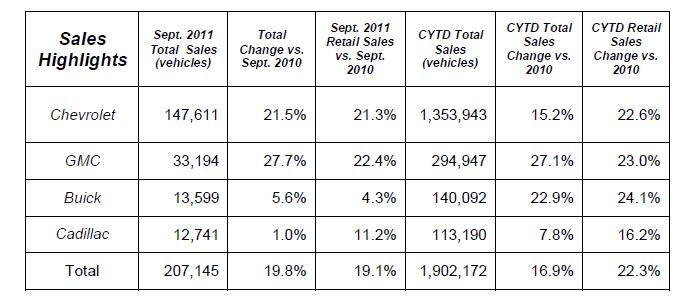
September was another very strong month for General Motors and our U.S. dealers. When you look at the numbers compared to September 2010, our total sales were up 20% to 207,145 units and all four of our brands saw increases in sales.

General Motors total passenger car sales increased 12% compared with September 2010. Our crossover sales increased 7% and truck sales and this includes pickups, SUVs as well as vans increased 34%. And across all of these three segments, retail sales were up 19% and totaled 74% of our mix, plus sales to fleet customers went up 22%.

…the incentive spike in the industry that a lot of people have been talking about in the last few months and had predicted as the Japanese OEMs recovered from the supply destructions does not appear to have materialized in the industry.

… our spending in September was actually down about $50 per unit compared with August while our average transaction price improved by more than $400.

Just like all of you, we are concerned about confidence. We are concerned about sentiment and about the budget battles in Washington. But having said that, we continue to expect that full year US total vehicle sales will be in the low end of our 13 million to 13.5 million unit range.

…our rationale for not revising our forecast is pretty straightforward. It comes down to a couple of things, first of all the timely end of production problems, for the most part, at our domestic and our Japanese competitors, which will bring people back into the market, people who have been on the sidelines.

The other factor is a modest, but steady continuing release of pent up demand as we continue to see the age of the fleet being 10.7, 10.8 years. So, a lot of those people continue to have to buy and come back into the market.

…industrial production, retail sales and employment data all point to a slow growth scenario not a double [dip].

…the rebound [in pickup trucks] was largely industry–wide. As I said, the segment as a percent of industry grew from 12% to 12.8%

… our full size utility were up about 56% and I think we characterized that in the latter comment more accurately, which is with gas prices stabilizing with at least some stability in consumer confidence we were totally surprised to see those vehicles increased in sales.

… clearly growth in employment is going to be one of the biggest drivers of the industry getting to we will call normal post recession growth rates. The good news right now is that we are at least seeing it stabilized, which I think is really important of really vehicle buying attitudes remain strong out there.

…Chevy Volt: 83% of the people [buyers]are new to General Motors, so they are new to the GM family which is great. The average household income was about $175,000 and the most traded in vehicle was actually the Prius

(click here if table and chart are not observable)

Posted in Earnings | Tagged , | Leave a comment

UK Services PMI Rises to 52.9

(click here if chart is not observable)

Posted in Economics | Tagged , , | Leave a comment

Spain and Italy Services PMI Continue to Contract

(click here if chart is not observable)

Posted in Economics, Employment, Euro, PIIGS | Tagged , , , , | Leave a comment

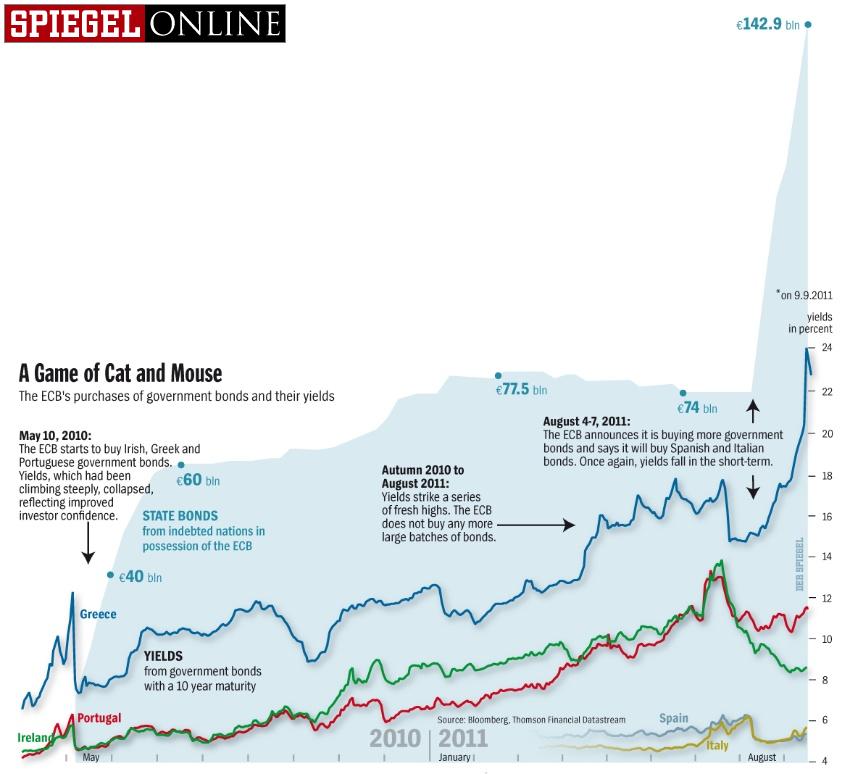
ECB’s Bond Purchases: A Game of Cat and Mouse

A little dated but an informative graphic nonetheless.

(click here if chart is not observable)
Posted in Black Swan Watch, Euro, Sovereign Debt, Sovereign Risk | Tagged , , , | Leave a comment