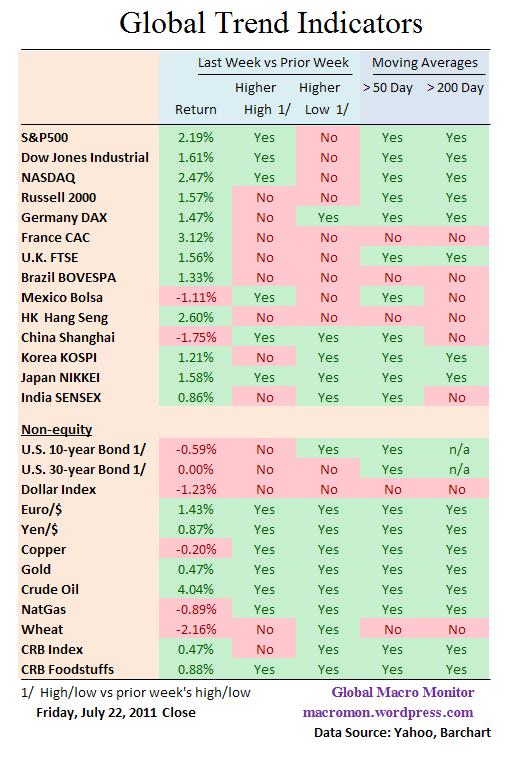
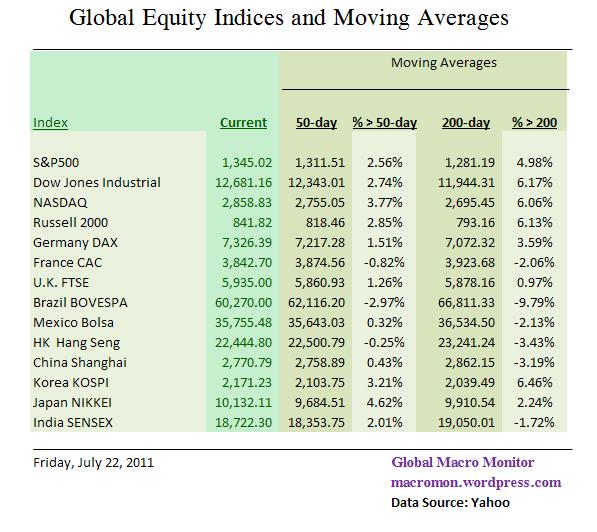
Global Trend Indicators

(click here if tables are not observable)

Posted in Global Trend Indicators | Tagged , , , , , , | Leave a comment

The Weekend Read: Europe Gives Birth to the “Trichet Bond”

As explained in the Financing Offer, investors will be offered four new instruments in addition to the opportunity to participate in a debt buyback program to be established by the Greek government in consultation with the official sector. The instruments are structured to attract voluntarily a wide range of investors. The four instruments involve:

  1. A Par Bond Exchange into a 30 year instrument
  2. A Par Bond offer involving rolling-over maturing Greek government bonds into 30 year instruments
  3. A Discount Bond Exchange into a 30 year instrument
  4. A Discount Bond Exchange into a 15 year instrument

For instruments, 1, 2 and 3 the principal is fully collateralized by 30 year zero coupon AAA Bonds. For instrument 4, the principal is partially collateralized through funds held in an escrow account. All of the debt servicing risk on these new instruments, however, remains full Greek risk.
–Institute of International Finance

China
China “Slowing” as Jintao Promises More Price Controls – Forbes
Slower China Economy Beats Boom and Bust: Caterpillar CEO – CNBC

Commodities
No PK, Bernanke and His Global Central Bankers are Driving Up the Price of Gold – EPJ

Companies
Borders collapse signals a new retail chapter – FT
Fake Apple store cuts to core of China risk to brands – Reuters
Tech heavyweights line up to woo Hulu – FT

Currencies
The Dollar, Gold and The Quality Of Money – Forbes

Economics
Bad economy may be mother of invention – USA Today
California job market is rebounding, but unevenly – LA Times
Concerns About Economy, Jobs Outweigh Worries About Deficit – Gallup
Location Matters in Manufacturing – TR
The Lesser Depression – Paul Krugman
Why Companies Win While Economies Lose – Moneyland

Emerging Markets
Locally Denominated Emerging-Market Bonds Attract Fresh Capital – WSJ

Europe
Europe Debt Plan Relieves Pressure – WSJ
Europe finally admits its debt problem to save the euro – Joseph Stiglitz
Europe Must Choose a Currency Union or a Financial Union – Floyd Norris
Europe’s debt crisis: Counteroffensive – Economist
Fitch: Greek Deal a Restrictive Default – WSJ
Greece Debt Exchange Offer: Statement by the IIF – IIF

Fiscal/Monetary Policy & Debt
Debt and Delusion – Robert Shiller
Geithner in crisis meetings on default threat – FT
The Next Debt Crisis Could Come from Paris – Bloomberg

Geopolitical
Moves to ease tension in South China Sea – FT
Terrorism strikes Scandinavia – Economist

Japan
Japan’s debt: The domino that never falls – Economist

Markets
Default Insurance Has Some Quirks – WSJ
Frank Quattrone on Bubble 2.0 — or is it? – CNN Money
Investors again pay big for dot-com stocks – USA Today

Technology
Big Science: The Universe’s Ten Most Epic Projects – PopSci
First Analysis of Trends on China’s Version of Twitter – Physics arXiv Blog
Nanosensor Tattoo Tracks Sodium and Glucose via iPhone App – TR
They came from Mars: Scientists begin the search for DNA on Mars – Scienceline
Sounds like space: recordings collected by NASA’s spacecraft – Scienceline

Video: Space shuttle Atlantis final landing: NASA 30-year program over

(click here if video is not observable)

Posted in The Weekend Read | Tagged , , , , , | 2 Comments

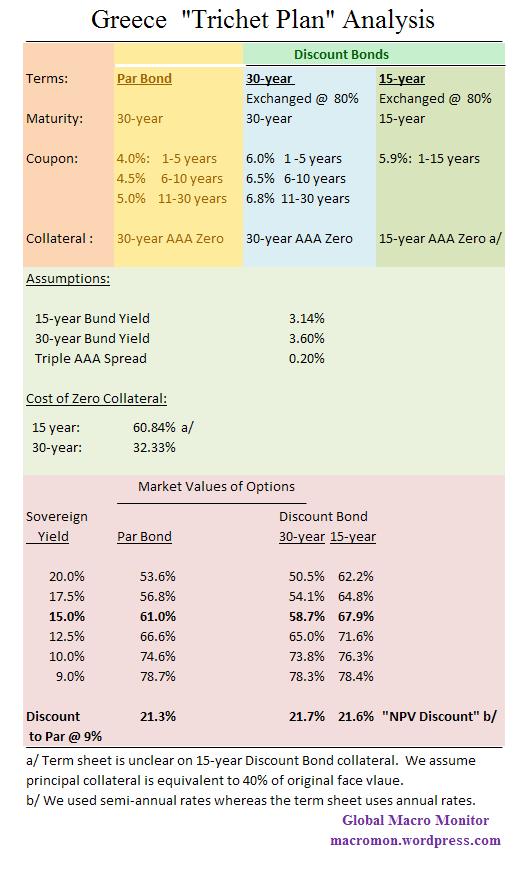
Analysis of Greece’s “Trichet Plan” Restructuring

We’ve done some quick analysis of Greece’s commercial bank “Trichet Plan” restructuring announced late last night (click here for term sheet) by the Institute of International Finance (IIF).   The IIF is a consortium of the world’s largest banks.

Interestingly, the plan looks very similar to the one presented on this blog in late April.   The structure uses the Brady Plan framework from late 1980’s and early ‘90’s and is really the first step to deal with bond maturities coming due over the next few years.

The realized debt and debt service relief to Greece will not be known until the final deal is closed.   It is a beginning and huge step in the right direction as it finally addresses  the structural problem of Greek’s debt overhang.

The table below shows that assuming a Greek sovereign yield of 15 percent, just about 100 bps below its current 10-year yield, the three options will trade in the secondary market from 59 percent to 68 percent of face value, much higher than the current price of Greece debt.   The authorities who negotiated the deal tried to make the options in the menu equivalent based on a Greek sovereign yield of 9 percent.    They state in the term sheet “all instruments will be priced to be economically equivalent at 21 NPV discount at a discount rate of 9%.”

This doesn’t mean that it will provide Greece with a 21 percent haircut, but that the bonds will trade at 21 percent discount in the secondary market if Greek sovereign yields are 9 percent.  Like many other issues, including contributions to public pensions or estimating the cost of global warming, it all comes down to the discount rate assumption.   The Mexico Brady Plan Bank Advisory Committee spent several weeks debating the discount rate, which had a large impact on the final structure of Mexico’s deal.

Many will dismiss this deal as it does not solve and provides only limited relief to Greece’s debt overhang, but it’s a start and makes Greece’s debt problem much more manageable over  the short-term.  There will be many positive externalities from the deal not to mention the increase in confidence and higher bond prices, which will strengthen the balance of sheet of Greece’s bank creditors.   Furthermore, at a 15 percent yield, which still incorporates a relatively high probability of default, more than half of the market value of the Par Bond, for example is the AAA zero coupon collateral.

At the end of the day, the Brady Plan did not provide much net debt relief to the participating countries and was even initially criticized as so by the IMF.   Its success was really the result of the positive externalities generated from reducing debt rather than increasing it.   In addition, Greece will have more time to reduce its debt through buybacks and debt swaps, such as debt-for-equity, debt-for-environment, and debt-for-education swaps.

There are still many issues that need to be addressed, including how to deal with the free rider problem as no doubt vulture funds have and will be buying Greek bonds in the secondary market with the hope of being paid in full.  However, many of the largest European banks and largest creditors to Greece have already signed onto to the deal, including Deutsche Bank, BNP Paribas, Société Générale, Commerzbank, and ING.   Step by step.  No magic solutions.

Our sense is that shorts are going to be reaching for the KY.   Godspeed, Greece.

(click here if table is not observable)

Posted in Black Swan Watch, Euro, PIIGS, Sovereign Debt, Sovereign Risk | Tagged , , , | 5 Comments

Greece’s Brady Plan, Finally

The International Institute of Finance, a consortium of the largest global banks,  just released a  term sheet for a Brady-type Plan for Greece.

The menu of options include Par and Discount Bonds, with principal collateral,  and a buyback option.  The coupon on the 30-and 15-year Par Bond will step-up from 4-5 percent.  The Discount Bond, which includes a 20 percent haircut at exchange, will have a 5.9 percent coupon and 30-year maturity.  This sounds a lot like the paper we presented here in April.

Europe finally gets it and is beginning to address the periphery’s structural debt overhang, though the term sheet says the deal is “unique” to Greece due their “exceptional circumstances.”  Many of Europe’s largest banks have already signed on to the deal, including Deutsche Bank,  BNP Paribas, Société Générale, Commerzbank, and ING.

The haircut, some will no doubt argue, may not be big enough, but it’s a start.  European bank stocks were up big today, some almost 10 percent.  Our sense, the markets will like it, but you never know.  We need to further analyze the term sheet and will get back to you.  Stay tuned!

Posted in Euro, PIIGS, Sovereign Debt, Sovereign Risk | Tagged , | 1 Comment

Apple Nation: Key Metrics as a Country GDP

In prior posts we’ve compared Apple’s market cap and cash position to country GDPs.  Here is our update, which also includes annualized revenue and profits from the recent earnings release.

Apple’s market cap is now larger than all three European PIG (Portugal, Ireland, and Greece)  economies.   The company’s annual revenue and cash position would rank 60 and 64th of the 180 plus economies tracked by the IMF.   Apple’s annual profits are more than double the size of Iceland’s economy.   The upshot is the Apple nation is growing!

We’re disappointed and surprised how Apple is trading after its blow out numbers.  Our sense is that weekly options are keeping the stock from taking off as those who bought calls at high premiums prior to earnings are barely above water even after the $10 move and are lightening up.   It could also be the that some Board members are talking about a succession plan, which is spooking investors, and the very fact that Apple has become so big it takes a lot more firepower from the rest of the market to move it.   At the end of the day, however, nobody knows for certain.

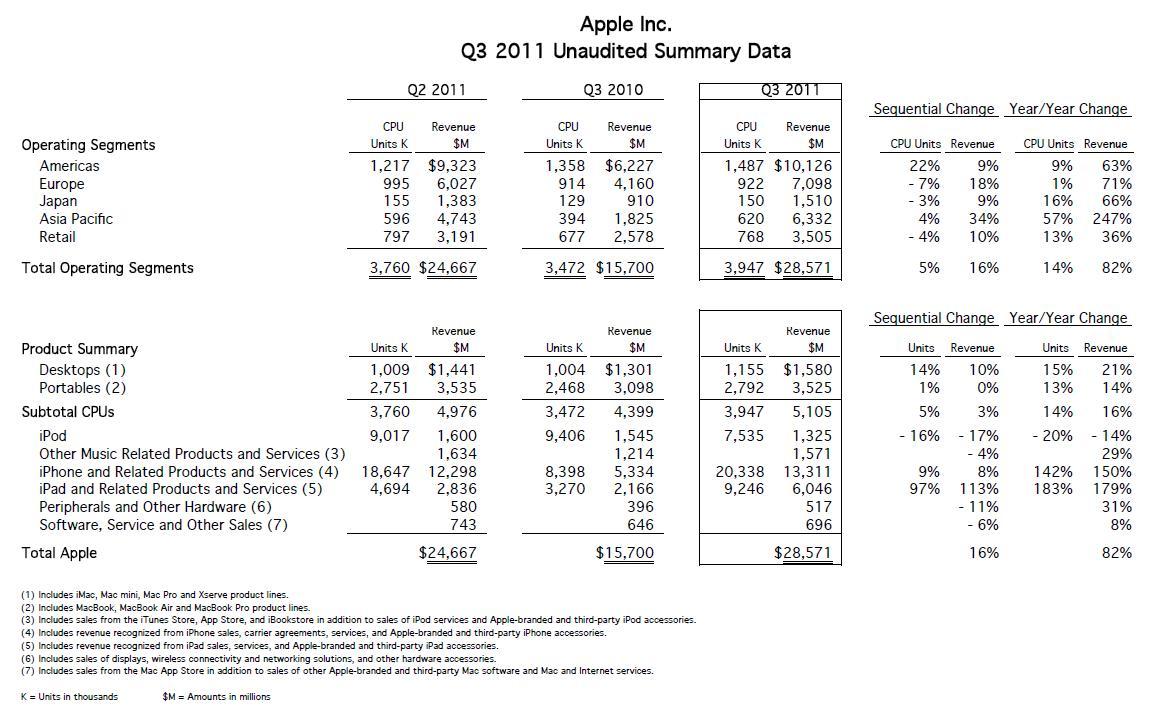
Nevertheless,  we believe more want to buy this stock than sell it and look for it to head much higher as they tap into and realize the growth potential of China and BRIC demand.  Management announced a staggering 247 percent annual revenue growth in Asia Pacific in latest quarterly results.   This company even works in a down economy.  It’s the younger generation’s escape in troubled times as fishing and movies were for the greatest generation.

And, please, no lectures on comparing stock and flow data!


(click here if table is not observable)

Posted in Apple | Tagged , | 2 Comments

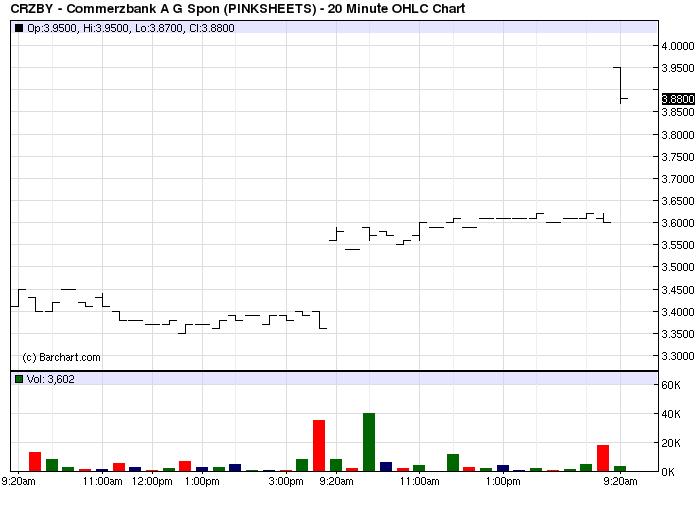
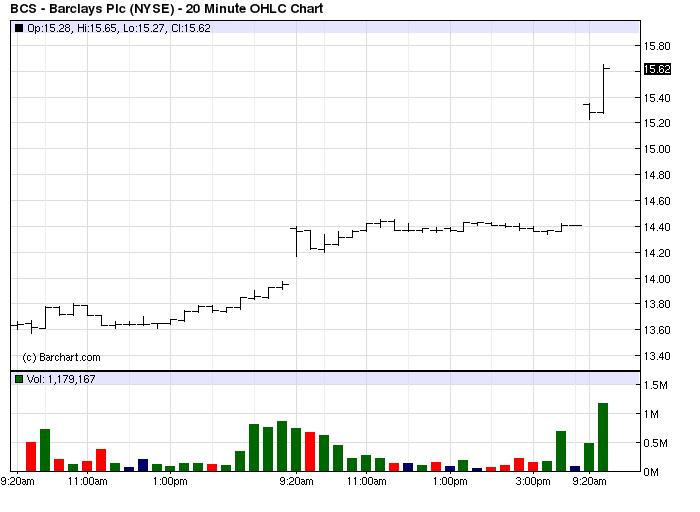
European Banks Rockin’………….

Take a look at Germany’s Commerzbank and Barclays of the UK.   Both of their U.S. ADRs are up around 10 percent today.    Optimism over a Marshall Plan for Greece is helping the European banks and the Euro today.  The markets are once again offside and not long enough equity and risk.  More optimism [on a European and U.S. debt deal] could send the risk markets “to the moon,  Alice!”

 (click here if charts are not observable)

Posted in Black Swan Watch, Equities, Euro, Sovereign Debt, Sovereign Risk | Tagged , , | 2 Comments

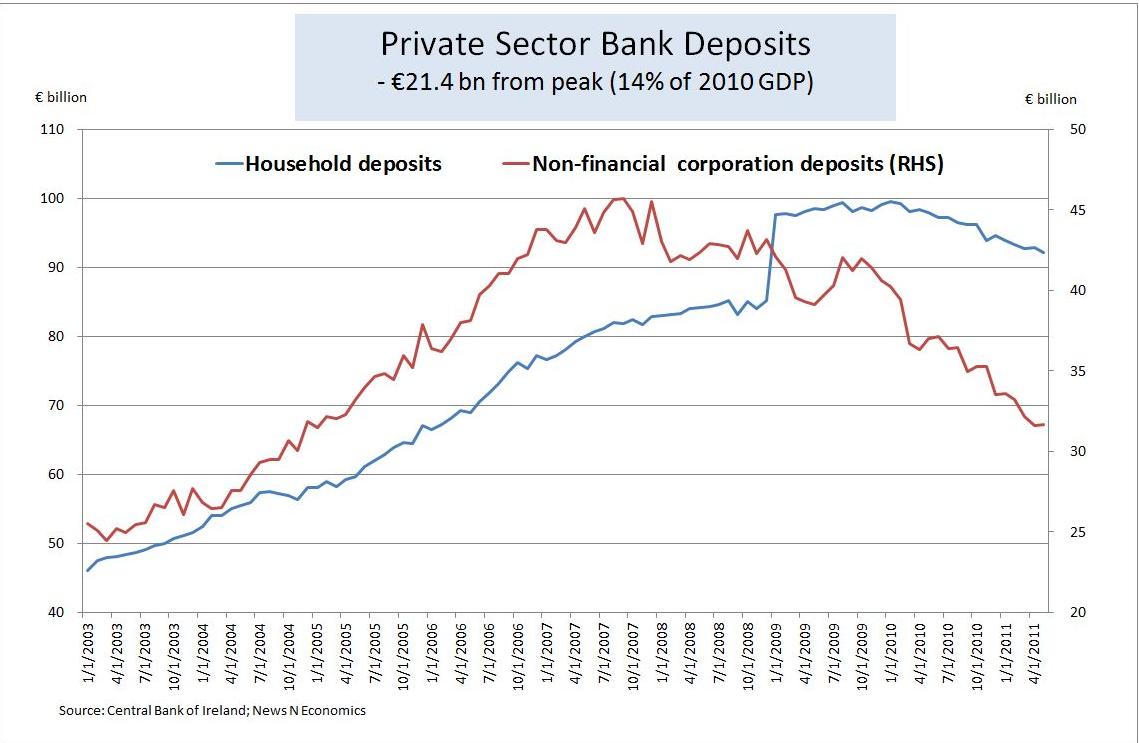
Chart of the Day: Ireland’s Silent Bank Run

We found this great chart posted over at New N Economics by Rebecca Wilder.  She points out the non-financial corporates have been fleeing Irish banks since 2007 and households 2010 to the tune of 14 percent of GDP.    Irish banks now borrow about one quarter of what they lend from the ECB,.   The ECB  exposure to Irish banks is  more than Euro 100 BN, or close to 100 percent of the country’s GDP.

(click here if chart is not observable)

Posted in Black Swan Watch, Monetary Policy, PIIGS, Sovereign Debt, Sovereign Risk | Tagged , , | 1 Comment

Nonlinear thinking: New Developments in Electric Cars

Time’s Money land blog reports the following changes in the world of electric cars:

1)  Chevy Volt’s been very successful … at selling the Chevy Cruze. Fortune reportsthat in the same way drivers have been drawn to Chevy dealers to check out the latest Corvette, only to wind up buying the less expensive Camaro, loads of curious shoppers have been flooding in to get a look at the gas-electric hybrid Volt—but drive away with a Cruze or Malibu. The Volt and the Cruze have similar appearances, and both can claim to get good gas mileage, but while the Cruze Eco boasts 42 mpg on the highway, the Volt can’t be beat with upwards of 125 mpg. On the other hand, the Cruze starts at a bit over $16K, the Volt at $41K, which could be a reason why the Cruze is by far outselling the Volt.

2) Toyota will sell electric cars next year—not a puny hatchback but a mini SUV. After rumors surfaced that Toyota’s all-electric compact SUV, the 2012 RAV4 EV, would only be available via car sharing programs, the carmarker announced that the battery-powered, larger electric alternative to the Volt and Nissan Leaf would, in fact, be sold to the general public in 2012. When, exactly, and for how much? That info hasn’t been released yet.

3)  Rolls-Royce (!) has introduced an electric vehicle of its own. Instead of the V12, 17-mpg engine powering your standard $380K Rolls-Royce Phantom, the latest Rolls, the 102EX, uses two all-electric motors that combine for the equivalent of 388 horsepower and can be driven a bit over 100 miles on a full charge. Will the potential savings in gas make the 102EX a sensible purchase? Not a chance.4(

4)  Nissan increases availability, features—and price—of the Leaf. The base price of the Nissan Leaf is rising $2,420 (up to $36,200) for the 2012 model. The 2012 Leaf will also have new standard features, including battery warmers and heated seats, and they’ll be newly available for sale in several parts of the country—Alabama, Florida, Georgia, Illinois, Maryland, Mississippi, North Carolina, South Carolina, Virginia, Washington, D.C.—in addition to the states where it can already be purchased (Arizona, California, Hawaii, Oregon, Tennessee, Texas Washington).

5)  An all-electric car sharing service is being launched. Car2Go, which loans Smart cars to members in Austin and Vancouver, among other places, is launching the first-ever all-electric car sharing operation in San Diego. A fleet of all-electric Smart cars, each with a driving range of 84 miles per charge, will be available for members of the car-sharing service by the end of 2011.

6)  An “electric highway” is coming to the Pacific Northwest. A series of fast-charging stations is being installed every 40 to 60 miles in Washington along I-5 and U.S. Rte. 2, creating what will be the first EV highway in the country. While the time to recharge an electric vehicle varies widely depending on the charger and the car, the combo of the fastest charger and the most high-tech vehicle (Nissan Leaf Level 3) would mean a full recharge could occur in 30 minutes all along the EV highway. In related news, I now can’t get the Eddy Grant classic “Electric Avenue” out of my head.

Posted in Energy, Nonlinear Thinking, Technology | Tagged , | 1 Comment

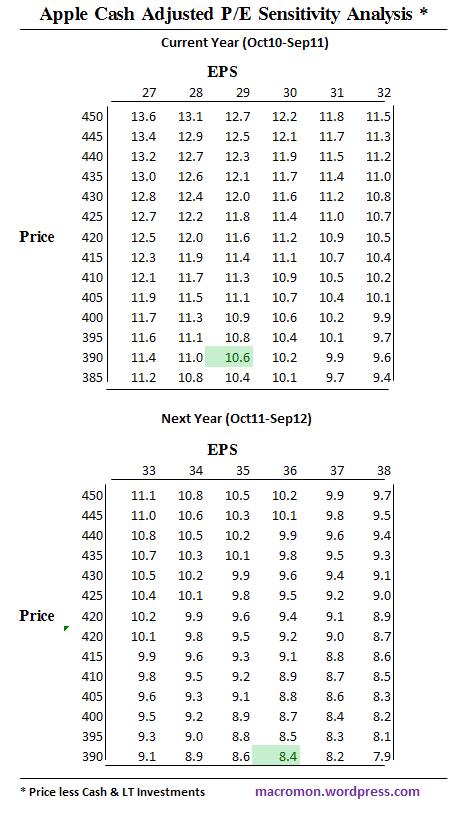
Apple Valuation and Sensitivity Analysis

(click here if charts and table are not observable)

Posted in Apple | Tagged , , | 2 Comments

Apple’s Big Beat: What’s Next for the Stock?

We’re still reeling from Apple’s stunning and historic earnings release after the market close.   The company beat expectations by over 34 percent, posting $7.79 per share and up an unbelievable 121.9 percent y/y and 21.7 percent q/q.  Revenues grew 81.5 percent y/y and 15.5 percent q/q.  The company now sits on over $76 BN of cash and long-term securities, which equates to around $83 per share.  We read somewhere that Apple could almost purchase RIMM with just the increase in its cash position this quarter.

We found it interesting listening to traders after the release.  Many were itching to sell the pop in after hours, which saw the stock trade over $400.  Normally after such a nice short-term run into the release we would agree.  But when the company blows away earnings in such a stunning manner we look to history to get a sense of how the stock trades post earnings.

The most similar post crash quarterly result we could find was the Q2 2010 release, where the company beat estimates by almost 36 percent.  The table below shows the earnings and revenue growth for that quarter were not even in the same zip code as today’s announcement, however.

Furthermore, in the following charts we compare how the stock traded prior to the two relevant quarterly results.   Apple has been consolidating for almost the entire year and was only a couple percent above its February $365 intraday high going into today’s earnings announcement.

What’s next?   We’re not certain, but if past is prologue, the stock could trade up to almost $420 in the next few days before consolidating its gains and preparing for the next leg up into, what many expect, the September release of the iPhone 5.

Can’t you just hear the prayers of those hoping for a pullback so they can get long and longer?  Other than the health of Steve Jobs, the only thing holding the stock back, in our opinion, is that numbers are so good they just can’t be believed.   If Apple earns $8.38 this quarter, the stock, at $395, trades for a multiple of 13.6. That is hard to believe given the company’s growth rate.   Stay tuned.

(click here if charts are not observable)

Posted in Apple | Tagged , , | 1 Comment