Nonlinear Thinking: Smart Phone Cataract Detecting Device

This is what we’re talkin’ about! We stumbled upon this while reading a Blooomberg piece this morning, Health Tools for Apple’s IPhone May Get Same Scrutiny as Stents.  This is the exact technology that will lift the American and global economy out of its current funk.  Not more stimulus, not QE7, but entrepreneur led cutting edge practical tech applications, which marries the mobile revolution with societal and cultural trends.   These are the types of positive black swans which render medium-term economic forecasts useless.

After all, who would of predicted the rise of the internet and its impact on the economy of the late 1990’s when President Clinton was fighting with Newt Gingrich about shutting down the government in the mid-1990’s?  Not only did it get Clinton reelected, but helped, albeit temporarily,  balance the Federal government’s budget for the first time in many years.  This, while the CBO had predicted perpetual deficits just a few years earlier.

So rather than having a Malthusian investment strategy of hoarding commodities, we place our bets with the likes of Peter Thiel of Clarium Capital, and one smart guy, who believe technology is really the only game in town.

On that note,  Apple’s on deck after the close and expected to earn $5.80 per share.   The stock has run, but it still only a few percent above its high made in March.   The company usually beats estimates  by 10-20 percent and we have a feeling this could be big and are using options to play for a nice surprise.  We’ve maintained that Apple has helped to create the hardware infrastructure to reinvent itself, say, as a mobile medical equipment or apps company.  This cataract detecting device is an example of what’s possible.  Stay tuned.

Click here for our previous nonlinear thinking posts.

(click here if video is not observable)
Posted in Apple, Nonlinear Thinking | Tagged , , , | 3 Comments

Sovereign Debt and Geriatric Deadbeats

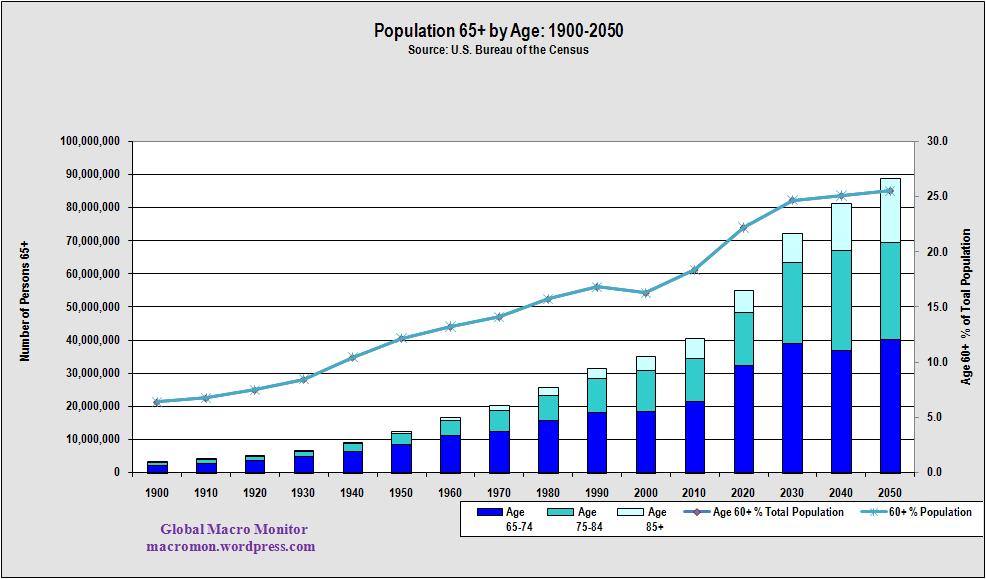
In the spirit of our earlier post, The Clash of Generations, we point you to an interesting piece, Geiatric Deadbeats, written by Ali Alichi of the International Monetary Fund (IMF).   He argues the age of a country’s population is inversely correlated with a sovereign government’s willingness to pay its debt obligations.

Because holders of sovereign loans and bonds generally have no explicit recourse to hard assets or a “sovereign balance sheet” in the event of default, a debtor government’s willingness to pay is almost as important as its ability to pay.   Go no further than Europe or the debt ceiling negotiations in the U.S. Congress for confirmation.

Mr. Alichi writes,

Studies have shown that a country’s willingness to repay is as important as whether it has the resources to repay. This willingness deteriorates as voters age because they have a shorter period to benefit from their country’s access to international capital markets and become more likely to opt for default on current debt. Moreover, older voters generally benefit more from public resources—such as pension and health care benefits—which could shrink if debt is repaid. If the old are a majority, they might force default, even if it is not optimal for the country as a whole. Lenders will take this into account and reduce new lending to an aging country.

Thomas Friedman spoke yesterday in his New York Times column of the “powerful sense of ‘baby boomers behaving badly’ and their legacy of the “incredible debt burden and constraints” they will leave on their children.   According to Mr. Alichi this bad behavior of the boomers may not end at retirement.   He writes,

Now if the old are altruistic and care about their children as much as themselves, they will not vote for default with its negative consequences for future generations. But Altonji, Hayashi, and Kotlikoff (1997) have shown that altruism does not hold at the overall level in the United States—although there are few studies of this sort for most other countries.

The next ten years will surely be interesting.    We at the Global Macro Monitor are baby boomers and implore our generation, at least, those who can afford it, to take one for the kids.  If this means we have to play muni golf courses instead of Pebble Beach and Pinehurst and hitting Top Fiites instead of Pro V1s (sorry FILA) in our twilight years, so be it.

Mr. Alichi has some good ideas on how to improve our national credit profile.  His piece is short and sweet and well worth your time.  Click here for the article.

(click here if charts are not observable)

Posted in Black Swan Watch, Demographics, PIIGS, Sovereign Debt, Sovereign Risk, State and Local Government | Tagged , , , , , | 4 Comments

Macro Notes from the IBM Conference Call

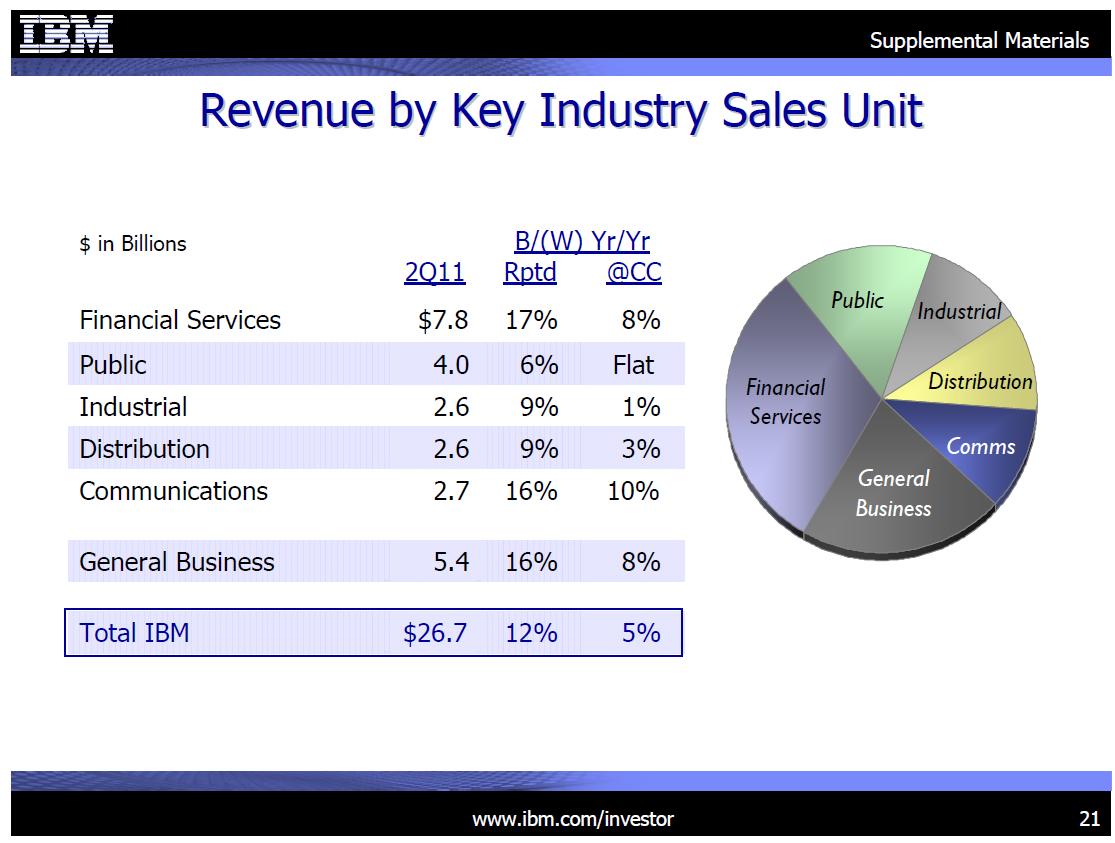
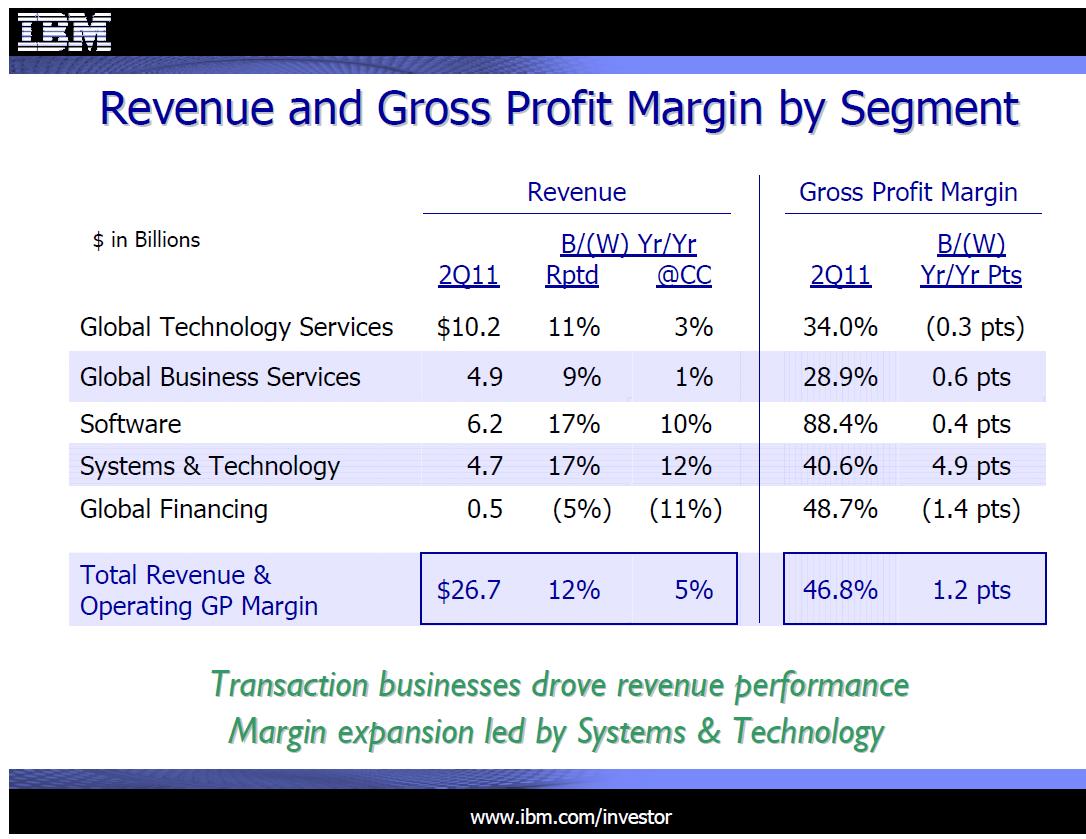
The following are direct quotes from today’s IBM earnings conference call, which was fairly upbeat.  Note, however,  more than 50% (7 of the12 percent) of the company’s revenue growth was due to currency effects.

Key Metrics
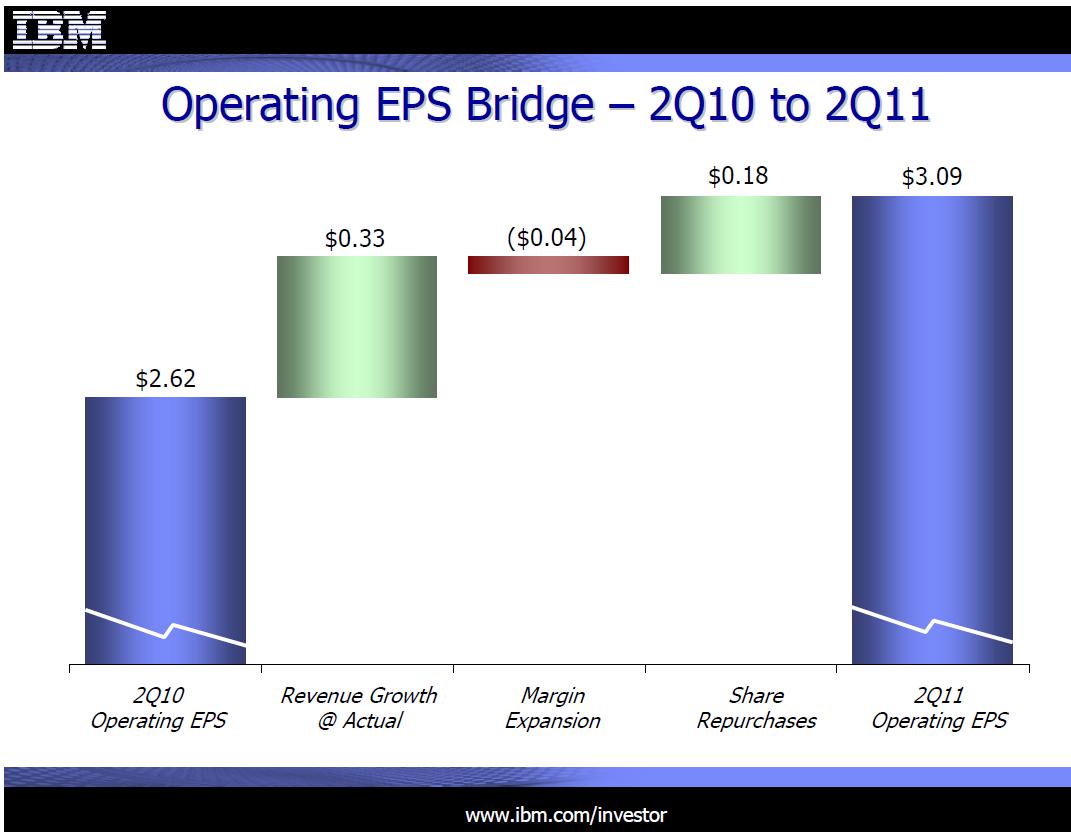
In the second quarter, we delivered revenue growth of 12% [5% business and 7% currency effects], and operating earnings per share of $3.09, up 18% year-to-year.

Our strong earnings performance resulted in $3.4 billion of free cash flow in the quarter, and in the last 12 months we’ve generated $16 billion of free cash flow.

Guidance
With this performance, we’re increasing our full year 2011 expectation for operating earnings per share to at least $13.25, which is up $0.10 from our previous view of at least $13.15, and up $0.25 from the beginning of the year.

Geographical Performance
Based on local currency

Major markets revenue was up 3%. The U.S., our largest market, was up 6% and Canada was up 11%, driven by momentum in our server and software businesses.

Europe had a modest improvement in the year-to-year growth rate, with continued growth in U.K., France and Spain. And this quarter, Germany and Italy returned to growth.

In Japan our revenue was down 5%, consistent with the first quarter growth rate.

Growth markets continued their very strong performance, outpacing the majors by 10 points. Since we announced our growth markets unit in the beginning of 2008, the revenue growth rate has outpaced the major markets by an average of 9 points, again on a local currency basis.

We also had double-digit growth and share gains in each of the BRIC countries. The combined revenue in the BRICs was up 21%. But our success goes beyond the BRICs, we had double-digit growth in almost 40 growth market countries.

We remain confident that growth markets will approach 30% of IBM’s geographic revenue in 2015, and drive half of IBM’s revenue growth with strong margin performance.

Expenses
Our total operating expense and other income was up 20%, with about half of the growth attributed to currency, from both translation and hedging dynamics.

We hedge our major cross-border cash flows to mitigate the currency volatility in global cash planning. With the year-to-year change in currencies, hedging programs generated losses this quarter, as compared to gains last year.

Our base expense, excluding currency and acquisitions, was up 6 points.

Buybacks & Dividends
We returned almost $10 billion to shareholders. We spent $8 billion in share repurchase, where we bought back almost 50 million shares. At the end of the second quarter, we had $8.7 billion remaining in our buyback authorization.

We took our dividends up 15% in April, and through June we paid out $1.7 billion in dividends. This is the 16th consecutive year that we raised our dividend, and the eighth year in a row of double-digit increases.

Europe
I do feel that we’re in a more stable position in Europe. The growth rate in Europe went from 2%, 3%. Within that, we returned to growth in Germany. We returned to growth in Italy. We’ve got some very strong plays in Europe.

(click here if charts are not observable)

Posted in Earnings | Tagged , , | 6 Comments

The Clash of Generations

Thomas Friedman is “connecting the dots” in his New York Times column piece over the weekend, The Clash of Generations.    The Global Macro Monitor posted a similar piece, Connecting the Dots: The Coming War Between Generations,  back in March.

During the Egyptian revolt and as concerns over public pensions in the U.S. really started to increase,  we wrote

It is also time to connect some dots.  What we are witnessing in the Middle East where the young, who have little or no political voice and a not so bright future are throwing off their autocratic gerontocracies at an incredible pace.   Something similar will manifest here and the rest of the aging west, though probably in different way, when younger generations realize the consequences of being saddled with a massive debt and declining public services as the tax revenues are diverted to debt service and retirement benefits.   Not to mention the world full of carbon they have inherited.

They to, like their Facebook brethren in the Middle East, will revolt and throw off the gerontocracy that will control the political system as baby boomers age, which over taxes them to pay the debt used to finance the excessive consumption and current retirement benefits of their parents and/or grandparents generation.It doesn’t take a C.I.A. analyst with a Ph.D. to realize the potential for political blowback when one generation is rendered into servitude due to the excesses of another.   Or does it?

Here’s Friedman in his Clash of Generations,

Indeed, if there is one sentiment that unites the crises in Europe and America it is a powerful sense of “baby boomers behaving badly” — a powerful sense that the generation that came of age in the last 50 years, my generation, will be remembered most for the incredible bounty and freedom it received from its parents and the incredible debt burden and constraints it left on its kids.

It is no wonder that young Greeks reacted so harshly when their deputy prime minister, Theodoros Pangalos, referring to all the European Union loans and subsidies that propelled the Greek credit binge after 1981, said, “We ate it together” — meaning the people and the politicians. That was true of the baby boomer generation of Greeks, now in their 50s and 60s, and the baby boomer politicians. But those just coming of age today will never get a bite. They will just get a bill. And they know it…

I was struck by one big similarity between what I heard in Tahrir Square in Cairo in February and what one hears in Syntagma Square today. It’s the word “justice.” You hear it more than “freedom.” That is because there is a deep sense of theft in both countries, a sense that the way capitalism played out in Egypt and Greece in the last decade was in its most crony-esque, rigged and corrupt deformation, letting some people get fantastically rich simply because of their proximity to power. So there is a hunger not just for freedom, but for justice. Or, as Rothkopf puts it, “not just for accounting, but for accountability.”

How long before the young realize they’ve had their future stolen from them by the baby boomers?   The answer to this question will determine your  our defined benefit pension,  social security and medicare benefits.  Reality meets us at sunset.  Stay tuned.

Posted in Black Swan Watch, Bonds, Demographics, Egypt, Fiscal Policy, Geopolitical | Tagged , , | 8 Comments

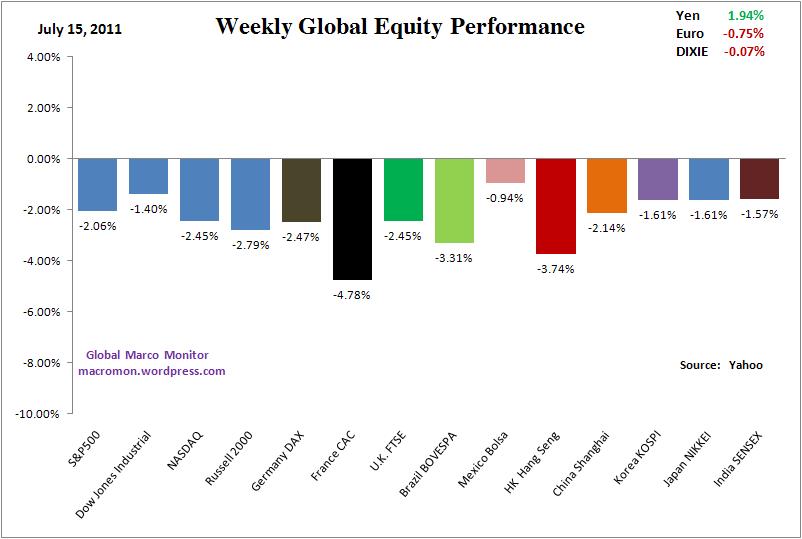
Week in Review: It’s the Politics, Stupid!

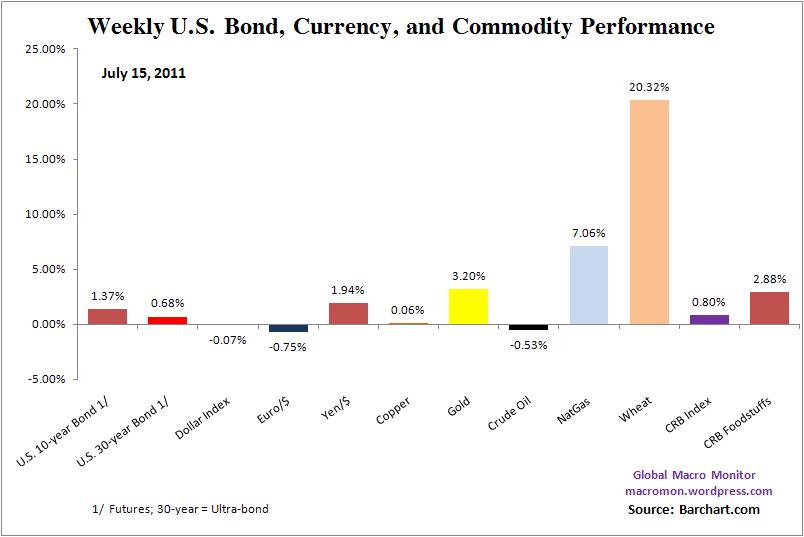
The direction of markets this week will be determined by the politics of debt, both  in Brussels and Washington    We are expecting some decent volatility as the markets begin to price the negative scenarios.  Given the unpredictability of politics, we’re not making big directional bets, however.   Could the Congress really choose the nuclear option and not raise the debt ceiling?   Logic says no.   Are politicians logical?   Place your bets.

After Google’s huge rally on the back of its earnings beat,  we are watching Apple very closely.   A beat and similar rally would signal, at least to us, the safe haven trade is now in strong balance sheet/decent growth private sector companies, both their debt and equity.  The times they are a changin’!  And, yes,  don’t forget gold.

    (click here if charts are not observable)

Posted in Week in Review | Tagged , , , , , | Leave a comment

Nowhere to Hide…

Larry Summers understands the risks the game Congress is playing with on lifting the debt ceiling.   Bloomberg writes,

Summers said a potential default makes him worry about “runs on banks, runs on money market funds,” exchanges facing “the prospect of collapse, institutions that had been built over decades” being “swept away.”

“The ability to carry on routine financial business — to clear checks, to pay bills, to meet obligations would be lost,” he said.

“It would be a totally self-inflicted cataclysm,” he said. “There’s no question the United States can meet its obligations. This idea that somehow that we cannot pay because we’re having a political fight over how to handle the spending and taxing” is “democracy functioning in the worst possible way,” he said.

There you have it.  One of the most influential economic policymakers in modern U.S. history saying even the stock exchanges — and we think he also means the clearing mechanisms — will collapse.

We hear of nervous investors,  worried about a U.S. default, are moving into safe havens, such as FDIC backed bank CDs.   You know the FDIC, the institution which has the backing of the full faith and credit of the U.S. government.    We may all still end up living under the freeway and eating bark, after all, which, according to our high level policymaker friends,  was a very real possibility as the global financial system and economy teetered on the brink, not once, but several times during 2008 financial crisis.

Posted in Black Swan Watch, Budget Deficit, Fiscal Policy, Sovereign Debt, Sovereign Risk | Tagged , , , | 2 Comments

Global Trend Indicators


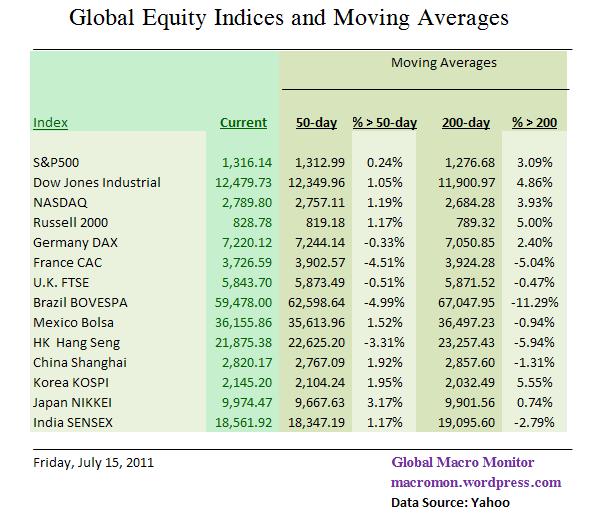
(click here if tables are not observable)

Posted in Global Trend Indicators | Tagged , , , , , | Leave a comment

The Weekend Read: Death by Debt

“WE HAVE a system of government in which everybody has to give a little bit.” So said Barack Obama at the start of this week. But parse that sentence. Does the president mean that America already has a system in which everybody has to give a little bit? Or does he mean only that it ought to have such a system? It is not too much to say that the country’s economic well-being hangs on the answer.  – Economist

China
China’s economic growth eases to 9.5% – FT
On the matter of misvalued Chinese land – FT Alphaville

Commodities
Return of the Gold Standard as world order unravels – Ambrose Evans-Pritchard

Companies
Google: Q2 Earnings Destroy Expectations ‘Despite Competitor Efforts’ – IBT

Economics
Behind the downgrades and the doubt: A crisis of growth – BBC
Britain Reels from Brutal Austerity–GDP, Jobs Disappoint – Fiscal Times
U.S. CPI drops 0.2% in June as energy costs ease, core hot – Market Watch

Emerging Markets
Brazil: Boom or Bubble? – Council of Americas
The Geopolitics of Brazil: An Emergent Power’s Struggle with Geography – Stratfor

Europe
Blame Silvio’s antics for Italy’s bond market fall – FT
Don’t blame Moody’s for a messy euro crisis – FT
Europe must consider radical options – El-Erian
From Italy to the US, utopia vs reality – Martin Wolf
Is the euro doomed? Not so fast – CNN
Italian parliament passes €45bn cuts package – FT
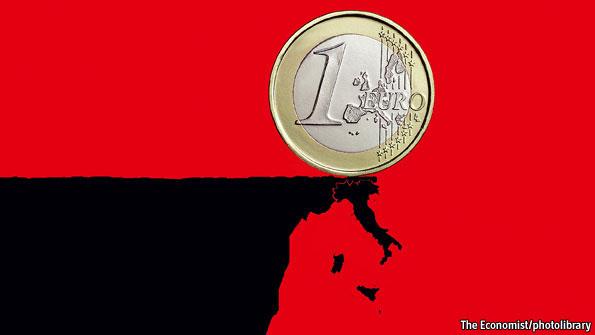
Italy and the euro: On the edge – Economist
Nine banks fail Europe stress tests – FT
True Europeans now need a ‘plan B’ – George Soros

General
Learning from Crises – Harold James
U.S.turn to be banana republic – Financial Post

Geopolitical
Libya After Qaddafi – Project Syndicate

Housing
Beginning of the end of the entire crisis? – Mark Hulbert

Japan
BOJ June Minutes: Two Members Said More Easing May Be Needed – iMarketNews

Monetary/Fiscal Policy
Dicing with debt and the future – Economist
Plan B Emerges on U.S.Debt – WSJ
Sovereign risk and banks: Joined at the hip – Economist
US triple A rating: brave messengers, Lex – FT
Worried About Debt Limit? The Bond Market Isn’t: Caroline Baum – Bloomberg

Technology
Evidence Suggests that the Internet Changes How We Remember – TR|
Locusts Swarm Like Twitterers Tweet – Science Daily
Nanostructures Could Result In Cheaper Electric-Car Batteries – TR
New Way to Store Sun’s Heat – Science Daily
Smart mattress automatically shifts bedfast patients – CNET

Video:  Wreck of 1853 Schooner Found

(click here if video is not observable)

Posted in The Weekend Read | Tagged , , , , , , | 2 Comments

Is Gold Money?

During today’s Congressional testimony Fed Chairman, Ben Bernanke, was confronted by Rep. Ron Paul with the question, “Is gold money”?  (see video below)  The Chairman answered, “no” and went on to say the reason why central banks hold gold is because of “tradition”.    Interesting!

In prior posts we’ve written about how difficult it is to even to define money, much less measure it.   The traditional and most basic test is does the object – piece of paper, commodity, item — act as a:   1) medium of exchange; 2) store of value; and 3) unit of account.

Though gold has not yet become a widespread medium of exchange, that is, used to transact in the marketplace, or used to price goods as a unit of account, it certainly seems to have become a standard international store of value.  Many of our very smart friends tell us they are more uncomfortable holding cash dollars than almost any other asset class and would rather hold gold or other commodity ETFs.  From what we read, the Chinese government and other central banks seem to feel a similar discomfort.  Can you blame them with negative real interest rates?

Given the ease at which one can now convert, say the gold ETF, GLD, into purchasing power, we would argue that it, or any commodity or asset, for that matter, is becoming a quasi-medium of exchange.   For example, a $100K brokerage account fully allocated to GLD can write checks on the balance, either using margin or selling down a portion of the position.   The ease at which the yellow metal can be held and converted into purchasing power increases its use as a medium of exchange and therefore makes it money.

During our graduate school days when monetarism was in crisis as the relationship between money supply figures and GDP started to unravel, the Fed toyed, or at least, researched the possibility of including equity mutual funds in the money supply figures.  During the dot.com boom, for example, stock options were widely used in Silicon Valley as a medium exchange.  Stories of restaurants and other vendors taking stocks options as a means of payment from start-ups were widespread.  Furthermore, the ease at which homeowners could convert their equity into purchasing power – the “Housing ATM” – also made even the most illiquid of assets a form of money during the height of the bubble.

This illustrates how difficult or even impossible it is for central bankers to pursue a stable monetary policy and the danger of the unintended consequences of negative real interest rates.  Monetary policy is, at best, a “black box”, in our opinion, and it’s about time the academics, who justify every commodity or asset price spike (including housing) as a result of the “fundamentals,” start to humble themselves and admit that it is so.

One last point. We do agree with Chairman Bernanke that gold’s intrinsic value is steeped mainly in tradition, has limited practical use, and has value only if it is perceived to have value. After all, at the end of the day “you can’t eat gold.”

This is why here at Global Macro Monitor we are among those who believe gold is beginning to share its store of value status with other commodities, such as energy and foodstuffs, which have a more intrinsic and practical value.  As we mention above, the growing ease at which one can hold commodities and convert them to purchasing power will accelerate this transition.

Quantitative easing therefore becomes much more difficult as gold, a relatively benign store of value, where relative price spikes hurt a limited population, shares its store of value status with other commodities, such as food and energy.   Relative price spikes in these commodities are not so benign, however, and can, and have, toppled economies and governments.   Godspeed, Ben Bernanke.

(click here if video is not observable)
Posted in Black Swan Watch, Crude Oil, Currency, Dollar, Gold, Monetary Policy, Video | Tagged , , , | 15 Comments

Gold’s Perfect Storm? Nears All-time Closing High

Gold is creeping higher as many believe it is the only place to hide.  Cash gold is near its all-time closing high of 1563.20 on April 29th and closing in on its May 2nd intraday high of 1575.10.   We find it interesting many want to sell it here just at the time a perfect storm is brewing for the yellow metal.

If the situation in Europe continues to deteriorate,  our bet is gold goes parabolic as the ECB will have no choice but to crank up the printing press to backstop the financial system.  There is already talk of the ECB buying sovereign bonds.   Rather than hanging on to their Euros or buying dollars,  gold could and should be the first choice of capital flight from Europe.   Gold is extremely difficult to trade as it really has no clear valuation metric and moves, primarily,  on the second derivative of the perception of future monetary policy.   We may be wrong and remain disciplined.

(click here if chart is not observable)

Posted in Commodities, Dollar, Euro, Gold, Sovereign Risk | Tagged , , , | 4 Comments