Bank Exposure to Domestic Sovereigns

Here at the Global Macro Monitor we perceive a rapidly changing financial landscape.  The concept of risk-free is being redefined as we write and analysts are now forced to look at the systemic risk caused by a banking system’s exposure to their domestic sovereign.  This, not in Ecuador, but now in the core of Western Europe!

The BIS released a report today that included the following chart, which we thought was very interesting and relevant to today’s market.  It measures the percentage of equity capital each country’s banking system is exposed to the domestic sovereign.  Italy’s banks, for example,  have more than 60 percent of their equity exposed to the government, which partially explains how the sovereign finances such a large portion of its deficits internally.

As the perceived credit risk of the Italian government increases, however,  the banks, who are highly exposed,  will likely reduce their holdings and willingness to purchase new bonds or debt, thus leading to a potential domestic buyers strike.   This is how a downward spiral develops, which, if not aggressively addressed can lead to a sovereign funding crisis.  The feedback between the financial sector and the sovereign further complicates the policy response.   Reuters writes,

But while a wide range of investors had sold bonds, the major driver behind the moves was a lack of domestic Italian institutions willing to buy the paper on offer forcing banks to mark their prices lower, traders said.

“What we’ve seen in the crisis so far when we have the big widening moves is the Italian domestics come in. we’ve seen an absence of them in the last week and reduced activity for the two weeks before that,” said Justin Knight, head of European rates strategy at UBS in London.  Domestic demand could be shrinking due to a number of technical factors, analysts said.

The same is true with Japan.  However, Japanese banks’ exposure to the government is in a different universe and is illustrated on the right axis.   Now can you guess who has been financing Japan’s massive fiscal deficits?

Let’s hope our leaders in Washington have their “Sputnik moment” very soon as they watch Europe come unraveled over fiscal and debt mismanagement.   Is it possible both parties can have an epiphany about the current fragility of market confidence in highly indebted sovereign borrowers and how difficult it is to regain that confidence?  In the next 11 days and with a sub-3 percent 10-year bond yield?

(click here if chart is not observable)
Posted in Black Swan Watch, Bonds, Budget Deficit, Charts, Euro, Fiscal Policy, Sovereign Debt, Sovereign Risk | Tagged , , , , , | 2 Comments

Quote of the Day: Brussels, We Have a Problem

According to current banking regulations, sovereign credits are considered “risk-free.”   This means that banks can take on as much sovereign credit risk as they like without setting aside any capital.  Under such a structure, selling short CDS protection is akin to free money for the banks.

Likely, the real worry is that the first default will expose the fiction that sovereign debt is risk-free.  If the authorities permit one default, their credibility to prevent additional defaults will be lost.  No one knows how much aggregate exposure to sovereign debt and CDS is hidden in the banking system, and no one is itching to find out.   The European regulators are trying to calm the market by conducting “stress tests” on the banks.  This might be comforting if the stress tests included testing the possibility of a sovereign default.  They do not.  What is the point of a stress that fails to test the most obvious and visible risk facing the banks?
– David Einhorn,  Greenlight Capial     July 7, 2011

Posted in PIIGS, Policy, Quote of the Day, Sovereign Debt, Sovereign Risk | Tagged , , | Leave a comment

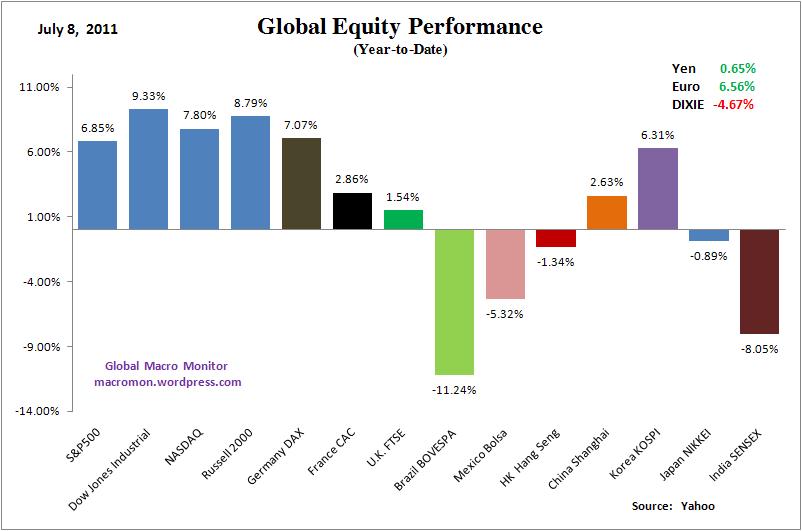
Week in Review: Tremors of a Major “Euroquake”

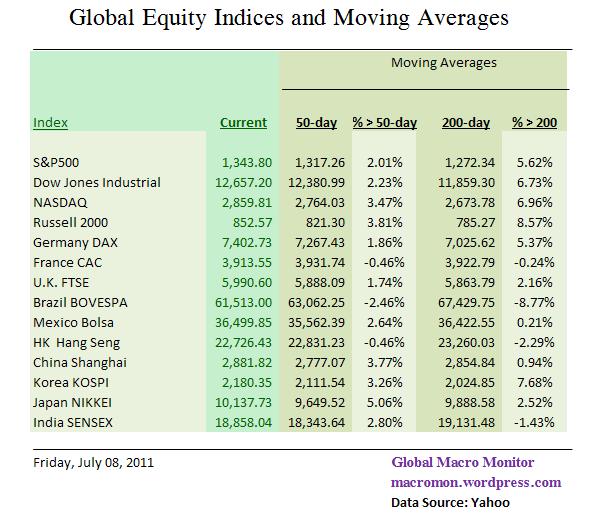
Not much to say as the employment numbers dumped cold water on the equity rally.  The markets, especially Apple,  did show some impressive resilience on Friday, but we’re still maintaining equities are at the top end of their range.   Investors and traders should, in our opinion,  start preparing for a major earthquake in Europe.  The politicos have let the European Debt Crisis get away from them as it is now creeping into the core countries, such as Italy.   Monitor European financials closely.

Anyone that lives in an earthquake zone knows that predicting the timing of a major quake is impossible, but it is best to be prepared for one.  We don’t know how it will play out in Europe, but it is certainly not moving toward a resolution anytime soon.   High leverage and heavy exposure to a declining asset class are a toxic brew and that is the case with the European financial system.

Then you have the bozos in Washington playing with fire and seem to have no idea of the consequences once markets call their bluff.   Good luck out there.


(click here if charts are not observable)

Posted in Week in Review | Tagged , , , | Leave a comment

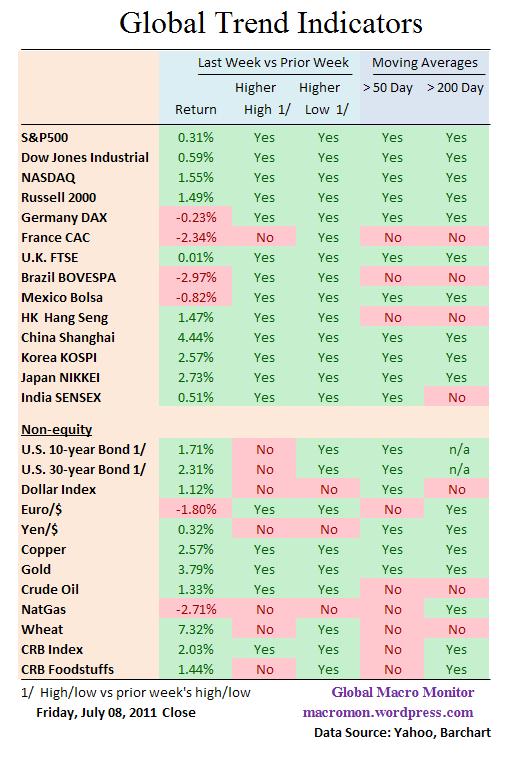
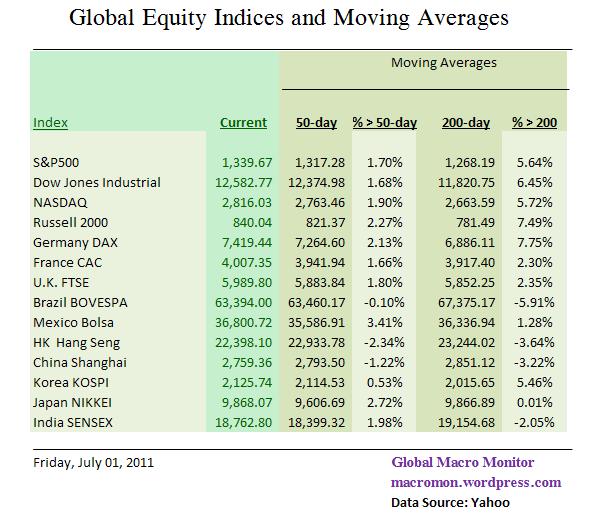
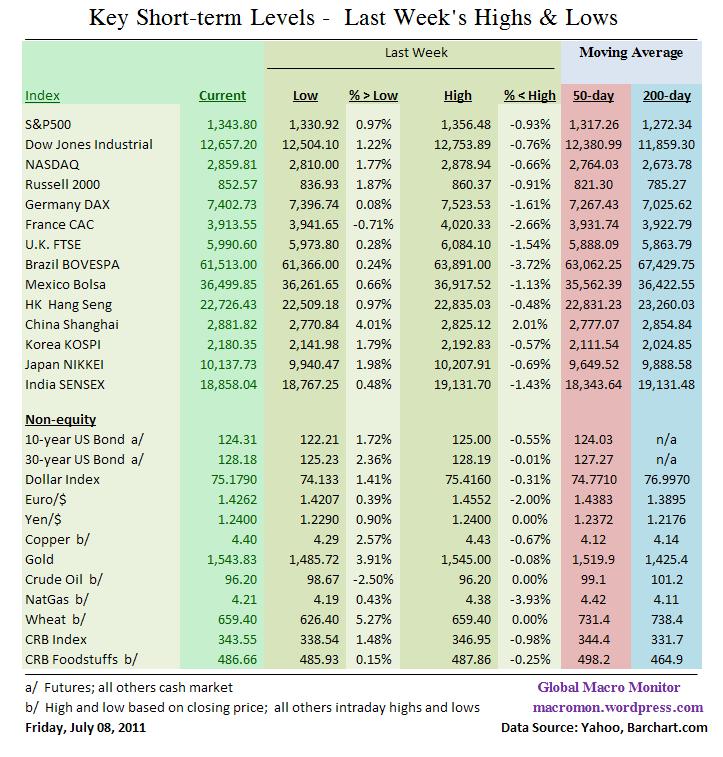
Global Trend Indicators

(click here if tables are not observable)

Posted in Global Trend Indicators | Tagged , , , , | Leave a comment

The Weekend Read: Reality Meets Perception

Higher energy and food prices are crowding out consumer demand for other items, and the market consensus is that QE2 has proven to be counter-productive. Unable to concede this, Mr. Bernanke nonetheless seems determined to have it both ways, remarking in a recent speech that monetary policy cannot be a panacea. We won’t know whether the Fed is serious until it withholds monetary easing in the face of a further softening of economic conditions or a falling stock market.  – David Einhorn

Bonds
Echo of Reagan warning could rouse bond vigilantes – FT

China
China to tolerate some inflation in econ transition –Zhou – Reuters
Where Is China In Its Tightening Cycle? – Brown Brothers

Commodities
Heatwave in central US and brisk China demand lift corn – FT
Pacific Ocean Seabed Rich in Rare Earth Minerals – OilPrice.com
The commodities bubble is about to burst – CSM

Companies
The Tea Party and Goldman Sachs: A Love Story – The Nation

Economics
5 Economic Disasters That Haven’t Happened – US News
Household Debt Is at Heart of Weak U.S. Economy: Business Class – Bloomberg
‘Horrific’ Jobs Report Renews Fears of Double-Dip Recession – CNBC
Only further stimulus can tackle America’s jobless, wage-less recovery – Laura Tyson
The Sorrow and the Pity of Another Liquidity Trap: Brad DeLong – Bloomberg
The Cost of Austerity – NY Times

Emerging Markets
Brazil, the Un-China – Time
Will Brazil’s Good Times Roll On? – Project Syndicate

Europe
A Tale of Two Defaults – Daniel Gros
A Tale of a Euro Exit Foretold – The American
EU Fears For Stress Test Credibility As Deadline Nears – WSJ
Europe for Sale – Project Syndicate
Greek Debt: How Much for the Acropolis? – Fiscal Times
Is Europe’s debt crisis a “Lehman Moment” for America? – Reuters
Spain and Italy risk being sucked in – FT

General
America and Europe sinking together – FT
America’s 15th financial panic… and our recovery from it – Chicago Tribune
How the bubble destroyed the middle class – MarketWatch
Lagarde’s Challenges – Raghuram Rajan

Geopolitical
A Thai Spring? – Project Syndicate

Housing
The Next Big Boom Towns In The U.S. – Forbes

Markets
The next, worse financial crisis – MarketWatch

Monetary/Fiscal Policy & Debt
Debt-Limit Shuffle Buys Time for ‘Something Big’: Caroline Baum – Bloomberg
The politics of default – Asia Times

Technology
A Hundred Years of Superconductivity – Project Syndicate
Techno-farming: The New Economic Growth Industry – Fiscal Times
Technology and Inequality – Ken Rogoff

Video:  Remember the Days of the “Wall of Money“?

(click here if video is not observable)

Posted in The Weekend Read, Uncategorized | Tagged , , , , , | Leave a comment

When Apple Leads….

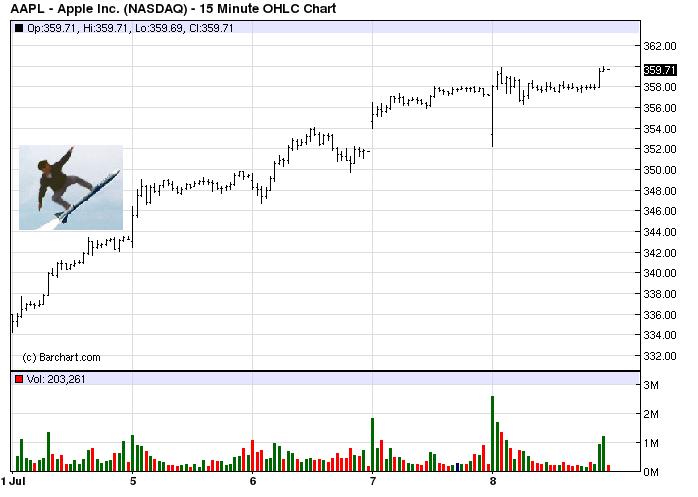
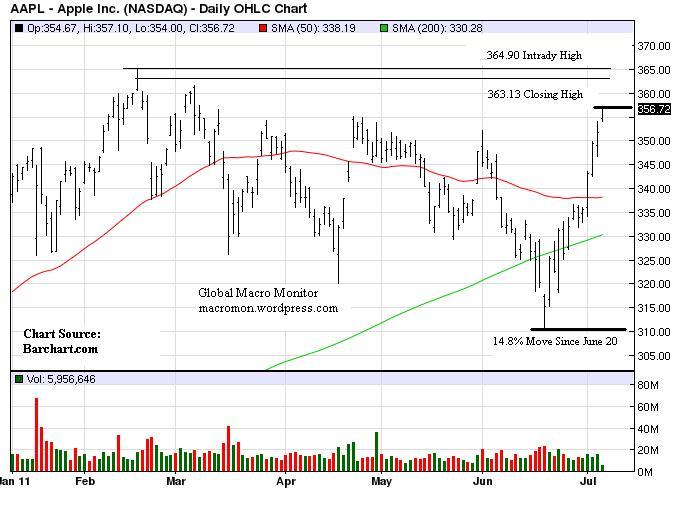
Apple is up almost 15 percent off  the June 20th low of 310 and leading the overall market higher.  This is the stock’s best move since last September.  We’ve posted several pieces on Apple’s market leadership (click here).  With no debt and more than $70 per share in cash and liquid securities, coupled with its innovation and growth prospects,  we may be seeing the beginning of the “good private sector/bad public sector” trade.   That is, who looks more risky when the terminally ill public sector balance sheets are juxtaposed with, say, Apple’s balance sheet, management and growth prospects?

The ugly macro picture is catching many offside as the equity markets, especially large cap/strong balance sheet tech,  ramp here.   This is not to say that Apple will move straight up if the U.S. G defaults, but let’s not dismiss the prospect the markets may be redefining “risk-free” and morphing into something we haven’t seen in the G7 economies.  Brazil, Mexico, Argentina, and many other emerging markets understand and have experienced such a situation when their governments, struggling with massive debt,  were perceived more risky than local blue chip companies.    Stay flexible.

(click here if chart is not observable)

Posted in Apple, Black Swan Watch, BRICs, Budget Deficit, Charts, Economics, Sovereign Debt, Sovereign Risk | Tagged , , | 2 Comments

Market Price Action and “Retrofitting the Fundamentals”

Amazing how all is well with global economy after a 7 percent rally in the S&P500.  We have a very smart friend who constantly reminds us that many, if not, most,  “retrofit” fundamentals to market direction.   If markets are going down, the fundamentals, or, at least, the perception of the fundamentals are poor.   If markets are moving up, all was well with the fundamentals.

George Soros says markets move from perception to reality and back to perception:

In my theory of reflexivity I assert that the thinking of economic agents serves two functions. On the one hand, they try to understand reality; that is the cognitive function. On the other, they try to make an impact on the situation. That is the participating, or manipulative, function.

The two functions connect reality and the participants’ perception of reality in opposite directions. As long as the two functions work independently of each other they produce determinate results. When they operate simultaneously they interfere with each other. That is the case not only in the financial markets but also in many other social situations.

Now we need some reality to back-up the perception.   A good employment number would be nice start followed by some nice earnings.   Stay tuned and stay with it until it stops working.

Posted in Economics | Tagged , | 1 Comment

Food Fight

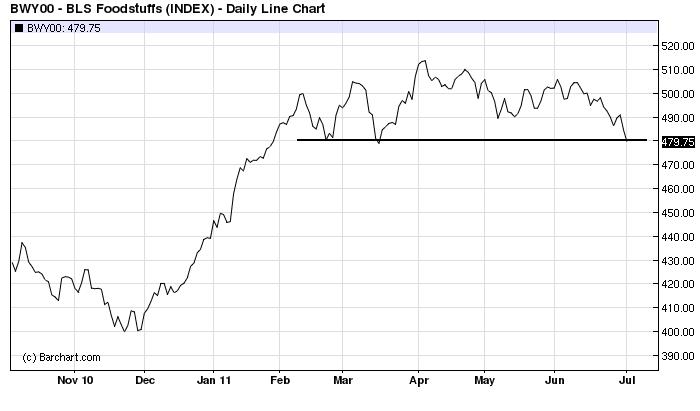
Check out the BLS Foodstuffs sub-index which is now right at key support.  The better than expected USDA report hammered the grains last week and traders now have to decide either to stay with the Ag trade or dump their positions.  Note the more than 25 percent spike in prices earlier in the year,  which helped usher in the “Arab Spring.”

(click here if chart is not observable)

Posted in Charts, Commodities, Food Prices | Tagged , , , | Leave a comment

Week in Review: Equity Fireworks

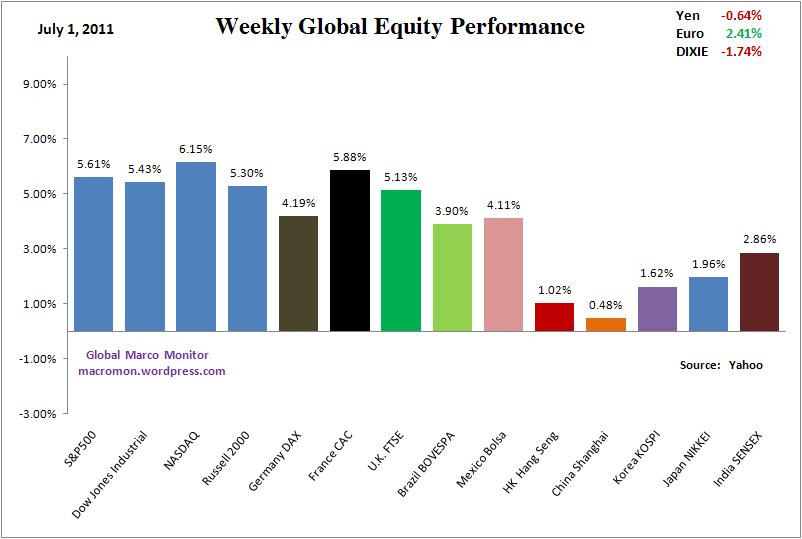
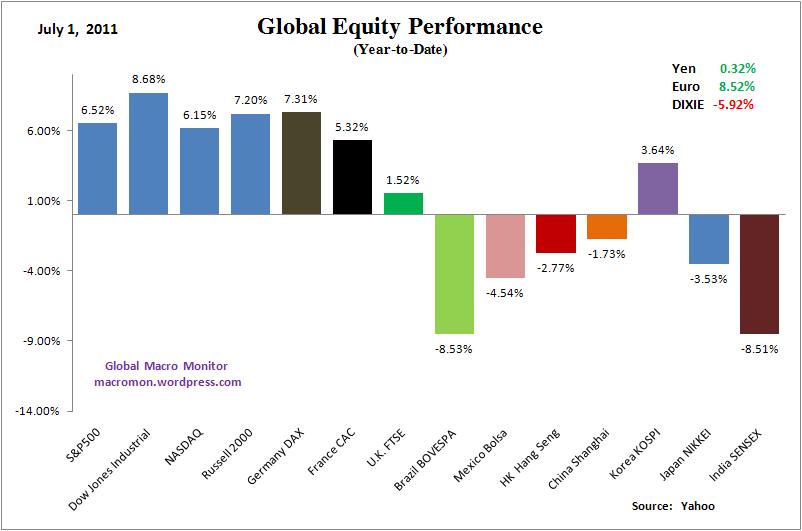
It’s amazing what a week makes.   Almost every American, Latin America and European equity market indices we track had their best weekly performances of the year.   The S&P500 ETF, SPY, for example, had five straight up days of over .85%, which is unprecedented since it began trading in 1993.  We’ll let the equity fireworks illustrated below in the charts speak for themselves.

Next week should see a rest before earnings kick off in earnest.  Our base case is the market trades in a range throughout the rest of the summer and most equity indices are getting close to the top of that range.  If earnings blowout, the “good private sector/bad public sector” trade could take-off where even equities of strong balance sheet/decent growth companies begin to be perceived as safer havens than governments.   We shall see.   Stay tuned.

(click here if charts are not observable)

Posted in Week in Review | Tagged , , , , , | 1 Comment

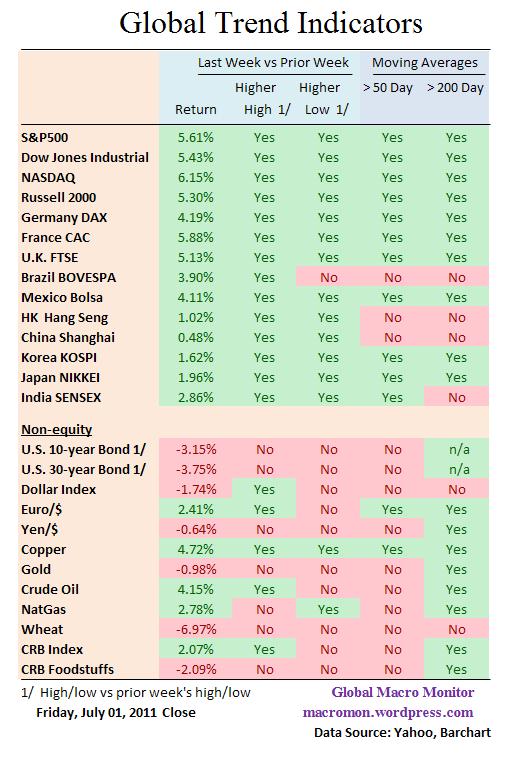
Global Trend Indicators

(click here if tables are not observable)

Posted in Global Trend Indicators | Tagged , , , , , , | Leave a comment