The Weekend Read: Equity Rampopotamus!

There are comments that there are underlying flaws in the ISM number and that GM’s (GM – commentary – Trade Now) sales numbers are inflated by some channel stuffing, but the market continues to act as if it doesn’t have a worry in the world. The bears, who are anxiously trying to fade this straight-up move, continue to be enormously frustrated. They aren’t even seeing mild weakness so far. – Jim “Rev Shark” Deporre


The Bluebird Electric, a high-performance electric supercar, currently holds the United Kingdom land
speed record for electric vehicles at 137mph.
China

China manufacturing growth slows further – Market Watch
Could China Be the Next Greece? – The Curious Capitalist
How manageable is China’s red ink? – Economist
Why China’s Heading for a Hard Landing, Part 1: A. Gary Shilling – Bloomberg
Why China’s Heading for a Hard Landing, Part 2: A. Gary Shilling – Bloomberg
Why China’s Heading for a Hard Landing, Part 3: A. Gary Shilling – Bloomberg
Why China’s Heading for a Hard Landing, Pt. 4: A. Gary Shilling – Bloomberg
Why China’s Heading for a Hard Landing, Pt. 5: A. Gary Shilling – Bloomberg

Commodities
Can Food Prices Be Stabilized? – Jeffrey Frankel
France First Country to Ban Extraction of Natural Gas by Fracking – Scientific American
Is Gold’s Run Coming to an End? – Smart Money
U.S. Corn Futures Plummet on USDA Reports – WSJ

Companies
Axel Weber named next UBS chairman – FT
More RIM employees speak out – CNET
Zynga files for IPO – CNET

Currencies
Farewell to the Euro? – Project Syndicate
The Brazilian Exchange Rate Conundrum – Wells Fargo Securities

Economics
Does Government Matter in the Economy? – Bloomberg
Great Recession cooks Friedman and Keynes – Market Watch
What’s Happening to the US Economy? – Martin Feldstein
The failure of Keynesian pump-priming – Calafia Beach Pundit
US manufacturing growth speeds up – FT

Emerging Markets
Is Brazil’s economic boom a bubble ready to burst? – BBC
Venezuela and Hugo Chávez, Lex – FT

Europe
Analysis: Weak economy may force second bailout of Ireland – Reuters
Greece: The abuses of austerity – Economist
Europe’s Naked Banks – Simon Johnson
Why austerity alone risks a disaster – FT
Will Crisis-Ridden Europe Find Its Own Alexander Hamilton?: View – Bloomberg

General
Strauss-Kahn – from Rikers Island to the Elysee? – FT
Strauss-Kahn released without bail – FT
Treasury Secretary Geithner considering leaving post after debt talks – WashPost

Geopolitical
Nine killed as Syrian protests spread – FT

Housing
Housing, and Reckless Disregard for Risk – RCM

Markets
New Investment Strategy: Preparing for End Times – DealBook
Shopping For Stocks? 5 Measures to Ignore – Smart Money
The most important point in market history – Todd Harrison
Where the rich are keeping their money – Market Watch

Monetary/Fiscal Policy
6 Tools Left in Bernanke’s Toolbox as QE2 Ends – TheStreet
Fail-Safe Plan Could Stop U.S. Default Disaster: Jonathan Alter – Bloomberg
The Deficit Is Worse Than We Think – Larry Lindsey

Technology
Motion-powered gadget charger back on track – CNET
Nanoparticles: Disguised Red Blood Cells as Cancer-Fighting Drugs – Science Daily
Spray-on Solar Goes Double-decker – TR
The Bluebird Electric, Europe’s fastest EV, will be shown at EcoVelocity – CNET
Why Manufacturing Matters – Technological Innovations Tied to Production – TR

Video:  4th of July for Math Nerds

(click here if video is not observable)
Posted in The Weekend Read | Tagged , , , , , , | Leave a comment

Apple aims to ship 12-14 million iPad 2s in 3Q11 – Digitimes

More news from the Apple supply chain.  This story was published earlier at Digitimes:

As the IT market approaches the third quarter, the traditional peak season, Apple is turning more aggressive in placing orders for its iPad 2 and is set to ship 12-14 million units in the quarter, up from 7-9 million units in the second, according to market watchers.

In order to significantly increase its shipments in the third quarter, Apple has been piling up its inventory of iPad 2 components such as panels in the second quarter to minimize the risk of facing component shortages.

Apple’s upstream component suppliers including LG Display, Catcher Technology, TPK Holdings and Radiant Opto-Electronics Corporation are all expected to benefit from the increased orders, according to the market watchers.

Posted in Apple | Tagged , | Leave a comment

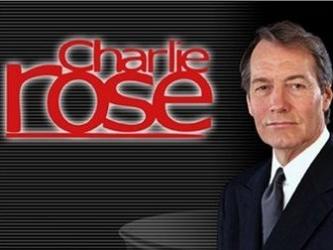
Aminio Fraga on Charlie Rose


Great interview with our old friend and colleague Arminio Fraga,  former head of Brazil’s central bank,  Soros hedge fund manager, and now head of Gavea Investments.   Arminio is a Princeton Ph.D. economist, understands markets,  and an expert on Brazil’s economist.   It’s well worth your time.  Click here for interview.

(click here if pictures are not observable)

Posted in Equities, General Interest, Sovereign Debt, Sovereign Risk | Tagged , | Leave a comment

Apple likely to dethrone HP as leading portable PC vendor – Digitmes

We found this interesting over at Digitimes:

Apple is likely to replace Hewlett-Packard (HP) as the global number one notebook vendor in 2012 if tablet PCs are included in the calculation of global notebook shipments, according to industry sources.

Global shipments of tablet PCs are expected to top 60 million units in 2011 with shipments from Apple likely to total 40 million units for a 60% share. And now some market research firms have predicted global tablet shipments are to top 80 million units 2012 with iPads accounting for 60 million units.

Additionally, Apple is also likely to ship 15 million MacBooks in 2012, bringing its combined shipments of notebooks and tablets to a total of 75 million units, accounting for 25-30% of the global notebook market, the sources estimated.

HP shipped 40 million notebooks in 2010 and is expected to ship 45-50 million units in 2011, noted the sources, adding that HP will not be able to compete with Apple for the tops title in 2012 based on its performance in 2010 and 2011

Good stuff!

Posted in Apple | Tagged , , | Leave a comment

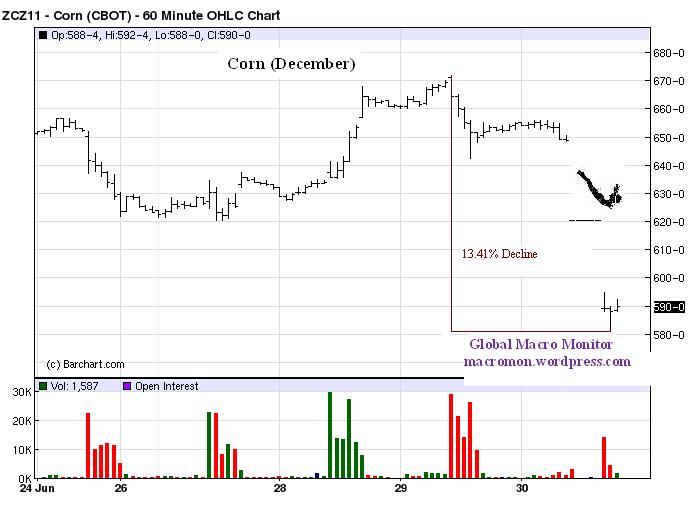
Jimmy (the Trader) Crack(s) Corn and Says Adios to QE2

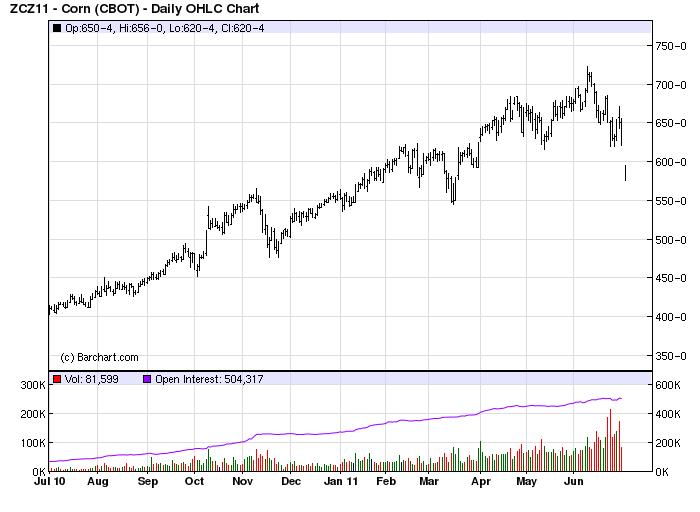
Wow!  December Corn futures finally opens with a 13.4 percent loss from Wednesday’s high to the opening low.  Wheat has also been hammered. The WSJ reports,

As recently as June 9, USDA officials had guessed that excessive rain and widespread flooding this spring limited farmers to 90.7 million acres. But a separate USDA report also found supplies were bigger than expected in early June, signaling relief for food companies, livestock producers and consumers.

Interesting how food prices are tanking at the end of QE2.  The USDA report gives the Fed an out that commodity prices are not driven by excess liquidity but by fundamentals.   Let’s see how low they can take ’em and debate this point later.   That’s what we like about the markets and economics:  You (we) don’t know jack; and you (we) can’t prove jack!

(click here if charts are not observable)

Posted in Commodities, Food Prices | Tagged , | Leave a comment

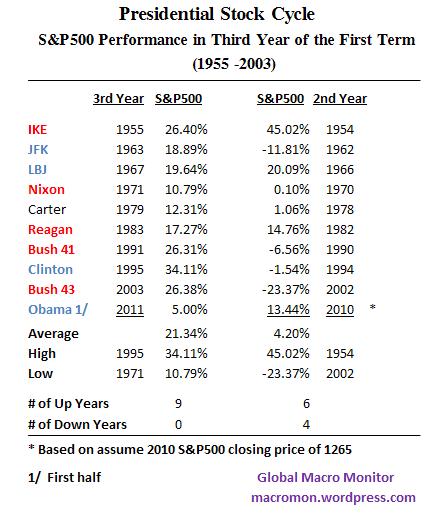
It’s beginning to look a lot like? Choose your analog…

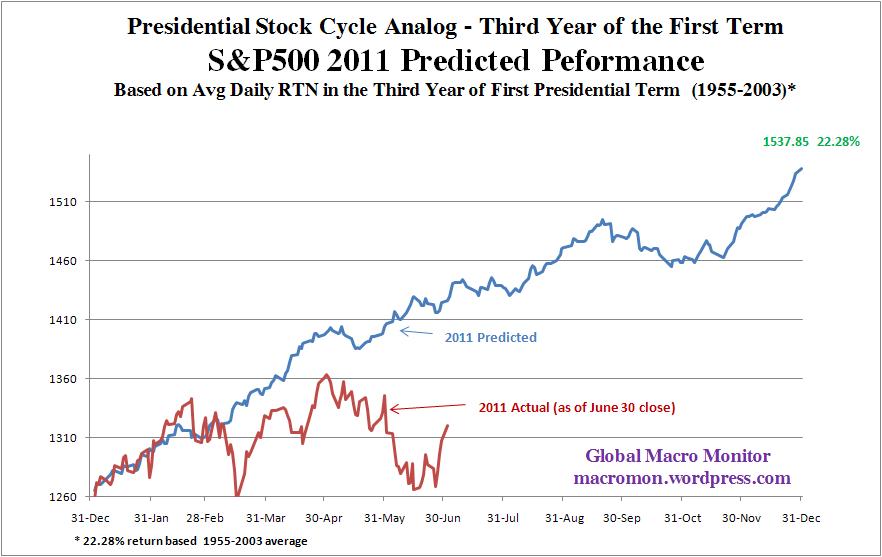
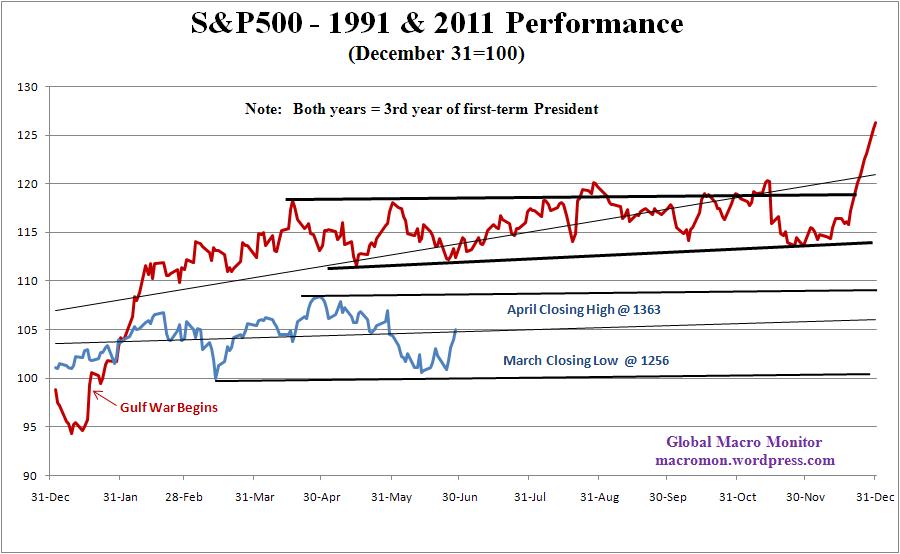
It’s the end of the first half and we’ve updated our Presidential Stock Cycle, Decennial, and 1991 analog charts.   Click here, here,  and here for background.  Note,  the predicted performance of the Presidential and Decennial analogs are constructed from the average of daily returns from the relevant years and thus smooths out much of the daily volatility.

So far this year the path of the S&P500 is tracking the Decennial analog fairly closely and has the same character and feel of the 1991 market, also the third year of a first term President and a year that ended in ‘1.   In addition, let’s not forget that 1991 was similarly a nervous time for investors and full of macro swans,  including the first Gulf War and a major credit crunch caused, primarily, by a downturn in housing.  Though constrained, we doubt President Obama wants to track the President Bush #41 election analog and will double his efforts to get the economy moving, which may include a new Treasury Secretary.

The last chart illustrates this year’s performance relative to 1991, when the S&P500 ramped in the first few months;  though not giving up all of its gains, had a modest correction;  and then settled into a relatively tight trading range until the 10.5 percent ramp in the last two weeks of the year.   Our best guess is the S&P500 trades in a similar t range – 1250 to 1350 – during the summer and through the end of Q3 then rallies into year end on the traditional seasonal strength.  The collapse of the VIX over the past few days may be signalling such a scenario.

The upshot?  Patience,  don’t chase, and beware of grinding up capital.  Stay tuned.

(click here if charts are not observable)

Posted in Equities, Housing, Policy, Politics | Tagged , , | 1 Comment

Sarkozy Attack Video

(click here if video is not observable)

Posted in Euro, Politics, Video | Tagged , , | 1 Comment

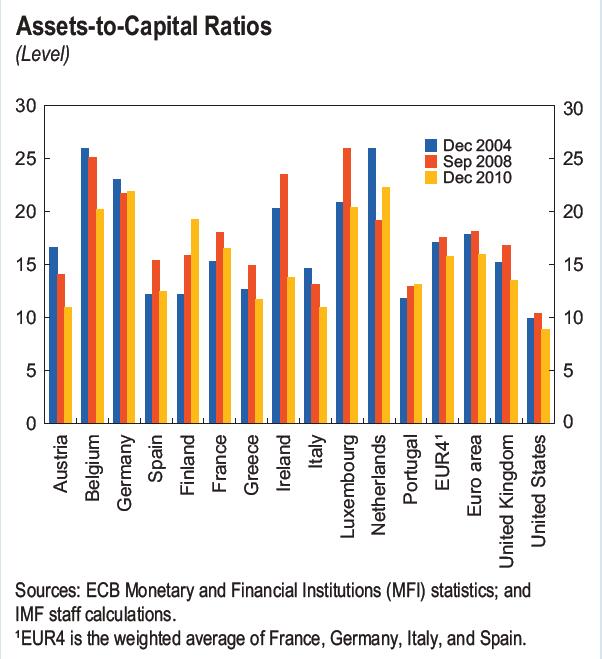
Why Europe Can’t Afford a Greek Haircut

If a picture is worth a thousand words, the following chart from the IMF encapsulates all the analysis one needs to understand why Mr. Trichet and the rest of the Eurozone bureaucracy are so adamant about not letting Greece restructure its debt.  The leverage ratios of some of Europe’s country banking systems are nothing less than stunning.   At the end of the day,  it was Lehman’s leverage coupled with its overexposure to a declining asset class that brought it down.  Once the markets sniffed this Lehman’s liquidity was cut off and the rest is history.

A Greek sovereign restructuring followed by, say Ireland and Portugal, and market speculation that Spain and Italy may be next, could bring down many of Europe’s  thinly capitalized country banking systems.    Fed Chairman, Ben Bernanke,  believes the Great Depression was not caused by 1929 stock market crash, but by the the 1931 failure of Austria’s Creditanstalt.  In a 2009 conversation with the Council of the Foreign Relations,  the Chairman reflects,

I learned basically two lessons from my studies of the depression.  The first is that monetary policy needs to be supportive, not contractionary…The second lesson is that — to reiterate what I said before, is that when the financial system breaks down, becomes highly unstable, then that has very severe adverse effects on the economy…  The Federal Reserve did not intervene to stop the failure of about a third of all the banks in the United States.  Globally, there were massive bank failures.  I think perhaps the most critical, in May of 1931, the Creditanstalt, which was one of the largest banks in Europe, failed, which generated a wave of financial crisis around the world.  Up till early 1931, arguably the 1929 downturn was just a ordinary — severe but ordinary downturn.  It was the financial crises and the collapse of banks and other institutions in late 1930 and early 1931 that made the Great Depression great.

Does anyone hear the rhyme of history?   These European banks can either raise new capital or shrink their balance sheets by reducing loans, for example, which, if done in mass, creates a credit crunch and an adverse impact on economic growth   Hopefully,   European policymakers are twisting the arms of these banks to reserve every single Euro of bailout money against loan losses as their Greek, Irish, and Portuguese sovereign bonds mature.  This will require taking a hit to profits and pushback from the banks.  Then,  let the haircuts begin.   That is, if the European political structure can endure for that long.

  (click here if chart is not observable)

Posted in Black Swan Watch, Bonds, Budget Deficit, Charts, Euro, PIIGS, Policy, Politics, Sovereign Debt, Sovereign Risk | Tagged , , , | 4 Comments

Markets Catch Traders Offside

Looks like traders, including yours truly, were caught catawampus in a pair of Nike shorts (ouch!),  either not long enough or short, both equities and the Euro, coming into the week, even as some of the short-term signals were turning positive: 1) the commodity sell-off as a positive for margins and consumer purchasing power; 2) the French proposal to rollover some Greek debt, though we believe is weak and full of holes, the policymakers are at least moving in the right direction and Sarkozy is one of the few global politicos showing leadership; 3) the Asian markets, most notably, the Shanghai, have stabilized; 4) the S&P500 was able to make a higher high and higher low last week.

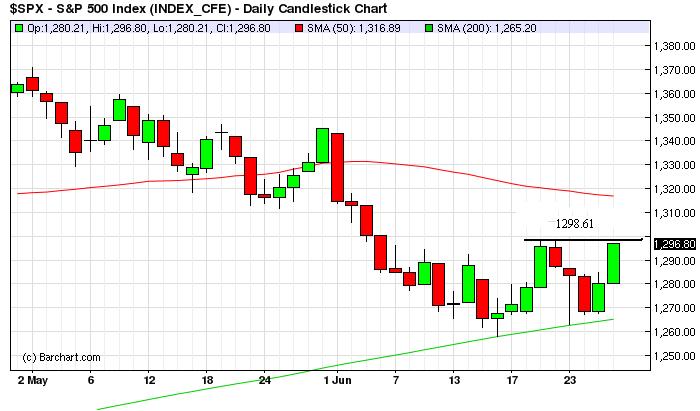
The S&P500 close today above the June 21 close of 1295.52, though on low volume, will now make traders think twice that this is only a bounce or just Q-end window dressing.  They may try and sell it down tomorrow as the perception of a quarter-end tape painting bid subsides. This will be the test and a bounce and trade above the short-term intraday high of 1298.61 could bring in enough firepower to take the S&P up to the 50-day moving average, which is around 1317, into earnings season.

The way the equity market is trading we have a sense, for what it’s worth, the market is sold out – that is, very few sellers x/traders getting short – and is becoming immune to Greek tear gas and other macro swans, at least short-term.   Bears need a new catalyst to take the market lower,  which could come if earnings disappoint.  Until then, we’re taking the over.

Wall Street is a very powerful industry and doesn’t get paid if markets trade “slide-ways” and that is one reality bears must live with.   The negative events that could spoil this short-term scenario is the obvious rejection of the Greece austerity package,  Euro debt contagion,  and/or disorderly sell-off in Treasuries as QE2 goes into drydock. These are not low impact events and need to be closely monitored, especially after the weak Treasury auctions of the past few days.

The first stage of any equity rebound, however, should coincide with a bond sell-off as without the Fed’s QE2 purchases or robust credit expansion, the markets have now become a zero-sum allocation game.   We don’t know for certain where the market is headed, but we’ve mapped the bullish case for the next few weeks and are now watching to see if they follow.  Stay tuned!

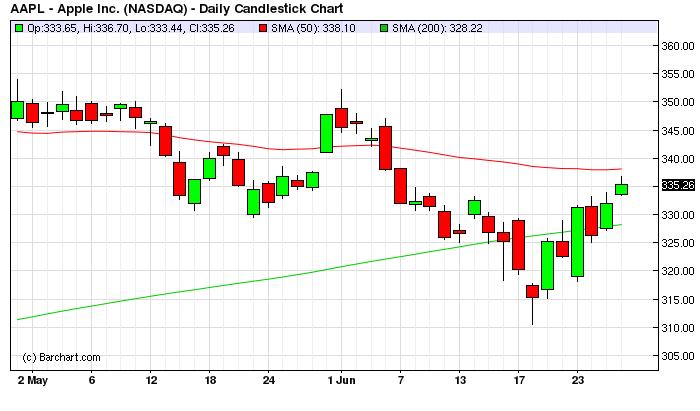
P.S.  Apple is leading the market rally and came within $1.40 of recapturing its 50-day moving average.

(click here if charts are not observable)

Posted in Apple, Equities, Euro | Tagged , | 2 Comments

Chart of the Day: Greek Parliament

(click here if chart is not observable)

Posted in Chart of the Day, PIIGS, Sovereign Debt, Sovereign Risk | Tagged | 1 Comment