Hot Retail Sales Not Supply Chain Positive

#CKStrong

The market view on Carol K. is starting to consolidate that she just may become is the GOAT of Comeback Kids. What a fighter!  Do you believe in miracles?  Go Neutrophils!

Summary 
– The market narrative explaining the breakdown in the global supply chain is starting to come together
– Some of the rock star pundits are now touting the supply chain is being swamped by too much demand, which has been our narrative since summer
– The initial shock came with the 22 percent collapse in point-of-sale demand (we use U.S. retail sales as our global proxy), then an extraordinary 34 percent rebound over a six-month period
– The unprecedented volatility in retail sales “bullwhipped” the supply chain and caused mass confusion and panic among upstream suppliers
– As the pandemic forced consumers to shift their preferences from services (restaurants, Disneyland, etc) to durable goods (kettlebells, golf clubs, etc.), the supply chain for merchandise goods was initially overwhelmed by the new and unexpected demand 
– The secondary shock came from the massive global stimulus, which drove consumption and retail sales much higher
– The combination of the shift in consumer preferences and massive increase in stimulus induced demand is primarily what broke the supply chain
– We don’t see an end to supply chain woes until point-of-sale demand moves back to its pre-COVID trend, which, for our proxy, dictates that U.S. retail sales fall by almost 12 percent from current levels or stay flat for 56 months, which, we believe is much too painful for the policymakers and markets
– We are not sure how this all plays out but we certainly don’t think “everything is awesome”
–  We believe historians will write about the Shortage Economy:  “The great supply shock of the COVID pandemic was, at the end of the day, a demand shock”  

This image has an empty alt attribute; its file name is wsj.png:

Americans stepped up their spending in September, a sign of resilient demand and rising inflation as consumers head into the holiday shopping season.

Sales at retail stores, restaurants and online sellers rose a seasonally adjusted 0.7% in September from the previous month, the Commerce Department said Friday. The rise in sales reflects persistently strong demand and higher consumer prices.

Consumers, armed with stimulus payments and rising wages, have stepped up spending this year, shrugging off the Delta variant of Covid-19, the end of enhanced unemployment benefits and emerging supply constraints. The retail sales, which aren’t adjusted for inflation, rose 13.9% in September from a year earlier. Consumer inflation increased 5.4% in that time, according to the Labor Department. – WSJ

What Broke The Supply Chain?

The bulk of the problems in the global supply chain are caused by excess demand.  Policymakers have injected too much stimulus into the global economy.  By combining income support through transfer payments, the central banks have effectively monetized much of the large deficits and spending run-up.

Our view is derived from [the above chart], where we use U.S. retail sales as a proxy for global aggregate demand.  The EU’s retail sales chart looks very similar.

[The chart]  illustrates that spending unexpectedly came roaring back after an unprecedented drop when global economies were turned off in March 2020 and had a massive “Bullwhip Effect” on the global supply chain.

[September] retail sales – our proxy for global aggregate demand, which is not observable, by the way – are 13.9 percent above and running 56 months ahead of its pre-COVID trend.  Retail sales are inflated by the policy measures and will need time (56-months of zero growth) and/or space (-11.9% down from current levels) to get back to trend.   No doubt, it will be a combination of both time and space.  A sharp, abrupt  correction in retail sales could be painful and confuse the supply chain even further.

We believe only when demand returns to trend will the global supply chains begin to heal.  Some will sooner than others, but it will take longer than most expect unless the global economy hits the skids big time or the central bankers panic. –  GMM, Sep 14th

We will concede that part of the retail sales overshoot to the upside is a catch-up from the overshoot on the downside, which beefed up consumer savings. 

Demand Shock And Bullwhip Effect

The initial shock to the supply chain was the collapse and abrupt snapback in consumer spending (point-of-sale demand), in the U.S. and elsewhere, which then “bullwhipped” the supply chain and caused mass confusion with upstream suppliers. 

Research indicates a fluctuation in point-of-sale demand of +/- five percent will be interpreted by supply chain participants as a change in demand of up to +/- forty percent. Much like cracking a whip, a small flick of the wrist a shift in point of sale demand can cause a large motion at the end of the whip manufacturers response.  – Wikipedia

Do the math, folks, as illustrated in our chart above downstream final or point-of-sale demand fell and an unexpected and unprecedented 22.3 percent from March through April, then, more surprisingly, rebounded 34.2 percent from May through October 2020. 

As final demand whipsawed last year, the upstream supply chain was jolted into mass confusion and panic. Many suppliers began to hoard, double and triple order, and secure materials in the black market. Input prices skyrocketed, lead times spiked. 

The bullwhip effect refers to a logistics supply chain inefficiency when there is either too much or too little inventory. Usually, this comes as a response to incorrectly reacting to or forecasting customer demand.

Small fluctuations at any point along the supply chain can have a major impact on the rest of the logistics chain. 

…The bullwhip effect either creates excess or a lack of inventory. A surplus of inventory is expensive and wastes resources, while insufficient stock leads to unfulfilled orders and poor customer service (which can result in lost business in the short- and long-term).

There may also be secondary impacts of the bullwhip effect, like a breakdown of communication, loss of the partnership, or shipping delays. Overall, it sets off a chain reaction that impacts the processes of every logistics partner, which in turn means loss and expense is nearly inevitable. – 

Excess Demand Causing Logistics Breakdown

Secondly, the amount of fiscal and monetary stimulus pumped into the global economy, illustrated in the chart below, is mindboggling.    Thought the Fed is expected start tapering next month but tapering is not tightening (withdrawing the digital money).  That’s a long way off, folks, and we suspect the Fed will have to surprise the markets. 

The massive stimulus has spiked global consumption and driven up U.S. retail sales (our proxy for global demand) to an unprecedented 15.6 percent above trend in April 2021 (see above chart), a good proxy for equilibrium, where supply equals demand.  Note supply curves are an abstract economic concept and not observable in the real world, though they can be estimated with rigorous econometric models.   

This image has an empty alt attribute; its file name is covid-packages.png

The September retail sales were released on Friday and illustrate the goods market is still significantly out of equilibrium, where excess demand continues to pressure the supply chain, most notably through congested ports with container ships floating at sea in a traffic jam waiting to bring the goods into the country, some of which will be counted in the October and November retail sales data.   The container ships are also full of intermediate goods.  It’s all upstream bottlenecks from there. 

 Yes, there are real breaks in the supply chain as there always are.

For example, we believe the labor supply curve has shifted left in the “Great Resignation” and wrote about it in early August..

Moreover, the low vaxed countries of Southeast Asia, mainly the result of their complacency to secure vaccines due to success of stamping out the first wave of COVID, has forced governments to lock down factories, further adding to supply chain woes,

Infection Surges In Southeast Asia Threaten Global Supply Chains

Malaysia, Thailand and Vietnam, countries that previously avoided the worst of the pandemic, are now seeing rapid increases in infections. The region serves as a key manufacturing hub for intermediate goods as companies shift production away from China. Now the surging cases are threatening to disrupt global manufacturing. — NIKKEI Asia, June 1

Supply shocks are commonplace and do not break the global supply chain.   The problems are macro and the big problem right now is in logistics and the transport of merchandise goods is being swamped by too much demand. 

We will let you figure out the logical conclusion policymakers should be making here.  

Others Seeing The Reality

We are starting to others draw the same conclusion and narrative that too much demand is the primary driving force behind the global supply chain woes.   Jim Bianco, the rock-star pundit and perennial candidate for a Fed governorship, posted these threads on Friday and earlier today. 

They so good we suspect he may be positioning himself as a “hawk” for the next FOMC seat.  We believe he draws the right conclusion, 

The only way this gets solved next month if we crush the economy so bad that all new sales stop. – Jim Bianco

If this is what it takes to fix the supply chain — crush retail sales — good luck,  the policymakers don’t have the stomach, in our opinion.   

PK

Even Paul Krugman is starting to waffle.  On Friday, he wrote, 

I’m basically for the former, on what has come to be known as Team Transitory, but I might be wrong — and the data are sufficiently ambiguous that both sides can claim that the evidence supports their take.

Yet policymakers can’t just shrug their shoulders; they have to, um, make policy. So what should they do in the face of uncertainty? The answer, I’d argue, is to make decisions that won’t do too much damage if their preferred take on inflation is wrong.

Not until the retail sales move back to trend our the suppliers believe the stimmy induced spike in demand is real and sustainable.  PK, NY Times

And this on Thursday,

About those supply-chain issues: It’s important to realize that more goods are reaching Americans than ever before. The problem is that despite increased deliveries, the system isn’t managing to keep up with extraordinary demand. – PK, NY Times

The words of the Nobel laurate bears worth repeating.  

“…the system isn’t managing to keep up with extraordinary demand.”

Extraordinary means too much, in our book. 

The great supply shock of the COVID pandemic is, at the end of the day, a demand shock.    

Posted in Uncategorized | 1 Comment

Auto Chip Shortage Causing An INSANE Black-Market

#CKStrong

Wow, it’s starting to feel like the old days of exchanging currency on the black market in the men’s bathroom at the Rio de Janeiro airport. 

“The current black market price of a Bosch ESP chip (brake control system) is 4,000 yen, which $625, which is going to add an enormous price to a car and the only possible reason that you’ll be willing to pay this much for a $2 part because it’s the one thing you need to sell your car…this black market price is ludicrous it’s nearly 300 times higher than the normal price…”

Posted in Manufacturing, Semiconductor prices, Semiconductors | 1 Comment

5G Marketing Outpaces Service Reality

#CKStrong

The low 5G usage numbers in the one-minute video will surprise.  Has the market mispriced them, either over or under? 

In telecommunications, 5G is the fifth-generation technology standard for broadband cellular networks, which cellular phone companies began deploying worldwide in 2019, and is the planned successor to the 4G networks which provide connectivity to most current cellphones. 5G networks are predicted to have more than 1.7 billion subscribers worldwide by 2025, according to the GSM Association. Like its predecessors, 5G networks are cellular networks, in which the service area is divided into small geographical areas called cells. All 5G wireless devices in a cell are connected to the Internet and telephone network by radio waves through a local antenna in the cell.

The main advantage of the new networks is that they will have greater bandwidth, giving higher download speeds, eventually up to 10 gigabits per second (Gbit/s). Due to the increased bandwidth, it is expected the networks will increasingly be used as general internet service providers for laptops and desktop computers, competing with existing ISPs such as cable internet, and also will make possible new applications in internet-of-things (IoT) and machine-to-machine areas. 4G cellphones are not able to use the new networks, which require 5G-enabled wireless devices. – Wikipedia

Posted in Uncategorized | 2 Comments

Are “Woke” Central Bankers Transitory?

#CKStrong   Bullish on CK,  ANC > 1100!

Can anyone spot which Age was transitory?

Woke Central Bankers 

“We have a generation of central bankers who are defining themselves by their wokeness,” Summers, who is now a professor at Harvard University, said on Wednesday. “They’re defining themselves by how socially concerned they are.”

“We’re in more danger than we’ve been during my career of losing control of inflation in the U.S.,” the 66-year-old Summers, a paid contributor to Bloomberg, said. “We’ve gone even further towards losing it in Britain and I think we’re at some risk in Europe.”  – Bloomberg

I have worked with — not as an employee but more an investor/informal advisor, and, at times, in an adversarial role — with many central banks during my career, including several that were in the beginning, middle, end, and post hyperinflation (see charts below).   

Of course, none, x/ the Fed, had the privilège exorbitant of controlling the world’s dominant reserve currency but all had to navigate an environment with heavy political and social pressures.

Most of the high inflation central banks, engaged in non-transitory deficit monetization and money printing until all street cred was lost and the economy broke. Demand for the currency collapsed and hyperinflation ensued.

In most cases, hyperinflation begins when demand for the local currency collapses.

We doubt that will be the case in the U.S. but if the Fed doesn’t get it right, and its a rapidly closing and small window –there will be pain. If the U.S. central bank caves again to political and social pressure when asset prices get rocked as they begin to reverse monetary policy next month, add the the “Age of High Inflation” to the above timeline.

Today’s “woke” market action priced that New Age.

We are looking at Israel’s hyperinflation as a model for our high inflation case (but not even close to Israel’s peak print) in the U.S. x/ the worries over default. 

Wait…hold that thought. 

In 1984, the Israeli economy was in dire straits: it had an annualized inflation of about 400 percent (and even 1,000 percent in the second half of 1984); a budget deficit of about 17 percent of the gross domestic product; and a current account deficit—driven by massive capital outflows—which drove down foreign reserves, and with it reducing the likelihood that Israel would be able to service its external debt obligations. – Brookings

We think a U.S. default, that is a blanket moratorium on Treasury debt payments, is a complete but useful delusion for the politicians.  A selective default, maybe, but doubtful, where the Treasury skips a payment on, say, debt held by the Fed.  Not sure about the legality, however.     

Which Period Of High Inflation Was Transitory?

Biggest Constraint On “Normalizing” Monetary Policy

It’s not rocket science but valuations, folks.

The U.S. stock market is now valued at over 200 percent of GDP versus the average valuation of 106 percent from 1996-2020 and over 40 percent above the extreme valuation of the Dot.com bubble.

Three Steps And A Stumble

A rule of thumb stating that the prices of stocks fall significantly after the Federal Reserve raises interest rates three times in a row.  –  Free Dictionary 

We doubt they will be able to raise three times, and thus the end game will be inflation but not before a few deflation scares.  

We do get it’s all about the trade, “riding the gravy train as long as it lasts” as CK has done and is much wealthier than I for it, but come on, man, lets call the useful delusionary narratives for what they are, and we suspect they are gonna rock the wealth of the people, who not prepared and can at least afford it.   

What’s The Matter With The Supply Chain?

The fundamental problem in the supply chain is that it is both still reeling from the volatile shock to final or downstream demand — the “Bullwhip Effect“- and policymakers continue to over stimulate the global economy.  Moreover, the spike in the demand for transport services, both over sea and land, is now starting to cause micro supply shocks.

We will get the data on retail sales tomorrow, which we use as a proxy for global demand.  We suspect a miss as the current level of monthly sales is way over its skis.   

As the chart below illustrates, after the massive and unprecedented volatility in Q2 2020,  the level of retail sales in the U.S. is running 51 months ahead and 11.2 percent above its pre-COVID trend.

We’ll concede that some of the overshoot may just be catch-up from Q2 2020 collapse. We shall see.

Protect your blind side, folks. 

As always, we reserve the right to be wrong, and often are, but, do please, at least contemplate we could be right.  After all, we were laughed at when we posted in early February that a 4 percent CPI was coming by mid-year and we wouldn’t be surprised to see a 5 percent print by year-end.

Posted in Uncategorized | Leave a comment

Can You Tell The Difference Between AI And A Human?

#CKStrong

How do you know if Carol K. or myself are not ChatBots?

The [pandemic] crisis accelerated the adoption of analytics and AI, and this momentum will continue into the 2020s, surveys show. Fifty-two percent of companies accelerated their AI adoption plans because of the Covid crisis, a study by PwC finds. Just about all, 86%, say that AI is becoming a “mainstream technology” at their company in 2021. Harris Poll, working with Appen, found that 55% of companies reported they accelerated their AI strategy in 2020 due to Covid, and 67% expect to further accelerate their AI strategy in 2021. – HBR

Posted in Uncategorized | 4 Comments

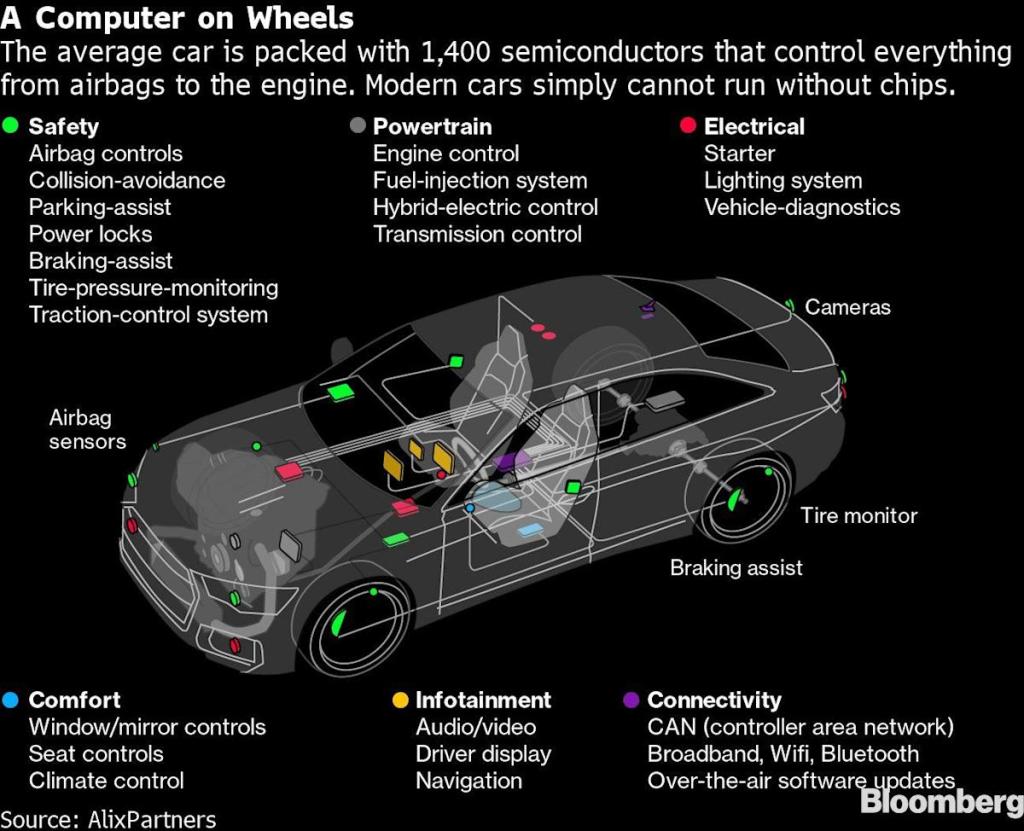
Semiconductor On Wheels

#CKStrong

Source: Bloomberg

Posted in Uncategorized | Leave a comment

Demand Surge Gumming Up Global Ports

#CKStrong

The “surge in demand” is congesting the global container ports. That is, it’s a primarily (though not all, and getting less so by the day, at the micro level) an excess demand issue creating the shortage economy.

Some $10.4trn of global stimulus has unleashed a furious but lopsided rebound in which consumers are spending more on goods than normal, stretching global supply chains that have been starved of investment. Demand for electronic goods has boomed during the pandemic but a shortage of the microchips inside them has struck industrial production in some exporting economies, such as Taiwan. 

...The risk now is that strains in the economy lead to a repudiation of decarbonisation and globalisation, with devastating long-term consequences. That is the real threat posed by the shortage economy.  – Economist, Oct 9

American consumers are going to get a sense of what life is like in a more closed economy, one with heavy trade restrictions, this Christmas with empty shelves and big price spikes. We are not optimistic they will be able to make the right connection and proper extrapolations but we do hope we are wrong.

We are not even confident the policy makers clearly understand what’s driving the global economy. They are conducting an experiment that has never been tried in all of history. And the stock market is valued at 200 percent of GDP!

As they say in the supply chain, “it’s all downstream from here.”

Posted in Uncategorized | Leave a comment

The Taiwan Strait Getting Hot, Hot, Hot, Hotter…3.0

#CKStrong

We are reposting a repost of a piece we did last September. 

Our sense is Mr. Xi is testing and doing the calculus if the U.S.is willing to fight WWIII over Taiwan. 

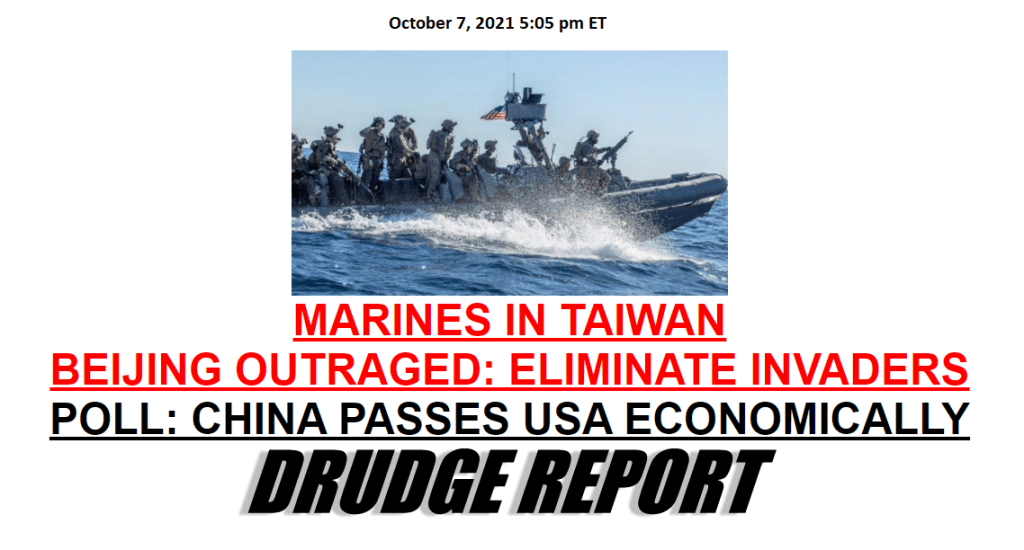
Taiwan and U.S. officials have expressed alarm over nearly 150 flights near Taiwan in the past week by Chinese military aircraft. The Chinese aircraft have included J-16 jet fighters, H-6 strategic bombers and Y-8 submarine-spotting aircraft and have set a record for such sorties, according to the Taiwan government.  – WSJ,  Oct 7

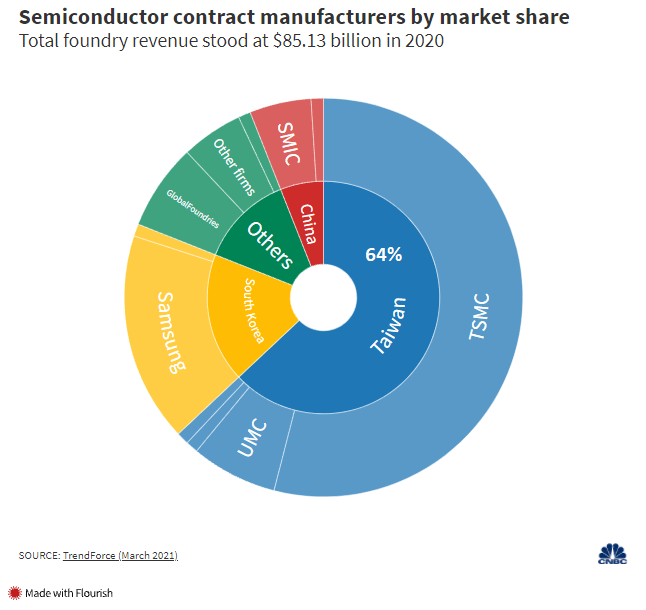
Taiwan is now the most geopolitically important country in the world in a way that no Middle Eastern country ever was.  Semiconductors are the new oil, and Taiwan produces almost 2/3rd’s of semi global manufacturing. 

Loose Lips, Sinks Battleships

No doubt Mr. Xi was taking copious notes as he viewed and listened to this very destabilizing and damaging interview, in which the POTUS effectively stated that America’s NATO allies were expendable.  We called out how dangerous this talk was in our 2018 post, The Day “Strategic Ambiguity” Died..  

Tucker Carlson:  So membership in NATO obligates the members to defend any member that is attacked.  So let’s say Montenegro, who joined last year,  is attacked, why should my son go to Montenegro to defend it from attack?

President Trump:  I understand what you are saying. I have asked the same question. You know Montenegro is a tiny country with very strong people… They may get aggressive, and congratulations you are in World War III…But that is the way it was set up, don’t forget I just got here.  – GMM,  July 2018

Trump is gone but Mr. Xi knows the country is divided and 74 million Americans voted for Mr. Trump.

If the Evergrand crisis spins out of control, will Mr. Xi need to Wag the Dog? 

摇狗 Yáo gǒu?

As with all things in the market, it doesn’t matter until it matters.  It is starting to matter.  

Currently, low risk, high impact event with the temperature rapidly rising.   

No Pom-Poms

Sorry, folks, we don’t do pom-poms at GMM. 

Nevertheless, we have given up on how markets will react — to just about any and everything, for that matter — as tensions ratchet up in the Straight.  We have are suspicions, and they don’t make us sleep better at night even in this everything market where everything is bullish.  

Protect your Blind Side, folks.   Keep the Taiwan Straight on your radar.

The Taiwan Strait Getting Hot, Hot, Hot…2.0

The Taiwan Strait Getting Hot, Hot, Hot…

One of GMM‘s most excellent followers, who we very much like and respect, responded with this:

In an interview with Fox’s Tucker Carlson last night, President Trump seemed to question the raison d’être of NATO and foreign alliances in general.

Tucker Carlson:  So membership in NATO obligates the members to defend any member that is attacked.  So let’s say Montenegro, who joined last year,  is attacked, why should my son go to Montenegro to defend it from attack?

President Trump:  I understand what you are saying. I have asked the same question. You know Montenegro is a tiny country with very strong people… They may get aggressive, and congratulations you are in World War III…But that is the way it was set up, don’t forget I just got here.  – The Day “Strategic Ambiguity” Died. GMM  July ’18

Wonder what our dear reader is thinking now?  

Posted in China, Geopolitical, Geopolitics, Global Stock Performance, Uncategorized | Tagged , , , | Leave a comment

October Surprise

#CKStrong

A nice little factoid to impress at a cocktail or…err…Cannabis party as we usher in the new quarter.

October is here, and in the Northern Hemisphere, that often means the days are flush with falling leaves, chilling weather, and growing anticipation for the holiday season.

The tenth month by our Gregorian calendar, October shares a root with octopus and octagon—the Latin octo and Greek okto, meaning “eight.”

Why is October named after the number eight?

According to the original Roman republican calendar, October was the eighth month of the year rather than the ninth. The Roman calendar was only 10 months long and included the following months: Martius, Aprilis, Maius, Junius, Quintilis, Sextilis, September, October, November, and December. As you can see, January and February hadn’t been added to the calendar yet!

Like its neighboring months September,November, and December, the month of October kept its numerical name, even after Julius Caesar expanded the calendar year from 10 months to 12. October entered Old English via Old French, replacing the English vernacular term Winterfylleð (“Winter full moon”). – Dictionary.com

Posted in Uncategorized | Leave a comment

What Causes Stock Market Bubbles

#CKStrong

Posted in Uncategorized | 3 Comments