
-
In economics, things take longer to happen than you think they will, and then they happen faster than you thought they could.
-
Join 1,202 other subscribers
Contribute To GMM

Categories
- 3D Printing
- Agriculture
- AI
- Algos
- Apple
- Automation
- Banking
- BFTP
- Bitcoin
- Black Swan Watch
- Bonds
- Brazil
- Brexit
- BRICs
- Budget Deficit
- Capital Flows
- Cartoon of the Day
- Cashless Society
- Chart of the Day
- Charts
- China
- Clean Tech
- Climate Change
- Coach C
- Commodities
- Coronavirus
- COVID
- Credit
- Crude Oil
- Currency
- Cyprus
- Daily Risk Monitor
- Day In History
- Debt
- Demographics
- Disinflaton
- Dollar
- Earnings
- ECB
- Economics
- Economist
- Egypt
- Electric Vehicles
- Emerging Markets
- Employment
- Energy
- Environment
- Equities
- Equity
- Euro
- Eurozone Sovereign Spreads
- Exchange Rates
- Fed
- Finance and the Good Society
- FinTech
- Fiscal Cliff Monitor
- Fiscal Policy
- Food Prices
- France
- Futurist
- Game Theory
- General Interest
- Geopolitical
- Geopolitics
- German Bund
- Germany
- Global Macro Watch
- Global Reset
- Global Risk Monitor
- Global Stock Performance
- Global Trend Indicators
- Gold
- Greece
- Healthcare
- Heat Map
- Hedge Funds
- Housing
- Human Interest
- Immigration
- Impeachment
- India
- Inequality
- Inflation/Deflation
- Infographics
- Innovation
- Institutional Investors
- Interest Rate Monitor
- Interest Rates
- Interviews
- Italian Yields
- Italy
- Japan
- Jobs
- Lectures
- Macro Notes from Conference Calls
- Manufacturing
- Masters
- Mexico
- Monetary Policy
- Movies
- Muni Bonds
- Muni Market
- Natural Gas
- News
- Nonlinear Thinking
- North Korea
- Overbought Markets
- Picture of the Day
- PIIGS
- PMIs
- Policy
- Politics
- Population
- Populism
- Poverty
- President Trump
- Qunat Strategies
- Quote of the Day
- Quotes
- Rare Earth Elements
- Readership
- Reads
- Real Estate
- Relative Strength Index
- Robert Shiller
- RSIs
- S&P500
- Sector ETF Peformance
- Semiconductor prices
- Semiconductors
- Social Media
- Socialism
- Song for the Week
- Sovereign Debt
- Sovereign Risk
- Spain
- Sports
- State and Local Government
- Tail Risk
- Technical Analysis
- Technology
- The Big Reset
- The Weekend Read
- This Day In Financial History
- Trade War
- Trades
- Tweet of the Day
- Ugly Chart Contest
- Uncategorized
- US Releases
- Video
- Volatility
- Wages
- Week Ahead
- Week in Review
- Weekend Reads
- Weekly Eurozone Watch
- Whales
-
Recent Posts
Meta
QOTD: And There Is Blood
Inflation is way too high given exremely easy financial and monetary conditions. There will be blood…The Democrats should begin to worry. – GMM, June 11, 2021
Posted in Inflation/Deflation, Uncategorized
1 Comment
Going Back To Houston…
Carol K. was slated to be discharged from a Boston hospital this week after a 5 1/2 month stay in isolation from a stem cell transplant (SCT) to treat her Acute Myeloid Leukemia (AML). Her comorbidities — ovarian cancer, kidney failure, pneumonia, and COVID — made the SCT a Hail Mary and longshot against all odds. The SCT grafted, her blasts are down to normal levels and ANC (white blood cell count) are rising rapidly. Unfortunately, last week she was diagnosed with pneumococcal meningitis, probably the result of her recurring bouts with pneumonia and COVID complications. Friday she slipped into a coma and is back in the ICU. Send all you got her way, folks. Godspeed, Carol K.
Since baseball dominated the first 25 years of my life, GMM usually posts a piece on the World Series, which is already underway. The Atlanta Braves lead the Series three games to two as the Fall Classic heads back to Houston for the last two games of the best of seven.
I have a couple of baseball related posts in the can that need some polishing but Carol’s health has been our priority.
One with a draft title, “1970’s Inflation And Nolan Ryan’s Fastball”, the other, “What Dusty Baker Taught Me About Race.”
Dusty is the 72-year old manager of the Astros and one of the nicest most loving persons you will ever meet. He was closer than a big brother to me as a young teenager. Wait for it.
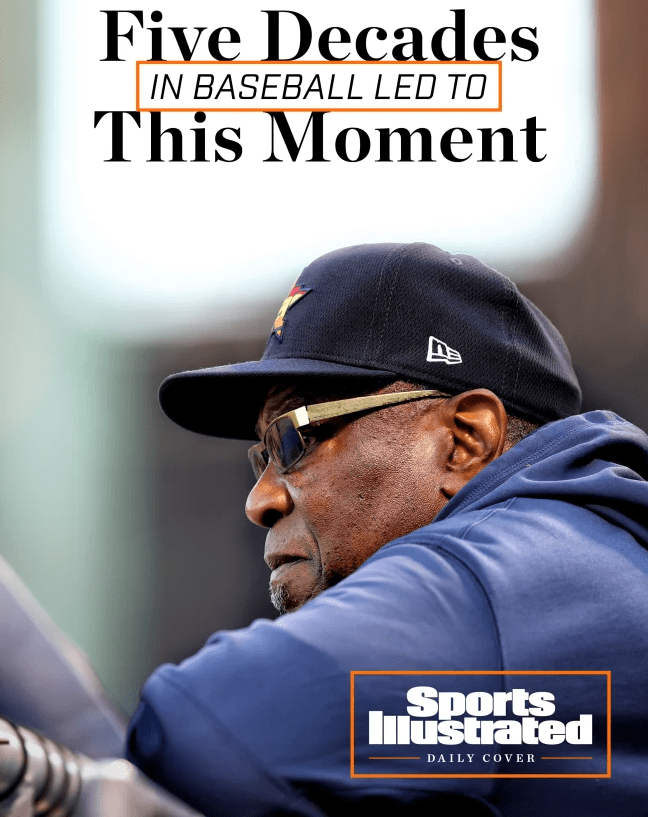
Baker is the Forrest Gump of modern baseball. He has been there in uniform for Aaron’s 715th home run (he was on deck), the first high five (he and Glenn Burke), the first NLCS MVP (he won it), Reggie Jackson’s three-homer World Series game, Fernandomania, the 1989 World Series earthquake, Barry Bonds’s record-breaking 71st home run, the largest blown lead of a World Series potential clincher (2002 Game 6), The Bartman Game (2003 NLCS Game 6), the only time batters reached consecutively on each of the four ways to get on base without putting the ball in play (2017 NLCS Game 5) and the cleanup from the Astros’ sign-stealing scandal. – Sports Illustrated
Not surprised, Dusty invented the “high five” hand slap.
Posted in Uncategorized
Leave a comment
The U.S. Budget Deficit
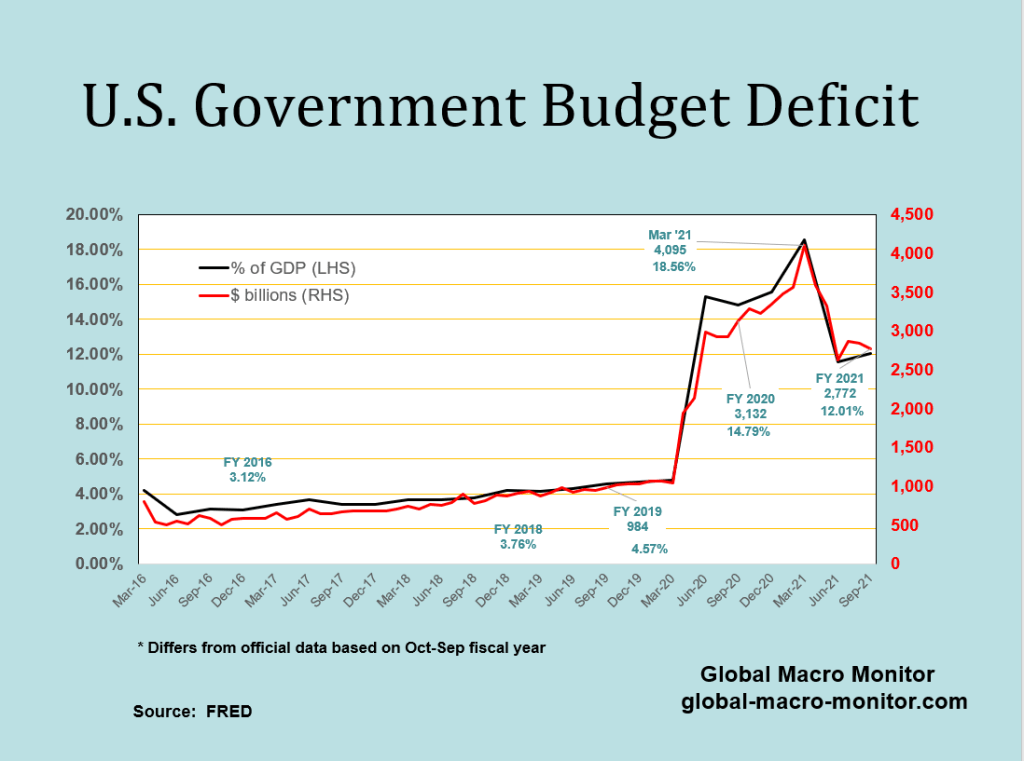
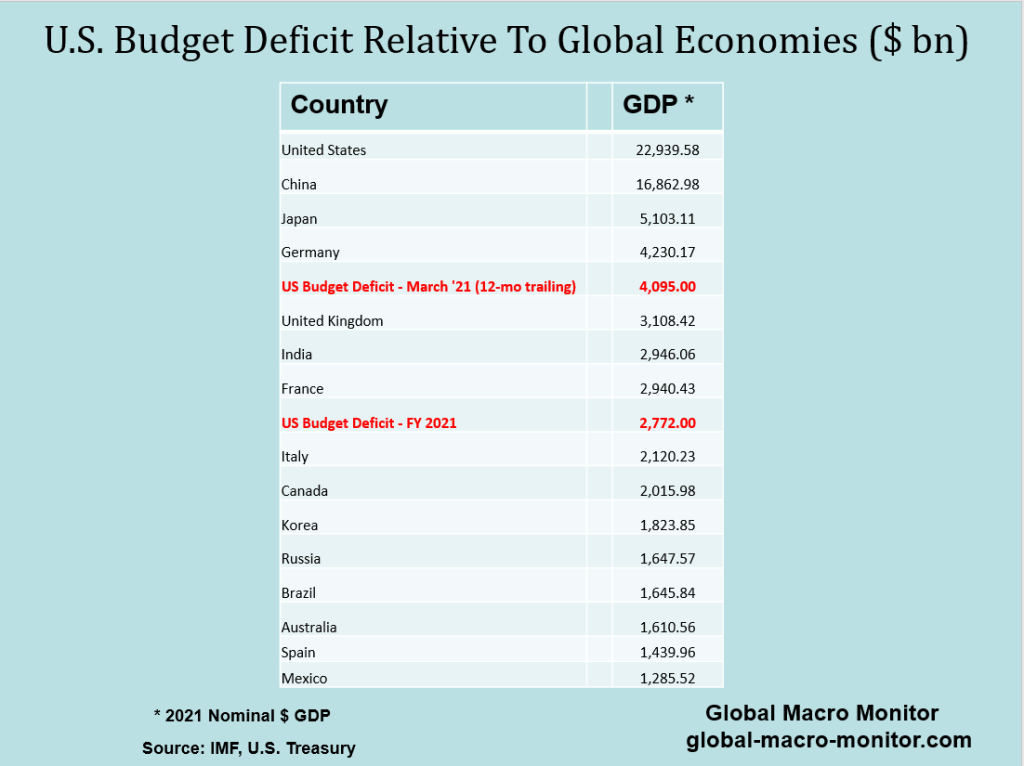
The U.S. Treasury findly released their monthly statement on Friday, which closed the books on the government’s 2021 fiscal year (October to September). The deficit came in at $2.8 trillion (12.0 percent of GDP, based on our Q3 GDP estimate) , a bit lower than FY 2020’s $3.1 trillion (14.8 percent of GDP). Those are some massive deficits, folks.
U.S. Deficit Larger Than 95 Percent Of Global Economies
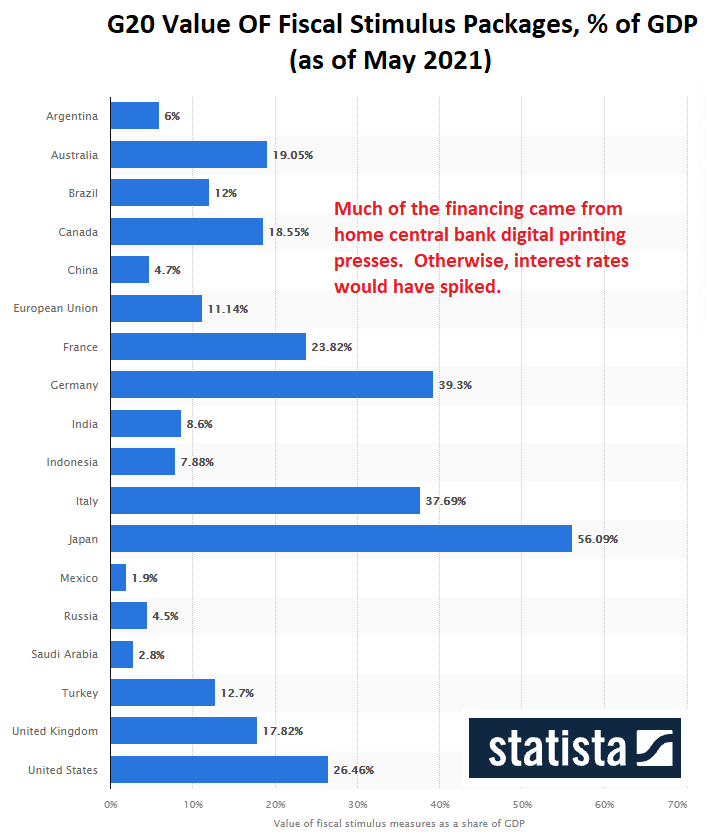
In fact, the FY 2021 deficit was larger than Italy and Canada’s economy, bigger than 185 of the 192 country economies in the IMF’ World Economic Outlook (WEO) database. Take a look at the peak 12-month deficit of $4.1 trillion in March. The March deficit would have made the G5.
Financing The COVID Deficit
How can the U.S. Treasury finance $5 trillion in borrowing over the past 18-months without spiking global interest rates, crowding out investment and other asset markets, and tanking asset prices? They can’t.
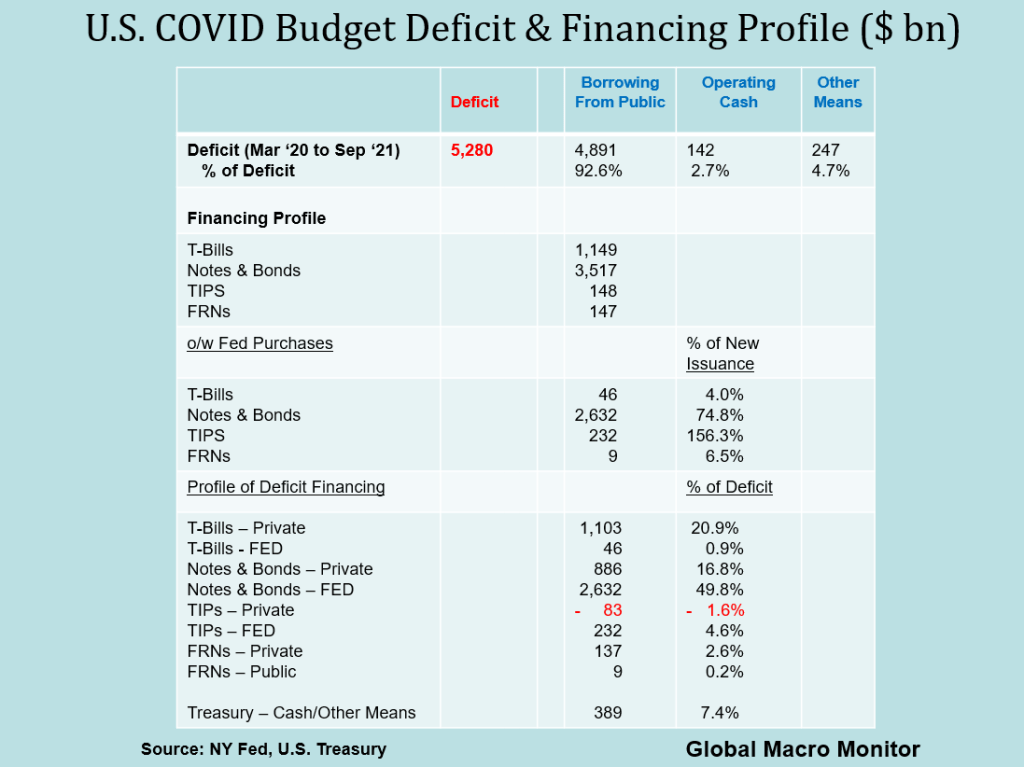
The table below breaks down the financing by several different measures. Check it out.
The bottom line is that 23 percent of the COVID deficit borrowing has been financed by an increase in Treasury bill issuance, easy given the mass excess liquidty on the short-end where the Fed is soaking up over a trillion with overnight reverse repos in order to keep short-term rates positive. Most of that liquidity, by the way, was created from QE, which, by extension, was, in effect, the Fed financing Bill purchases.
Of the remaining $4.1 trillion of non T-Bill debt issuance, 75 percent was taken down by the Fed, albeit indirectly.
No Judgement
There you have have it, folks, T-Bills and the Fed have financed the bulk of the COVID deficit and debt buildup. No judgment, but policymakers are now going to have engineer a soft landing in the economy and asset markets as we approach a fiscal cliff to normalize the budget deficit and tighten up monetary policy.
We are not throwing stones as the policymakers saved the world from a global economic castasophe.
We do criticize their continued irresponsible policies as inflation rages and stagflation sets in. It’s not wise, in our experience, to try and monetize supply shocks. We learned that hard and painful lesson by doing so with the OPEC oil shocks of the 1970s.
Deficits and monetization don’t matter? Go ask the purchasing managers up and down the global supply chain, who have been swamped by too much demand, spiking input costs, and parabolic commodity prices.
Narrow window for a soft landing. Stay tuned.
Email us or comment if you have questions.
Appendix
Posted in Uncategorized
2 Comments
The Neuroscience Of Branding – Big Think
#CKStrong Ready to breach the 1300 ANC level. You go, girl!
Fascinating stuff!
“Powerful branding can not only change how you feel about a company, it can actually change how your brain is wired.
“We love to think of ourselves as rational. That’s not how it works,” says UPenn professor Americus Reed II about our habits (both conscious and subconscious) of paying more for items based primarily on the brand name. Effective marketing causes the consumer to link brands like Apple and Nike with their own identity, and that strong attachment goes deeper than receipts”
What Are Bond Yields & Breakevens Telling Us?
Carol K.’s ANC broke above 1200 today. Absolute Neutrophil Count (ANC ) measures a type of white blood cell that kill and digest bacteria and fungi to help the body fight infections and heal wounds. At a time around Day 0 of her stem cell transplant, it was below 100, which is severe neutropenia and often fatal for cancer patients. Her fight and grit coupled with the combination of the miracle of modern medicine, deep resources, and all of your support — prayers, positive thoughts and energy, and other — around the world produced this miracle. Thank you so much to all of you. She will be discharged after a 5 1/2 month hospital stay in isolation in early Novie. Halle-freaking-lujah!
A very close friend posed the question in this post’s title to me the other day.
I laughed and said, “are you kidding me? I mostly ignore the bond market flapdoodle as it was nationalized long ago. Bond yields and breakevens are about as relevant as the price of sausage, Back In The USSR! Ergo, the bond market is not a real market with real price discovery.
Baby, It’s Foggy Outside
Unfortunately, policymakers continue to make policy based on totally distorted flight instruments, which is very dangerous when it gets foggy. The economy is foggy today, folks.
It looks like PK is starting to waffle, and seems, to us, he may be considering playing out his option on Team Transitory,
Why is it so hard to make a call on inflation right now? Because the current economy, still very much shaped by the pandemic, is, to use the technical term, weird. In particular, the standard measures economists use to distinguish between temporary price blips and underlying inflation are telling different stories. – Paul Krugman, NY Times
Krugman’s piece is a must read.
Fed Intervention In The “COVID” Bond Market
Maybe if we had a free bond market, we would have seen this inflation spike coming through a real and true bond yield and breakeven price.
The conventional wisdom is that the Fed has financed 40-50 percent of the debt the U.S. Treasury has put on its books during COVID, and that is confirmed by the data at 46.6 percent of all new issuance, including Treasury Bills. We dig deeper in the following table.
Look at the profile of the new debt that financed the COVID deficit, however.
The Fed has effectively purchased 75 percent of all new note and bond issuance and 160 percent TIPs issuance from March 2020 to September 2021. If they hadn’t, interest rates would have spiked higher, maybe 500 bps higher, and it is possible some of the auctions would have failed.
Why doesn’t the Treasury fund itself with more longer-term debt to lock in the lower rates? Because they can’t, which illustrates why T-Bill issuance was up $2.5 trillion during COVID.
Moreover, if you are going to repress coupon yields from moving to their equilibrium, you must also do the same in the TIPs market, otherwise breakevens would have gone wild and made no sense, especially given its a relatively illiquid market.
If there was real price discovery in the bond market, it may have tipped us off about a coming inflation spike and what markets really think about the path of future inflation. After all the supply chain lbroke last year, so there was plenty of time for the bond market to get it right. See our post, Hot Retail Sales Not Supply Chain Positive.

Financing Of The Monthly Budget Deficits
The following chart illustrates the path of the U.S. monthly budget deficits (red line) during COVID and how they were financed.
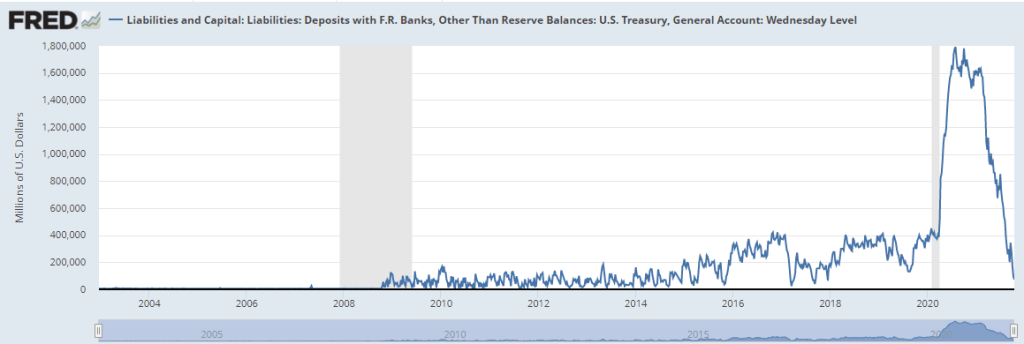
Treasury finances itself either through: a) borrowing from the public (black line), b) reduction in operating cash. mainly in its General Account at the Federal Reserve (blue line), which is down from $1.8 trillion in July 2020 to a measly $78 billion on October 13 (see here), and confirms Secretary Yellin’s assertion the government is almost out of cash, and through c) other means, such as running arrears on Treasury contributions to federal government employee pension funds, to suppliers, and other extraordinary ways.
We suspect “defaulting on the debt” as an “other means” form of financing is a bluff as the government will look for other bills and/or entitlements to run up arrears on to conserve cash and prioritize spending.
Tapping The Market When It Can
The chart also shows that Treasury seems to be very good at tapping the market when there is a flight to quality bid. Note how almost 70 percent of all COVID borrowing from the public took place during March 2020 to June 2020, and exceeded the cumulative deficit during that period by 50 percent. The positive difference went to build their reserves in the Treasury’s General Account.
Even still, the Fed bought, albeit indirectly, the equivalent of about 55 percent of all new borrowing during March 2020 to June 2020.
Debt Ceiling Politics
Nevertheless, the political cost to the Administration of using other means as a source of financing, say, suspending Social Security payments, if legal, is certain political death, and that, folks, is the game that is playing out in Washington today.
Forget about advancing the national interest, just destroy the opposition, and to be fair, it always seems M&M is on the wrong side of this issue.

(the sum of the three non red lines in the chart above will always equal the red deficit line)
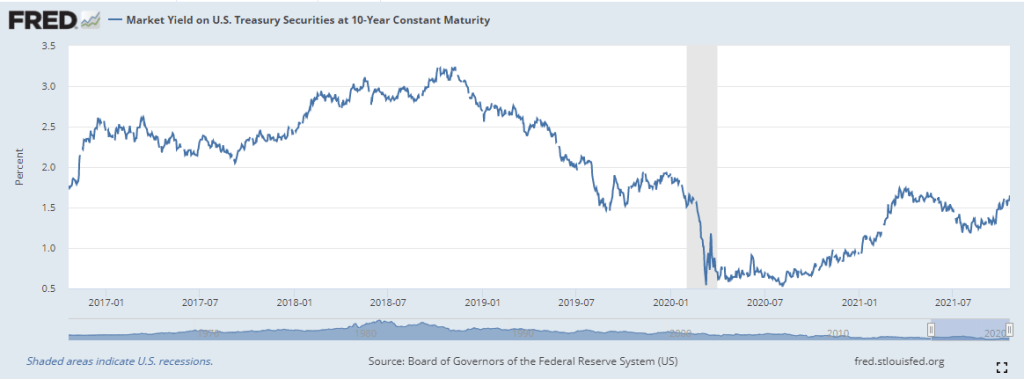
It is interesting that the Treasury’s borrowing from the public (black line) is constrained by the debt ceiling and has been negative over the past few months, all while the Fed is taking $80 billion per month in Treasury securities out of the market. No wonder why bond yields dipped during the summer, which some took as “everything is perfect,” deflation is coming, and, though we hope not, the policymakers took “as inflation is under control.”
It is almost laughable to hear comments, such as,
Is inflation caused by [monetary] inflation or by the supply chain problems?
These are coming from major market pundits, who appear, and we could be wrong, they don’t even understand the basic concepts of inflation, much less where it comes from and how to stamp it out.
My experience working with the high to hyperinflation central banks back in the day was there were lots of shortages throughout the economy. No bread on the shelf at grocery stores because of hoarding and a breakdown in…wait for it…local supply chains.
We seriously doubt we get there and will be speaking “Argentine” anytime soon if the FOMC does its job. They tell us they have the tools but do they have the stomach given such lofty and stretched asset valuations? Starting to smell a bit of panic the Fed is way offsides and needs to move quicker.
Stay tuned, folks.
As always, we reserve the right to be wrong in our conclusion as we are pretty certain we have the facts (data) right. We like to tell this story about getting our conclusion wrong.
Facts Right, Conclusion Wrong
President Lincoln, a great storyteller, had something to say about drawing different conclusions from the same established or, what economists like to call “stylized facts,”
During his days as an Illinois circuit court lawyer, legend has it Lincoln would persuade juries with the use of his funny but truth piercing stories,
The story goes that Lawyer Lincoln was worried he had not convinced the jury during the closing argument of a civil case against a railroad. The jurors had gone to lunch to deliberate. Lincoln followed them and interrupted their dessert with a story about a farmer’s son gripped by panic,
“Pa, Pa, the hired man and sis are in the hay mow and she’s lifting up her skirt and he’s letting down his pants and they’re afixin’ to pee on the hay.” The farmer responded to his panicked boy, “Son, you got your facts absolutely right, but you’re drawing the wrong conclusion.”
The jury ruled in Lincoln’s favor.
Chart Appendix
Treasury General Account Balance At The Fed, October 13
10-Year Treasury Yield
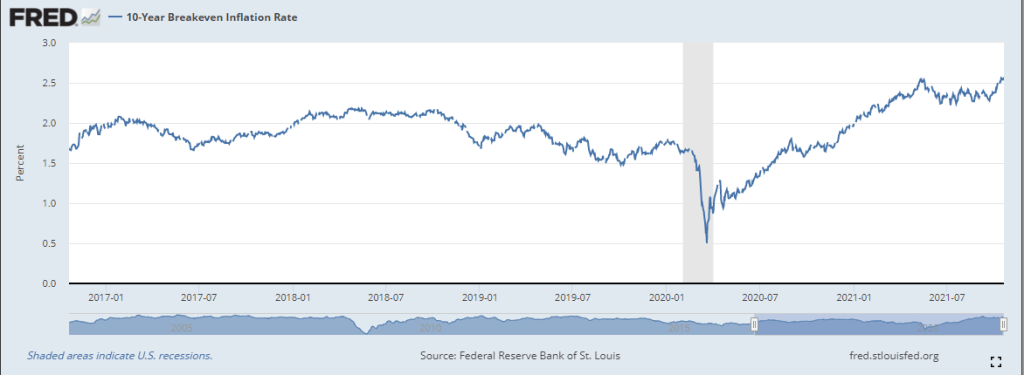
10-Year Breakeven Inflation Rate
Black Monday, 1987: Inside The U.S. Treasury
Originally Posted
October 19, 2020
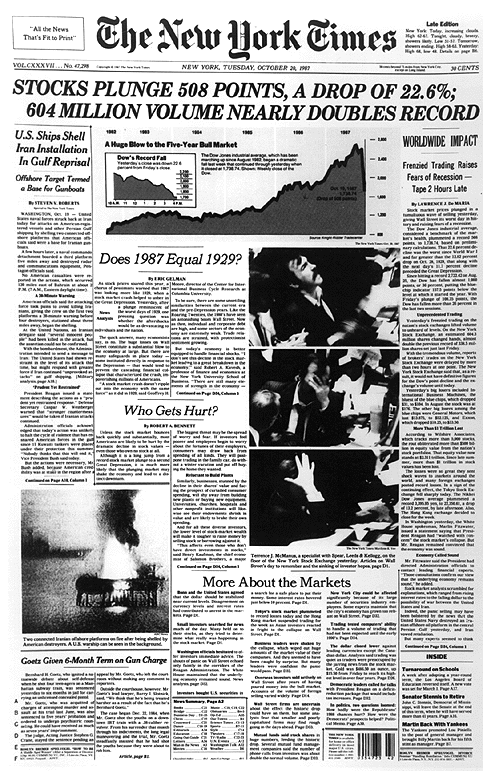
The following exchange took place between President Reagan and reporters after the market close on Black Monday, October 19, 1987. Leaving to visit the First Lady in the hospital, President Reagan spoke just after the market lost over 20 percent of its value on the day.
Q: What about the market? Tomorrow will it go down again?
President Reagan: I don’t know. You tell me.Q: Is the market your fault?
President Reagan: Is it my fault? For what, taking cookies to my wife?Q: Reaganomics?
President Reagan: I just told you. Good Lord, we reduced the deficit over last year by $70 billion. And all the other things I’ve told you about the economy are as solid as I told you. So, no, I have no more knowledge of why it took place than you have.
Thirty-three years ago today, now infamously known as Black Monday, my grandfather, M. Peter McPherson, was Deputy Secretary of the U.S. Treasury and acting Secretary that day, while Treasury Secretary James Baker was in the air traveling to Europe. McPherson was the most senior Treasury official left in Washington to handle the crisis.
The stock market had already peaked in August after an almost 100 percent rally in the prior two years. By late August, the DJIA had gained 44 percent in a matter of seven months, raising concerns of an asset bubble, and had become very volatile as interest rates had been rising rapidly since bottoming in September of the prior year.
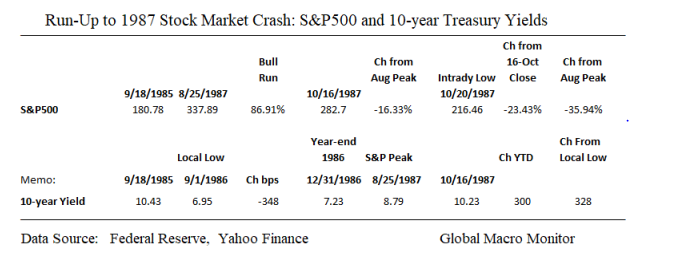
Similar to 1929, where the stock market peaked in early September, the markets had already begun to unravel, foreshadowing the record losses that would develop that Monday in October.
As the markets around the world began to crash, my grandfather convened with the U.S. Treasury’s Undersecretary of Domestic Finance and the Department Chief of Staff to discuss the government’s appropriate response. The Dow Jones eventually closed 508 points down, or a 22.61 percent, almost double the historic Crash of 1929, where the Dow fell 12.8 percent in one day.
Government Kicks Into Action
According to my grandfather, the situation demanded that his team put together a plan to calm the markets. The economy was doing fine, and there were no signs of recession. Real GDP growth came in at 3.5 percent in 1987.
Jitters about the U.S. trade deficit, rising interest rates, and the path of the U.S. dollar during the Plaza Accord are oft-cited as the fundamental reasons that triggered the crash, but nobody knows for sure. Trees don’t grow to the sky, and neither do markets. Stocks markets do what stocks markets do, keep their own schedule, and march to their own drummer.
The team’s conclusion at Treasury that day was the market was under severe strain for technical reasons and complicated by the new computerized program trading related to portfolio insurance. Nevertheless, the steep losses were causing significant dislocations in the financial markets.
Many large firms were under heavy liquidity pressure and were dangerously close to not making their margin calls and on the brink of failure.
My grandfather and his team placed a call to the then-new Federal Reserve Chairman, Alan Greenspan, only two months into the job, to encourage the issuance of a Fed statement that it would do whatever it takes to provide the liquidity to keep markets functioning.
It wasn’t the time to think about the policy’s broader economic implications, such as the potential moral hazard, as the plane was on fire and going down and desperately needed a rescue plan.
It was also clear Greenspan had been thinking along similar lines.
Fed officials drafted much longer statements for release, but Greenspan reasoned that a short, clear message would do the most to stabilize markets.
It is also important to point out that when Secretary Baker arrived in Europe late that day, he immediately began communicating with key finance ministers, such as those from Germany, Japan, France, and the UK to coordinate a global response to the financial crisis.
October 20
Greenspan issued his statement the next morning, October 20,
“The Federal Reserve, consistent with its responsibilities as the Nation’s central bank, affirmed today its readiness to serve as a source of liquidity to support the economic and financial system.” – FRB
In typical Greenspan fashion, the statement was vague in methodology yet resolute in purpose.
The market opened down and continued falling, there were no buyers and it appeared, at one point, the global financial system was headed for a complete meltdown.
“Tuesday was the most dangerous day we had in 50 years,” says Felix Rohatyn, a general partner in Lazard Freres & Co. “I think we came within an hour” of a disintegration of the stock market, he says. “The fact we didn’t have a meltdown doesn’t mean we didn’t have a breakdown. – WSJ
Then at about 12:38 pm, with many stocks not trading and pressure growing to close the markets a miracle seemed to happen.
With the closing of the Big Board seemingly imminent and the market in disarray, with virtually all options and futures trading halted, something happened that some later described as a miracle: In the space of about five or six minutes, the Major Market Index futures contract, the only viable surrogate for the Dow Jones Industrial Average and the only major index still trading, staged the most powerful rally in its history. The MMI rose on the Chicago Board of Trade from a discount of nearly 60 points to a premium of about 12 points. Because each point represents about five in the industrial average, the rally was the equivalent of a lightning-like 360-point rise in the Dow. Some believe that this extraordinary move set the stage for the salvation of the world’s markets. – WSJ
The rest, as they say, is history.
My grandfather felt that the Treasury’s phone call contributed to Greenspan’s thinking and as he made the decision to issue a statement to calm the market. The statement was the most critical event in stabilizing the markets and preventing substantial economic damage to the U.S. and the global economy.
My grandfather spoke about how the simplicity of the message prevented speculation while instilling confidence. Not unlike ECB President Mario Draghi’s, “whatever it takes” July 2012 speech, which saved the Euro currency, the European banking system, and ultimately the European Union during their debt crisis in 2011-12.
The Birth Of Stock Market Moral Hazard
Some argue, including one of the regular authors on this website, the Fed’s response to Black Monday ushered in a new era of faux investor confidence and the moral hazard that the central bank will always backstop falling markets. Thus, forever distorting market risk and real price discovery and contributing to the current boom-bust asset market cycle the global economy now experiences and will be extremely difficult to reverse.
Global Macro Monitor (GMM) often argues, which is not necessarily my own opinion, what was supposed to be a one-off market intervention in 1987 has now become the norm, which monetary policymakers will find it impossible to extract itself from, ultimately resulting in a major market and economic dislocation. We shall see.
President Reagan’s Confidence And Sense of Calm
During the crisis, President Reagan, whose administration my grandfather served several key roles in, was an excellent communicator and never once conveyed a sense of panic in October 1987.
Though not having a financial background, President Reagan did have a degree in economics and understood the nature of markets and how they coveted a sense of calm and leadership from the government during such a crisis.
The following video is President Reagan speaking to the press at the White House on Black Monday as he is preparing to board Marine One to visit the First Lady in the hospital.
Skip to the dialogue, which starts 5:40 minutes in.
Note President Reagan’s incredibly calm demeanor and sense of confidence after the most massive stock market crash in U.S. history.

