Lex Rex: SCOTUS Saves The American Republic

Lex Rex

The literal meaning of the two words is “Law King” . . . which as Rutherford explained ( and was imprisoned for what he said and came close to losing his head for it) . . . means the King (or man) is not the supreme Law 

Chief Justice John Robert’s majority opinion on the Court’s ruling on President Trump’s tax returns is a must read, folks.  Click on the link to read it in full.  Patriots will not be disappointed.

TRUMP v. VANCE, DISTRICT ATTORNEY OF THE COUNTY OF NEW YORK, ET AL.

Two hundred years ago, a great jurist of our Court estab- lished that no citizen, not even the President, is categori- cally above the common duty to produce evidence when called upon in a criminal proceeding. We reaffirm that principle today and hold that the President is neither abso- lutely immune from state criminal subpoenas seeking his private papers nor entitled to a heightened standard of need. The “guard[ ] furnished to this high officer” lies where it always has—in “the conduct of a court” applying estab- lished legal and constitutional principles to individual sub- poenas in a manner that preserves both the independence of the Executive and the integrity of the criminal justice system. Burr, 25 F. Cas., at 34. – Chief Justice John Roberts 


Posted in Politics, Uncategorized | Tagged , , , | Leave a comment

Looks Like A Democratic Tsunami – Cook Report

Cook_Report

This election is looking more like a Democratic tsunami than simply a Blue wave. President Trump, mired in some of the lowest job approval ratings of his presidency, is trailing Biden by significant margins in key battleground states like Pennsylvania (8 points), Michigan (9 points), and Wisconsin (9 points). He’s even running behind Biden in his firewall states of Florida and North Carolina.  — Cook Report

Cook_Report_1


Posted in Politics, Uncategorized | Tagged , , | 2 Comments

Riding The Gravy Train: S&P500 Key Levels

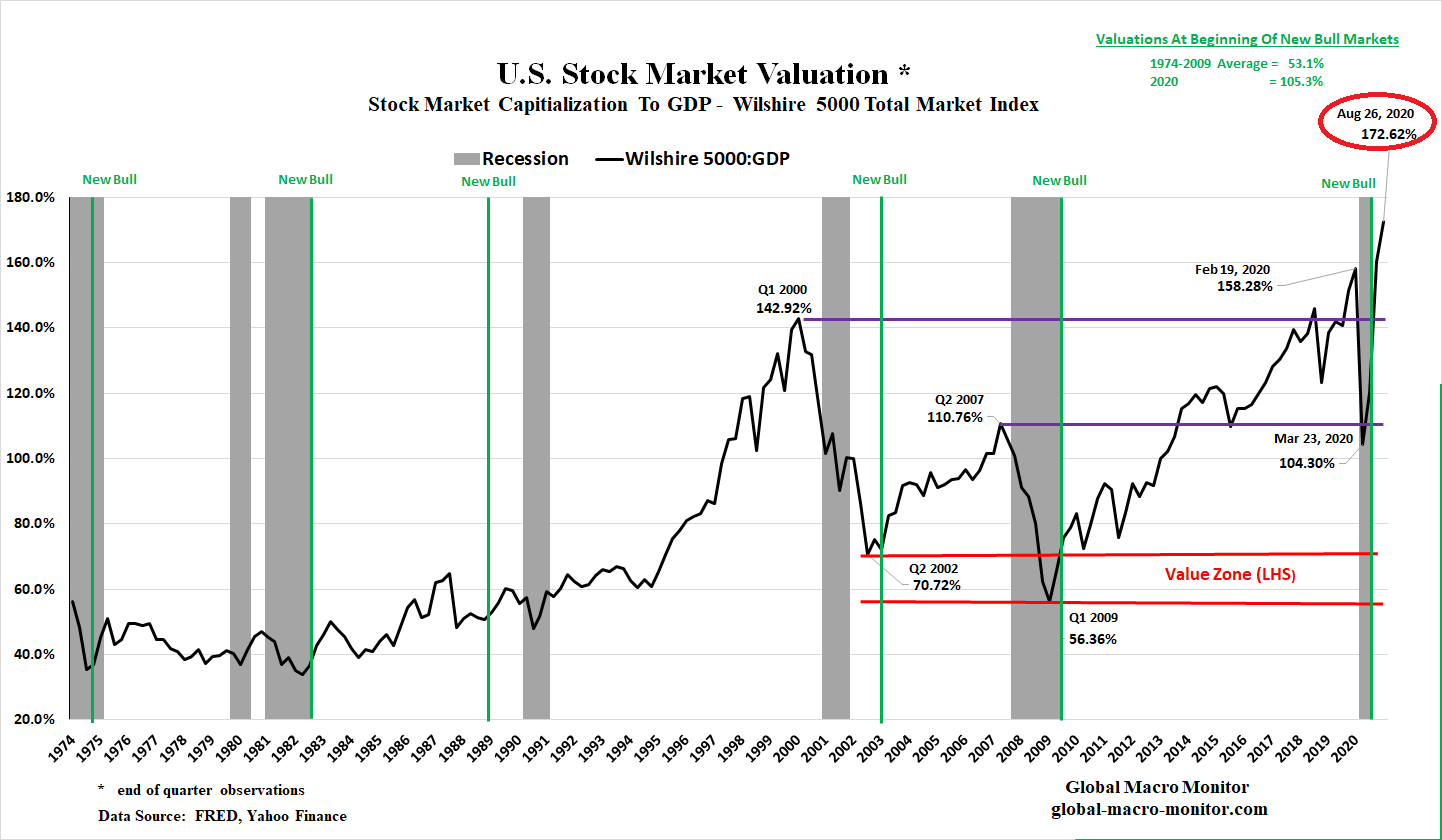
The U.S. stock market is very expensive and narrow, led by large-cap tech with S&P500 range-bound between 3233 and 2965, a 9 percent range, closing today at the upper 1/3rd of that range.   Not a fan, and a dangerous market, in the opinion of the GMM macro heads.

However, as our stock-picker extraordinaire, Coach Carol, says you “gotta ride this gravy train as long as it’s running.”  Nobody calls the top, nor the bottom, or knows the future.

Her long-term perspective as an investor is uniquely coupled with the discipline of a trader as we watch her practice the mantra,

“Cut Your Losses Short & Let Your Winners Run”.

Her performance in her personal portfolio speaks for itself.  She has, however, been raising a lot of cash recently.

Key Levels to watch (underlined)

Upside       – 3165.81 and 3184.15
Downside3142.93, 3130.01, 3109.33, 3103.77  

S&P


S&P_Chart


S&P_Nasty100

Hat Tip:  @Not_Jim_Cramer

Posted in Coach C, Equities, Uncategorized | Tagged , , | 1 Comment

QOTD: Crises & Economic Ideas

Only a crisis – actual or perceived – produces real change. When that crisis occurs, the actions that are taken depend on the ideas that are lying around.  – Milton Friedman

Hat Tip:  Joe Calhoun @JoeCalhoun3

Anyone dare to take a crack on the idea lying around that will be/has been taken up during this crisis?

Hint:  I just bought a book on the topic that is still lying around that I need to take up and read.  It should also put significant downward pressure on the following chart. 


Dollar Index

Posted in Quote of the Day, Uncategorized | Tagged , , | Leave a comment

Mike Trout Doubt’s America’s False Choice

We have always maintained that to reopen the economy was a false choice unless the public had confidence the virus had been contained.

Covid

The U.S. is losing control of the COVID crisis due to the colossal failure of leadership by the Administration.  Sure, deaths are way down but they lag the new case count by around two to four weeks.  If the market rally is based on the lower death count, then it should be a short lived rally.

Death Count

The weekly seasonality in the data must have to do with how it is reported.

Look at the date of this Tweet.

White Flag

If the economy is “reopened” next week, will the stock and bond market bubbles reinflate?   Will the unemployment rate move back to below 4 percent?   

Very unlikely.  False hopes and false choices will result in disastrous consequences. 

If people are afraid that the invisible enemy is still among us,  the economy has zero hope of recovering and the country should prepare itself for a long drawn out recession or even depression.  Forget about productivity, which is the ultimate driver of long-term economic growth.

Only if most of the public has confidence COVID-19 has been dealt a fatal blow can a robust economic recovery even be considered a possibility. – Is America Already Waving The White Flag?, GMM, March 23rd 

The U.S. could have done so much better yet here we are morphing into a failed state and a Third World Country.   We needed a national plan to reopen and strong leadership at the Federal level but only got, at best,  mixed messaging and political polarization.

Plan

None, nada, just more Potemkin noise, the hallmark of this administration, coupled with massive gaslighting.  It’s up to the Governors now to get it right and land the plane.

The Trump campaign strategy now seems to be keep whiping up the base and try to even…wait for it…. gaslight death. Don’t think it is gonna work on both counts.  – GMM, April 21st

Baseball Players Not Even Comfortable 

Here’s Mike Trout, who is on his way to becoming the GOAT of baseball. 

Buster Posey of the Giants,

Listen to Sean Doolittle of the Washington Nationals,

Sounds like baseball may not even happen this year.  Sad.

Where will the country be without their circuses?

B&C


Failed State

What Is a Failed State?

People use this expression to indicate a political entity whose government has ceased to perform most or all of its basic functions. Such a condition can result from civil war, untrammeled corruption, natural disaster, or some combination of those and more. The Fund for Peace, which has been working on such issues for more than 70 years, lists four criteria to identify such a country:

  • “Loss of control of its territory, or of the monopoly on the legitimate use of physical force therein
  • Erosion of legitimate authority to make collective decisions
  • Inability to provide public services
  • Inability to interact with other states as a full member of the international community”

I’ve always thought of such fallen lands (sometimes given a fatal shove by my own government) as far-away places. Countries like Libya. The Fund for Peace identifies that beleaguered and now fractured nation, where rival armed forces compete for primacy, as the one in which government fragility has increased most over the last decade. The present chaos began when the United States and its NATO allies stepped in militarily, precipitating the overthrow of autocrat Muammar Qaddafi, with no particular plan for the day after.

Then there’s Yemen, where Washington’s support for the intervention of Saudi Arabia and the United Arab Emirates only exacerbated an ongoing civil war, whose civilian victims have been left to confront famine, cholera, and most recently, with a shattered healthcare system, the coronavirus. And before Libya and Yemen, don’t forget the Bush administration’s disastrous 2003 invasion of Iraq, which damaged that country’s physical and political infrastructure in ways it is now, 17 years later, starting to dig out of.

So, yes, I’d known about failed states, but it wasn’t until I read “We Are Living in a Failed State” by George Packer in the June 2020 Atlantic magazine that I began to seriously entertain the idea that my country was bouncing down the same flight of stairs. As that article’s subtitle put it: “The coronavirus didn’t break America. It revealed what was already broken.”  – Common Dreams

Posted in Coronavirus, Uncategorized | Tagged , , , | 1 Comment

Canada Crushed The COVID Curve As The U.S. Struggles

“They had a healthy respect for this virus.”

U.S. Canada

The U.S. leaders thought they could gaslight science and the virus,  Canadian pols respected science and it shows in the data.  The Canucks were not influenced or led by the “Jesus Is My Vaccine” nonsense.

Canada is now only seeing a few hundred new cases per day versus over 50K in the U.S., which is a factor of 223x.  Rather stunning considering the U.S. has a population of only 8.7x that of Canada.

By the way,  GMM is proud to have a Canadian citizen on board.  One of the smartest, most rational, and commonsensical persons we know.  The Canuck was a big influencer in our warning about the strategy of the U.S. leaders back in April,

The Trump campaign strategy now seems to be keep whiping up the base and try to even…wait for it…. gaslight death. Don’t think it is gonna work on both counts.

We have to get this right, folks.  Listen to the scientists and  F the politics. — The Plan Is, There Is No Plan, GMM, April 21


Posted in Coronavirus, Uncategorized | Tagged , , , | 1 Comment

The Real History Of The 4th Of July

July 4th

Good stuff from Dictionary.com.  Looks like John Adams was two days early in his forecast on the date of the celebration.  Fortunately, he wasn’t trading S&P options, where timing is everything. 

The history of Independence Day was also/still is very complicated by America’s legacy of slavery, which appears we are finally addressing as the touch of leadership is slowly passed to a generation of younger Americans.  The great American social reformer, abolitionist, orator, writer, statesman, and free slave Frederick Douglass’ powerful July 4, 1852 speech, “What to the Slave Is the Fourth of July.” seems just as appropriate for today as it did almost 170 years ago. 

Providentially, America is still a relatively young nation, 

There is hope in the thought, and hope is much needed, under the dark clouds which lower above the horizon. The eye of the reformer is met with angry flashes, portending disastrous times; but his heart may well beat lighter at the thought that America is young, and that she is still in the impressible stage of her existence. May he not hope that high lessons of wisdom, of justice and of truth, will yet give direction to her destiny?

…Great streams are not easily turned from channels, worn deep in the course of ages. They may sometimes rise in quiet and stately majesty, and inundate the land, refreshing and fertilizing the earth with their mysterious properties. They may also rise in wrath and fury, and bear away, on their angry waves, the accumulated wealth of years of toil and hardship. They, however, gradually flow back to the same old channel, and flow on as serenely as ever. But, while the river may not be turned aside, it may dry up, and leave nothing behind but the withered branch, and the unsightly rock, to howl in the abyss-sweeping wind, the sad tale of departed glory. As with rivers so with nations.  — Frederick Douglass, July 4, 1852

Bet you didn’t know the following, we sure didn’t.

WHERE DOES 4TH OF JULY COME FROM?  – Dictionary.com

The federal government of the United States officially designates “Independence Day, July 4” as a “legal public holiday.” Independence Day is also widely referred to as July 4July 4ththe Fourth of July. Data indicates that, of the terms, Independence Day is most common, but keep in mind that is likely because many other countries around the world observe their own independence days, marking when they became independent from a foreign power. That said, Independence Day is widely known in specific reference to the US’s national independence.

The term Independence Day is recorded as early as 1790, but the term Fourth of July, in reference to the US independence, is found as early 1779. Of course, the Independence Day/4th of July commemorates the events of July 4, 1776, when the Second Continental Congress adopted the Declaration of Independence, which declared the Thirteen Colonies to be free and independent of England.

The Second Continental Congress, which formed after the start of the American Revolution in 1775, voted to declare their independence (sovereignty) on July 2, but the Declaration of Independence, the document largely authored by Thomas Jefferson explaining this vote, was adopted on July 4th. When the Founding Fathers actually signed the document, however, remains disputed. American independence from the British monarchy was secured in 1783, marking the end of the American Revolution in 1783.

After the July 2 vote, John Adams famously wrote to Abigail, his wife:

The second day of July 1776, will be the most memorable epoch in the history of America. I am apt to believe that it will be celebrated by succeeding generations as the great anniversary festival. It ought to be commemorated as the day of deliverance, by solemn acts of devotion to God Almighty. It ought to be solemnized with pomp and parade, with shows, games, sports, guns, bells, bonfires, and illuminations, from one end of this continent to the other, from this time forward forevermore.

Indeed, Americans commemorate their independence this way—but on July 4th, of course.

While celebrations of the 4th of July have taken place since 1777, it wasn’t until 1870 (referred to as the fourth day of July as a holiday for the District of Columbia) that it became a federal holiday—unpaid for federal employees until 1938. In 1781, Massachusetts was the first state to officially recognize the holiday.

Why are we emphasizing the word federal (vs. state and local) here? Because the US does not observe any national holidays mandated by the federal government, although the 4th of July is, in effect, celebrated like an official national holiday.  The US Embassy in the UK provides a helpful explanation here:

Technically, the United States does not celebrate national holidays, but Congress has designated 10 “legal public holidays,” during which most federal institutions are closed and most federal employees are excused from work. Although the individual states and private businesses are not required to observe these, in practice all states, and nearly all employers, observe the majority of them.

Remarkably, both Thomas Jefferson (the US president who enslaved the most people) and John Adams (one of the few of the early presidents who didn’t) both died on July 4, 1826.

WHO USES 4TH OF JULY?

The 4th of July is traditionally celebrated with fireworks, barbecues, festivals, and other public events, including readings of the Declaration of Independence. Due to the patriotic nature of the holiday, it often involves red, white, and blue decorations (after the US flag), as well as tributes to American troops and government institutions. On the 4th of July, many people get to enjoy a day off from work to enjoy a long weekend or vacation.

Americans may wish one another (or be wished by residents of other countries) as Happy Independence DayHappy July 4thHappy Fourth of July, or simply Happy 4th. The 4th of July appears throughout popular cultures, such as in the films Born on the Fourth of July (1989, based on a 1976 autobiography by Ron Kovic) and Independence Day (1996).

The 4th of July, however, remains a complicated holiday given the history of slavery in the US. The Declaration of Independence famously observes: “We hold these truths to be self-evident, that all men are created equal, that they are endowed by their Creator with certain unalienable Rights, that among these are Life, Liberty and the pursuit of Happiness.” But that freedom, equality, and independence was not granted to Black people, who were enslaved and oppressed. Frederick Douglass powerfully addressed this painful paradox in his 1852 speech, “What to the Slave Is the Fourth of July?” In it, Douglass memorably remarks:

What have I, or those I represent, to do with your national independence? Are the great principles of political freedom and of natural justice, embodied in that Declaration of Independence, extended to us? and am I, therefore, called upon to bring our humble offering to the national altar, and to confess the benefits and express devout gratitude for the blessings resulting from your independence to us? – Dictionary.com


Posted in Uncategorized | 2 Comments

Happy Birthday, America!

In Congress, July 4, 1776.

The unanimous Declaration of the thirteen united States of America, When in the Course of human events, it becomes necessary for one people to dissolve the political bands which have connected them with another, and to assume among the powers of the earth, the separate and equal station to which the Laws of Nature and of Nature’s God entitle them, a decent respect to the opinions of mankind requires that they should declare the causes which impel them to the separation. – Declaration of Independence


BDF81BDB-9E0D-4A64-B3E1-1BBC1A41C6AC


Posted in Uncategorized | Leave a comment

The Mathematics Of Weight Loss

Fascinating Tedx Talks vid by Ruben Meerman, The Surfing Scientistespecially for those planning to drop a few after the fireworks.

Chemical Formula For Human Fat

C55H104O6

Where does the fat go after you lose it?   Listen up.

Well worth the 20 minutes of your time.  Might just change or even save your life.

Posted in Uncategorized, Video | Tagged , , | 2 Comments

Markets Have Jumped The Shark

Jump The Shark

The beginning of the end. Something is said to have “jumped the shark” when it has reached its peak and begun a downhill slide to mediocrity or oblivion. It’s said to have been coined by Jon Hein, who has a web site, jumptheshark.com, and now a book detailing examples, especially as applied to TV shows. It supposedly refers to an episode of the TV show “Happy Days” in which Fonzie jumps over a shark on water skis, which Hein believes was the point at which the series had lost its touch and was beginning to grasp at straws. – Urban Dictionary

Welcome to the Twilight Zone.    Nothing seems real anymore — not the economy, not the markets, not the politics — and it is increasingly difficult to distinguish the difference between what is and what isn’t.  It truly feels the economy, markets, and the U.S. political system are in a period of suspended animation.

S&P500 to 4,000 On Money Supply Expansion 

Larry Lindsey,  the former director of the National Economic Council, under President Bush #43, came out on CNBC this morning making a market call of an S&P500 at 4,000, based solely on the expansion of the money supply via the Fed balance sheet.

LL_Money Supply

Click here to view the interview

Here’s a snippet,

“…I just did some math on what is happening to the money supply…when you have a rapid expansion of the Fed’s balance sheet that the main effect is on asset prices….so I simply do the extrapolation…of what might be expected to happen in stock prices.” – Lawrence Lindsey

The great Kelly Evans then jumps in putting a date on the 4,000 S&P target at year-end 2021.

There you have it, folks, a forecast of the creation of more than $7 trillion of wealth over the next 18 months based, not on productivity gains, innovation, nor economic growth, but by keeping the digital printing press running.

Can it really be that easy, folks?

Whether the wealth is real at the end of 2021 will depend on the purchasing power of the dollar, which we suspect will be lower than most currently expect.

Sounds like the market gurus are grasping at straws.

The New Henry Kauffman?

Lindsey’s call hearkens back to the days of Solomon Brothers’ economist and market guru, Henry Kaufman, using his money supply forecasts to predict interest rates,

The job of restraining money supply growth ”will be more difficult and involve a greater degree of monetary restraint and adverse development for interest rates than is now envisioned by the authorities,” Mr. Kaufman said. – NY Times,  July 23, 1982

Nothing but Happy Days ahead as long as we keep the press that prints the digital money rolling.  Just remember, folks, it was when the Fonz “jumped the shark” that ended Happy Days.

M2 Money Supply Growth

Does the following chart of the monthly year-on-year growth of the M2 money supply look normal, stable, or sustainable?   That, folks, is what Larry Lindsey and many of today’s “market gurus” and talking heads are using to rationalize the rally in risk assets.

Money Supply

What Is Money?

Fair enough. But economists can’t even agree on what defines money, how it should be measured, and what should be included in the monetary aggregates.  Should brokerage accounts, for example, where you can lever up on gold ETFS and still write checks on the account be considered part of the money supply?

During my graduate school days when monetarism was in crisis as the relationship between the money supply figures and GDP started to unravel, the Fed even toyed, or at least, researched the possibility of including equity mutual funds in the money supply figures.

Why This QE Is Different From The Past

The increase of the money supply via the Fed, rather than bank credit expansion,  though more stable, is potentially much more inflationary.  During the Great Financial Crisis (GFC) and, shortly thereafter, the financial system was impaired and credit — which also creates money — was contracting and the Fed moved quickly to offset the shrinkage of endogenous money.

No credit crunch during the COVID crisis, however,  as the Fed has backstopped, or announced to the world it would, almost anything and everything.  Credit is flowing just about as freely as the Mississippi River during storm season.

By the way, the CEO of a major restaurant chain called for the US government to backstop all restaurants’ rent payments on CNBC today.  Just wow, and how do you think that would be financed?  Unfunded pension plans are most likely next and it won’t stop there.

My good friend, Joe Calhoun’s  new piece, Here Come The Corona Capitalists. is a must-read for anyone  wanting to understand the feeding frenzy currently taking place at the public trough and what is to come.  Warning.  Prepare to be disgusted.

We are so far down this rabbit hole there is no returning.

Donut Shop Analogy

The Fed is adding more liquidity into the system at a zero percent IOER largely by removing financial assets from the same system and replacing them with reserves or cash equivalent balances.  These reserves can then be used to create additional credit or even more money.  We won’t get into it here but why would banks keep excess reserves that now earn zero or close to zero percent on their balance sheets?

The Fed is also indirectly financing the USG’s budget deficits, which include direct cash grant payments to American households.  No doubt much of this is needed and the right thing to do, in our opinion, but we can think of better ways to do it.   The timing and necessity of speed probably left no better alternatives.

If the next government doesn’t embark on a series of strong structural reforms, then we are really…you know, rhymes with shucks.

The Local Donut Shop And Financial Asset Inflation

Imagine your local donut shop, which is very busy on Saturday mornings with lines running around the block.   The donut shop serves only chocolate and maple donuts.   The chocolate donuts represent financial assets and the maple represent real goods and services.

The people in line, many of which already own several chocolate donuts, have certain preferences for chocolate versus maple donuts.

Before opening, a Brinks Truck pulls up and buys up half the chocolate donuts in the shop and those held by the customers standing line.  In addition, they hand out an additional $100 to everyone standing in the line that can only be spent in the donut shop.

Take a guess at what’s going to happen to the price of chocolate donuts when the shop opens?

The Fed, the Brinks Truck, has created a demand and supply shock for chocolate donuts or financial assets.  A positive demand shock by handing out cash and injecting more liquidity through its purchases.  A negative supply shock by removing chocolate donuts or financial assets from the donut shop and those of the customers in line.

All good until the price of maple donuts begins to rise, especially if some are imported from Canada with a now weaker currency,  as the mandate of Brinks company is to maintain a stable price and production of maple donuts.

A crude analogy, which we wouldn’t try to defend in front of a dissertation committee but it paints a pretty good picture of what, we believe, is driving asset markets.  This new supply-side economics has been going on for years but now it’s overdosing on steroids.

The End Game 

We don’t how this all ends but imagine the owners of the donut shop, which employs most of the customers in line and has made a killing but is now very dependent on the Brinks Truck showing up every Saturday morning.  The owners have used the easy money policy of Brinks to help finance a very lavish lifestyle and have borrowed money to expand production.

The Brinks company sees the price of maple donuts rising.  Can they now pull back and stop showing up on Saturday morning without collapsing the donut shop?   We don’t think so.

Infinite money demand or the notion velocity remaining an asymptotic function approaching zero is not a forever game. The risk is increasing it’s closer to the ninth inning than the first.  What is truly alarming is that monetary policy is such a black box that nobody knows, including Jerome Powell and the rest of the monetary authorities.

Gold, baby.

Posted in Monetary Policy, Uncategorized | Tagged , | 18 Comments