
This is not going away.
Listened to a Ray Kurzweil podcast the other night. He said UBI will be ubiquitous by 2030.
This is not going away.
Listened to a Ray Kurzweil podcast the other night. He said UBI will be ubiquitous by 2030.
Trump was apparently (ill) advised that China’s readiness to reduce the bilateral trade imbalance won’t be enough. No, Washington needed to impose on China enforceable structural reforms. Without that, as has been frequently repeated by U.S. Commerce Secretary Wilbur Ross, China’s destabilizing trade surpluses would be back in no time. – CNBC
This is a no win situation for Trump. Markets will rally temporarily and then sell, in our opinion.
Also, lot’s of Mad King risk.
Trump will be accused of being weak and out negotiated. Fox News is already pounding him to nuke the China trade deal. Conversely, Forbes is saying the March 1 tariffs cometh.
Who knows how POTUS will react to another one of these covers?

There is history.
Go no further than the recent government shutdown. A repeat, similar to that, will be a disaster.
Oh yes, you did hear it here waay first.
Kudos to POTUS for trying but the U.S. would be in much better shape if the administration had handled the China talks with a multilateral approach, enlisting allies – who were with us — and negotiating through the World Trade Organization (WTO).
Happy President’s Day!
Summary of Jefferson’s Message To Millennials
Jefferson In Paris
Thomas Jefferson, America’s third president and author the Declaration of Independence, was the Minister to France at the beginning of the French revolution. He supported and even allowed his residence to be used as a meeting place for some of the rebels led by Lafayette.
Jefferson was able to observe the causes and consequences of the French revolution first hand and understood that debt and aristocracy were inexorably linked and were anathema to republican democracy
Letter To James Madison
In 1789, Jefferson wrote a letter to James Madison, the Father of the U.S. Constitution, where he laid out the rationale for sweeping social and political reform to prevent such a revolution in the new formed States.
Jefferson had estimated the natural life of a generation during its majority. He used the mortality tables of the great scientist Georges-Louis Leclerc Buffon and arrived at the term of 19 years. Life expectancy during the day was approximately between 30 and 40 years, so, of course, the 19 years would have to be indexed into current life expectancy, let’s say 40 years. Nice, the biblical approximation of a generation.
“The Earth Belongs To The Living”
The upshot of the third president’s letter to the fourth president, a decade or two before either would assume power, was the basic proposition “that the earth belongs to the living: that the dead have neither powers nor rights over it.”
That is every generation has a claim to rule itself and that every generation was like an independent nation with respect to every other generation.
TJ offered three applications of this principle:
Jefferson applied the principle to the constitution and laws of government. “No society can make a perpetual constitution or even a perpetual law. The earth belongs always to the living generation. . . . The constitution and laws of their predecessors [are] extinguished . . . in their natural course with those who gave them being. . . . Every constitution then, and every law, naturally expires at the end of 19 years. If it be enforced longer, it is an act of force, and not of right.” Madison, who had just gotten the Bill of Rights passed, would have nothing to do with it. – VQR
So, there you have it, millennials, WWJD – “what would Jefferson do?
Madison thought TJ’s letter was nuts and Jefferson never really pressed these issues any further. Interesting, provocative, and a bit prophetic, nonetheless. Party like 1999 1789!
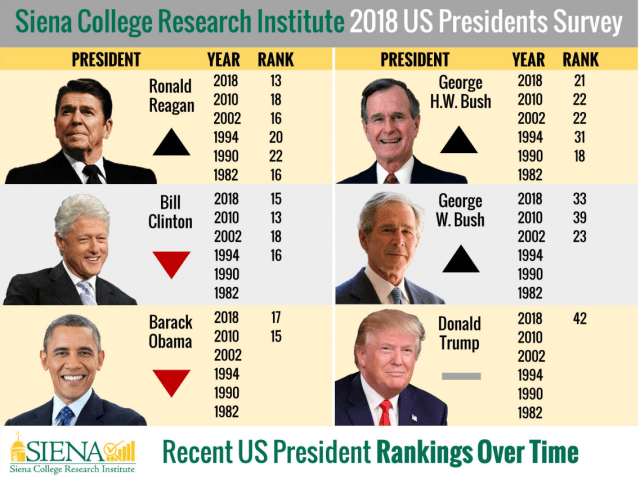
Loudonville, NY – For the sixth time since its inception in 1982, the Siena College Research Institute’s (SCRI) Survey of U.S. Presidents finds that experts rank Franklin D. Roosevelt, Teddy Roosevelt, Abe Lincoln, Thomas Jefferson and George Washington as the United States’ top five chief executives. The 157 participating presidential scholars for the first time name Washington as number one with FDR second, Lincoln third, Teddy Roosevelt fourth and Jefferson fifth. Donald Trump enters the survey as the 42nd rated president, and he joins Andrew Johnson, James Buchanan, Warren Harding and Franklin Pierce in the bottom five. Dwight Eisenhower moved up to sixth, the highest ranking he has ever achieved, while Ronald Reagan was up five spots to 13th, and George W. Bush was up six places but remains in 33rd place. Barack Obama slipped two spots to 17th, Bill Clinton dropped to 15th from 13th, and Andrew Jackson fell five places to 19th.
…Scholars rate presidents on each of twenty categories that include attributes – background, imagination, integrity, intelligence, luck and willingness to take risks, abilities – compromising, executive ability, leadership, communication, and overall ability and accomplishments – party leadership, relationship with Congress, court appointments, handling the economy, executive appointments, domestic accomplishments, foreign policy accomplishments and avoiding mistakes. Theodore Roosevelt is rated highest on attributes, Lincoln tops the list on abilities and Washington leads on accomplishments.
…The Siena College Research Institute (SCRI) Survey of U.S. Presidents is based on responses from 157 presidential scholars, historians and political scientists that responded via mail or web to an invitation to participate. Respondents ranked each of 44 presidents on a scale of 1 (poor) to 5 (excellent) on each of twenty presidential attributes, abilities and accomplishments. Overall rankings were computed by assigning equal weight to each of those twenty categories. For additional information about the survey visit http://www.siena.edu/sri/research or contact Don Levy at 518-783-2901, dlevy@siena.edu or Doug Lonnstrom at 518-783-2362. – Siena Research Institute


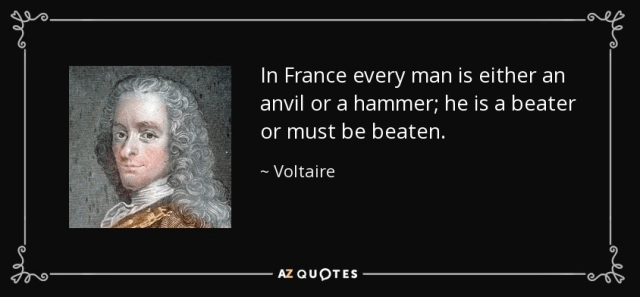
QOTD = Quote of the Day
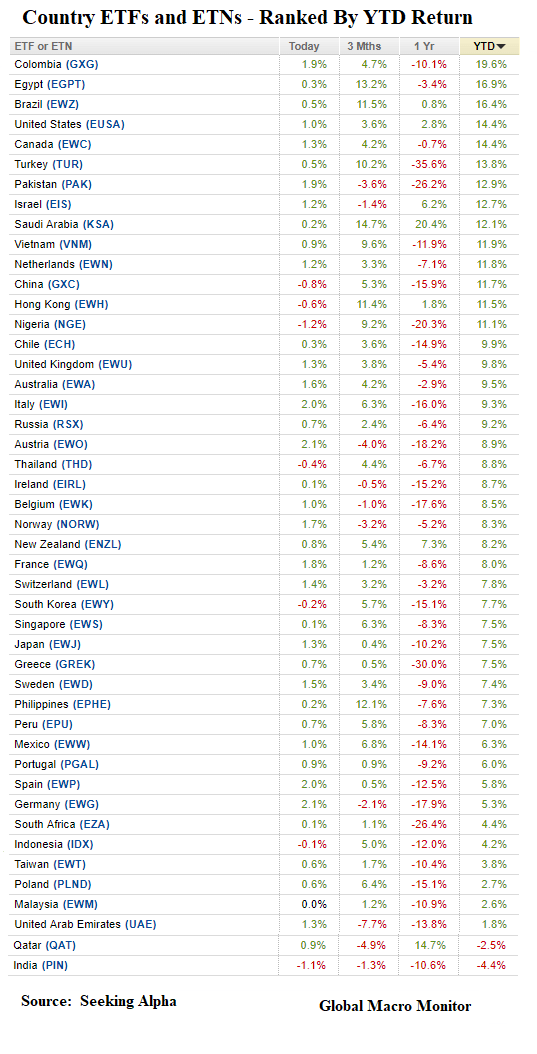
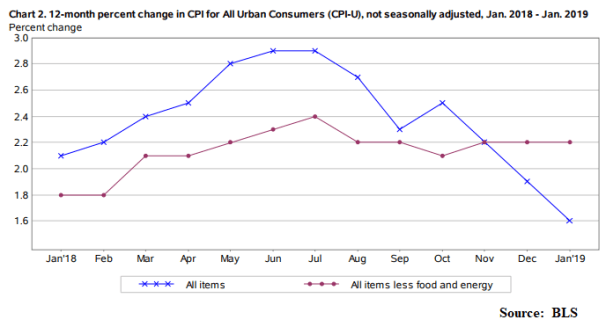
Commentary: Markets partying like the world is on the verge of a huge global growth spurt. Yet we see commentary the Fed will be cutting rates and buying Treasuries later this year even with core CPI consistently running over 2 percent.
Moreover, the inside scoop is that China is not moving on big issues but POTUS says all is well with trade negotiations.
Markets need their own version of the 25th amendment. Waaay overbought, steering clear, and selling.
Happy Presidents Day and happy hunting this week, folks.
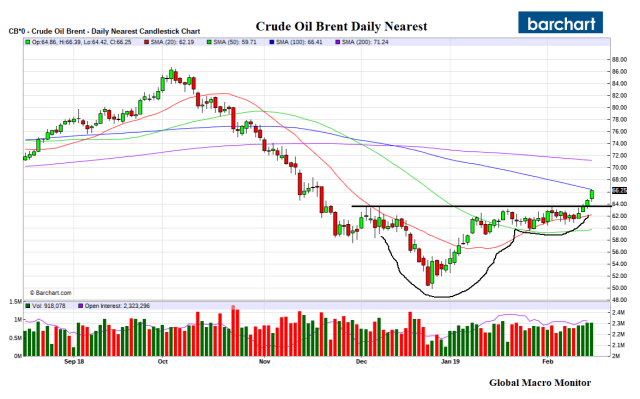

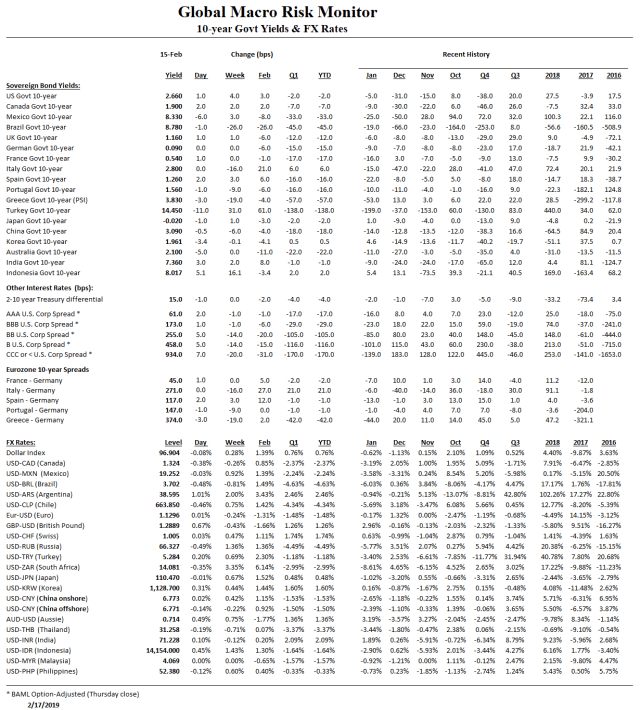
Wow! Not one red bar. Don’t think we have ever seen this. Must be a contrarian signal.
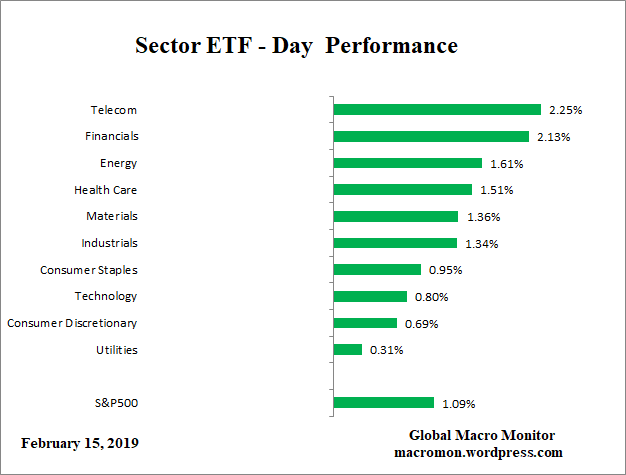
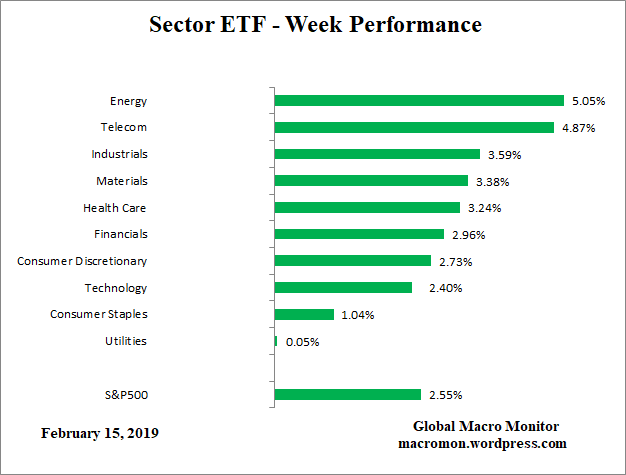
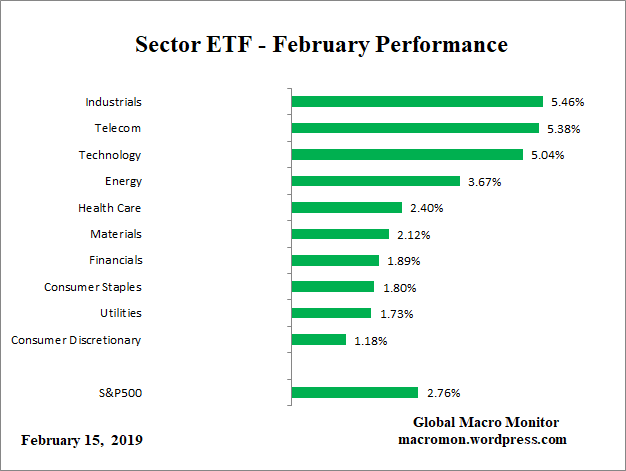
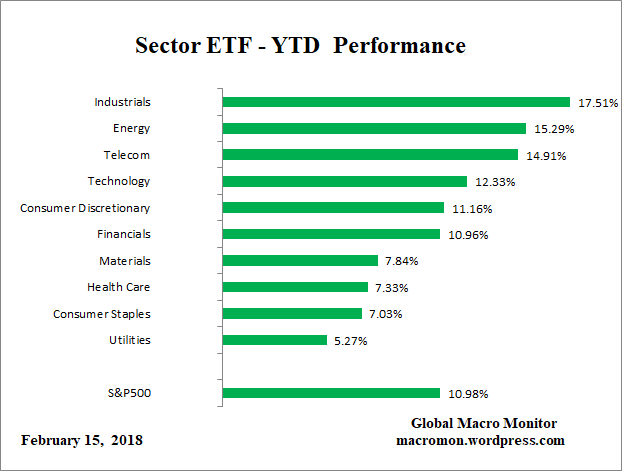

Forbes asks the $382 billion question this morning, Is A China Trade Deal Slipping Away?
President Trump and Chinese leaders are trying to put a positive spin on their marathon trade talks, but the fact is that there is little sign of progress. – Forbes, Feb 16th
That is our thinking and watched with astonishment the Puff The Magic Dragon rally on Friday, with the Dow closing up over 400 points.
You know our thoughts,
Seriously, folks, do you really think the Middle Kingdom, with all its history and past glory, after climbing back to global superpower status after hundreds of years, is now going to cave and give up some of its sovereignty because Trump demands it?
President Xi already seems to be preparing his population for the worst case scenario, warning of “challenging times ahead” possibly in the event Trump goes ahead with the tariff hikes. Maybe we are reading too much into it and maybe not. – GMM
No way in hell will the Chinese give up sovereignty because Trump, whom they now view as Paper Tiger, demands it. No doubt they were watching the government shutdown negotiation debacle with great interest and learning.
Potemkin Trade Deal
So, it looks like we will get an extend and pretend of the March 1 deadline unless Trump decides to play hard and bring down the markets and economy. Xi’s big gamble is that he is too politically weak to do so and won’t.
There is a possibility that I will extend the date. And if I do that; if I see that we’re close to a deal or the deal is going in the right direction, I would do that at the same tariffs that we’re charging now. I would not increase the tariffs. – President Trump, Feb 15th
The Trump team has run into a “Great Wall” of Chinese negotiators and seem to have failed to access what the deal breakers are for President Xi, which is one of the first principles of good negotiating. Bullying and threats of tariffs won’t work and will result in a worse situation than the status quo.
The final deal will be some sort of convoluted Potemkin trade deal (yet another one) with little structural reform to the Chinese economy, which will then invite great criticism of the administration. That is that he caved once again.
Again, we reserve the right to be wrong and will eat our crow BBQ style drowned in sriracha sauce.
BS Degrees From MSU
All administrations, political parties, and governments, in general, are full of officials with BS degrees from MSU. BS, as in Bull Shit; MSU, as in Make Shit Up.
But they seem more ubiquitous in the Trump administration, starting at the top. Weak in economic training, expertise, and understanding, and strong on ideology,
…Malpass nomination highlights the remarkable character of Trump’s economic appointments.
Remarkable in what way? Well, remarkably bad. Every economist, yours truly very much included, gets it wrong sometimes. But Trump only seems to choose men who have been wrong about everything.
Beyond that, however, what’s remarkable is the extent to which this president consistently chooses economists whose ideology is at odds with his own professed views on policy. – Paul Krugman, Feb 14th
When will Mr. Market learn?
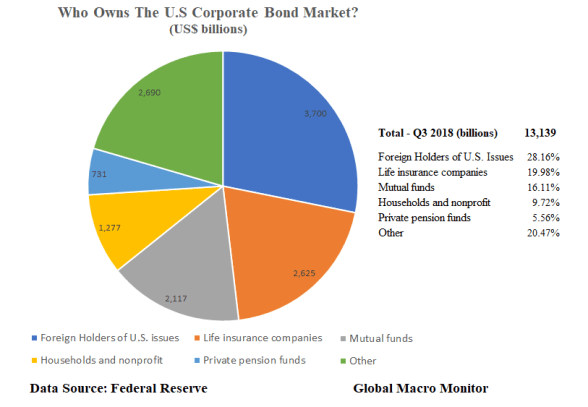
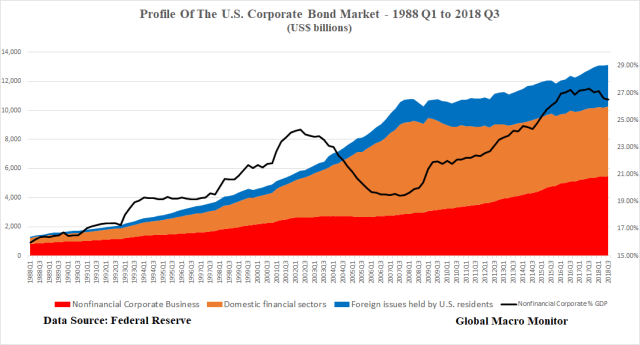
Nice piece in ZH on Jeff Gundlach dishing with Yahoo Finance on the vulnerability of the corporate bond market in the next recession. In our data analysis piece, which we reposted below, we highlight the fact largest holders of U.S. corporate bonds are “weak handed” foreigners. Given the diminishing market making capacity of the Street, good luck finding a bid when they decide to hit the exits.
Money quotes from the Bond King,
Major risks facing the market
JULIA LA ROCHE: Right. Well, a lot certainly has changed, as you mentioned. And you’re someone who’s known as someone who always looks at risk. You look at various risks. So I’m curious, what is on your radar right now? What are you focused on?
JEFFREY GUNDLACH: Well, I think the biggest risk– and it may not materialize for a little while longer– is that when the next recession comes, there’s going to be a lot of turmoil because the corporate bond market is extraordinarily leveraged. The ratings of the corporate bond market are very low. There’s a study by Morgan Stanley research that said that if you use leverage ratios alone– and there are other variables that the rating agencies used, but the most important, of course, is leverage ratios of a corporation. And if you use leverage ratios alone, that 45% of the investment grade bond market would be rated junk right now. Right now.
So if there’s a recession, obviously, these ratings will have to be lowered. For now, the rating agencies are listening with sympathetic ears to reassuring statements by some large corporations that they’re aware that their leverage ratios are kind of high, but they plan on addressing that sometime in the next few years. If there’s a recession, it’s obvious that the leverage ratios will not be addressed, and the ratings will have to go. So that’s a really big risk.
Also, during the next recession, we’re going to have an extraordinary national debt problem, because the national debt is growing at a very rapid rate already. And we’re supposedly, if I listen to Larry Kudlow and the president, they keep telling me that it’s the best economy ever. I know that they know that they’re being hyperbolic. But it is a growing economy. Real GDP is 3% year over year of the most recent reading. And yet, the national debt in fiscal 2018, which ended September 20, was increased by $1.27 trillion. – Yahoo Finance
Our latest data work on the corporate bond market is very interesting and kinda flew under the radar. We repost it, right here, right now!
Summary
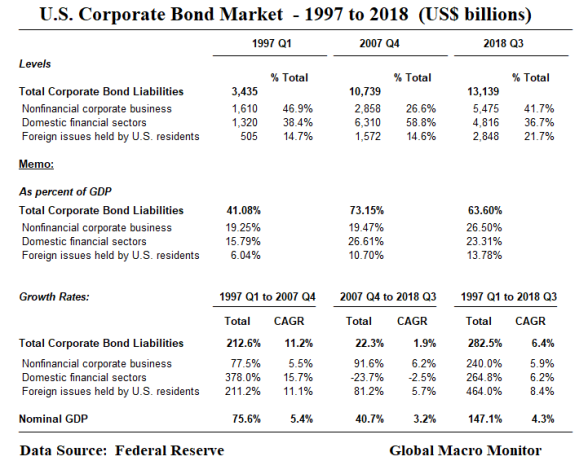
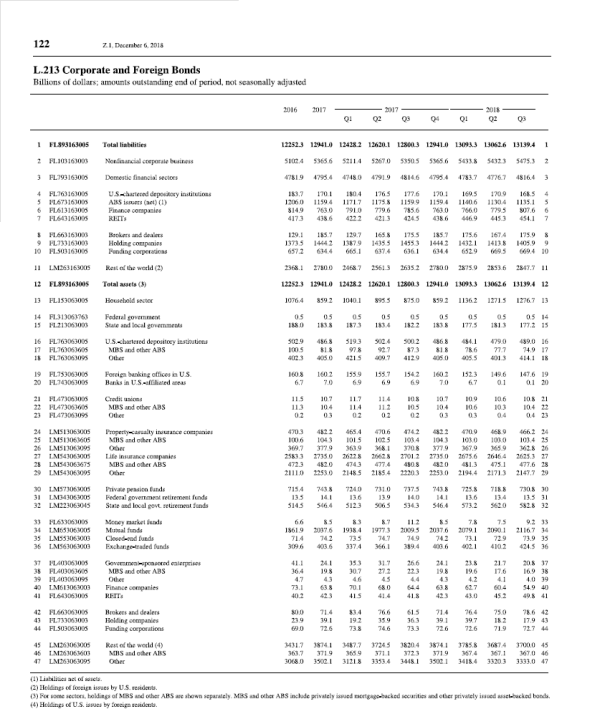
We spent most of the day crunching numbers on the U.S. corporate bond market as stocks went on another roller coaster ride. Given all the hand-wringing and concern over the buildup of corporate debt since the Great Financial Crisis (GFC), we have a real need to see and understand the data.
The Data
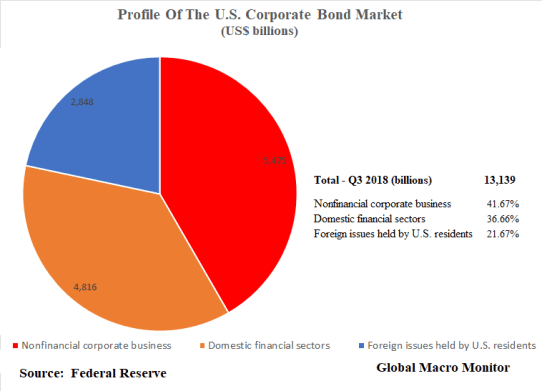
We look at the changes in level, profile, and ownership of the corporate bond market over two different periods with the Fed’s Flow of Funds data. Our point of reference is Q4 2007, which was not only the end of the early century bull run in stocks and beginning of the GFC but also the quarter where nonfinancial corporate debt as a proportion of the corporate bond market was at its lowest (26.6 percent).
Fast forward 43 quarters to Q3 2018, the latest available data, and lag back 43 quarters from Q4 2007 to Q1 1997, and there you have our three points of measurement.
Conclusions/Data Inferences
1997 Q1 to 2007 Q4
2007 Q4 to 2018 Q3
Who Owns The Corporate Bond Market
Upshot
You now have the data and charts, folks. Short and sweet, easy to read.
Now you have the knowledge and can’t claim you were unaware of the risks if the GE refrigerator falls through the kitchen floor.
Data Source
Help keep the lights on at the Global Macro Monitor. Contribute any amount based on your perception of our value added by clicking the PayPal donate widget at the right side of the screen. You don’t need a PayPal account just a credit card. Thank you!

Bonus
Click here for video.

 Global Macro Monitor