Europe Has A Big Problem

Italy’s president, Sergio Mattarella,  named Carlo Cottarelli, prime minister as the attempt to form a left-right populist coalition government fell apart after Mattarella’s veto of Eurosceptic economist, Paolo Savona as finance minister.    An extraordinary development almost tantamount to the Queen of England prohibiting the U.K prime minister from appointing a chancellor of the exchequer.

Sergio Mattarella, Italy’s president, has tapped Carlo Cottarelli, a former senior IMF official, as caretaker prime minister after frustrating a bid by two populist parties to run the eurozone’s third-largest economy.

Mr Mattarella asked Mr Cottarelli to assemble a technocratic cabinet as Italian bonds and equities were hit by a sell-off in reaction to the rising political uncertainty and a mounting constitutional crisis.

Mr Cottarelli accepted the mandate and attempted to deliver a soothing message to markets, although he is widely considered unlikely to win a vote of confidence, which would trigger fresh elections by the autumn. 

But the message failed to register with investors amid the confrontation between the populists and the old political order. The country’s debt yields ratcheted up to levels not seen since the aftermath of the eurozone debt crisis as Italian government bonds came under heavy selling pressure.

The FTSE MIB index was also hit hard, led by bank stocks. In mid-afternoon trading in Milan, Italy’s main stock barometer was down 2.5 per cent, leaving the loss for the month of May at nearly 9 per cent and wiping out all against this calendar year.  FT, May 29

Upshot? 

More political uncertainty and bigger populist blowback.  The markets are not buying the appointment of an IMF technocrat as it did during 2011 European debt crisis with Mario Monti, seeing through it an impetus for greater political blowback.

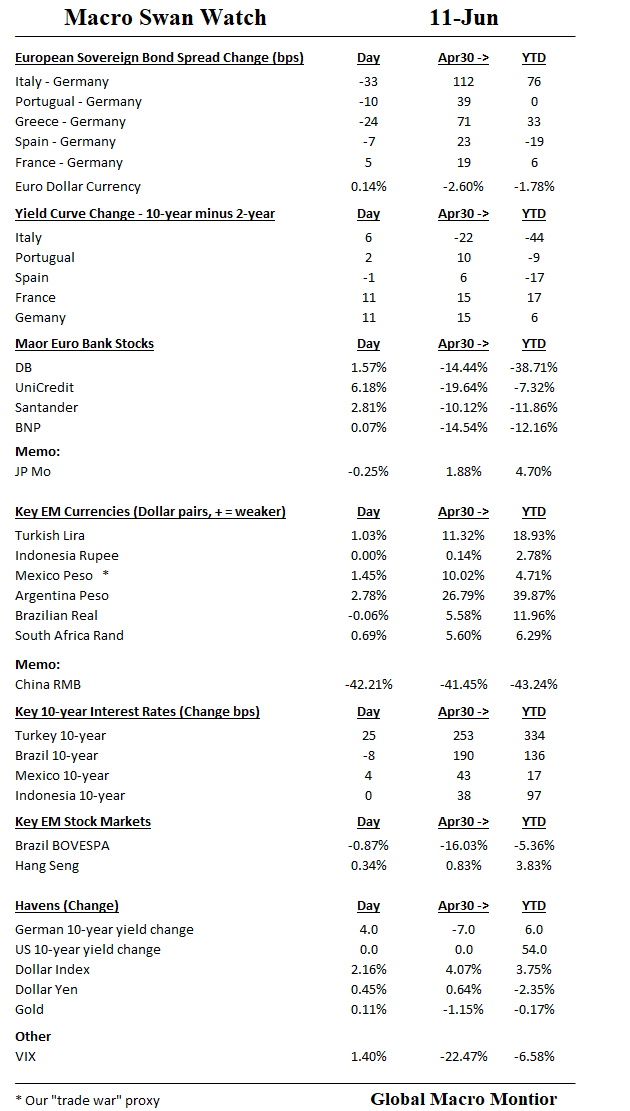
Italy is the 4th largest sovereign debtor government in the world.   The risk of contagion to the rest of the world is more likely than not, in our opinion.   It has already begun in Europe as sovereign spreads are starting to correlate.  Today’s spread widening: Italy + 29 bps;  Spain +12 bps;  Portugal +19 bps;, and Greece +15 bps.

Bond Market Convexity Going To Do More Damage

A massive spread blowout today will also be more painful and do more damage than it did in 2011 due to how lower interest rates have affected the convexity of the bond market.  That is given an increase in yields; bond prices are hit much harder.    The New York Fed has written about the “convexity event risks” in the bond markets.

The pain will have to get much worse in Italy to put the fear of  ITALEXIT into the country’s realpolitik.

That said, Italy was still able to auction debt today.

Italy placed the top planned amount of 1.75 billion euros ($2 billion) of a zero-coupon bond maturing in March 2020 at a gross 0.35 percent yield, up from a negative yield of minus 0.275 at the previous auction in late April…

…At Monday’s auction, Italy also placed a combined 1.25 billion euros of two inflation-linked bonds maturing in May 2022 and May 2028, meeting the top of its targeted issuance range.

The May 2022 BTPei bond fetched a gross negative yield of minus 0.05 percent. It had last been sold in February at minus 0.41 percent.

Italy paid 1.28 percent to place the May 2028 linker up from 0.47 percent when it last auctioned it a month ago. 

The Treasury will sell six-month bills on Tuesday and up to 6 billion euros in bonds on Wednesday, including 5- and 10-year nominal bonds as well as a seven-year floating-rate one. –  Reuters

We are not close enough to the auctions to know whether they had official support.  For example,  the Fed took down 20 percent of the latest U.S. 10-year note auction as it rolled over some of its maturing Treasuries.

We need to confirm on whether or how the ECB directly participates in bond auctions.  The posted auction results are not as transparent as in the U.S. (see next link).  Nevertheless, the Italian 10-year went off with a 2.23 bid-to-cover today.

There doesn’t seem like funding stress quite yet, but an Italian 2-year at 0.35 percent with a depreciating Euro is a juicy target for the bond market vigilantes who want to test Super Mario and whether eMac is ready to lead Europe

President Trump, The Populist

Furthermore,  the Trump administration’s  “save Europe” policy in the event of a crisis will likely be much different from the pro-EU Obama administration during the 2011 crisis.  Philosophically, President Trump is closer to the populists than he is to Macron.

The shorts have already stepped up their positions against Italy’s bond market.

The Draghi Put

Italians bond yields should not be this low on a fundamental basis, yet they are, and it is the result of the Draghi put.   We wrote the following in our May 9th post,  Italy’s North-South Economic Divide,

The Italian 10-year government bond is 112 bps through the U.S. 10-year note yield, and the country doesn’t have an independent central bank!   Moreover, the Germans are coming to town at the ECB very soon.   How is that for pricing risk?

Covered interest rate parity?   Doubt it.  Just another example of how QE has FUBARed risk pricing. and how the euro markets are repricing individual sovereign risk to European sovereign risk, again.   – GMM, May 9

Complicated German Politics

Moreover, the political dynamics in Germany are going to complicate another ECB bailout of Italy if one is needed.

Eckhard Rehberg, a member of Chancellor Angela Merkel’s Conservatives, didn’t mince words: “Italy is playing with fire and is endangering the euro zone.”  – Handelsblatt Global 

It’s deja vu all over again.

Also watch Spain’s vote of no confidence on Friday.

Seatbelts <>.  EUROPE HAS A BIG PROBLEM

May28_BundBTP


May28_UniCredit


May28_EuroSpreads


Posted in Bonds, Euro, Eurozone Sovereign Spreads, Italian Yields, Uncategorized | Tagged , , , , | 32 Comments

A World Awash In Sovereign Debt


May27_World Debt


Source:  World Economic Forum (WEF)

If you add up all the money that national governments have borrowed, it tallies to a hefty $63 trillion.  – WEF


May27_World Debt_Table

Posted in Debt, Uncategorized | Tagged , | Leave a comment

Never Forget & Stop Thanking Them…


May27_MemDay

Hat Tip: John P. Erwin


Posted in Picture of the Day, Uncategorized | Tagged | Leave a comment

Going Back To Houston!


and here’s why:

As the late, great Champ said never bet against Klay!

Never put your money against Cassius Clay, for you will never have a lucky day.  – Muhammad Ali


P.S…  For all the x/ baby boomers, that was Dean Martin singing Houston.

Posted in Sports, Uncategorized | Tagged , | Leave a comment

Tweet of the Day: Prophecy In The Comic Strips

Posted in Tweet of the Day, Uncategorized | Tagged , | Leave a comment

Week In Review – May 25

Summary

  • The S&P500 is trapped in a 2-week trading range between 2707 to 2742. Of note, 2742.92 is the 61.8 Fibo in the correction, 2702.78 the 50 percent level Fibo.  The 100-day moving average is also support at 2710.86.  Watch these levels
  • Big blowout in Euro periphery spreads, led by political and policy uncertainty in Italy, and Friday’s political tape-bomb in Spain. Italy sovereign spread out 40 bps on the week
  • Dollar index (60 percent euro weight) continues higher
  • Turkish lira pounded another 5 percent on the week and 24 percent YTD. Erdogan asks Turks to convert their foreign currency holdings to lira.
  • Other EM currencies stabilized, eking out small gains of around 2 percent
  • Big move down in 10-year bond yields in the majors. Flight to quality as macro swans gather
  • Bond yield spike in Brazil, Indonesia, and Italy
  • Global stocks relatively weak with big selloffs in Argentina, Brazil, and Italy
  • Saudi and Egypt country ETFs standout as only two with double-digit YTD return
  • JFK-Trump S&P500 analog had a big divergence this week. Friday marked 389 trading days since the election, and the  day of JFK’s S&P500 flash crash, taking the index down 6.7 percent on the day, and 11 percent over the five day period.  We can force fit the analog by changing start dates but will not.  Still on the shelf and will bring it out when it starts working again.  Note the Trump S&P500 has always lagged the JFK market over the history of the analog.


Weekly_Chart1


Weekly_Euro_Spreads


Weekly_Currency


Weekly_10-year_yields


Weekly_Recovery1


Weekly_Recovery2


Weekly_Bull_Bear


Weekly_2018_ETFs

Weekly_Table


Posted in Bonds, Uncategorized, Week in Review | Tagged , , , , , | Leave a comment

Sector ETF Performance – May 25

ETF_D

ETF_W

ETF_M

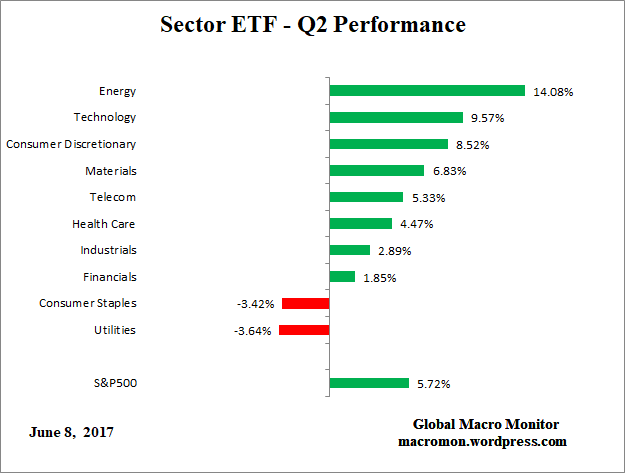
ETF_Q

ETF_YTD


Posted in Sector ETF Peformance, Uncategorized | Tagged , | Leave a comment

Global Risk Monitor – May 25

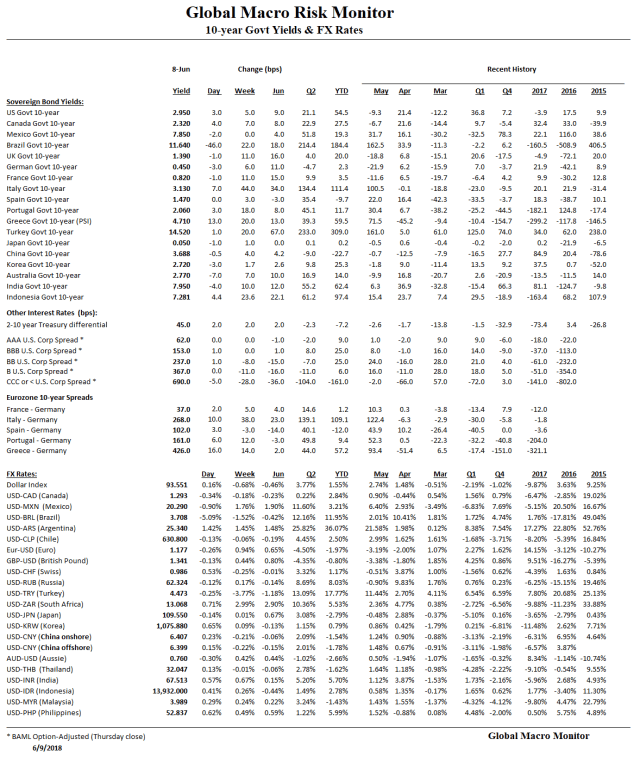
RiskMon_1

RiskMon_2

Posted in Daily Risk Monitor, Uncategorized | Tagged , , , , , , | 3 Comments

Get up and fight, sucker!

53 years ago today, one of the most iconic photos in sport: Ali vs Liston II, captured by the brilliant Neil Leifer – @MeredithFrost

May25_Ali


The ending of the second Ali-Liston fight remains one of the most controversial in boxing history. Midway through the first round, Liston threw a left jab and Ali went over it with a fast right, knocking the former champion down. Liston went down on his back. He rolled over, got to his right knee and then fell on his back again. Many in attendance did not see Ali deliver the punch. The fight quickly descended into chaos. Referee Jersey Joe Walcott, a former World Heavyweight Champion himself, had a hard time getting Ali to go to a neutral corner. Ali initially stood over his fallen opponent, gesturing and yelling at him, “Get up and fight, sucker!”  – BoxRec

Posted in Sports, Uncategorized | Tagged , , , | 1 Comment

When The U.S. Government Defaulted

One of the most pervasive myths about the United States is that the federal government has never defaulted on its debts. There’s just one problem: it’s not true, and while few people remember the “gold clause cases” of the 1930s, that episode holds valuable lessons for leaders today. – Sebastian Edwards, Project Syndicate,  May 21, 2018

My friend, UCLA professor,  Sebastian Edwards, is out with a must-read summer book, American Default: The Untold Story of FDR, the Supreme Court, and the Battle over Gold.


May24_Edwards


Sebastian has also published an excellent synopsis of the the book, Learning from America’s Forgotten Default, on the Project Syndicate (PS) website.   It is an excellent introduction to the subject material but only scratches the surface and should not be a substitute or excuse for not purchasing the book.

Money quotes from the Project Syndicate  piece:  

  • There was a time, decades ago, when the US behaved more like a “banana republic” than an advanced economy, restructuring debts unilaterally and retroactively
  • In April 1933, in an effort to help the US escape the Great Depression, President Franklin Roosevelt announced plans to take the US off the gold standard and devalue the dollar. 
  • …this would not be as easy as FDR calculated. Most debt contracts at the time included a “gold clause,” which stated that the debtor must pay in “gold coin” or “gold equivalent.” 
  • These clauses were introduced during the Civil War as a way to protect investors against a possible inflationary surge.
  • …the gold clause was an obstacle to devaluation. If the currency were devalued without addressing the contractual issue, the dollar value of debts would automatically increase to offset the weaker exchange rate, resulting in massive bankruptcies and huge increases in public debt.
  • Congress passed a joint resolution on June 5, 1933, annulling all gold clauses in past and future contracts.
  • Republicans were dismayed that the country’s reputation was being put at risk, while the Roosevelt administration argued that the resolution didn’t amount to “a repudiation of contracts.”
  • On January 30, 1934, the dollar was officially devalued. The price of gold went from $20.67 an ounce – a price in effect since 1834 – to $35 an ounce.
  • …those holding securities protected by the gold clause claimed that the abrogation was unconstitutional. 
  • Lawsuits were filed, and four of them eventually reached the Supreme Court; in January 1935, justices heard two cases that referred to private debts, and two concerning government obligations.
  • On February 18, 1935, the Supreme Court announced its decisions. In each case, justices ruled 5-4 in favor of the government – and against investors seeking compensation. 
  • Justice James Clark McReynolds… wrote the dissenting opinion – one for all four cases… He ended his presentation with strong words: “Shame and humiliation are upon us now. Moral and financial chaos may be confidently expected.”
  • …the 1935 ruling is invoked [today] when attorneys are defending countries in default (like Venezuela). And, as more governments face down new debt-related dangers – such as unfunded liabilities associated with pension and health-care obligations – we may see the argument surface even more frequently.
  • …the US government’s unfunded liabilities are a staggering 260% of GDP – and that does not include conventional federal debt and unfunded state and local government liabilities.
  • A key question, then, is whether governments seeking to adjust contracts retroactively may once again invoke the legal argument of “necessity.”
  • The US Supreme Court agreed with the “necessity” argument once before. It is not far-fetched to think that it may happen again.  – Sebastian Edwards

A Roadmap? 

There you have it, folks.

The good professor lays it all out, which may or may not be the roadmap for how the U.S. and other highly indebted governments resolve their ,massive and almost impossible to fulfill contractual obligations to both creditors and its citizens.   The Supremes have already ruled in favor of the government under the “necessity” argument.

Modern Monetary Theory (MMT)

Sebastian’s material gives us much ammunition in arguing with the Modern Monetary Theory crowd, who believe a sovereign government cannot and will never default on its local currency obligations if it has an independent central bank.    Of course, they will argue that FDR and the U.S. didn’t have an independent monetary policy because of its link to the gold standard.

Russia 1998

When we bring up Russia’s 1998 default on local currency GKO debt (David Tepper’s worst trade, BTW) the MMTs argue “special case.”

It seems to us the MMT crowd believe that because a government has an independent central bank and can always print money to payoff debt, they will never, ever experience rollover risk.  Complete nonsense.

Can you say Venezuela?

When a government experiences financing problems through a sudden stop in funding, the leaders must make a political decision on whom to inflict the pain.

Either default, which hurts their creditors, and who be predominantly consists of foreigners, as was the case in Russia in 1998; and is the case with the U.S. federal government marketable debt in 2018;  or monetizing the rollover, resulting in hyperinflation and wiping out domestic residents.

We have the first-hand experience of the latter and have written about it in many posts over the years,

We’ll also never forget being in the Bulgarian central bank in 1996 just before some very large maturities of treasury bills were coming due.  The market had lost confidence in the government and a high ranking central bank official looked us straight in the eye and said “we will not let the government default.”

We knew instantly a massive amount of liquidity was about to hit the local markets, the demand for the currency was going to collapse, and the country was headed for hyperinflation.   Rioting broke out, the government fell, and the country eventually implemented a currency board, not too dissimilar from  that of the Euro, in order to enforce fiscal discipline upon the government. – GMM, November 2011

We suspect when the day of reckoning comes for the United States to pay for its debt profligacy, it won’t be such a simple binary choice. There will be many and various types of public sector obligations in the queue to be paid, which may require differential treatment.

Sebastian’s example of the U.S. government default in the 1930’s is a combination of both.  The default on the contractual gold clause and the inflating away of much of the debt through devaluation.

This is tantamount to an emerging market government unilaterally and retroactively converting its foreign currency debt into local currency and then monetizing it, and supported by the legal system.

How would that work out for, say,  Venezuela dollar denominated bond holders?

Let’s hope our political leaders and policy makers come to their senses before that dreadful day is upon us.

Now take the few minutes to read the full article and go buy the book for some excellent beach reading. .

Posted in Bonds, Budget Deficit, Sovereign Debt, Sovereign Risk, Uncategorized | Tagged , , , , , , | 43 Comments