Global Risk Monitor – June 8

RiskMon_2

Posted in Daily Risk Monitor, Uncategorized | Tagged , , , , , | Leave a comment

Speaking Of Wile E. Coyote Moments…

The stimulus “is going to hit the economy in a big way this year and next year, and then in 2020 Wile E. Coyote is going to go off the cliff,” Bernanke said, referring to the hapless character in the Road Runner cartoon
Ben Bernanke,  former Fed Chairman, June 7

Stunning valuation metric of the U.S. stock market.

We used the Fed’s Flow of Funds for all domestic sectors for corporate equities in the numerator.   It is the same numerator as Doug Short’s but includes the equity market value of the financial sector.    Yes, it may be a bit distorted due to buybacks.

We invite you to confirm the calculation.  Click here to download the data from Table L.223 for the equity data and Table F.2 for the GDP data.

Nonetheless, the Buffet Indicator is not exactly  flashing a “buy the market it is cheap” signal.

The sun came up today and “you wanna talk about tail risk?”  Come on, man!

Bernanke’s Wile E. Coyote moment is coming to the stock market.  The question is not if but when?  Our bet it will be certainly before Gentle Ben’s.

Rentals only, my long brothers and sisters.

Stay tuned,  Roadrunner.


Market Cap_GDP

Posted in Equity, Uncategorized | Tagged , , | 33 Comments

Nonlinear Thinking: European Inventors Awards

The European Inventor Awards organized by the European Patent Office celebrates inventors not just from Europe but also from the US and Canada…

READ MORE : http://www.euronews.com/2018/06/07/eu…

Posted in 3D Printing, Nonlinear Thinking, Technology, Uncategorized | Tagged , , | Leave a comment

Swan Lake – June 7

The swans were restless and a bit weaker today.

Italy 10-year is blowing out again, now just ten bps below May 29th closing high of 3.16 percent.  The yield curve in Italy continues its re-flattening, as shorts seem to be feasting on the two-year at 1.305 percent.  If that is the case, and our knowledge of the liquidity and the market microstructure of the euro periphery bond market is de minus, Portugal, and Spain 2-years are going to become juicy targets at around 0.0 percent as the ECB embarks on normalizing monetary policy.

Deutsche Bank stock attempted a rally but flopped at the close, down 3 percent off its intraday high.  There were rumors of a merger with Commerzbank floating around today.  Unicredit back below €14.00.

EM is ugly as in Brazil, which is becoming the poster child and main indicator species of diminishing global liquidity.  The Brazilian BOVESPA traded in a 7 percent range today, closing down 3 percent and now down over 14 percent since the April 30th close. The economic and politics in Brazil have been worse, but the idiosyncratic fundamental deterioration has provided a story and reason to sell.

Global liquidity is about to get exponentially worse in the coming months as the ECB changes monetary policy and Federal Reserve’s quantitative tightening (QT) caps step up to $50 billion per month in September.

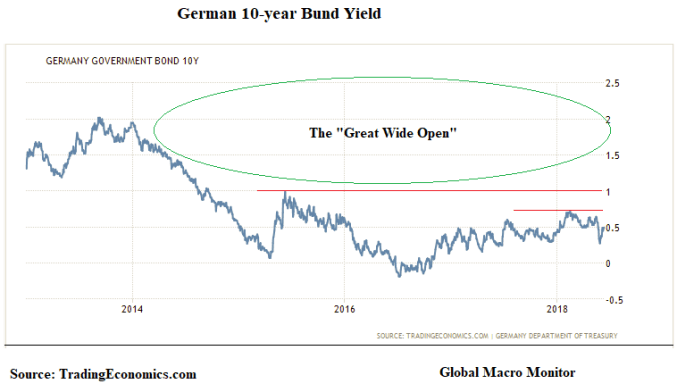
Quite a bit of volatility in the U.S. 10-year yield today.  As it approached, 3 percent volume picked up as the buying algos kicked.  We have firm conviction 3 percent will not hold, and long rates are heading much higher than the market anticipates, unless, of course, the market is hit with a high sigma negative shock.  It may be a spike in long-term rates in the U.S. is that high sigma shock.

The sun came up today even as global macro risks are increasing ergo the risk markets are still bullish.   The prevailing narrative is now strong U.S. economic growth.

We don’t fight the market.

Stay tuned.


SwanLake_Table


Posted in Black Swan Watch, Uncategorized | Tagged | Leave a comment

The Clash Of Generations Cometh

You heard it here first, comrades!

https://twitter.com/jameshasson20/status/1004096297316601856?s=21

Posted in Demographics, Uncategorized | Tagged , | Leave a comment

The Tale Of Two Fat Tails

May25_Fat Tails

In a normal probability distribution…blue curve), the odds of risky outcomes (bad stuff happening) are thin at the extremes. In fat-tailed distributions, such outcomes have a greater chance of occurring (the [greenish] curve). Source

Non-normal distributions can be heavily skewed and unstable. – Decline of the Empire

Fat Tails In Real Life

If you have been following the Global Macro Monitor more than, say, a year,  it should be clear by now we love living in the fat tails.  That is we are natural contrarians, love to play devil’s advocate to and jackhammer the prevailing perma bullish narrative,  and always looking for the next big move in the markets.

By fat tails, we mean more than a two standard deviation (sigma) move, which happens more often in the markets than they should in a normal distribution of returns.  Ergo the “fat tails.”

Hawaii

In the past year,  we have experienced some very high sigma events in real life.  If you recall in April, we went on a short-term spring break.  To where, you may ask?

The rim of the Kilauea volcano on the big island of Hawaii!

This just a few weeks before it blew.  As my 15-year daughter perused the landscape, which looked like a scene from the surface of Mars, we snapped the following picture of the rim with my iPhone.   Again, this was just a few weeks before it blew as illustrated in the subsequent images.

I recall thinking at the time that the probability is very low of a volcanic eruption but what if while we were here?  I have lived through some very terrifying earthquakes, one that destroyed our home.  However, being stuck in the middle of the giant Pacific while the volcanic island is blowing its top would be scary, especially when you have your youngest child with you.

In fact,  I even thought of posting a piece about fat tails back then.   While visiting the museum at the top of the rim,  I came across a Richter scale that shows seismic activity usually significantly increases before an eruption.  It was the inspiration for this quote,

Markets rarely fall out of the sky and usually signal something big is coming by a sharp rise in volatility.    Think of a Richter scale before a volcano blows.  – GMM, April 21

Pele is upset.

Pelehonuamea, to be exact. “She who shapes the sacred land.”  In Hawaiian myth and culture, Pele is the goddess of fire and volcano and devours the Big Island when she is perturbed. She has a wicked temper and she made her home in the Halemaumau crater.  – Washington Post

Kilauea is home to Pele, goddess of the volcano

Godspeed to our friends on the Big Island..

iPhone Shot On Spring Break (early April)

May8_Volcano

A Few Weeks Later

May25_Volcano

May25_Volcano_2

May25_Volcano_Space

The October NorCal Fires

If you were tuned in to the Global Macro Monitor, you recall our experience fleeing from the flames of the October fires in Northern California.   See here and here.

Those were some stressful daze.   ‘

The lot just before the what looks like a Roman colonnade in the picture taken the morning after was our old home.  Still stunned when I drive through the old neighborhood that something like that could have happened.  Only one house is standing in the old track of about 600 homes.

I guess empirical probabilities become distorted relative to the logical probability when you wake up every morning and the sun still rises even though there were concerns and warnings that such a devastating fire could take place.   I often thought of those warnings but dismissed them as a low probability  “tail risk.”

We are now at ground zero of all that ills the housing market.   The acute shortage of residential housing supply is driving rents sky high.   The labor shortage coupled with increasing construction costs are making it difficult for contractors to build.

Regulatory red tape and the slow bureaucracy is adding to the difficult task of rebuilding.  You can see in our old neighborhood not one lot is under construction more than eight months after the fire.  The water was contaminated, and underground architecture was destroyed and needs rebuilding before residential construction can begin.

Many of the above problems in our local housing market are also reflected in the national housing market, which is fueling another price bubble.  The current bubble is much different from the one experienced 2006-08, however, and driven not so much by leveraged buying but by the new supply-side economics.  The price adjustment will therefore have much different dynamics.

Though devastating and one is too many lives lost the October fire was not even close to the devastation wreaked upon Puerto Rico and Houston from last year’s hurricane season.

Lessons Learned

What did we learn through all this?

Tail risk is real and more likely than a normal distribution foretells.   Moreover,  the real world and markets live in probability distributions with obese tails.

Finally, someday the quant driven trading algorithms are going to simultaneous short-circuit because they have their probability distributions wrong, causing a major market meltdown and significant damage to the global economy.

Stay tuned, HAL and Kurt.


Our Old Neighborhood The Morning After

May8_Paxton_Fire

Same Shot A Few Weeks Ago


May8_Paxton

Posted in Algos, Climate Change, Economics, Uncategorized | Tagged , , , , , | 52 Comments

Swan Lake – June 6

The swans were relatively well behaved today.  Watch Brazil.

Significant move in Italian 2-year, up 35 bps, resulting in big curve flattener.  Yields up across the board in Europe as ECB making noises QE is about to change.

Mario Draghi is on the verge of a watershed moment in the European Central Bank’s efforts to leave behind its crisis-fighting monetary policy

Chief Economist Peter Praet on Wednesday signaled the bank’s first formal round of talks on when to stop buying bonds is imminent. That would start the process of bringing down the curtain on stimulus efforts that have resulted in almost 2.5 trillion euros ($2.9 trillion) of bond purchases since 2015.  – Bloomberg

The markets dismissed, though German and U.S. 10-year yields spike, the significance of what the ECB is signalling but that is what markets do when they are in bullish mode.  The sun still comes up even with increasing risk and it follows must be time to hit the beach.

The risk markets want to move higher.


SwanLake_Table


Posted in Black Swan Watch, Uncategorized | Tagged , , , , , | Leave a comment

Italy’s New Government: Who’s Who?

After weeks of negotiation the Italian Government is ready to get to work. But who are the key players?

… READ MORE : http://www.euronews.com/2018/06/06/it…

Posted in Italy, Politics, Uncategorized | Tagged , , | Leave a comment

Swan Lake – June 5

Swans behaving badly + VIX down = Complacency reigns

Jun5_picture.png


SwanLake_Table

Posted in Black Swan Watch, Uncategorized | Tagged , , | Leave a comment

QE And The Laurel vs. Yanny Distortion

Interesting clip from Wired,  interviewing  a neuroscientist explaining how people get the sound Laurel and Yanny name so different.

The interview is profound if you take the principles and apply them to the markets.  It’s all about reading the correct signals  — such as low or high frequencies –to determine what you hear.

Money Quotes: 

Neuroscientist:  It sounds a lot like Yanny to me…The clip is distorted so it has a lot of high frequency information in it, more than usual. and I just might be better at hearing these high frequencies than you…

Q:  What about hearing Laurel one day and Yanny the next?  

Neuroscientist:  That is mysterious and plays into our expectations…In psychology they call this a bistable illusion…

The difference between what speech sounds we hear depends on what frequencies are in those sounds…The difference between Laurel and Yanny is whether the information is low frequency, like Laurel,  or high frequency, like Yanny. 

Bistable illusion, indeed.  I call it being whipsawed.

QE Effects

Our biggest critique of quantitative easing (QE) is that central banks have drowned out, or, at best, distorted market signals, making it much more difficult to read, access, trade, and invest in the markets.

The distorted market signals also result in extremely divergent market views and perceptions.   You see a Laurel market,  I see a Yanny market.

Some don’t care, however, and just want to make money, and to make money, you have to be in the game.  As Chuck Prince infamously said,

As long as the music is playing, you’ve got to get up and dance, We’re still dancing  – Chuck Prince, former Citigroup CEO, July 2007

That is probably where most of the market is, and certainly the modus operandi of Wall Street.   It’s all about the year-end bonus, Che.

Distorted Signals

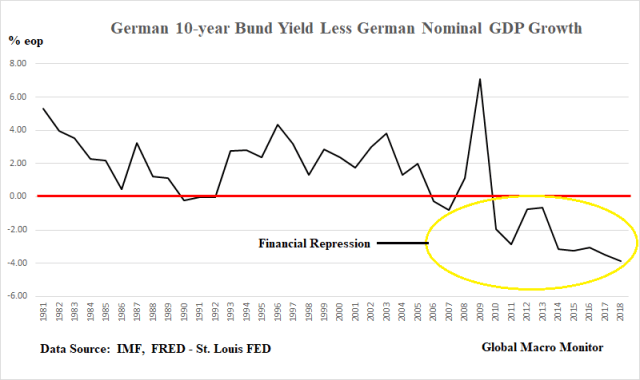
What is a U.S. 10-year bond yield at 3 percent signalling when nominal GDP is growing at 5 percent plus?    What is the market signal of Portugal’s 10-year sovereign yield trading 117 bps through the U.S. 10-year note yield?  Or a 10-year JGB at 5 bps?   Does anyone care anymore?

It’s difficult to ascertain considering  how the Fed and other central banks, who are not price sensitive,  are majority owners in the U.S. and other sovereign yield curves.

Treasury Auctions

Even though QE ended in the U.S. in 2014, its legacy still hangs around in the Treasury auctions.   The Fed, for example, took down around 20 percent of the U.S. Treasury auctions in May.

In order to constrain the direct financing of the Treasury by the central bank,  the Federal Reserve Act only allowed the Fed to buy and sell Treasury securities in the secondary market.  That changed after the great financial crisis (GFC) as the Fed’s SOMA portfolio regularly participates in the auctions, though with noncompetitive bids,  as notes and bonds in their portfolio mature and a portion are reinvested back into the market.  Technically, SOMA participation in Treasury auctions does not constitute direct financing.

Nevertheless, the Fed’s participation in the auctions still distorts the market clearing yield by allowing the U.S. government to issue more notes and bonds at a lower yield.

QT Will Start To Bind Fed Participation In Auctions

The quantitative tightening caps  will  step up to $30 billion per month in September and begin to exceed the amount of notes and bonds maturing in the SOMA portfolio.   That is the Fed’s participation in the Treasury auctions will begin to wane, and in many months going forward,  will be net zero.

We suspect when the market internalizes that the Fed will be out of most of the monthly auctions, interest rate volatility will increase at the same time the Treasury is ramping up supply.  Our view of much higher long-term yields will then likely be realized.

As always,  we may be wrong.

Stay tuned, Yanny.


Posted in Interest Rates, Monetary Policy, Uncategorized | Tagged , , , , , | 14 Comments