Asset Markets, The Sports Illustrated Jinx, And The Dodgers

Why do stocks and assets markets crash?

Why is there is a Sports Illustrated jinx and magazine cover stories often signal a sign of a top or bottom of the subject being portrayed?

Regression to the mean, or, more simply, just moving back to the long-run averages.   

Dodgers Tank After SI Cover Story

After going on a tear of 51-9,  the best 60 game winning stretch in 105 years,  the ink was barely dry on the August 28th Sports Illustrated’s cover, which read, “Best Team Ever,” before the Dodgers went into a major tailspin.

Dodgers_SI_Jinx

.

“Best. Team. Ever?” The ink was barely dry the cover of our Aug. 28 issue—which hit newsstands Aug. 23, with a corresponding comparison to the greatest teams in history online—when the Dodgers fell into a tailspin that they have yet to escape. Through Aug. 25, they had gone 91-36 for a .717 winning percentage, which put them on a 116-win pace, good enough to tie the 2001 Mariners for the highest total of the 162-game expansion era. Since then, they’ve lost 10 of 11 to the Brewers, Diamondbacks and Padres, and while they still have an ample cushion to win the NL West and wrap up homefield advantage in the National League playoffs, they’ve shown that even if the infamous Sports Illustrated cover jinx is a myth, this squad is hardly invincible.  –  Sports Ilustrated, September 6

Sports Illustrated Cover Jinx A Myth?

We disagree.

Teams, players, politicians, companies,  markets or, whatever or whoever, always seem to be cover stories either at at their peak or nadir.   For sure,  the Dodgers 51-9 winning stretch was unsustainable, and the law of averages had to kick in.

Black Swans Are Rare

We do admit there are on rare occasions when Black Swans come along that defy all probabilities and shatter age old records.  Rarely.

The 2015-16 Golden State Warriors were one, but couldn’t validate their 73-9 record shattering season, reverting to the mean after executing the biggest choke in NBA championship history.   Blowing a 3-1 lead to the Cleveland Cavaliers.

In other words,  the Warriors lost three games in a row in the NBA finals, 33 percent of what they lost over the 82 game season.  That was one “mean” reversion to the mean!

No more, however.

“The Warriors are going to win forever, if everything stays the same. This season is over. You know, we’re gonna play it out, and the Warriors are gonna win. And then the next year it’s gonna be the same thing.” – Jeff Van Gundy, September 6

Regression To The Mean

Bell Curve_SI_Jinx

What about the [Sports Illustrated] curse? What happens is that some athlete somewhere in some sport will perform way above average. Sports Illustrated has to have something on its cover and so seeks out those athletes who are doing exceptionally well, and picks from among them the one that outperforms them all. In other words, this particular athlete will have performed way, way above average, a rare event. At this point, their picture is shown.

But, lo! In the coming weeks, our poor athlete slumps back to average or even below, disappointing all, and once again proving the validity of the curse.

All that has happened, however, is that the athlete has “regressed to his mean.” The overwhelming probability is for that athlete to perform near his average, which the athlete subsequently does. It’s no slump after all, just a return to regularity.

To say the SI has a “cover curse”, then, is no different than saying a coin has been hypnotized after a “Tail” finally shows up after a successful run of 20 “Heads” in a series of coin flips. – William M. Briggs

What Does The Sports Illustrated Jinx Have To Do With Asset Markets?

First,  markets are not immune to the magazine cover curse.  We can recall many covers that were contrarian calls of market tops or bottoms.

Probably the most famous was BusinesWeek’s August 1979, The Death of Equities, cover.

Death of Equities_SI_Jinx

The stock market had been in a decade long bearish funk.  The cover didn’t mark the end of the bear market as it banged around another seven months with the S&P500 falling another 8.6 percent bottoming in March 1980.  The market didn’t break out into the multi-decade bull run a few years later in August 1982.   Timing is tricky but close enough for government work.

The stock market had performed way below its long-term average performance, everyone was bearish on equities and had sold out, including BusinessWeek.  Ergo, regression to the mean with some overshooting.

Yes,  markets almost always overshoot, not only to the downside but also to the upside.

Current Asset Markets

That brings us to today’s asset markets and U.S. household net worth.

We came across a chart, similar to the one below, which piqued our curiosity and motivated us to crunch the data and come up with our own observations and conclusions.

Net Worth Chart_SI_Jinx


The Data

The chart is self-evident. We are in another asset bubble.

This one, however, is more complicated.

More of a steel bubble, if you will.

Harder to burst and long lasting as it is created and driven by central bank money.  Credit based money bubbles pop easier and more quickly as they are vulnerable to a lightning fast deleveraging as was the case in the last crisis.

Asset prices, as reflected in household net worth, are once again divorced from economic reality now more than ever before.  In our above analysis, the difference between the time series of household net worth and nominal GDP.

The two series tracked each other very closely for 45 years up until 1997.  Asset prices grow with fundamentals, which, ultimately, are driven by economic growth.

U.S. household net worth is currently 38 percent or more than three standard deviations above the nominal GDP index, where the average difference is only 6 percent for the 65-year sample period.

Greenspan Put

The difference data (net worth less GDP) appears to have become non-stationary – e.g., an unstable mean, etc. — after 1997.

Let’s also not forget the flaws of assuming a normal distribution in asset markets, which have   “fat tails”  and skewed distributions,  which is evident with this data,  post 1997.

It may be the result of many things, including the rise of the internet and moral hazard.

The result of the cumulative effects of 1987 stock market bailout,  the 1995 Mexican Peso bailout, and the 1997 Asian Financial Crisis, where western policymakers immunized investors from taking long-term losses.   Thus, 1997 may have been the year markets finally realized and recognized the “Greenspan Put” was alive and for real.

Deleveraging     

Granted there has been some deleveraging by households since the great recession, mainly in mortgage debt, so some of the increase in net worth could be the result of slower growth in liabilities.  In additon, some may  be due slower nominal GDP growth.

More analysis is needed to confirm these alternative hypotheses but you don’t pay us enough for us to put in the extra effort.

We did construct a nice table for you, however, and our conclusion of the above alternative explanations?  De minimus.

It’s all asset inflation the result of the expansion of global central bank balance sheets.

Change In Net Worth Table_SI Jinx

CenBanks_SI_Jinx

Pension Entitlements

One of the results that really surprised us most in our analysis was the rapid rise in pension entitlements as a proportion of household wealth.

Pension Chart_SI_Jinx

We don’t view this as positive as about 30 percent of pensions, on average, are currently underfunded.  Either contributions are going to be dramatically increased or pensions will be restructured and future payouts reduced.

Either case will be bad for demand and the economy.

Unfunded Pension Entitlements_Apr14

The alternative is to cut current services, which is also already taking place. Again, it will only add to the “clash of generations” and more political conflict.

We eventually believe the pension shortfalls will become so large the federal government will be forced to nationalize and monetize them leading to inflation.  We have a lot of experience in countries that have resorted to such policies.

Unfunded pensions are nothing more than “fake wealth.”

Conclusion

Several times a week I walk with a good friend who could have played center field for the Cleveland Indians.   But he had a higher calling.  Let’s call him Joltin’ Joe (JJ).

We have been friends for years and have seen many asset cycles.

We live in a lovely county in Northern California, which is in the midst of another raging housing bubble.   The median income for the county is around $61,000, up about 16 percent from the year 2000.   The median house price is $639,000,  which has more than doubled from $319,000 in March 2012.

Fundamentals dictate that the median price should be, more or less three and half times the median income, or around $215,000.   Let’s add another $50K for the California sunshine premium,  though it was 111 degrees here on Saturday!

At an expected or fundamental value of $265,000, that puts the current median home price in our county 140 percent overvalued.

In general, housing prices should move with inflation and wages.  Such a large change in relative prices is a massive transfer of wealth from the young to the older generations, who own most of the housing stock.

That is if the young are gullible enough to pay these prices.  Again,  more potential conflict leading to the clash of generations.

JJ’s Observations

JJ likes to talk about the housing market.   He is very astute noting that this housing bubble is different than the last one just ten years ago.  There isn’t the leverage that there was in 2007.

A lack of supply drives this housing bubble

Hedge funds, private equity firms, and other investors swooped in during the crash and bought up many of the modest homes in foreclosure.   They then foreclosed on the buyers and are now raising rents on their newly owned homes.

People, such as “The Foreclosure King”  (and you know who I am talking about), who would be living under a bridge or freeway if they were not bailed out by the U.S. taxpayer and the Fed during the financial crisis, somehow think they deserve and are entitled to their dubiious created wealth.    Now they are gouging the younger renters, some of who they probably foreclosed on,   who are now priced out of the market and can’t afford to buy a home.   These people are the new “welfare queens.”

Wonder why the body politic is so angry?

Economic anxiety will only lead to greater political instability.

A Mean Regression To The Mean

JJ is not an economist.  I tell him to be patient unless he wants to day trade and try and flip houses, which can be very profitable if your timing is right and you get out before the bubble pops.

There are few people who do,  however.  Greed usually overpowers common sense when you’re making that kind of easy money.

Assets, whether it be stocks, bonds, emerging market debt, or houses will eventually regress to their mean or fundamental value.  They inevitably always overshoot, creating incredible buying opportunities.

Just as the Los Angeles Dodgers are now doing, regressing to the mean and overshooting their true potential, while in the midst of their own Sports Illustrated jinx.

Diiferent Type Of Asset Bubble

This asset bubble is different.

It is larger, encompasses almost all asset classes, may inflate much further, will  likely last longer than many expect, and will be harder to burst because the global central banks have taken $13-15 trillion in assets out of the markets, creating artificial asset supply shortages,  and repressed interest rates to zero or below.  Leaving few alternatives but to chase risk assets.

Enjoy riding the bubble.  It is fun making money in bubbles and you can become very rich if you time it and get out it time.

It is getting late, however, and there are an increasing number of events looming on the horizon that can knock the markets for a loop.

Also be careful on the short side.  Wait for the markets to break.

When the bubble does burst, and it may take some time, it will be one helluva “mean” regression to the mean.

Or it could crash next month.  Timing is tricky.

We are waiting for the S&P500 to make the cover of Sports Illustrated.  We may waiting a long time, however, as very few believe these asset markets are driven by real lasting organic fundamentals.

Good luck, comrades.

Posted in Black Swan Watch, Equities, Housing, Inflation/Deflation, Uncategorized | Tagged , , , , | 23 Comments

Analysis Of Presidential Job Approval Ratings

We’ve analyzed the Presidential Job Approval Ratings from Gallup since Truman to Trump.  It compliments our August 27 post,  Presidential Job Approval: Truman to Trump.

Political Junkies And Financial Types

Since the dollar index is highly correlated to President Trump’s approval ratings,  we believe the data are relevant not only for just political junkies but also financial types.

We do expect the president’s poll numbers to jump in the next few weeks, due to his performance in executing the relief efforts for Hurricane Harvey.   In fact,  Gallup already has him up one point since the last weekly poll ending September 3rd.

The federal government’s initial response to Hurricane Katrina in 2005 was a complete debacle and effectively was the nail in the coffin for Bush #43’s presidency and the beginning of the cyclical swing left in the country, in our opinion.

President Trump’s Prospects

We conclude after crunching the data, there is both good news and bad news for President Trump.

Good News

The good news, he starts with a very low bar.

The most unpopular president to enter office in the modern era (post-FDR), with a job approval around inauguration day of just 45 points,  six points below the next lowest,  Bush #43.   He dropped 10 points a little over 200 days in office, bottoming at 35 percent on August 27th.   The latest poll, ending September 3rd, has him at 36 percent approval. which is only 14 points off Harry Truman’s all-time low.

Therefore the potential upside for President Trump’s job approval  has a lot of runway. That is if he didn’t see peak approval at the start of his term as did, Truman, Ford, and Obama with LBJ very close (see last table).

Bad News

The bad news is that President Trump inherited a relatively strong economy with full employment and a bubblious relatively expensive stock market.

Only three presidents have left office with higher approval ratings than when they entered the Oval  – Reagan, Clinton, and Bush #41.

Both Reagan and Clinton inherited terrible economies, either in deep recession and or coming out of recession, and both oversaw huge stock market runs.

The fact that Bush #41 was not reelected to a second term with such a high approval rating at the end of his term was mainly due to Ross Perot securing 18.91 percent of the vote as a third party candidate in the 1992 general election.  The economy was also in recession during part of the 1992 campaign  President Bush pinned his election loss on then Fed Chairman, Alan Greenspan, due to high interest rates.

The upshot?   Inherit a weak economy and recesson and sluggish stock market at the start of your presidential term.

Highest Average For An Administration

President Kennedy has the highest average job approval rating at 70 percent during an administration.  Unfortunately, his term was tragically cut short and served just a little over 1,000 days.  His popularity was declining before he was assassinated in November 1963, hitting a low of 56 percent in September of 1963.  His approval rating at 221 days into office was 76 percent, compared to Trump’s 36 percent.

Thus far, Trump has lowest overall average but there is still lots of time to improve.  Truman and Carter drag up the rear.

Gallup_2_Overall

Gallup_3_JFK

Highest At Start Of An Administration

Not coincidental both President Truman and Johnson have the highest job approvals at the start of their administration as both inherited their presidencies after the death of a popular predecessor.  Both Truman and LBJ (see chart) went almost straight down after the start of their terms.  Truman’s job approval was 75 percent 209 days into his administration versus Trump’s 36 percent.  Truman also has the lowest approal rating at 22 percent.


Gallup_4_Start

Gallup_4_Truman

Highest At End Of An Administration

President Clinton and Reagan ended their adminsistrations with the highest approval ratings.   Strong economic growth and big stock market gains  helped, though the dot.com bubble did burst before President Clinton left office.  President Clinton had a 44 percent approval rating 217 days into office versus President Trump’s 36 percent.

President Nixon resigned with a 24 percent approval rating.

Gallup_5_End

Gallup_5_Clinton

Largest Differential — End From Start Of An Administration

President Reagan finished 12 points higher at the end of his term than the start. Along with Clinton and Bush #41, they were the only presidents to finish their terms more popular than when they started.   President Reagan’s approval numbers were 60 percent after 209 days in office versus President Trump’s 36 percent.

President Truman’s job approval collapsed by 55 points from the start to the finish of his term.  “Give ’em hell, Harry!”

History has been kind to President Truman, however, with the latest poll of presidential historians ranking him 6th best president of all time.


Gallup_6_End to Start

Gallup_6_Reagan

Highest Approval Point Of An Administration

Both President Bush #43 and #41 have the highest recorded job approval ratings at a given point, mainly as the result of wars.  President Bush #43’s job approval rating shot up 39 points after 9/11.   Both presidents squandered their high approval ratings.   W.’s approval rating at 218 days into office was 55 percent.

President Obama, Nixon, and Reagan have the lowest highs.


Gallup_7_High

Gallup_7_W

Lowest Approval Point Of An Administration

President Truman has the lowest recorded approval rating at 22 percent with President Nixon not far behind at 24 percent when he resigned.

President Kennedy never fell below a 55 percent.


Gallup_8_Low Point

Highest Differential from Low to High

President Truman and President Bush #43 have the highest peak to trough differential in their approval ratings.  President Bush #41 is the only other president in the 60’s with President Carter not even close. at 47 percent.   Probably due to  “the higher you are, the farther you fall” syndrome.   All three have the highest point approval ratings.

President Obama and JFK along with President Trump have the smallest differential.


Gallup_9_Low to High

Peak Approval At Start Of Term

Finally, we rank the presidents by their peak approval relative to the beginning of their terms.    Presidents Truman, Ford, Obama, and Trump had/have their highest approval ratings at the beginning of their term.

President Bush #43 shot up 38 points after the start of his term as the result of the 9/11 attacks

Gallup_10_Peak Approval

Data Reference Table


Gallup_1_Total

Posted in Politics, President Trump, Uncategorized | Tagged , , , , , , , , , , , , , | Leave a comment

QOTD: Can NK be just another country?

…North Korea is not a Marxist-Leninist or a Stalinist state but an ethnonational-socialist country patterned more after Imperial Japan than [the] Soviet Union – The Korea Times, September 1

Posted in Uncategorized | Leave a comment

Deflation Or Change In Relative Prices?

Interesting chart via statista measuring the cost of one hour of light through ages.

We find it relevant today as there is much confusion over the concept of deflation and inflation.  It appears many can’t distinguish between the difference between deflation and a relative price change.

Sometimes, in the heat of a policy making moment, it isn’t easy.

The costs for the production of light, one of the most important enablers of progress, have dropped in a way that is hardly imaginable. The environmental economists Roger Fouquet and Peter Pearson have retraced this development for England.

One hour of light (referred to as the quantity of light shed by a 100 watt bulb in one hour) cost 3200 times as much in 1800 in England than it does today, amounting to 130 euros back then (or a little more than 150 dollars). In 1900, it still cost 4 euros (close to 5 dollars). In the year 2000, we arrived at a cost of 4 euro cents (5 U.S. cents).

You can also put this into relation with the amount of time that an average worker needed to labor during different ages in order to earn enough for the 100 watt bulb to glow for an hour – just like the economist William Nordhaus has done in one of his classic essays.

The people of Babylon, in 1750 B.C., who used sesame oil to light the lamps, had to work for 400 hours to produce the said amount of light. Around 1800, using talcum candles, 50 hours needed to be invested. Using a gas lamp in the late 19th century, 3 hours were due. Using an energy saving bulb today, you will have to work for the blink of an eye – a second. – statista

Stocks And Oil Price

There was a period a year or two ago that the stock market would move tick for tick with the price of crude oil on the perception lower prices signaled declining global aggregate demand and thus deflation and recession.  No worries today as the oil price moves are chalked up to supply, driven, mainly, by technological change.  That is a secular decline in the relative price of crude oil.

ECB Monetary Policy As Oil Prices

The European Central Bank (ECB) monetary policy seems to driven by the price of oil, concluding that price declines are deflationary.   We believe this is flawed analysis as Europe imports most of their oil and a decline in the oil price is a relative price change and stimulative as real incomes rise.

The Europeans are going to someday pay a hefty price of the ECB’s flawed logic.

It used to be true in the U.S. before the country became a major oil producer.   Now a decline in the price of oil is a bit more ambiguous.   It is expansionary or contractionary?

Historic Perspective

It will be interesting as history looks back on this period to see what we got right and wrong about distinguishing the differences between a generalized price deflation/inflation and a change in relative prices.

We suspect a lot!

Chart_Cost of Light

Posted in Crude Oil, Energy, Uncategorized | Tagged , , , , | 7 Comments

Sector ETF Performance – September 1

ETF_DayETF_WeekETF_QETF_YTD

Posted in Sector ETF Peformance, Uncategorized | Tagged , | Leave a comment

The Most Dangerous Of Presidential Tweets

There have been many presidential tweets that have caused us alarm,  but this is the one that concers us most.

Not going to happen.  Is there any faster and clearer path to a Category 5 Global Depression, complete market meltdown, and World War III  than following through on this one?

North Korea is in the “Big Boys” club now,  though run by an immature little boy,  and will have to be dealt with accordingly.  Diplomacy, deterrence, and patience until the regime collapses, which it surely will.

But, give the president credit.  He is exploring and thinking about all options.

Posted in President Trump, Uncategorized | Tagged , , | Leave a comment

August U.S. Sector ETF Performance

ETF_Month

Posted in Sector ETF Peformance, Uncategorized | Tagged , | Leave a comment

Cohn Dropping In Prediction Markets As New Fed Chair

If tax reform looks stalled, and we should find out in the next few weeks, is there any reason for Gary Cohn to stick around if he concludes he won’t be appointed Fed Chair?  We wonder.

Odds he will replace Yellen are dropping like a stone on PredictIt.   Down about 30 percent in August.  Especially after his recent comments to the Financial Times,

Gary Cohn, the top White House economic official, said the Trump administration “must do better” in condemning neo-Nazis and white supremacists following the violent protests in Charlottesville this month that sparked one of the biggest controversies of Donald Trump’s presidency.

Mr Cohn, a Jewish-American who was president of Goldman Sachs before becoming head of the White House national economic council, told the Financial Times he faced “enormous pressure” to quit after the uproar over Mr Trump’s reaction to the clashes in the Virginia university city that left one woman dead. – FT, August 25

The President has rumored to still be fuming over these comments.

  • …people close to the president said he is simmering with displeasure over what he considers personal disloyalty from National Economic Council Director Gary Cohn, who criticized Trump’s responses to a deadly white supremacist rally in Charlottesville on Aug. 12.
  • The president has been quietly fuming about Cohn for the past week but has resisted dismissing him in part because he has been the face, along with Treasury Secretary Steven Mnuchin, of the administration’s tax-cut strategy.   – Washington Post, August 31

Cohn has fallen from almost a certainty toreplace Yellen to 20 percent in the prediction markets.

Add this to our event risk checklist.

If the stock market begins to fret and tank over growing worries of Cohn’s future,  we’ll,  no doubt, expect a sweet tweet from the president expressing support for Mr. Cohn.

Welcome to the new markets. Is this Kafkaesque , or what?


Cohn_2_Chart

.Cohn_Chart

Posted in Monetary Policy, Politics, Uncategorized | Tagged , | 12 Comments

General Kelly Is Pissed Off

We cited a Washington Post piece in our post yesterday morning citing the growing friction between the President and his Chief of Staff,  General John Kelly,  now dubbed the Church Lady by the White House staff.   The President was quick to tweet his support for General Kelly early Friday morning.

The NY Times is out with a  piece today,  Forceful Chief of Staff Grates on Trump, and the Feeling Is Mutual,  with new information about the palace intrigue taking place at 1600 Pennsylvania Avenue.

President Trump was in an especially ornery mood after staff members gently suggested he refrain from injecting politics into day-to-day issues of governing after last month’s raucous rally in Arizona, and he responded by lashing out at the most senior aide in his presence.

It happened to be his new chief of staff, John F. Kelly.

Mr. Kelly, the former Marine general brought in five weeks ago as the successor to Reince Priebus, reacted calmly, but he later told other White House staff members that he had never been spoken to like that during 35 years of serving his country. In the future, he said, he would not abide such treatment, according to three people familiar with the exchange.

…The question now is how long Mr. Kelly will stay, with estimates ranging from a month to a year at the most. White House officials say that Mr. Kelly has given no indication he intends to leave anytime soon.  – NY TImes, September 1

The president performed very well today and looked good in Houston, hugging and mixing it up with the victims of Hurrican Harvey, and should see a nice bump in his poll numbers.

But this new revelation by the NY Times,  if true, scares the bejesus out of us.  It should do the same to you.

The country, or, at the very least,  the White House,  is one presidential temper tantrum away from complete political chaos.   What odds are you making there will be one in the next month or two?

Add it to our event risk checklist, which we expect to trigger a decent  October correction.   But, first, maybe a blow-off buying panic in risk assets as the Goldilocks crowd gets more lathered up and shorts panic in the first-half of September.

Stay tuned.

Posted in Politics, President Trump, Uncategorized | Tagged , , | 2 Comments

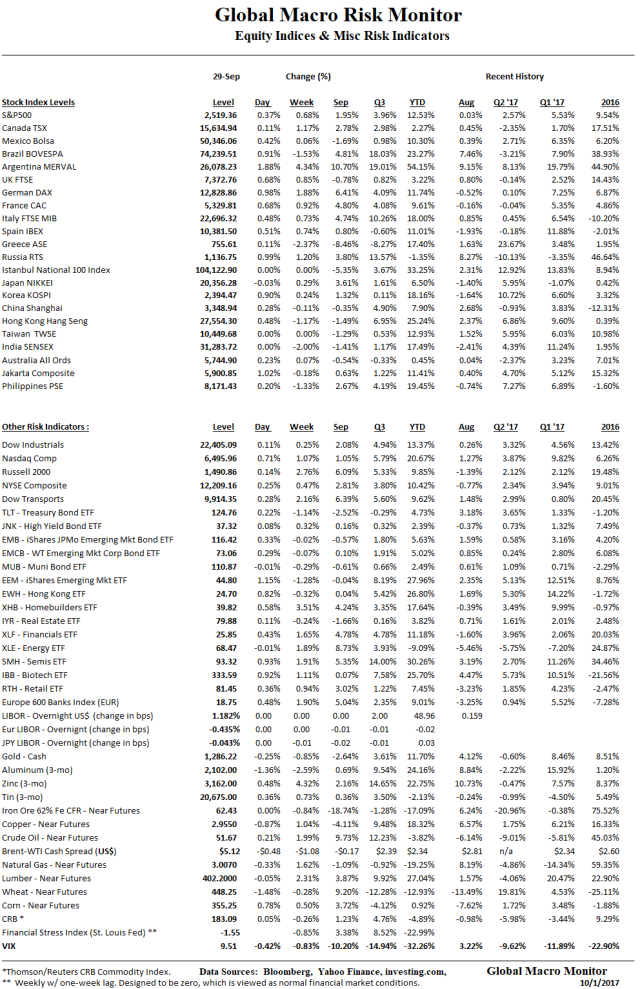
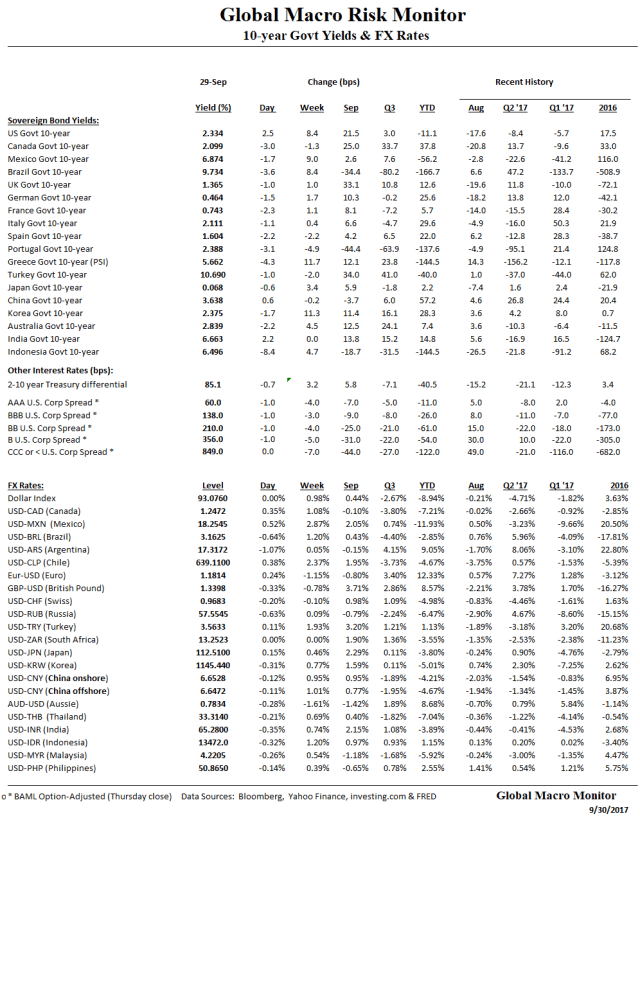
Global Risk Monitor – September 1

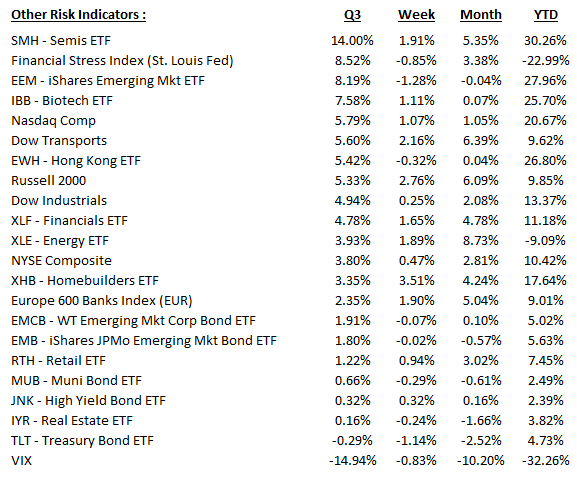
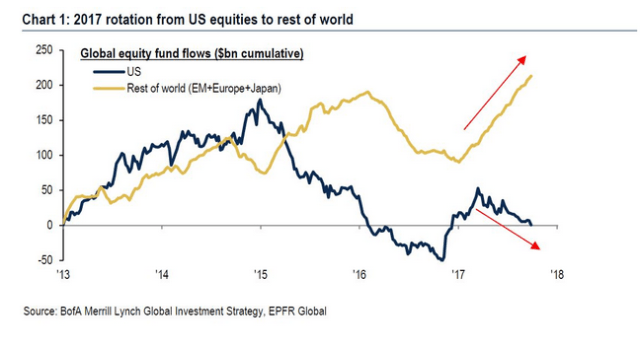
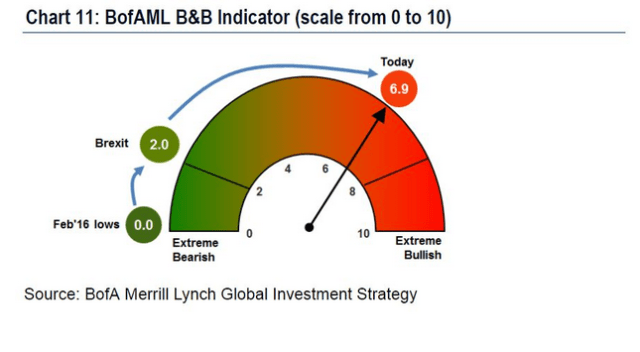
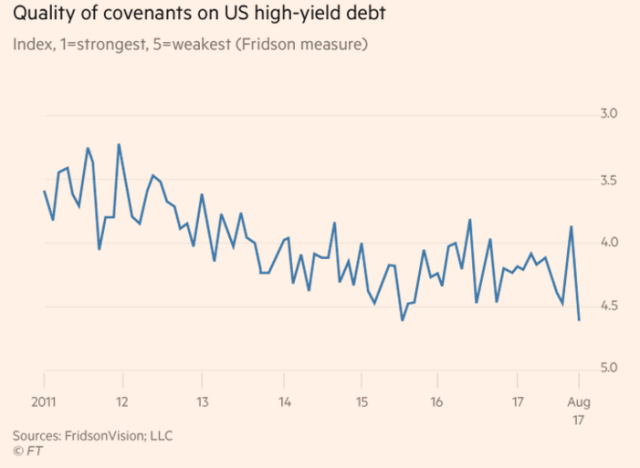
RiskMon_1RiskMon_2

Posted in Daily Risk Monitor, Uncategorized | Tagged , , , , , | Leave a comment