
-
In economics, things take longer to happen than you think they will, and then they happen faster than you thought they could.
-
Join 1,200 other subscribers
Contribute To GMM

Categories
- 3D Printing
- Agriculture
- AI
- Algos
- Apple
- Automation
- Banking
- BFTP
- Bitcoin
- Black Swan Watch
- Bonds
- Brazil
- Brexit
- BRICs
- Budget Deficit
- Capital Flows
- Cartoon of the Day
- Cashless Society
- Chart of the Day
- Charts
- China
- Clean Tech
- Climate Change
- Coach C
- Commodities
- Coronavirus
- COVID
- Credit
- Crude Oil
- Currency
- Cyprus
- Daily Risk Monitor
- Day In History
- Debt
- Demographics
- Disinflaton
- Dollar
- Earnings
- ECB
- Economics
- Economist
- Egypt
- Electric Vehicles
- Emerging Markets
- Employment
- Energy
- Environment
- Equities
- Equity
- Euro
- Eurozone Sovereign Spreads
- Exchange Rates
- Fed
- Finance and the Good Society
- FinTech
- Fiscal Cliff Monitor
- Fiscal Policy
- Food Prices
- France
- Futurist
- Game Theory
- General Interest
- Geopolitical
- Geopolitics
- German Bund
- Germany
- Global Macro Watch
- Global Reset
- Global Risk Monitor
- Global Stock Performance
- Global Trend Indicators
- Gold
- Greece
- Healthcare
- Heat Map
- Hedge Funds
- Housing
- Human Interest
- Immigration
- Impeachment
- India
- Inequality
- Inflation/Deflation
- Infographics
- Innovation
- Institutional Investors
- Interest Rate Monitor
- Interest Rates
- Interviews
- Italian Yields
- Italy
- Japan
- Jobs
- Lectures
- Macro Notes from Conference Calls
- Manufacturing
- Masters
- Mexico
- Monetary Policy
- Movies
- Muni Bonds
- Muni Market
- Natural Gas
- News
- Nonlinear Thinking
- North Korea
- Overbought Markets
- Picture of the Day
- PIIGS
- PMIs
- Policy
- Politics
- Population
- Populism
- Poverty
- President Trump
- Qunat Strategies
- Quote of the Day
- Quotes
- Rare Earth Elements
- Readership
- Reads
- Real Estate
- Relative Strength Index
- Robert Shiller
- RSIs
- S&P500
- Sector ETF Peformance
- Semiconductor prices
- Semiconductors
- Social Media
- Socialism
- Song for the Week
- Sovereign Debt
- Sovereign Risk
- Spain
- Sports
- State and Local Government
- Tail Risk
- Technical Analysis
- Technology
- The Big Reset
- The Weekend Read
- This Day In Financial History
- Trade War
- Trades
- Tweet of the Day
- Ugly Chart Contest
- Uncategorized
- US Releases
- Video
- Volatility
- Wages
- Week Ahead
- Week in Review
- Weekend Reads
- Weekly Eurozone Watch
- Whales
-
Recent Posts
Meta
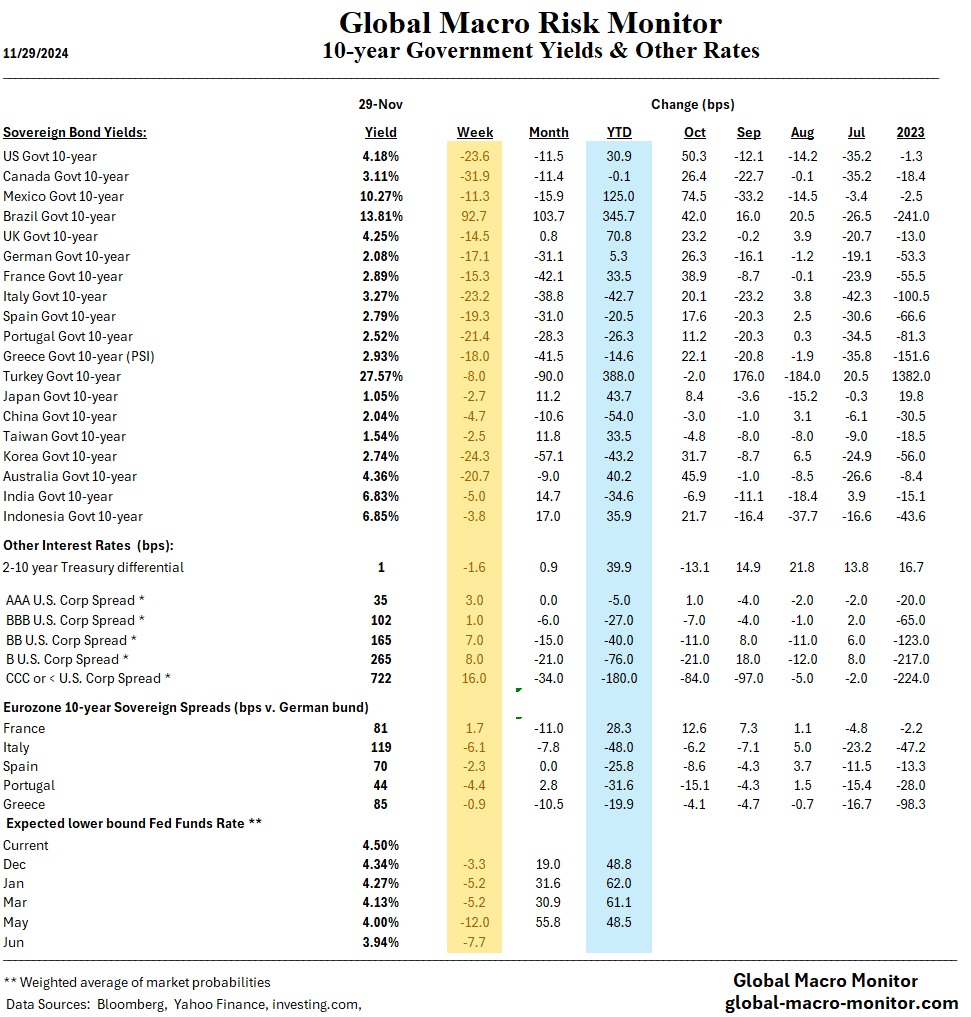
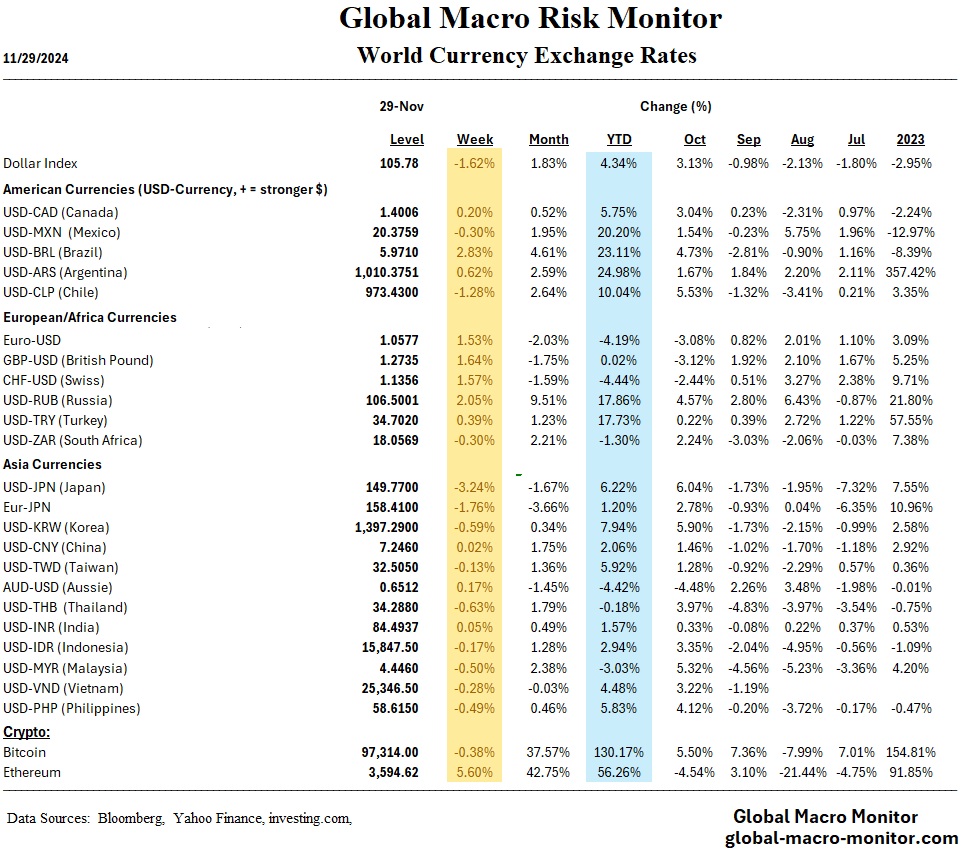
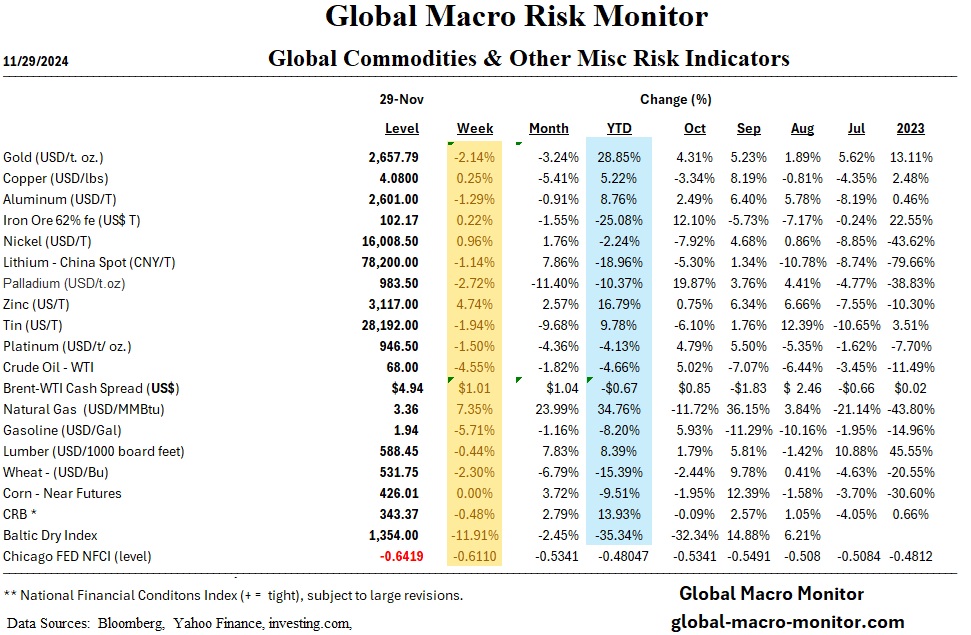
Global Risk Monitor: Week In Review – Nov 29
Cracks in Global Economies Amid Easy Financial Conditions
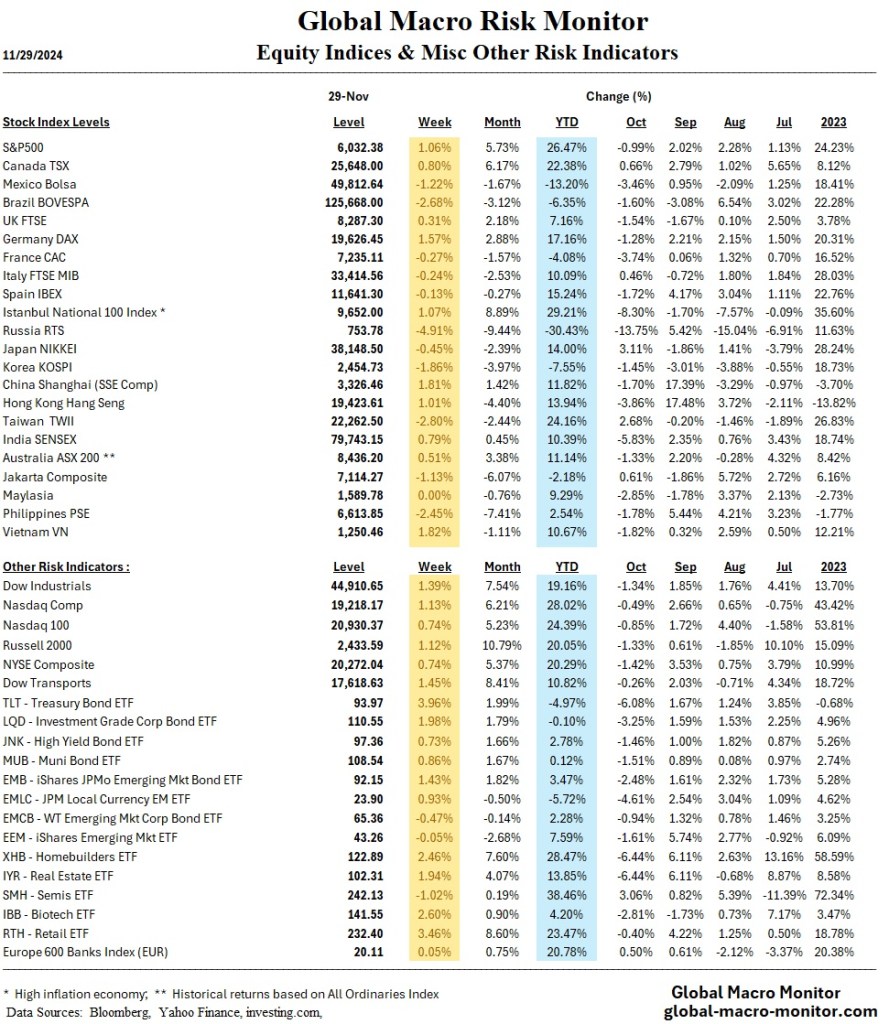
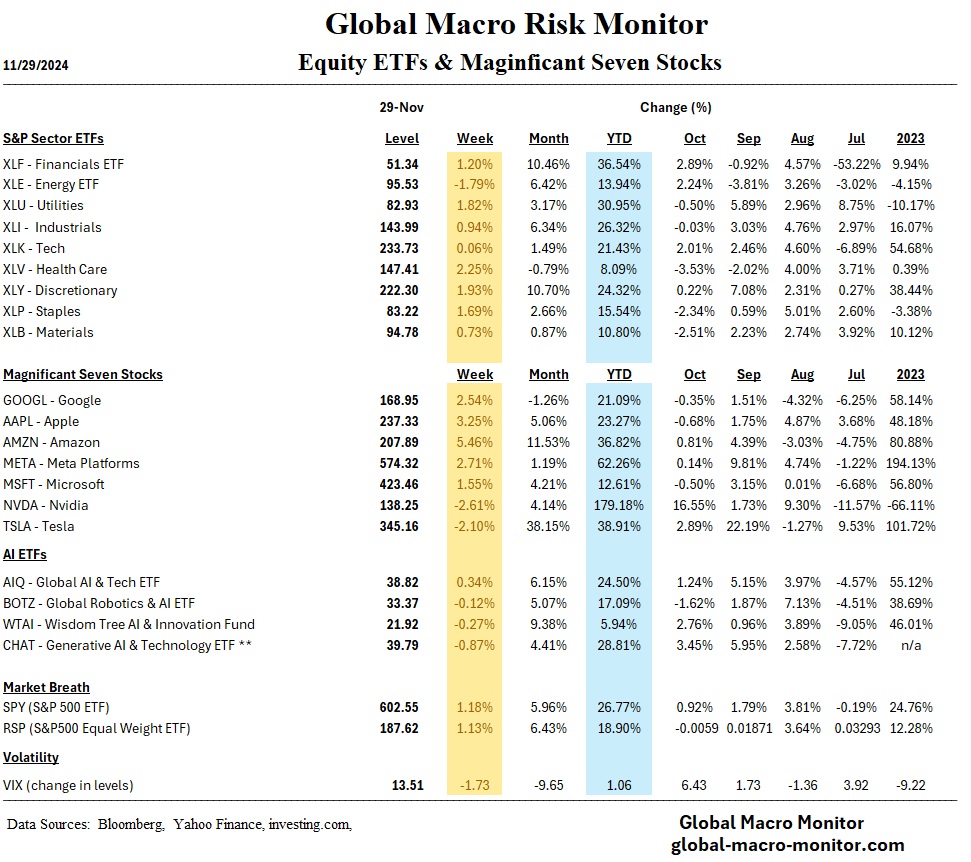
Despite the extremely easy financial conditions in the United States as measured by the Chicago Fed’s National Financial Conditions Index (NFCI), significant economic stress is emerging across key markets, exposing vulnerabilities that could threaten financial stability.
France
In France, political paralysis and strained public finances are raising alarms of a potential debt crisis. Borrowing costs have surpassed Greece’s amid investor fears over the government’s ability to pass a deficit-cutting budget. Prime Minister Michel Barnier faces resistance from far-right and leftist opposition parties, and his minority government risks collapse over fiscal reforms. France’s deficit, expected to reach 6.2% of GDP, leaves little room for maneuver. While analysts downplay the comparison to Greece’s past crisis, prolonged political uncertainty and reliance on extraordinary legislative measures like Article 49.3 are exacerbating concerns about governability and fiscal sustainability.
Russia
In Russia, the ruble has plummeted to its lowest levels since 2022, driven by falling oil prices, soaring inflation at 8.5%, and record interest rates of 21%. New U.S. sanctions on Gazprombank have disrupted critical financial channels, threatening the Kremlin’s ability to fund its war effort and receive export revenues. Meanwhile, defense spending continues to balloon, straining a war economy already grappling with labor shortages and rising consumer goods theft. Experts warn the economy risks overheating, further jeopardizing financial stability.
Brazil
In Brazil, the real has hit an all-time low, reflecting market skepticism over President Luiz Inácio Lula da Silva’s fiscal policies. A proposed $12 billion cost-saving plan has failed to reassure investors as rising state expenditures feed inflation and worsen the fiscal deficit, now at 9.3% of GDP. Despite robust GDP growth, the central bank has tightened monetary policy to combat inflation, but doubts persist over the government’s political will to implement meaningful reforms.
These developments highlight emerging cracks in major economies, even under historically favorable financial conditions.
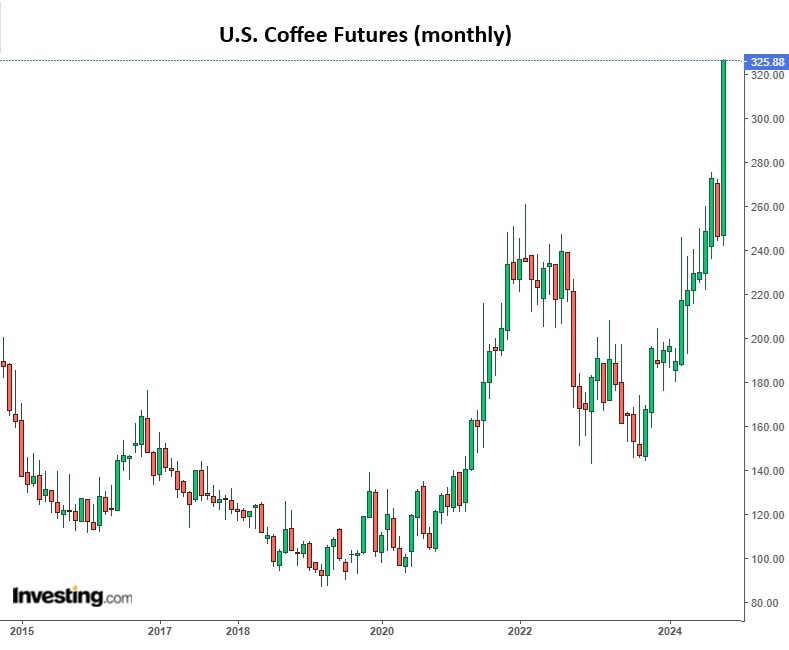
Morning Joe Spiking
Key Facts:
- Record Prices: Arabica and robusta futures reached their highest levels in nearly five decades.
- Supply Crisis: Brazil’s drought and Vietnam’s robusta deficits have driven a prolonged global shortage.
- EU Regulations: Import restrictions tied to deforestation concerns are pressuring European buyers.
- Market Behavior: U.S. roasters increased purchases amid tariff concerns and rising prices.
- Consumer Impact: Prices are expected to rise further, signaling a prolonged strain on coffee markets.
“I have never seen anything like this before,” said Tomas Araujo, trading associate at brokerage StoneX. “This is not going to be resolved this year and that’s why the roaster has started going into panic mode.”
Coffee futures soared to a 47-year high due to global supply shortages and concerns over impending EU anti-deforestation laws. Arabica prices surged 4.7%, reaching $3.23 per pound, while robusta climbed 7.7%, doubling its price since the year’s start. Prolonged droughts in Brazil, the largest arabica producer, and poor weather in Vietnam, the leading robusta producer, have exacerbated the supply crunch.
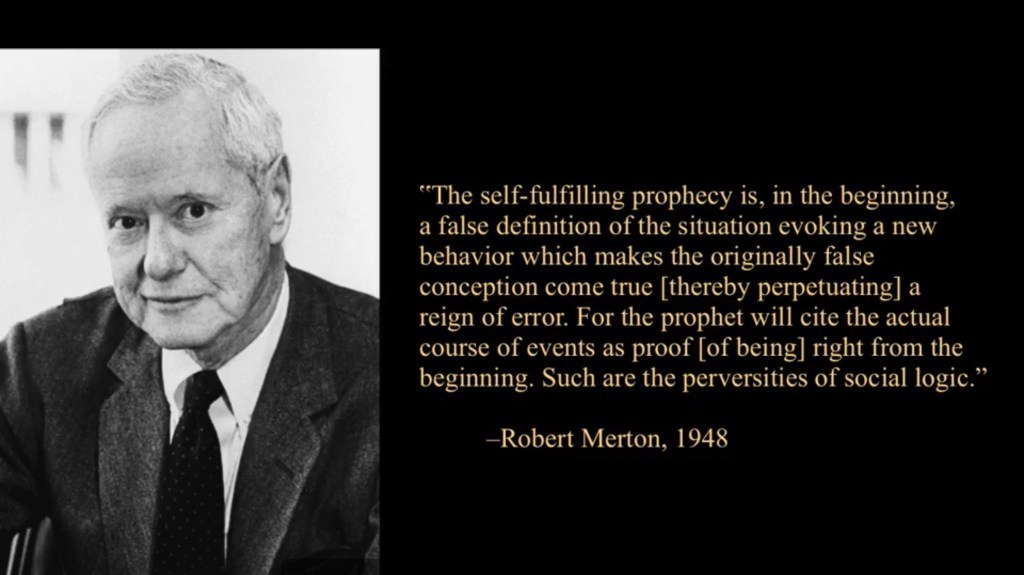
Commercial buyers, anticipating tighter markets and regulatory uncertainty, have aggressively stockpiled (self-fulfilling!). The EU legislation requiring proof of deforestation-free coffee imports has added urgency to these purchases. Furthermore, potential U.S. import tariffs have prompted early buying by American roasters. This mix of factors points to sustained price volatility, pressuring profit margins across the coffee value chain.
Source: FT
Posted in Uncategorized
Tagged arabica, coffee, coffee-beans, robusta, robusta, travel
Leave a comment
La France sous pression
Key Facts:
- Market Impact: French 10-year bond yield spreads hit their highest since 2012, reflecting investor concerns about political instability.
- Budget Controversy: The €60bn budget proposal includes significant austerity measures, risking parliamentary backlash.
- Political Stakes: Far-right leader Marine Le Pen’s party could trigger a no-confidence vote, threatening government collapse.
- Debt Concerns: France’s budget deficit exceeds 6% of GDP, far above the EU’s 3% target.
- EU Oversight: France is under an EU “excessive deficit” procedure, pressuring it to reduce deficits within five years.
French financial markets are under pressure as Prime Minister Michel Barnier faces a political and fiscal crisis. His proposed €60bn budget, featuring spending cuts and tax hikes, has been met with fierce opposition, risking a no-confidence vote that could topple his government. Investor concerns have pushed 10-year French bond yields above 3%, nearing levels seen in Greece, signaling heightened debt sustainability fears. The budget deficit, projected at over 6% of GDP, has drawn scrutiny from Brussels, placing France under “excessive deficit” monitoring. Political uncertainty compounds economic challenges, with the government struggling to reassure markets.
Source: FT

Confessions of ChatGPT
I was playing around with ChatGPT this morning juxtaposing comp sales from Walmart and Target. I noticed Chat gave me a 4.6 percent y-o-y growth rate for Walmart, which was not what the company reported. I asked ChatGPT where the number came from and it responded with the following. Beware of hallucinations, folks!
Q: How did you come up with the 4.6 percent comparable sales growth for Walmart?
A: The 4.6% figure I mentioned earlier appears to have been a misstatement. Upon clarification, Walmart’s actual U.S. comparable sales growth for Q3 FY2025 was reported as 5.3% (excluding fuel), based on the latest available data from Walmart’s earnings release.
Thank you for pointing this out! Walmart’s strong performance was indeed slightly higher, demonstrating robust growth across key categories like grocery and health and wellness, supported by a focus on value offerings.
Posted in Uncategorized
Leave a comment
 Global Macro Monitor