Will The Algos Crush The Shorts Once Again?

If there is one thing we have learned over the past few years,  “the algos will find you out”.   Add to that,  always bet against the fast money crowd.

According to Bloomberg, the shorts have been upping their positions again in the S&P500.  Though not yet at extreme levels.

S&P 500_Shorts

Why not just wait for the break?  That day will surely come.  Maybe soon or maybe later.

And why short a trending bull market?  Maybe for a scalp,  but a trending market, which looks like it is starting to break out of a consolidation?  Are you out of your freaking mind?

Stocks Are Expensive
Absolutely stocks are expensive,  but nobody knows when the bull market will end.  Alan Greenspan gave his “irrational exuberance” speech 3 1/2 years before the market topped.   Stocks are expensive for a reason.

Too Much Liquidity
There is so much liquidity and money in the U.S. financial system today versus any time in history.    Markets just aren’t functioning normally.  Therefore the default scenario for the markets are lower than normal interest rates and higher than normal asset valuations.

We have estimated a global liquidity concept called the “global monetary base” which is simply the sum of the U.S. monetary base and the world’s official foreign exchange reserves.   Since most of the official FX reserves — about 65 percent — are held in dollars most of the global monetary base is in the U.S. financial system.

Note that in 2007 the global base was at about 50 percent of U.S. GDP compared to almost 80 percent at the end of 2016. — Global Macro Monitor, April 26, 2017

.

Global Monetary Base

If you don’t believe us, go ask the bond market vigilantes, for example, if there are any still alive.  Let us know, by the way,  if you can find one.

Technological Advances
Not to mention the rise in algorithmic and HFT trading that are notorious for setting short-term bear and bull traps.    And how about those trading ‘bots that spoof the bid and the offer and probe the market until they find the real buying or real selling then quickly reverse?

There will come a day when all this new technology short circuits and creates a 1987-like flash crash.  Please tell us that date, however.

Where Will The Real Sellers Come From?
Who is going to sell stocks unless we have some catalyst and Black Swan event?  A global military conflict, or, say, a series of surprise 3-4 percent inflation prints that set off panic rate hikes and Fed rapid balance sheet reduction, for example — both, of which are pretty much unpredictable.     Or maybe something like our Six Sigma political event?

By the way,  the South Korean Kospi stock index is up over 16 percent and the currency has strengthened over 7 percent versus the dollar year-to-date,  all while the missiles continue to fly up north.  Talk about climbing a real “wall of worry.”

Pension Funds Underfunded
Unfunded pension fund entitlements are going parabolic and their managers have no choice but to reach for yield and return and, definitely, will not find it sitting in cash or the 10-year at 2.25 percent.

Unfunded Pension Entitlements_Apr14

Earnings Resurgence
The U.S. stock market has just emerged from an almost two-year earnings recession — granted much ado about crude oil prices — but the S&P500 has kept moving higher.

Now the fundies are turning, earnings are increasing — even on the top line — albeit at higher stock prices.  Stocks don’t trade levels, but on first and second derivatives of those levels.

S&P 500_Earnings

Capital Flows
So we ask you, folks, where is the global flood of money going to go?   Could be “money heaven” if all markets crash if they wake up one morning and decide to reprice and regress to their mean longer-term valuation levels.  Good luck on that.

A global margin call like 2007-08 as housing credit began to contract?  Not there and nowhere near the economy wide credit growth we saw in the early to mid-2000’s.

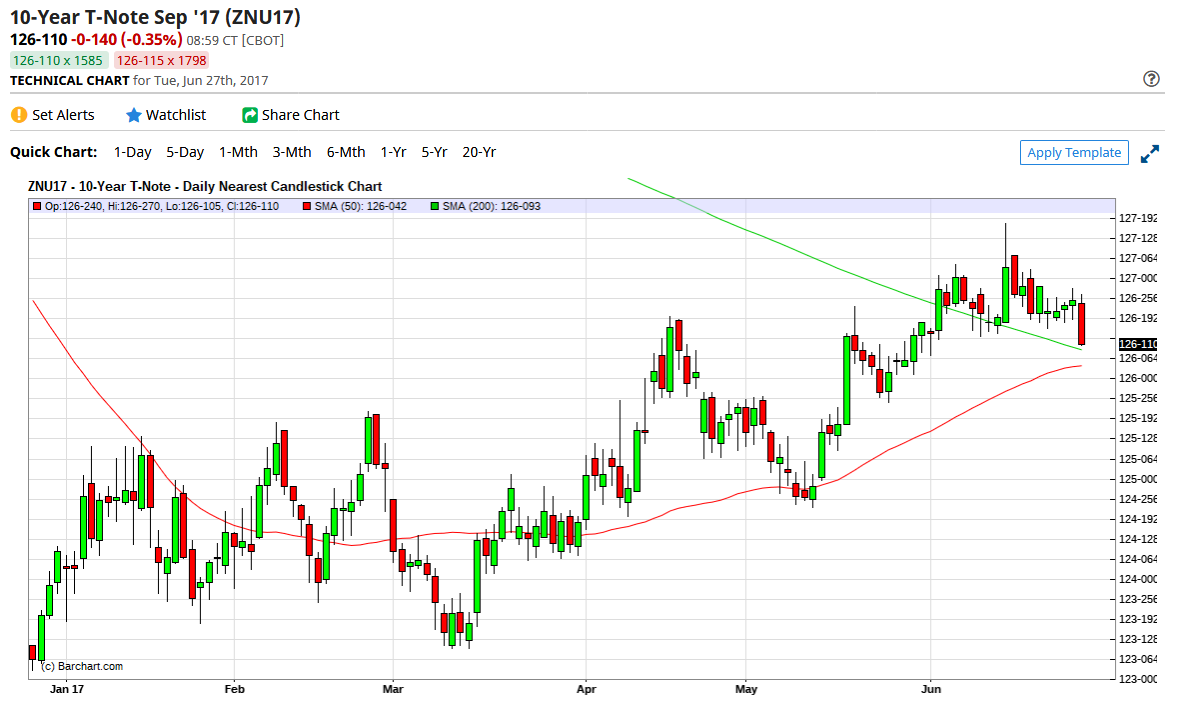
German 10-year bunds at .35 percent?  The Japanese 10-year JGB at .04 percent?   The 10-year U.S. T-Note at 2.25 percent (though attractive relative to European and Japanese bonds, which keeps the 10-year note well anchored below 2.60 percent)?

Though credit expansion has been relatively lackluster or weak recently, just imagine if velocity starts to reverse and the banking system really begins to extend credit.   This will create an additional tidal wave of money, albeit leveraged,  and a subsequent further boost to asset and real inflation.   The upside scenario, but most likely a lower probability event, in our opinion.

Risks
The impeachment trade?  In the words of President Obama,  “come on, man!”   Presidental scandals alone are not sufficient to crush stocks.   Hope you read our piece,  Beware Shorting Impeachments.

If the Trump agenda stalls into year-end, this will only increase the risk and our conviction of an October correction.   But Republicans may fear losing the House in 2018 and move to the “two-minute” drill trying to expedite legislation.

Don’t get us wrong,  we are not raging bulls, are relatively bearish medium to long-term, and at these valuation levels not expecting blockbuster returns for the rest of the year.   Just kind of a boring summer trading range that slowly drifts higher and shorts are forced to cover.   Once again.

A relatively larger cash position in the event of a correction?   Understandable, for sure.

Pain Trade
Maybe the increase in shorts is a pairs trade, say, shorting the S&P500 against emerging market or European stocks.  Nevertheless,  the pain trade is higher for S&P500, in our opinion,  and the shorts will once again have their family jewels caught in a vice that slowly tightens in on them.

Ouch!  We have been there many times.

The challenge for short sellers is how long they can stay solvent before being forced to buy back the shares that they have borrowed and sold. And the pressure to cover is building. A Goldman Sachs Group Inc. basket of most-shorted stocks has jumped 6 percent this quarter, almost triple the return in the S&P 500.  –  Bloomberg, May 26, 2017

And beware of the “seek and destroy bots“, Mr. Short.

Conclusion
Patience, our friends, until the global central banks start draining the swamp or the Fed funds rate hits a tipping point — we think at around  3-4 percent if no Fed balance sheet reduction.

Those kind of rates will do some ugly damage to the U.S. budget deficit with higher interest payments on a much larger debt stock, which will beget an even higher debt stock and ever higher interest payments and larger budget deficits.   A nasty positive feedback loop and we are not so sure the Fed will allow it and will thus choose to begin to reduce their balance sheet instead.

Nobody Knows Mr. Market
The bear market can start next week, or in five years.  We have no idea, nor does anyone else.  Though we do expect a nice buying opportunity in the fall.

Some expect the Fed may begin to reduce their balance sheet in the fall, China’s 19th National Congress of the Communist Party will conclude in October and the country’s economic policy put will implicitly expire.  Then a possible nasty economic or policy surprise out of China creating a catalyst for some temporary global risk aversion.  Maybe.

We just don’t think we have topped quite yet.

Professional money managers are not paid to sit with high cash levels and shorts, as you know, are an impatient lot.

Calculated risk and good money management, comrades.    Stress test those old sleeping dogmas.  Remember, asset bubbles don’t easily pop.  That is until they do.

Posted in Equities | Tagged , | 1 Comment

Global Risk Monitor – May 26

Click on table to enlarge and for better resolution

RiskMon_1RiskMon_2RiskMon_3

Posted in Daily Risk Monitor, Uncategorized | Tagged , , , , , | Leave a comment

Mozambique Update

Just a little update from the FT on Mozambique, which was highlighted in our last piece, World Current Account Balances (CAB).

Note first,  Mozambique is a very small economy with a nominal dollar GDP of only $11 billion in 2017 or about 1/7th the size of the economy of Memphis, Tennessee.   The exchange rate has been weak over the past five years,  though strengthening recently, which has reduced nominal $GDP and has made external debt service more burdensome.

MOZ_FX

It began four years ago, with money meant to herald the start of a modern fishing industry for one of southern Africa’s poorest nations — a fleet of new boats to trawl the sparkling waters off the coast of Mozambique.

This month, one of the most controversial government debt scandals in Africa this decade neared its denouement as Kroll investigators delivered a much-delayed forensic audit into an $850m “tuna bond” and more than $1bn in hidden loans to opaque state-affiliated companies.

When these loans — and more purchases of naval vessels and security equipment than tuna boats — were uncovered last year, international donors cut off aid. Investors in huge offshore gas discoveries were also rattled as Mozambique plunged into a financial crisis.

Now donors, who funded about a quarter of the budget, are asking if Frelimo, the former liberation movement that has ruled with a tight grip since independence in 1975, can punish those within its ranks implicated in the audit.

“It’s the $2bn question,” says one diplomat in Maputo, referring to the debt defaults that last year undermined Mozambique’s status as one of the fastest-growing economies in Africa and threatened plans to develop the gasfields.
FT, May 27, 2017

Posted in Uncategorized | Tagged , , | Leave a comment

God Bless Our British Brothers and Sisters

We are with you during these dark days.   Only time can heal and then never fully.   I know, my family experienced a similar tragic hate crime several years ago.  Try not to let the bitterness, which is only natural,  eat you up and ruin the rest of your lives.  Easier said than done.

How many times I have dropped my daughters off at concerts without even thinking about such a terrible tragedy what you have just experienced could happen.   It’s heartbreaking to think of the pain what the families involved are now experiencing.

These people who did this are the scum of the earth and as far from the Muslim faith as one can get.

“Of all bad men religious bad men are the worst.”  – C.S. Lewis

Posted in Politics, Uncategorized | Tagged | 2 Comments

The Fed’s Overnight Reverse Repurchase Agreements

Interesting piece on Barry Ritholz’  Big Picture blog yesterday,  Implementing Monetary Policy: Perspective from the Open Market Trading Desk.    An excellent follow-up to our last week’s post, Orwellian Monetary Policy.

Recall we noted the structural change in monetary policy and what seems to be an inconsistency where the Fed now injects liquidity into the financial system by paying (printing) interest payments on excess reserves to raise the Fed Funds rate.   Prior to the crisis, the Fed would raise the Fed Funds rate by removing reserves or draining liquidity from the banking system.

The Fed also now uses a supplementary tool,  the overnight reverse repurchase agreements (ON RRPs) to keep the Fed Funds rate at the target level.

Here are the money quotes:

The primary tool—interest on reserves (IOR)—applies to the reserve balances held by banks in their accounts with the Federal Reserve.3 In principle, the federal funds rate should not fall below IOR, because depository institutions have no incentive to lend federal funds at interest rates below what they could earn simply by leaving the funds in their reserve accounts. However, a number of frictions have caused the effective federal funds rate to print moderately below IOR, leading the Federal Reserve to use a supplementary tool—a facility that offers overnight reverse repurchase agreements (ON RRPs) at a specified offering rate to a wide range of counterparties.4

The ON RRP facility helps to reinforce the floor under market interest rates by providing an outside investment option to a broad group of nonbank market participants that are not eligible to earn IOR.5 We’ve observed that a high volume of actual ON RRP usage has not been necessary to achieve interest rate control. In the first half of 2016, for example, average daily usage of the facility was $63 billion. In principle, even with zero usage, the ON RRP facility can support market rates by ensuring that counterparties demand rates on other investments at least as attractive as the rate offered on the Federal Reserve’s ON RRPs.

The ON RRP facility also serves as a flexible shock absorber that helps to maintain interest rate control when transitory shifts occur in the supply and demand for short-term market instruments. For example, around key month- and quarter-end reporting dates, some financial institutions shrink their balance sheets, a measure that reduces the availability of private money market investments, puts downward pressure on money market rates, and produces higher ON RRP take-up. Last fall, the ON RRP facility also helped to maintain rate control during the implementation of money market fund reform by temporarily absorbing heightened demand for safe, overnight investments by government money market funds.  –  The Big Picture

In our opinion,  monetary policy still a black box as to how/when it ultimately affects the economy.

Posted in Monetary Policy, Uncategorized | Tagged , , | Leave a comment

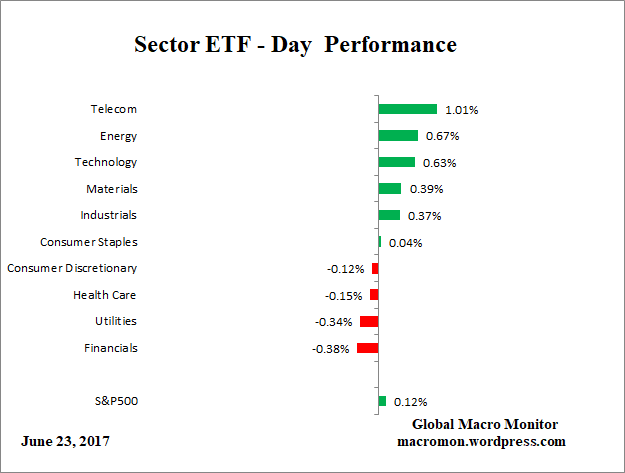
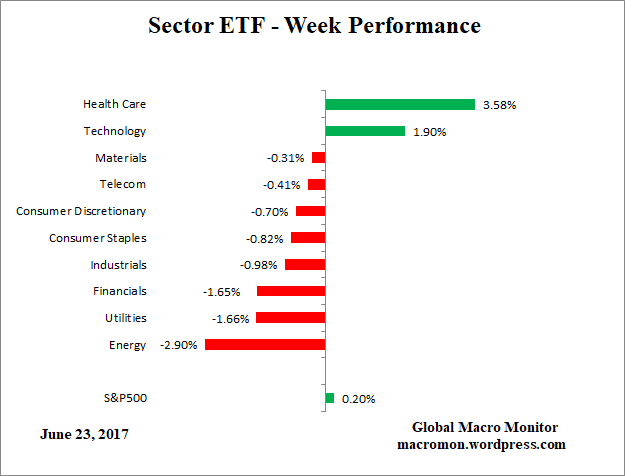
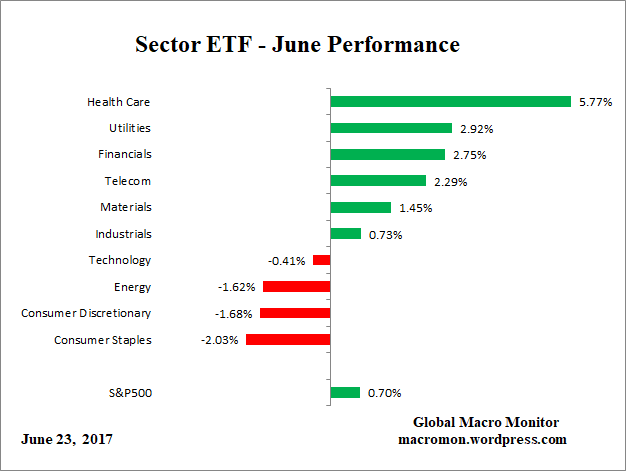
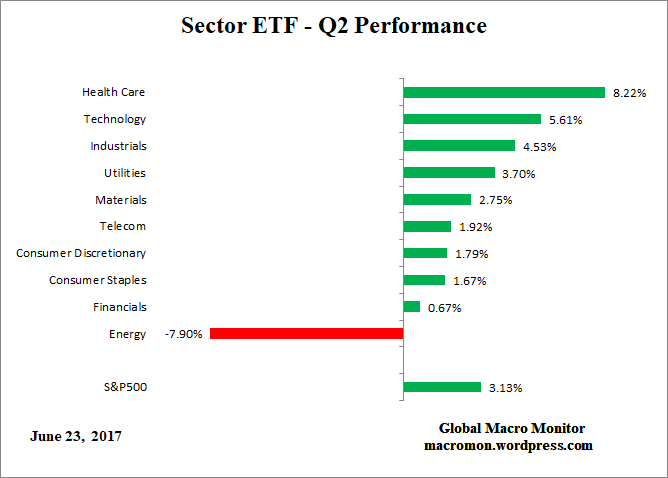
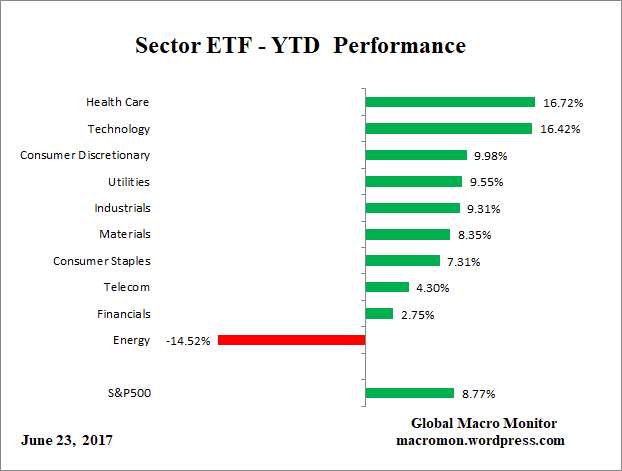
US Sector ETF Performance – May 19

ETF_DayETF_WeekETF_MonthETF_QETF_YTD

Posted in Sector ETF Peformance, Uncategorized | Tagged | Leave a comment

Global Risk Monitor – May 19

Click on table to enlarge and for better resolution

RiskMon_1RiskMon_2RiskMon_3

Posted in Daily Risk Monitor, Uncategorized | Tagged , , , , , | Leave a comment

How Presidential Scandal Endangers Global Stability

In our latest post, Beware Shorting Impeachments,  we noted:

Bad things tend to happen in the world when the U.S. administration is distracted and looks weakened by political scandal.  And, believe us, there is a legion of bad things out there just waiting to happen, all of which are stock market negative.  – Global Macro Monitor

We just found this tidbit of history from Politico of how during the Watergate scandal the Nixon administration was melting down and the President retreated to self-medication,

The Nixon administration began disintegrating—the president unable to play his role as the leader of the nation and the free world—at 7:55 p.m. on October 11, 1973.

The newly appointed secretary of state, Henry Kissinger, picked up his telephone. His trusted aide at the National Security Council, Brent Scowcroft, was on the line from the White House. The Arab-Israeli war of 1973 was in its fifth day, escalating toward a global crisis and a potential nuclear conflict.

SCOWCROFT: The switchboard just got a call from 10 Downing Street to inquire whether the president would be available for a call within 30 minutes from the prime minister. The subject would be the Middle East.

KISSINGER: Can we tell them no? When I talked to the president he was loaded.

President Richard Nixon—ravaged by more than four years of war in Vietnam, 15 months of Watergate investigations and countless nights of intense insomnia—was incapacitated.  – Politico

Wow!  POTUS was hammered as the world spiraled toward nuclear conflict and incapable of taking “the call.”

This further confirms our suspicions that domestic political scandals, such as Watergate, distorts and weakens the global perception — and maybe not just perception — of U.S. leadership in the world.   And contributed, at least, partially,  to the 1973 Yom Kippur War and subsequent economic crisis caused by the related OPEC embargo.

It was only nine days later after the above account by Politico the Saturday Night Massacre took place.

If past is prologue,  as Trumpgate thickens we suspect the world may become more unstable.   As an example,  the behavior of, say,  North Korea may become more nefarious as they perceive the U.S. administration weakened and distracted.  This already seems to be the case, no?

This only adds to the “wall of worry” and checks over bullishness and probably why the market refuses to correct.

Thank goodness President Trump doesn’t drink,  but he does seem to find release — i.e., self-medicate — through his Twitter account.   And recent history shows that one “bad” tweet can do more damage and be more self-destructive to a Presidency than, say,  five martinis.   Gulp!


Posted in Politics, Uncategorized | Tagged , , , , | 11 Comments

Beware Shorting Impeachments

We’ve analyzed the behavior of the S&P500 during the Watergate impeachment hearings and the Clinton impeachment.  If you’re shorting risk markets solely based on speculation that President Trump may be impeached, maybe you should think again.

Let’s first look at the Clinton impeachment S&P500.   The market never seemed to take the Clinton impeachment seriously and was never a threat to the stock market.

Then we’ll analyze the more complicated Watergate scandal, which many consider the main culprit of the 1973/74 bear market, a 50 percent decline in S&P500 from January 11, 1973 to October 3, 1974.

Finally,  we will take a look at Trumpgate and introduce you to our newest political Six Sigma political thriller.

Clinton Impeachment
The rumors of the Clinton-Lewinsky affair broke January 19, 1998, on the Drudge Report, which was a market holiday.  Recall U.S. stocks were in a rip-roaring bull market and massive bubble that saw the Dow rise 253 percent during the Clinton administration, second only to Calvin Coolidge’s roaring twenties bull market (see here for Presidential Stock Returns).   The NASDAQ, home of the infamous dot.coms,  rose a multiple of the Dow.

The table below shows the timeline of various key events and the S&P500 returns.

Clinton Table_Impeachment

Even after the news broke and the “blood was in the water” — recall the media frenzy,  probably crazier than now because it involved sex — U.S. stocks continued to march higher.   The S&P500 rose another 21.27 percent until its peak pre-Russia debt default high of 1,186.75 on July 17th.

Summer of 1998 – Russian Debt Default
Ironically,  Russia announced its debt default the same day President Clinton testified to the grand jury he had an “inappropriate relationship” with Ms. Lewinsky on August 17th.   The global markets fell apart and what was a garden variety correction in the S&P500 sharply accelerated.

The Brazian stock market fell 16 percent on September 10th.   The Fed was forced to cut interest rates several times in just 7 weeks.  Systemic risk was rising rapidly as  Long-Term Capital Management (LTCM) ultimately failed and was bailed out by a consortium of financial institutions in late September.

The total decline in S&P500 during this period was 19.34 percent finally bottoming on August 31, many months before the global economic crisis ended.

Was the financial crisis of 1998 the result of the fear of Clinton being impeached?  Hardly, or should we be blunter – NFW!

Remember, the U.S. had the “Committee to Save the World.”

Comittee to Save the World_Impeachment

The 1998 financial crisis was mainly the result of Russia’s debt default and the subsequent huge global margin call.   Hedge funds were big in Russian debt that had defaulted forcing them to sell many of their assets, say, even their Safeway bonds.   As credit spreads significantly widened in almost every credit instrument,  the extremely levered LTCM with all its Nobel laureates tanked.

Even if you believe the march toward impeachment was a contributing factor in the ’98 financial crisis,  it wasn’t,  or it needed a sufficient condition,  and was not even a necessary condition,  in our opinion.    We will admit there is a possibility the Clinton administration was distracted by the scandal and may not have allowed or wanted Russia to default.

We lost a lot of money betting Russia was “too nuclear to fail” even as we were in the euro bonds the Russians continued to pay.  At one point, these bonds with 9 plus percent coupons fell into the teens with current yields of over 60 percent.  There were no buyers in sight.   If only we held on, but couldn’t as we were too levered.

Later, we will make the argument that Watergate may have been the necessary condition of the 1973/74 bear market,  but the OPEC embargo was the sufficient condition.

Impeachment and Acquittal
By the time President Clinton was impeached in the House of Representatives on December 19th, the S&P500 was up 23 percent since the Lewinsky rumors first surfaced.  The Senate acquitted President Clinton on February 12, 1999, and with S&P500 up 26 percent since the start of the scandal, “the long national nightmare” of the bankrupt impeachment short sellers was over.

The S&P500 continued higher for another year, finally bursting on March 24, 2000, up 56 percent from the day of discovery of the Clinton-Lewinsky affair.

Clinton Chart_Impeachment

What we did learn in 1998 was that stock market bubbles don’t pop easily.   That is until they do.

Watergate Scandal
The analysis of Watergate on the stock market is a little more difficult to unpack as it involved the conflation of three major “rock your world” events:

1) A nasty bear market that took the S&P500 down almost  50 percent from January 1973 to October 1974;

2) A potential constitutional crisis (never the case during the Clinton impeachment) as it was uncertain if the White House would turn over “the tapes“.  President Nixon fired the Special Prosecutor who was charged to oversee the federal criminal investigation in Watergate;

3) And we think,  most important, was the first OPEC oil embargo that shook the global economy on October 16, 1973

Watergate Table_Impeachment

The break-in of the Democratic National Committee headquarters in the Watergate apartment complex took place in the summer of 1972.  It took several months before it hit the front pages as national news and became a Presidential scandal.   Bob Woodward and Carl Bernstein, now household names, were urban beat reporters rendered to the back pages of the Washington Post when they were assigned to the Watergate story.

The S&P500 was in rally mode going into the 1972 landslide reelection of Richard Nixon. The index peaked on January 11, 1973, at 120.24 and would not regain that level until more than 7 years later.    From the day of the Watergate break-in until the January peak, the S&P500 rose 11.22 percent.

Liddy and McCord Convictions
On January 30, 1973, two members of President Nixon’s re-election committee were convicted for the Watergate break-in.

“…two former officials of President Nixon’s re-election committee, G. Gordon Liddy and James W. McCord, Jr. were convicted yesterday of conspiracy, burglary and bugging the Democratic Party’s Watergate headquarters.”
Washington Post, January 31, 1973

Game on,  Watergate.

Short-term Bottom
The S&P500 continued to decline through the summer until making a short-term low on  August 22nd at 100.53,  down 16 percent from the January high.   It then rallied 11 percent for two months peaking on October 26th.

At this point, the S&P500 was only down 7.4 percent even after the John Dean testimony to Congress and the Saturday Night Massacre and the OPEC oil embargo, of which both occurred just a week before.    Similarly ironic,  the OPEC oil embargo and the Saturday Night Massacre occurred in the same week as did the Clinton confession to the grand jury and Russian debt default happened on the same day.

Watergate Chart_Impeachment

.

The double shock of OPEC, raising the price of oil by 70 percent with further cuts in production to follow,  coupled with the Saturday Night Massacre, raising the specter of a constitutional crisis in the U.S.,  sent the global economy and markets into a tailspin.

As the chart illustrates, these two events marked the end of the short-term rally.  The S&P500 proceeded to fall another 43.5 percent through the resignation of President Nixon on August 8, 1974,  until it bottomed on October 3, 1974.

From its January 1973 high until the resignation of President Nixon in August 1974, the S&P500 fell 32 percent.

OPEC or Watergate?
So we ask you, folks, what was the main cause of the 1973/74 bear market and 50 percent decline of S&P500?  Watergate or OPEC?

Structural Economic Damage of OPEC
Nobody knows for certain,   but we maintain speculate that if the global economy had not suffered the structural damage from the OPEC shock,  the Watergate scandal would have been just noise and the S&P500 would’ve probably not even entered a bear market and suffered only a normal correction.   That is unless Nixon sent tanks out onto Pennsylvania Avenue.

Though the S&P500 bottomed less than two months after President Nixon resigned,  it didn’t regain its January 1973 high until July 17, 1980.   The stagnation of the 1970’s brought on by the structural damage to and the massive realignment of the global economy of the OPEC shocks definitely took a major long-term toll on the financial markets.

Yom Kippur War
An argument can be made that Watergate distracted and weakened the Nixon administration, which emboldened the Arab nations that attacked Israel during the Yom Kippur War in early October 1973.    The Nixon Administration responded with Operation Nickel Grass, a strategic airlift to deliver weapons and supplies to Israel.

This was after the Soviet Union began sending arms to Syria and Egypt.  The Arab nations of OPEC, in retaliation to Operation Nickel Grass, raised the posted price of oil on October 16.  The actions of the Soviets and OPEC may have been the result that they and the world perceived the U.S. weak due to a domestic political scandal.   Pure supposition on our part.

So, Watergate, a necessary condition to the 1973/74 bear market?   Maybe.

What About Trumpgate?
So far no hard facts and no smoking gun, at least that is publicly known, no John Dean testimony, no tapes.

But potentially more complicated.  The underlying allegations are much more serious than covering up of a third rate political burglary and lying about, well, you know.   Also, a much wider net that could consist of many things, including improper business transactions that took place prior to taking office.

Lots of incompetence, strange and suspicious behavior from the administration, combined with speculation, rumors, coincidences, and what appears to be circumstantial evidence of some sort of a coverup, and the punditry in a feeding frenzy desperately trying to connect the dots.   Once again, a total media circus.

Oh yes, and the appointment of the highly and widely respected Special Counsel, Robert Mueller,  to “oversee the previously-confirmed FBI investigation of Russian government efforts to influence the 2016 presidential election and related matters.”

Though the appointment of Mueller illustrates just how serious the matter is, and is becoming, it should be seen as a positive by both those who suspect President Trump is guilty of something as it takes the specter of a constitutional crisis off the table. And for those who believe the President has done nothing wrong,  the appointment of the Special Counsel should vindicate him.   All other things being equal,  the Mueller appointment should be a positive for the markets.

Unless President Trump fires the Special Counsel.

Furthermore, doesn’t it seem like President Trump is making a special effort to go out of his way just to troll his political opponents?

Conclusion
Granted the initial conditions of these three cases differ greatly.  Valuations, liquidity conditions, and the structure of the global economy all have changed dramatically.  But as illustrated in our analysis,  it is usually not a great idea to short stocks based solely on an impeachment trade.   In fact,  we tend to agree with what Professor Jeremy Siegal of the Wharton School said yesterday on CNBC,

“If Donald Trump resigned tomorrow I think the Dow would go up 1,000 points,”  Jeremy Siegel, May 17, 2017

The corollary is that the Republican pro-economic growth agenda is then accelerated as the political distraction, incompetence and protectionist bias of the current administration are removed.  And that the policies are passed before the 2018 election, which the Republicans are becoming increasingly vulnerable to losing both houses of Congress.

The downside scenario is that the investigation lingers, the bad news keeps dripping out, nothing gets done,  the Democrats take the House in 2018 and introduce impeachment hearings.   That may be the most likely scenario and stocks won’t like it, especially given their high valuations.

Our sense,  the Republicans may believe this scenario and double up their efforts to unify and get something done quickly — that is going to the “two-minute offense” — as the clock runs out.   Stock positive.

One Big Caveat
Noted in our analysis are the two big “coincidences” of bad things concurrently occurring at tipping points during the two impeachment proceedings.   The Russian default on the same day President Clinton confessed to the grand jury and the OPEC oil embargo during the same week of Watergate’s Saturday Night Massacre.   Coincidences?

Bad things tend to happen in the world when the U.S. administration is distracted and looks weakened by political scandal.  And, believe us, there is a legion of bad things out there just waiting to happen, all of which are stock market negative.

And then there is “wag the dog“.

The 6 Sigma Event:  President Pelosi in 2019
Finally,   you know we like to think outside the box here at the Global Macro Monitor and live in the fat tails.

Contemplate this 6 sigma scenario:

Bad news for Trump continues to leak out and staffers and acquaintances are indicted all through the rest of 2017 and 2018.   The Democrats take the House and Senate in a landslide in November 2018.

Impeachment charges are brought both against President Trump and Vice President Pence, say, as a co-conspirator on obstruction of justice charges in the firing of James Comey.

It’s 2019 and the Dems control the House and the Senate with comfortable majorities.

The House impeaches the President and Vice President.   The Senate convicts both.

Who is next in line to assume the Presidency?   The Speaker of the House,  Nancy Pelosi?

The probability?  Six sigma or about 2 * 10^-9 or two in a billion.  Most likely,  even much, much lower. 

Hey,  but good stuff for a political thriller or fodder for the House of Cards,  no?

Posted in Politics, President Trump, Uncategorized | Tagged , , | 10 Comments