How Is That Reagan-Trump S&P500 Analog Working Out?

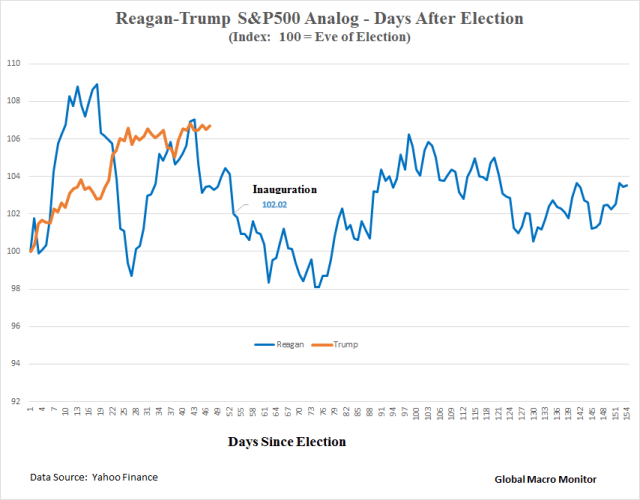
So far, at the close of 2016,  the Trump S&P500 is outperforming  the Reagan S&P500 by 0.38 percent, 38 days after the close of their respective election days.  The Trump bump has been a relatively steady climb before rolling over last week whereas a much more volatile S&P 40 days after the Reagan election.

Note also the Reagan bull market really didn’t begin until a year and a half into his Administration.  The S&P500 continued to slide after his inauguration as the economy was in the throes of a deep recession.   Monetary policy began to ease — see chart below where Fed Funds rate fell over 1,ooo bps from July 1981 to August 1982 * —  and the stock market finally bottomed toward the end of the recession in the fall of 1982.

The Reagan-Trump Analog is completely useless, in our opinion, as the relative  macroeconomic initial conditions at the advent of their two Presidencies are entirely different.   Nevertheless,  a fun tracking exercise and we do expect a little more give back in the S&P500 in the next month.  We don’t expect the almost 30 percent high-to-low give back in the first year and half of the new Administration.

President Trump will inherit and entirely different economy than President Reagan.   Stay tuned.

* Fed funds was not a target variable at the time, but does reflect monetary conditions.

reagan-v-trump_reagan

reagan-v-trump_reagan_1st-termreagan-v-trump_effective-fund-funds

Posted in Equities, Uncategorized | Tagged , , | Leave a comment

Global Macro Data Year in Review

Click on table to enlarge and for better resolution

2016_riskmon_12016_riskmon_22016_riskmon_3

2016_bonds2016_stocks2016_selected

Posted in Daily Risk Monitor, Uncategorized | Tagged , , , , , , | Leave a comment

The biggest moment of 2017: Donald Trump’s inauguration – Economist

Published on Dec 30, 2016

On January 20th 2017, the eyes of the world will be on Donald Trump as he takes the oath of office and is sworn in as America’s 45th president. The political tremors will reverberate around the world. But it is inauguration day itself that tops our list of the coming year’s biggest talking points.

Click here to subscribe to The Economist on YouTube: http://econ.trib.al/rWl91R7

Posted in Economics, Policy, Politics, Uncategorized | Tagged , , | Leave a comment

US Sector ETF Performance – Dec 30

etf_detf_wetf_metf_q4etf_ytd

Posted in Sector ETF Peformance, Uncategorized | Tagged , | Leave a comment

Daily Risk Monitor – December 30

Click on table to enlarge and for better resolution

riskmon_1riskmon_2riskmon_3

Posted in Daily Risk Monitor | Tagged , , , , , | Leave a comment

History Shows Why Prognosticators Should Be Discounted

It is the end of the year and prognosticators are crawling out of the woodwork.  So, it’s time to repost a piece from Global Macro Monitor years’ past.

Prophets are usually false, and that includes us.  After all, look at where we thought the Gold Miners Index (GDX) would at the end of the year?    Trading is calculated risk and if you stick with a forecast or outlook that biases your money management,  you’re dead.   Punto

Happy New Year!

History Shows Why Prognosticators Should Be Discounted

1927-1933 Chart of Pompous Prognosticators

1.  “We will not have any more crashes in our time.”
– John Maynard Keynes in 1927

2.  “I cannot help but raise a dissenting voice to statements that we are living in a fool’s paradise, and that prosperity in this country must necessarily diminish and recede in the near future.”
– E. H. H. Simmons, President, New York Stock Exchange, January 12, 1928

“There will be no interruption of our permanent prosperity.”
– Myron E. Forbes, President, Pierce Arrow Motor Car Co., January 12, 1928

3.  “No Congress of the United States ever assembled, on surveying the state of the Union, has met with a more pleasing prospect than that which appears at the present time. In the domestic field there is tranquility and contentment…and the highest record of years of prosperity. In the foreign field there is peace, the goodwill which comes from mutual understanding.”  – Calvin Coolidge December 4, 1928

4.  “There may be a recession in stock prices, but not anything in the nature of a crash.”
– Irving Fisher, leading U.S. economist , New York Times, Sept. 5, 1929

5.  “Stock prices have reached what looks like a permanently high plateau. I do not feel there will be soon if ever a 50 or 60 point break from present levels, such as (bears) have predicted. I expect to see the stock market a good deal higher within a few months.”
– Irving Fisher, Ph.D. in economics, Oct. 17, 1929

“This crash is not going to have much effect on business.”
– Arthur Reynolds, Chairman of Continental Illinois Bank of Chicago, October 24, 1929

“There will be no repetition of the break of yesterday… I have no fear of another comparable decline.”
– Arthur W. Loasby (President of the Equitable Trust Company), quoted in NYT, Friday, October 25, 1929

“We feel that fundamentally Wall Street is sound, and that for people who can afford to pay for them outright, good stocks are cheap at these prices.”
– Goodbody and Company market-letter quoted in The New York Times, Friday, October 25, 1929

6.  “This is the time to buy stocks. This is the time to recall the words of the late J. P. Morgan… that any man who is bearish on America will go broke. Within a few days there is likely to be a bear panic rather than a bull panic. Many of the low prices as a result of this hysterical selling are not likely to be reached again in many years.”
– R. W. McNeel, market analyst, as quoted in the New York Herald Tribune, October 30, 1929

“Buying of sound, seasoned issues now will not be regretted”
– E. A. Pearce market letter quoted in the New York Herald Tribune, October 30, 1929

“Some pretty intelligent people are now buying stocks… Unless we are to have a panic — which no one seriously believes, stocks have hit bottom.”
– R. W. McNeal, financial analyst in October 1929

7.  “The decline is in paper values, not in tangible goods and services…America is now in the eighth year of prosperity as commercially defined. The former great periods of prosperity in America averaged eleven years. On this basis we now have three more years to go before the tailspin.”
– Stuart Chase (American economist and author), NY Herald Tribune, November 1, 1929

“Hysteria has now disappeared from Wall Street.”
– The Times of London, November 2, 1929

“The Wall Street crash doesn’t mean that there will be any general or serious business depression… For six years American business has been diverting a substantial part of its attention, its energies and its resources on the speculative game… Now that irrelevant, alien and hazardous adventure is over. Business has come home again, back to its job, providentially unscathed, sound in wind and limb, financially stronger than ever before.”
– Business Week, November 2, 1929

“…despite its severity, we believe that the slump in stock prices will prove an intermediate movement and not the precursor of a business depression such as would entail prolonged further liquidation…”  – Harvard Economic Society (HES), November 2, 1929

8.  “… a serious depression seems improbable; [we expect] recovery of business next spring, with further improvement in the fall.” – HES, November 10, 1929

“The end of the decline of the Stock Market will probably not be long, only a few more days at most.”
– Irving Fisher, Professor of Economics at Yale University, November 14, 1929

“In most of the cities and towns of this country, this Wall Street panic will have no effect.”
– Paul Block (President of the Block newspaper chain), editorial, November 15, 1929

“Financial storm definitely passed.”
– Bernard Baruch, cablegram to Winston Churchill, November 15, 1929

9.  “I see nothing in the present situation that is either menacing or warrants pessimism… I have every confidence that there will be a revival of activity in the spring, and that during this coming year the country will make steady progress.”
– Andrew W. Mellon, U.S. Secretary of the Treasury December 31, 1929

“I am convinced that through these measures we have reestablished confidence.”
– Herbert Hoover, December 1929

“[1930 will be] a splendid employment year.”
– U.S. Dept. of Labor, New Year’s Forecast, December 1929

10. “For the immediate future, at least, the outlook (stocks) is bright.”
– Irving Fisher, Ph.D. in Economics, in early 1930

11.  “…there are indications that the severest phase of the recession is over…”
– Harvard Economic Society (HES) Jan 18, 1930

12.  “There is nothing in the situation to be disturbed about.”
– Secretary of the Treasury Andrew Mellon, Feb 1930

13.  “The spring of 1930 marks the end of a period of grave concern…American business is steadily coming back to a normal level of prosperity.”
– Julius Barnes, head of Hoover’s National Business Survey Conference, Mar 16, 1930

“… the outlook continues favorable…”  – HES Mar 29, 1930

14.  “… the outlook is favorable…”  – HES Apr 19, 1930

15.  “While the crash only took place six months ago, I am convinced we have now passed through the worst — and with continued unity of effort we shall rapidly recover. There has been no significant bank or industrial failure. That danger, too, is safely behind us.”
– Herbert Hoover, President of the United States, May 1, 1930

“…by May or June the spring recovery forecast in our letters of last December and November should clearly be apparent…”  – HES May 17, 1930

“Gentleman, you have come sixty days too late. The depression is over.”
– Herbert Hoover, responding to a delegation requesting a public works program to help speed the recovery, June 1930

16.  “… irregular and conflicting movements of business should soon give way to a sustained recovery…”  – HES June 28, 1930

17.  “… the present depression has about spent its force…” – HES, Aug 30, 1930

18. “We are now near the end of the declining phase of the depression.”- HES Nov 15, 1930

19.  “Stabilization at [present] levels is clearly possible.” – HES Oct 31, 1931

20.  “All safe deposit boxes in banks or financial institutions have been sealed… and may only be opened in the presence of an agent of the I.R.S.” – President F.D. Roosevelt, 1933

Colin J. Seymour, June 2001
http://www.users.dircon.co.uk/~netking
20 June 2001

Posted in Economist, Uncategorized | Tagged , | Leave a comment

Reagan v Trump Macro Initial Conditions

We hear lots of talk these days about,  Why Donald Trump’s Market Rally Echoes Ronald Reagan’s.   

We are big fans of Chaos Theory,

Chaos theory is a branch of mathematics focused on the behavior of dynamical systems that are highly sensitive to initial conditions—a response popularly referred to as the butterfly effect.[1] Small differences in initial conditions (such as those due to rounding errors in numerical computation) yield widely diverging outcomes for such dynamical systems, rendering long-term prediction of their behavior impossible in general.

So we thought we’d take a look at the macroeconomic initial conditions at the start of the Reagan Presidency versus the incoming Trump Presidency.

Check out the data:

reagan-v-trump_initial-conditions

In most all macro categories that we have have researched here,  the initial conditions just aren’t there for a Reagan type bull market, in our opinion.  First, and foremost, are the monetary headwinds.

Monetary Conditions
Reagan began his Presidency with interest rates nowhere to go but south with a 22 percent Fed Funds rate and a 10-year Treasury yield of 12 1/2 percent.  Though interest rates were not the policy target of the Fed at the time,  just several months into the Reagan Presidency the 35-year bond bull market ignited and drove almost all asset prices from real estate to stocks, including the expansion of the price to earnings multiple.

The polar opposite monetary conditions exist at the advent of the Trump Presidency.  Interest rates have nowhere to go but north, we believe,  especially if Mr. Trump’s fiscal policy is implemented.

Unemployment
Mr. Trump will not have the labor slack and surplus to draw upon to drive economic growth.   The country is pretty much at full employment although the level of tautness in the labor market can be debated. This risks much higher inflation than anticipated if his policies are passed and thus a more aggressive Fed.  Also note the aging of the baby boom generation, which has driven much of the growth over the past 30 years.

Total Debt
President Reagan began his Presidency with a relatively small stock of debt.   Mr. Trump will inherit a debt-to-GDP ratio almost three times that of President Reagan.  This leaves less room for deficits as a result of his tax cuts and increased spending.   The Trump plan is to increase economic growth and thus tax revenues through supply side and micro and regulatory policy.   This is the second chance for this argument to succeed.  Watch this space.

The high debt stock, coupled with expected large deficit spending,  risks a spike in real interest rates and a sovereign credit downgrade.

Real Oil Price
President Reagan took office with a relatively high real oil price.  Note this was in an era when high oil prices were considered “bad” for the economy.   The real oil price dropped almost 75 percent in the first five years of the Reagan administration.   President Trump will inherit a real oil price half that of Mr. Reagan, coupled with the ambiguity of not knowing if higher oil prices are good or bad for the economy.  We don’t know where to go with this one.

Dollar
Mr. Trump inherits a real trade weighted dollar a little over 10 percent stronger than President Reagan and, most likely, headed north given the world’s divergant growth and monetary policies. This could act as a headwind on corporate profits and export growth.

Individual Marginal Tax Rates
This is the pearl and central to the supply side argument.  Cutting marginal tax rates to incentivize economic behavior and growth, which will increase tax revenues that offset the revenue loss from the tax cuts.   Note,  President Reagan cut the top rate from 70 percent to 28 percent.   That was Yuuuge!   Mr. Trump just doesn’t have the room to do such large tax cuts as he starts at a lower base with the highest tax rate at around 40 percent.

Corporate Profit Margins
President Reagan took office with a lot of corporate inefficiency and room to expand corporate profits.  It feels we are close to peak margins.   Didn’t we just have an election to improve the wages of the average worker?    Watch this space.

Stock Valuations
Much like the debt stock,  Mr. Trump will inherit a stock market that is relatively highly valued.  Note,  one of Warren Buffet’s stock market valuation metrics,  Stock Market Cap to GDP, is more than 160 percent higher now than it was when President Reagan took office.  The U.S. will need lots of economic growth to “grow” into this metric.

Conclusion
There you have it.  The macroeconomic initial conditions at the beginning of two Presidencies.   This is just our first quick whack at this analysis.

President Trump is going to have to depend on “animal spirits” to do a lot of the heavy lifting and an exquisite execution of supply side, microeconomic, and regulatory reform to increase potential GDP growth.   Higher growth will increase the top line of companies and improve earnings.  But we think, after looking at the data,  the window is narrow.

Can we rally a lot?  Absolutely.  And probably will given the better business conditions initially created by regulatory reform and the fiscal stimulus.

A Reagan bull market?   We don’t think so.

By the way, and contrary to the conventional wisdom,  the Reagan bull market is only the 5th largest Presidential bull market since Teddy Roosevelt, just behind the Obama bull market.

We could be wrong and it surely hasn’t paid to short or underestimate Donald Trump.   But, he just won’t, and probably, can’t,  have the macro tailwinds that President Reagan had at his back given the initial conditions of the macro data.

Stay tuned.

Posted in Equities, President Trump, Uncategorized | Tagged , , | 11 Comments

COTD: Pain In Global Bond Portfolios

Lots of pain out there over the past few months in global bond portfolios.

Look at the reach for duration as global interest rates fell in the IMF chart below,  The IMF probably created the chart in late August/early September.  Compare to the chart of the change in 10-year bond yields since the beginning of November.

Central banks have certainly taken a hit on their QE bond purchases.

Other bodies soon to surface?

global-bond-portfolio-duration_dec26change-in-ten-year-yields_dec26

(COTD = Chart of the Day)


Posted in Uncategorized | Leave a comment

Heavy Drinking Americans And Seasonal Adjustment

Interesting piece in WashPost the other day,  Where the heaviest-drinking Americans live

hitting-the-sauce_dec26

…who among us is likely to do the most drinking this holiday season? The Department of Health and Human Services recently updated the official federal statistics on the percent of state residents ages 12 and older who drink at least once a month. Here’s a map of how those figures break down by state for the years 2014 and 2015.

New England is home to the nation’s heaviest drinkers — New Hampshire, where about 64 percent of residents age of 12 or older drink monthly, is tops in the country. Vermont, Maine and Connecticut also come in at drinking rates above 60 percent. Hard-drinking cheeseheads in Wisconsin see to it that their home is the only Midwestern state in the top tier of American drinkers.

The next tier of heavy drinking states are all in the northern part of the country. Some researchers posit that there may be a relationship between heavy drinking and latitude — at the country level, alcohol consumption tends to increase the farther you get away from the equator. This could be a function of the potential for boredom and depression during winter months when the nights are long, the days are short, and baby it’s cold outside — for a prime example of this, see recent stories involving alcohol and misconduct among people who live in Antarctica.

But other cultural factors can attenuate this relationship. On the map above, take a look at Utah and particularly Idaho. They’re in the bottom tier of the states for drinking frequency. Utah, where only 31 percent of adults drink in a given month, comes in dead last. This is almost certainly because of the large Mormon populations in those states — 58 percent of Utahans are Mormon, as are 24 percent of people in Idaho. Mormonism generally prohibits the use of alcohol and other drugs.

There’s likely a similar religious influence in places Alabama, Mississippi and the other Southern states where drinking is low. Those states have large evangelical Christian populations, many of whom are abstainers.

And the monthly data show why seasonal adjustments are necessary when crunching the numbers:

there’s no doubt that the holidays have traditionally been a time for boozing it up. Take a gander, for instance, at the total monthly alcohol sales in the United States. If you squint really hard you may detect a seasonal trend — those spikes are December of each year.

montly-beer-and-wine-liquor-salesGreat info for “cocktail” conversations about the Nation’s cocktail habits, no?

Posted in Economics, Food Prices, General Interest | Tagged , , | 1 Comment

US Sector ETF Performance – Dec 23

etf_detf_wetf_q4etf_ytd

Posted in Sector ETF Peformance, Uncategorized | Tagged | Leave a comment