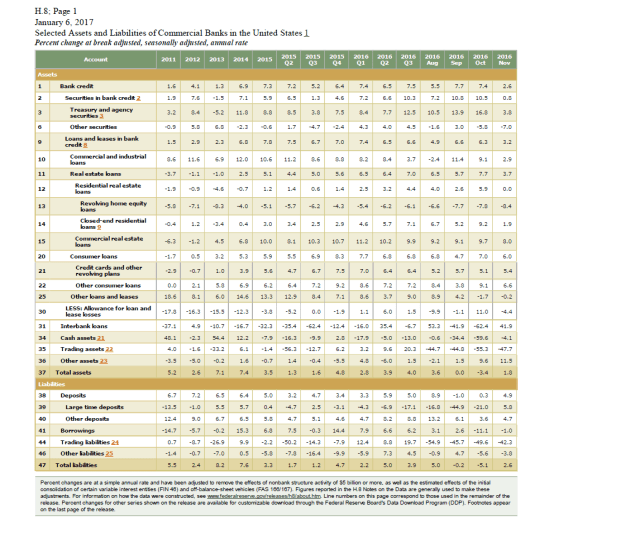
We’ve been busy crunching numbers on the consolidated balance sheet of U.S.-chartered depository institutions and comparing their mix of assets relative to their pre-crisis levels. The large U.S. banks begin reporting earnings on Friday.
The Coming Credit Led Expansion
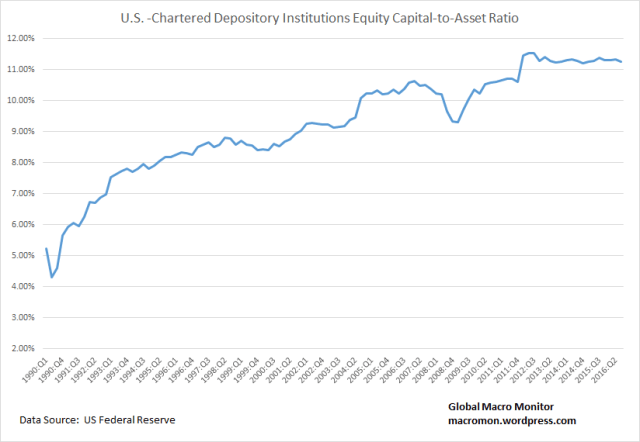
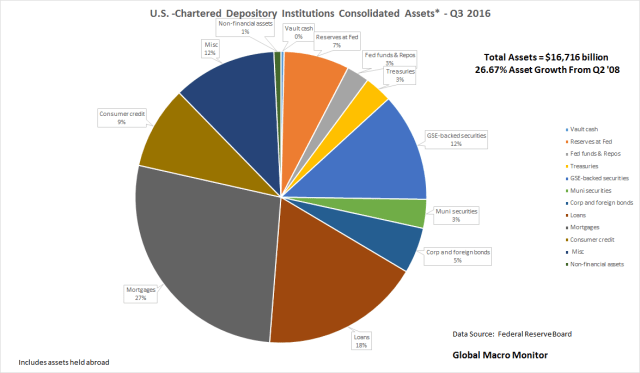
Our inferences from the data are: 1) the U.S. banking system has repaired its balance sheet with equity capital to assets hovering around recent highs (see chart above); 2) banks now hold over 7 percent of assets in reserves at the Fed versus 0.22 percent pre-crisis, most, of which, are excess reserves created by the Fed’s several rounds of quantitative easing (QE); 3) a more friendly regulatory environment under a Trump Administration, steeper yield curve, and the resurrection of animal spirits sets the stage for a U.S. bank-led credit boom; 4) growth and inflation will thus surprise to the upside; and 5) the Fed will be more aggressive than anticipated and will be forced to begin shrinking their balance sheet earlier than expected.
Excess Reserves Largest Growth in Bank Assets
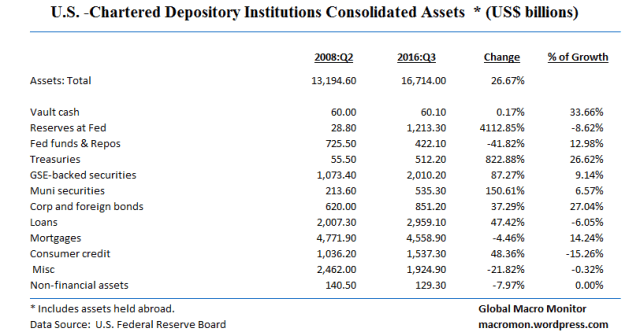
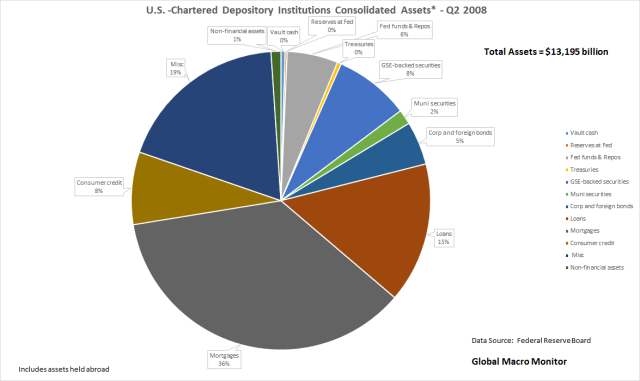
The table and two charts below illustrate the change in total bank assets pre and post-crisis and their respective mix of assets. Though banks have grown assets by almost 27 percent from the end Q2 ’08 to Q3 ’16, more than one-third of that growth has been a $1.2 trillion increase in reserves held at the Federal Reserve, most, of which, are deemed “excess reserves.” Reserves held at the Fed prior to the crises were primarily required reserves and earned no interest.
Under the Financial Services Regulatory Relief Act of 2006 (and the Emergency Economic Stabilization Act of 2008 which accelerated the effective date to October 1, 2008), the Board of Governors amended its Regulation D (Reserve Requirements of Depository Institutions) to direct the Federal Reserve Banks to pay interest on required reserve balances and on excess balances. – NY Federal Reserve
IOER Complicates Monetary Policy
The current interest rate on excess reserves (IOER) is now 0.75 percent and has become one of, if not, the main policy tool of the Federal Open Market Committee (FOMC).
Paying interest on reserve balances enables the Fed to break the strong link between the quantity of reserves and the level of the federal funds rate and, in turn, allows the Federal Reserve to control short-term interest rates when reserves are plentiful. In particular, once economic conditions warrant a higher level for market interest rates, the Federal Reserve could raise the interest rate paid on excess reserves–the IOER rate. A higher IOER rate encourages banks to raise the interest rates they charge, putting upward pressure on market interest rates regardless of the level of reserves in the banking sector. – Janet Yellen
Is Monetary Contraction Now Expansionary?
Using the IOER complicates monetary policy : 1) as the Fed makes interest payments to the banks, it injects, on the margin, more liquidity into the banking system, rather than draining it; and 2) reduces the Fed’s surplus returned to the U.S. Treasury, thus increasing the budget deficit, effectively making the so-called monetary tightening expansionary on the fiscal side. With trillions of dollars of excess reserves in the U.S. financial system, the Fed’s surplus returned to the Treasury will suffer a marked deterioration as monetary policy is tightened and the IOER is increased adding to fiscal pressures. No one is focused on this. More on this in a future post.
Remittances from the Federal Reserve to the Treasury Department fell to $92 billion last year, the U.S. central bank said Tuesday, a long-anticipated decline that officials have said was likely once interest rates start to rise. – WSJ, Jan 10, 2017
Paying interest on excess reserves acts as a throttle on credit and loan expansion and is an effective hurdle rate for the depository institutions’ marginal decision to lend or not to lend those reserves. Note, the banks are now holding over 7 percent of their aggregate assets in reserves at the Fed versus o.22 percent before the crisis began. Most of these reserves originated from the massive asset purchases by the Fed in its several rounds of quantitative easing (QE). If animal spirits take and begin to infect the banks as we expect, credit will be expand and IOER will have to move up higher than anticipated.
Bank Risk Aversion and Pancaking of Yield Curve
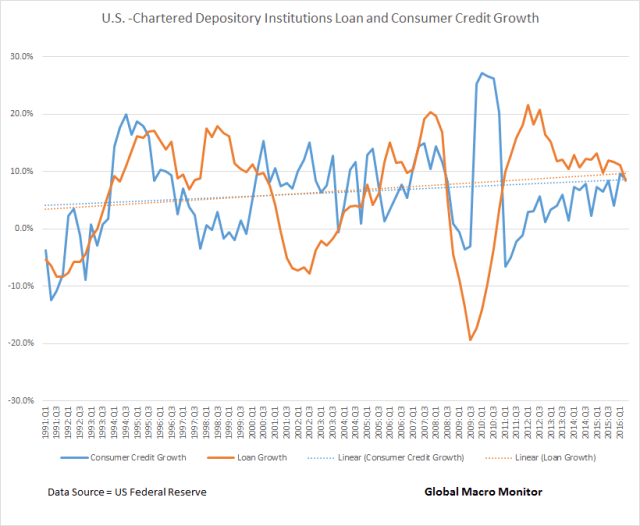
Rather than expanding credit with these reserves, banks have most recently used them as a liquidity safety cushion during the post-crisis economic uncertainty, while, at the same time, engaging in balance sheet repairment. Coupled with more restrictive regulatory requirements and the pancaking of the yield curve by the Fed, bank credit has tightened relative to pre-crisis levels constraining supply. Concurrently, global credit demand in the real sector has been relatively punk as excess capacity from the prior boom is being worked off. There are one-odd exceptions, of course, such as auto lending and student loans.
Aggregate household debt balances grew in the third quarter of 2016. As of September 30, 2016, total household indebtedness was $12.35 trillion, a $63 billion (0.5%) increase from the second quarter of 2016. Overall household debt remains 2.6% below its 2008Q3 peak of $12.68 trillion, but is now 10.7% above the 2013Q2 trough. – NY Federal Reserve
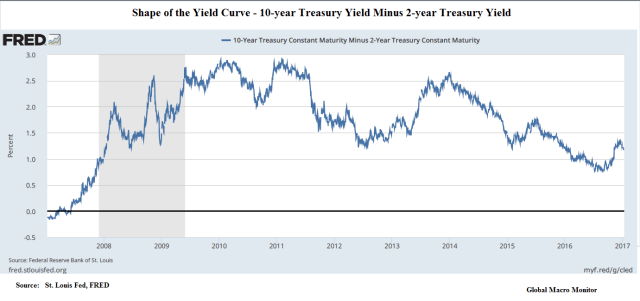
Consequently, banks reserves sit idle at the Fed earning the IOER and is one, if not, the main, reason why inflation from QE and zero interest rate policy (ZIRP) has been contained to financial and some real assets and has not spread to the real sector through a credit driven demand for goods and services.
Difficult to Reconcile Reserve Balances and Fed Balance Sheet
We find it difficult to reconcile excess reserves with the Fed’s balance sheet expansion. And we suspect some of FED the liquidity has leaked into the financial system bolstering the demand for financial assets complimenting the substitution effect of lower interest rates — you know, “John Bull can stand anything, but he cannot stand two zero percent.”
If anyone can help us out here, please e-mail, which is posted on our contact page.

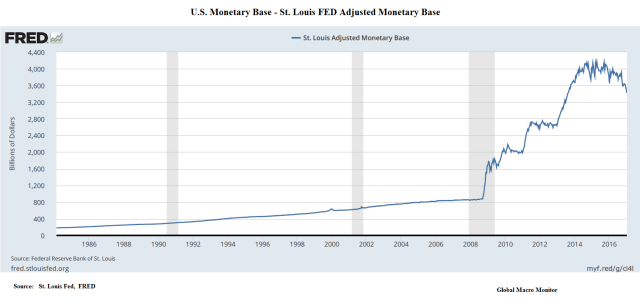
We believe these excess reserves, counted as the monetary base, and what was used to be called high-powered money, is the fuel, already in the system and sitting idle. that will drive credit expansion and the economy and inflation in the next few years. High powered money has been throttled through the broken credit system. That is about to change.
High-powered money is sometimes called the monetary base. It includes all cash, even vault cash at commercial banks, and commercial bank deposits at Federal Reserve Banks, which are redeemable in cash. These assets are called reserves because commercial banks hold them to honor checking account withdrawals during times when withdrawals exceed new deposits. New loans are also made out of reserves in the sense that a bank with no reserves would have no funds to loan out. The term high-powered is a reference to the fact that a $1 increase in the volume of high-powered money will cause the most narrowly defined measure of the money stock to increase by about $2.50.
Banks Are In Business To Lend
All the data, combined with a healthier banking system, the U.S. regime change, and improving financial and regulatory conditions, seems to us, sets the stage for a credit-led boom in the next few years. Banks like to lend.
The expanded monetary base will provide the fuel as banks begin to lend again. This scenario is probably already unfolding and we would watch the macro data to confirm, but it may take some time to really get the party going, say, early 2018.
Market Impact
The impact on markets? Bond negative, dollar positive, and initially equity positive before the Fed panics and the markets freak over the rise in interest rates and the dollar. The risk to the scenario? Political.
Of course, we could be wrong as economic forecasts usually are. And, if we are wrong? We’ll just declare, “fake news”, which seems to be all the rage now, no? Then we will take our lumps. Wish we could claim, “fake losses.”
Nevertheless, expect the unexpected with respect to monetary policy. Stay tuned.