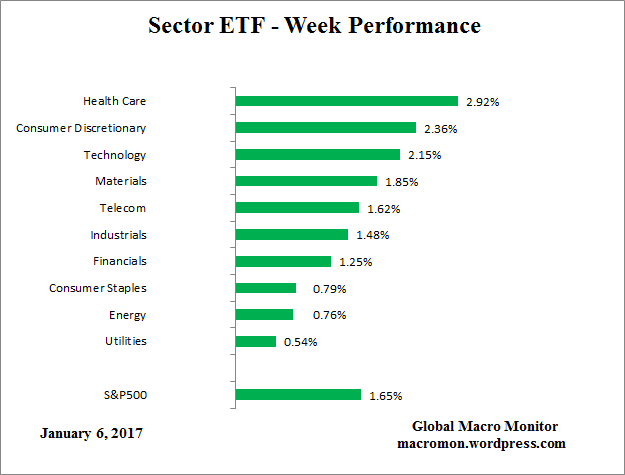
US Sector ETF Performance – Dec 16

etf_detf_wetf_metf_q4etf_ytd

Posted in Sector ETF Peformance, Uncategorized | Tagged , | Leave a comment

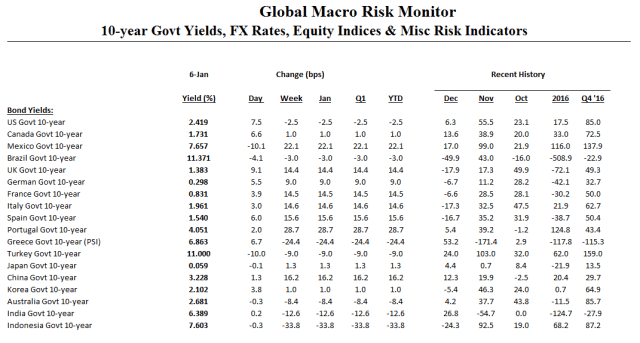
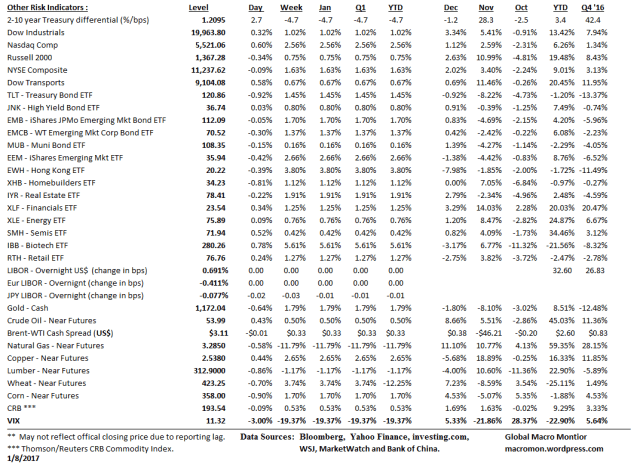
Daily Risk Monitor – December 16

Click on table to enlarge and for better resolution

riskmon_1riskmon_2riskmon_3

Posted in Daily Risk Monitor, Uncategorized | Tagged , , , , , | Leave a comment

Presidential Stock Market Returns

We’ve been busy crunching data from the Measuring Worth website on the Dow Jones Industrial Stock Index returns for each Presidents’ administration  going all the way back to Teddy Roosevelt.  We find the data very interesting and will, mostly, let it speak for itself.   Note,  President Obama still has about 20 trading days left in office.

presidential_stock_table_dec16

A few caveats,  the returns should be discounted for the total days in office.  For example,  FDR was elected to four terms and served 4,422 days in office before his death in April 1945, while JFK served only 1,035 days before his assassination and Gerald Ford, 894 days, finishing out what was President’s Nixon second term.  In general, the longer the time frame, the higher the return.

Also Measuring Worth notes,

Observations from October 7, 1896 to July 30, 1914 are from the first DJIA and has been adjusted to merge with the second series. See Source Note for DJA.

presidential_stock_chart_dec16

Roaring Twenties Top All
No doubt the 1920’s were truly “The Roaring Twenties!”   Check out the returns of Calvin Coolidge, add that to Warren Harding, who died in office in 1923, and couple those with another almost 20 percent move higher in the first 6 months of the Hoover administration before rolling over hard on Sept 3, 1929.  That was one helluva bull market and stock market bubble.

President Clinton also presided over a huge stock bull market and bubble with the Dow peaking at 11,722.98 on January 14, 2000.  President George W. Bush inherited the bursting bubble that did not bottom until almost  two  years into his Administration  at  7,286.27 on October 9, 2002.  The Dow thus plummeted 38 percent from the Clinton peak to the Bush 43 trough.

The Dow doesn’t do justice to the magnitude of the Clinton bull market/bubble as the dotcoms of the NASDAQ rose and lost much more,  more than double the Dow returns.  We were forced to use the Dow Jones Industrial Average as it was the longest running time series.

W.’s Bookend Bubbles
President Bush 43, with the second worst  Dow performance,  inherited a bursting bubble from President Clinton and handed off a bursting stock market — more of a bursting credit bubble — to President Obama.

The only reason we are all not living under a freeway and eating bark — i.e., a Great, Great, Great…. Depression — is the heroic and decisive efforts of Team Paulson, Bernanke, and Geithner.  Add Barney Frank to that list, who led Paulson’s effort on Capitol Hill — ironically, fighting against the Republicans, who initially opposed their own White House’s  stablization policies.  That was, until the Dow fell 777 points after the House’s first thumbs down vote on the Troubled Asset Relief Program (TARP)

.As it turns out, the House actually had to vote twice for the particular bill in which TARP was included. The first vote was on Sept. 29, 2008. The legislation failed to move, though, with 205 representatives voting in favor and 228 against. Of those who voted for the the passage, 140 were Democrats and 65 were Republicans.  – PolitiFact

If only these guys  and their collective knowledge  had been around in the early 1930’s,  maybe……..?   If, only.  But, hey,  then Bernanke wouldn’t be an expert on the Great Depression.   We are going to post an interesting piece on the Hoover administration next week. Make sure and look for it.

Nevertheless, the Dow was already crashing before the October 1929 crash, already down 31 percent from the September peak on the eve of the “Black Tuesday” crash and hit a short term bottom in November.  It banged around for about a year until the financial system suffered some major hits and the Fed failed to provide the necessary liquidity to prevent bank failures.  This, as Ben Bernanke likes to say, put the “Great” in the Great Depression.  The U.S. was considered in just a normal recession and appeared poised for recovery until the banks started to fail in the late 1930’s and 1931.

Yeah, yeah, yeah… we get it, some of these guys were partially responsible for creating the 2007-09 bubble and economic/financial imbalances in the first place.  And that angers us as much as you.  But, seriously, folks,  let’s not quibble when the house is burning down.  Let’s get the fire put out first!

“If you have a neighbor, who smokes in bed. And he’s a risk to everybody. If suppose he sets fire to his house, and you might say to yourself, ‘I’m not gonna call the fire department. Let his house burn down. It’s fine with me.’ But what if your house is made of wood? And it’s right next door to his house? What if the whole town is made of wood? Well, I think we’d all agree that the right thing to do is put out that fire first, and then say, ‘What punishment is appropriate? How should we change the fire code? What needs to be done to make sure this doesn’t happen in the future? How can we fire proof our houses?’ That’s where we are now. We have a fire going on.”   – Ben Bernanke

Facts versus Political Opinion
We’re  trying to state facts and make objective inferences from the data here.   Conflating facts with opinions or not being able to distinguish the difference between the two are the very  reason our democracy is faltering, in our opinion

It’s dangerous and we should heed the words of Thomas Jefferson,

“If a nation expects to be ignorant and free in a state of civilization, it expects what never was and never will be.  If we are to guard against ignorance and remain free, it is the responsibility of every American to be informed.”  – Thomas Jefferson

Look at, for example,  the stunning result of this opinion poll taken in May by  Public Policy Polling:

pp_stockmarket_poll_dec17

It is a fact the stock market has gone up under Barack Obama.  Not political opinion, but fact.   Yet by a margin of almost 30 percent,  those Republicans polled believe the stock market has gone down under President Obama.  Who are these people?

And this,

ppp_unemployment_poll_dec17

It is fact,  unemployment has gone down under President Obama, almost halved.

unempolyment_rate_dec17

This poll may be an aberration, but we can’t help but think that American democracy is in a bear market.   Fake news, facts are political opinions,  all the rage!   Lord, help us.

Now Ready For Some Data Partisanship?
You know we are fairly non-partisan over here at Global Macro Monitor.  In fact, our party affiliation in our state defines us as,

Voters who registered to vote without stating a political party preference are known as No Party Preference (NPP) voters.  NPP voters were formerly known as “decline-to-state” or “DTS” voters. – California Secretary of State

Nevertheless, let us finish with some data that kind of blew us a way.

The following table looks at the average of the returns of Democrat and Republican administrations on the Dow Jones since Teddy Roosevelt.

presidential_partisan_dec16

Absolutely stunning.

The average return on the the Dow Jones Average return under Democratic regimes is more than double than the average for all the Republican regimes – 92.17 percent vs. 44.85 percent, respectively.  Just the facts, ma’am!

Furthermore,  all of the Presidential administrations where the Dow return was negative were Republican.  That is kind of astounding given the popular perception that Republicans are best for the stock market, no?

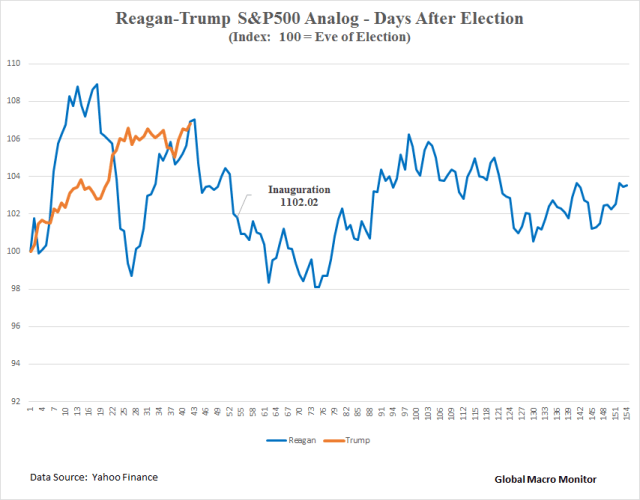
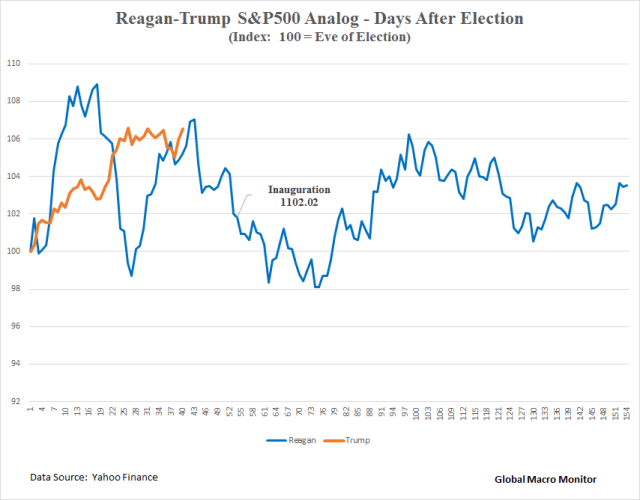
Note, President Carter squeaked out a positive return, 0.24 percent,  probably due to the 3.6 percent Reagan rally from the eve of election day to his inaugural.  Interestingly,  the Dow rallied 6.72 percent from the eve of the election on November 3, 1980 to November 20th before hitting key resistance at Dow 1,000,  then rolled over.   Also note,  traders sold the news and the Dow fell 18.28% from the Reagan inaugural to August 12, 1982 as the economy was in the throes of a deep recession.

Will the same happen with the Trump rally?  The Dow is up 8.67 percent since the eve of his election.  Trump inherits a much stronger economy than President Reagan, however, but the Reagan bull market had the tailwinds that it was the beginning of a 35-year bond bull market, which began in September 1981, where the 10-year Treasury note peaked around 16 percent,  and drove almost every asset class from real estate to stocks.

The incoming Trump administration faces the prospect of the end of the bond bull market and rising interest rates, however.   Stay tuned on this one.

 Interpreting the Data
We could massage and nuance the interpretation of this data until the cows come home.

Yeah, the data is skewed by Hoover, but the same can be said by Coolidge’s 262 percent return, no?   Yes,  Obama almost bottom ticked the Dow and W. inherited a major bear market from Bill Clinton.  Or, whatever.

What is really impressive is the over 40,000 percent increase  in the index since TR took office in September 1901.  That is a long-term affirmation and confidence in our country and confirms our view to “never short America”  over the long-term.

Was Truman Right?
So,  after looking at the data, maybe President Harry S Truman was right when he stated:

Harry Truman Quote.png

There you have it, folks.  Let the debate begin.


Posted in Equities, Politics, Uncategorized | Tagged , , , | 7 Comments

China Pushing Back, Gold Spikes $10

As we said a few days ago in our post,  Is Gold Finished,

to get a new bull market jump started…a bull market sparked by geopolitical risks, which could increase markedly, in a scenario where, say,  the new President-elect tries to bully the Chinese on various issues, and Mr. Xi, probably China’s strongest leader since Mao,  has to save face.  One morning we could wake up and U.S. battleships are squared off with the Chinese navy in the South China Sea.   Gold soars!  God help us.

We get the news this morning,

China has seized an unmanned underwater vehicle deployed by a U.S. Navy ship in international waters, according to Pentagon officials.

The seizure of the underwater vehicle took place Thursday, about 50 nautical miles northwest of Subic Bay in the Philippines, Pentagon Press Secretary Peter Cook said in a statement Friday.  – NPR

And this from the Guardian,

China’s Liaoning aircraft carrier battle group has conducted its first exercises with live ammunition, the country’s navy said, in a show of strength as tensions with the US and Taiwan escalate.

China’s first and only aircraft carrier led large-scale exercises in the Bohai Sea, the navy of the People’s Liberation Army announced late on Thursday.

Definitely China pushing back on President-elect Trump’s Taiwan strategy and tough rhetoric.

And we get this when the tape bomb hits the wires,

gold_dec16

Probably won’t stick,  but, for sure, gold going to build in a geopolitical risk premium as tensions with China heat up.

Don’t think putting Taiwan on the table as a negotiating ploy is a good strategy, in our opinion.   Some things are off limits and Mr. Xi is sending that signal on Taiwan.  Tantamount to asking your opponent to put his/her mother on the table as a negotiating chit.  Some things are just not negotiable.

Stay tuned.


Posted in Uncategorized | Tagged , | 2 Comments

Watch Those Gold Miners (GDX)

The gold miners index (GDX) gapped down another 4 1/2 percent today even after yesterday’s 5 percent down day.  Gold, the Feb futures contract, closed down about another $15 lower from the 5 pm electronic futures market close in New York last night.

The GDX also broke the key Fibonacci .618 retracement level  — from the swing January low to the swing August high — at $19.67 and is now barely hanging on to the March support at just under $19.   If it doesn’t hold here, the next stop looks to be the year and all-time low at $12.47.   Not going to get there tomorrow,  but we think – are guessing –  we close the year at around $16, down another 15 percent from today’s close.

This  would still give the GDX a respectable 17.7 percent return on the year.    The index is currently up 40 percent year-to-date even as gold, the commodity, now just up 6.4 percent year-to-date,  is going down faster than a case of a beer at a college frat party.

Note, the GDX  RSI is starting to signal oversold at 30.6.   Maybe that is why we saw big buyers step in right at the close to send the price back up to $19 level.

Stay tuned.

gdx_dec15


Posted in Gold, Uncategorized | Tagged , , | Leave a comment

Mr. “King Dollar” Takes The CEA

Congrats to Larry Kudlow,  a good guy (though a supply side ideologue),  as reports pour in that President-elect Trump will appoint him to head up the Council of Economic Advisors (CEA).

He has always advocated a strong dollar, or “King Dollar” as he likes to say,  and is kind of a “rules based”  hard money guy with respect to his views on monetary policy.   This makes us even more convicted that Stanford professor,  John Taylor, the author of the Taylor Rule, will be the next Federal Reserve Chairman.

More headwinds for gold, by the way.

Pres.-elect Trump plans to appoint CNBC contributor Larry Kudlow the chairman of his White House Council of Economic Advisers, according to the Detroit News. Conservative economist Stephen Moore disclosed Kudlow’s appointment during a speech to the Lansing Regional Chamber of Commerce today.

The CEA, established by Congress in 1946, “is charged with offering the President objective economic advice on the formulation of both domestic and international economic policy.” It is comprised of three people: a chairman and two members. – CNBC

kudlow

Kind of surprising Kudlow doesn’t have a Ph.D. in economics.  In fact,  Wikipedia reports:

Kudlow graduated from University of Rochester in Rochester, New York with a degree in history in 1969.[4] Known as “Kuddles” to friends, he was a star on the tennis team and a member of the left-wing Students for a Democratic Society at Rochester.

In 1971, Kudlow attended Princeton University‘s Woodrow Wilson School of Public and International Affairs, where he studied politics and economics. He left before completing his master’s degree.[5]


Posted in Economics, Economist, Fiscal Policy, Monetary Policy, Policy, Uncategorized | Tagged , , | Leave a comment

Is Gold Finished?

Big drop in gold today after the FOMC announcement.   Let’s go to the charts.

The yellow metal is approaching a 5-year low at around $1,050 (actually $1,046.25), which it hit right around this time last year.   Tough to see a big bounce back from here with the Fed in tightening mode, a massive stimulus and tax cut expected  and the growing expected growth differentials between the U.S. and the rest of the world, and, more importantly, a U.S. dollar in beast mode.

We have no idea, as does anyone else, where gold is headed.  Gold could start a new secular bull market tomorrow for all we know.  But, given the preponderance of evidence –  trend, momentum, and the lack of fundamental drivers – our bet is gold is heading south and at least tests, or takes out,  the lows of $1,050 made last December.  Who knows, maybe gold becomes a triple digit midget (whoops, not PC)  — a $900 handle — by the time The Donald takes the Oath of Office on January 20th.

Why Isn’t Gold Higher?
After years of massive money printing by the central banks, zero and negative interest nominal interest rates,  and negative real interest rates for much of this new century,  gold should be at $5,000.    But it’s not.  Now the monetary spigots are being turned off.

It seems gold needs some runaway inflation to get a new bull market jump started,  which may be coming,  but not just now.  Or a bull market sparked by geopolitical risks, which could increase markedly, in a scenario where, say,  the new President-elect tries to bully the Chinese on various issues, and Mr. Xi, probably China’s strongest leader since Mao,  has to save face.  One morning we could wake up and U.S. battleships are squared off with the Chinese navy in the South China Sea.   Gold soars!  God help us.

Possible?  Yes.   Probable?  No.  Not in the next few months before gold’s probable trip south to the Antarctic, however.

Gold Miners GDX
Also look at the gold miners index,  GDX.   After hitting an all-time low on January 19th of this year at $12.47,  it rallied 151 percent into August 2nd, to $31.32.   It closed at $19.89 today,  36.5 percent off  its August high.

It slightly broke support today and looks like the next stop is at $19.00.  Still,  GDX is way off its low in January and remains up 45 percent year-t0-date.   We really don’t like the GDX here.   A break from here back to the lows is a long cold trip to the South Pole.

Dollar Breaking To New Highs
All this, as the Dixie  (dollar index) breaks to new 13-year highs and, furthermore,  we think that party is just getting started and headed to the twenty year high of 120.

Also, note in the last chart down the page the huge rally in the dollar after the Reagan regime change, which many are making similar comparisons to the incoming Trump Administration.   Trump is following the same policy prescription as Reagan — large tax cuts, big increases in military spending, and even one step further,  a large infrastructure spend.  All this with very little talk of spending cuts.

Given the Reagan policies, the trade weighted dollar index in major currencies rallied over 50 percent from President Reagan’s inauguration until it peaked in early 1985.    It took the Plaza Accord – the agreement between Japan, U.K.,  West Germany, France ,  and the U.S. to weaken the dollar –to take the final steam out of the U.S. currency.

One major difference, however,  between Reagan and Trump is monetary policy.   The Fed  began to ease or, stop tightening, and interest rates were peaking early in the Reagan administration as Paul Volcker finally broke the back of inflationary expectations.   The polar opposite is the case with monetary policy with the incoming Trump Administration.   The Fed is just starting to take away the punch bowl and, who knows, they may even be way behind the curve in raising rates.   Another boost for the dollar and major headwind for gold.

We could be super wrong in our analysis, folks,  so don’ bet the ranch or trade on it.

Stay tuned!.  It is going to get very interesting.

gold_dec14_dailygold_dec14_weeklygold_dec14_gdxdollar_dec14_dailydollar_dec14_weeklydollar_monthlydollar_reagan

Posted in Gold, Uncategorized | Tagged , , , , | 4 Comments

Real Clear Markets Picks Up Our Free Trade Piece

Go to Off The Street section and click on A Story About Free Trade Globalization- Global Macro Monitor

Posted in Uncategorized | Leave a comment

Video of the Day: Cristo Redentor

Yikes!   Just driving up and down the road to get to the Cristo Redentor is scary enough!

These daring men are walking on one of the New Seven Wonders of the World. They’re risking their lives to do repairs due to a lightening strike that hit the limb, of the Christ The Redeemer statue, in Rio de Janeiro. We were amazed at the heights these dedicated men are working at. The concrete and soapstone statue is 30 meters high, the pedestal is another 8 meters, and the statue is located on the 700 meter peak of Corcovado mountain.                  – Faithreel

Posted in Uncategorized | Leave a comment

The Election of Donald Trump, the Electoral College, Free Trade and Globalization

We have a little interesting story to tell you, but first some substance and background.

The 2016 U.S. Presidential Election
Donald Trump won the Presidency and Electoral College, 306-232, by picking off three of the traditional Blue States – Michigan, Pennsylvania, and Wisconsin with 46 electoral votes — which Hillary was supposed to have won and the Republicans have not taken since the 1980’s.   Trump won these three states by a total of 77,744 votes, or by 0.56% of the sum total of all votes cast in the three states.

Furthermore,  Trump’s winning margin of  77K votes in the three states equated to only 0.057 percent of all votes casts during the election.   We are not trying to downplay President-elect Trump’s incredible surprise come from behind victory, but just trying to provide some perspective that his election was not exactly a landslide nor the impetus for a clear mandate.  And is effectively, as Milton Friedman would say,  “the tyranny of the minority.”  The small group and sufficient amount of voters hurt by free trade and globalization, which had incredible energy and motivation,  came out in these three Blue states and on the margin won the election for Donald Trump.

If HRC had won these three states as expected, the electoral vote tally would have swung in her favor 280-260 and we would be talking, instead,  about a President-elect Clinton.   But that, and $.62 can get you a cup of senior coffee at McDonald’s!

breaking-the-blue-wall

Remember,  “there is no road to 270 for Donald Trump?”  The so called experts and pundits also live in the same elitist bubble as the establishment does and Trump’s genius was to exploit this to his advantage.

Just 6 percent of people say they have a lot of confidence in the media, putting the news industry about equal to Congress and well below the public’s view of other institutions. In this presidential campaign year, Democrats were more likely to trust the news media than Republicans or independents. US News and World Report  April 18, 2016

Popular Vote
Hillary overwhelmingly won the popular vote, by a margin of 2.1 percent, or almost 3 million votes.  Only five Presidents have won the Office while losing the popular vote: John Quincy Adams in 1824, Rutherford Hayes in 1876, Benjamin Harrison in 1888, George W. Bush in 2000 and Donald Trump this November.

Hey, but the number of hits doesn’t matter in baseball, it’s how many runs you score, no?

An interesting aside, we were in a brew pub last night and met up with a couple female Canadian  millennials and staunch Bernie Sander supporters.  I asked what they thought of our election to which they answered to some effect, “you [majority of Americans] did the right thing and voted against Trump.”   In other words, they took comfort that HRC won the popular vote.  Interesting and consoling, but no cigar for our friends north of the border.

Why Was The Blue Wall Broken?
So why did Hillary lose Michigan, Pennsylvania, and Wisconsin?   Not enough of the white women vote?  Millennials didn’t show?  Not a high enough  African-American turnout?   Slice and dice all you want, but we think it was  Trump’s negative messaging on trade and globalization.

Note, a very good economist friend of ours makes the distinction between free trade and globalization.   Trade, he says, is where nations trade in goods and services.   Globalization is where the factory that makes the goods and services moves offshore to cheaper labor centers.   Keep that in mind when you contemplate the subject.

Academic Literature on Free Trade
The trade theory academic literature, where nations trade based on factor endowments –labor and capital — when we were in graduate school always assumed capital and labor immobility.   And, apparently, there has been very little addition, growth or adaption to the literature to take the rapid increase in immigration and capital mobility  into account.   Capital and labor immobility is not the world we have lived over the past 20 years.   The failure of the academics to update the trade literature has left a policy void and has contributed to the hollowing out of the middle class through globalization and, hence, the election of Donald Trump.

Trade Adjustment Assistance
Check out the federal governments lists of states who received Trade Adjustment Assistance in 2014.  But, first, let us define Trade Adjustment Assistance.

The Trade Adjustment Assistance (TAA) program is a federal program that offers a variety of benefits and services to workers  whose employment has been adversely impacted by foreign trade. Through training, employment and case management services, job search allowances, relocation allowances, and income support in the form of Trade Readjustment Allowances (TRA), the TAA  program provides trade-affected workers with opportunities to obtain the skills, credentials, resources, and support they need to return to the workforce in a good job. In addition, Reemployment

TAA and Alternative TAA provide wage supplements for eemployed older workers whose wages are lower than those earned in their trade-affected employment.

Since the inception of the TAA program in 1974, nearly 4.9 million workers have been certified as trade affected and eligible to apply for TAA benefits and services. As of December 31, 2014, the TAA program has served 2,210,934 workers. .  – Trade Adjustment Assistance for Workers,  Fiscal Year 2014

taa_1taa_2Note the relatively high levels of assistance going to the three states that swung the election, Michigan, Pennsylvania, and Wisconsin – almost 20 percent of the total budget going to 3 of the 50 states — even when adjusted for population.  Note also only $604 million spent on TAA, not enough and needs to be beefed up significantly.

Winners and Losers From Trade and Globalization
We are free traders and believe the majority of the country benefits from trade and, dare we say, globalization.   I used to pay $4,000 in the 1990’s for a Dell computer, for example, and now can buy one for less than $500 as Dell has moved their assembly plants and servicing centers offshore (prices also have been brought down by technological increases).  Thus, my real income (purchasing power) has risen through trade and globalization and I have more money to buy other goods and services or leave a bigger tip for, say,  the waiter at Denny’s.  My higher real income increases my consumption and creates even more demand and thus jobs.

But, there are losers in this transaction.  The small few who have lost their jobs at the Dell plant who assembled and serviced the computers.    We, and the rest of the elites, have enjoyed the gains from trade and have,  essentially, though not entirely,  ignored the losers from trade and globalization.   That has got to stop.

Rather, than shutting down trade, raising tariffs, where everyone would suffer through higher prices and lower real incomes, we need to beef up the Trade Adjustment Assistance mechanism, with say, maybe, something similar to a basic universal income package.

Also,  note it is not easy to retrain a steelworker and turn him/her into a big data analyst, an artificial intelligence expert  or python programmer.   Raising tariffs and, say, doubling the prices at Costco and WalMart would only hurt more those en masse than the relatively few we are trying to help.

So let’s figure out the right policy and get on with it!

Personal Story
Now a relevant little story.

After finishing up my Ph.D. comprehensive exams in economics and in between the dissertation, I interviewed at the White House,  Council of Economic Advisors (CEA), as a junior economist.  They had a program where the CEA would hire graduate students for one year who were in between their comp exams and the dissertation.

Ronald Reagan was President at the time and the day long interview took place in April 1986, just a few days after the U.S. bombed Muammar Gaddafi.  That day, security on the White House grounds and in the Old Executive Office Building, where the Council is located, was intense.  Secret Service, dressed in their black garb and flack jackets, everywhere.

Beryl Sprinkel was Chairman of the CEA and Michael Mussa was the real intellectual heavy weight of the CEA.  The entire council was made up of  “Chicago Boys,” not Chileans, but academics from the University of Chicago.  Very free market thinking in everything.

Note, this was during a period in the economy when the trade sector was getting hammered by the strong dollar.  The trade weighted U.S. dollar index had increased almost 30 percent since Reagan took office and was causing real hardship in the tradable goods sector.

dollar_reaganSo, the first question I was asked at the beginning of the interview was, “there is a bill in Congress to write the steelworkers, who have been displaced and lost their jobs through trade,  a check for $100,000 [$221,000 in 2016 dollars].   What do you think of this bill?

I answered, “no, I think retraining and other polices may be more optimal”.    They replied, “that’s what the Democrats think.”   I didn’t get the job.

The Chicago boys think the individual can choose their future and retraining better than the government.

That $100,000 was real money and compensation back then, much more than what the government offers to the losers of free trade and globalization today.  And, let’s get real,  at the end of the day, it was an “effective bribe” to the steelworkers to allow the country to keep pursuing free trade policies.

The day long interview ended in Beryl Sprinkel’s office where he asked me, “[Gregor], can you make good charts?  The President likes his charts.”   Indeed, President Reagan did.

reagan-charts

When I was leaving the Old Executive Office Building (OEOB) after the interview, I thought of taking a little tour of the White House grounds.  I walked out of the east end of OEOB onto the White House grounds, probably no less than 100 feet from the Oval Office.  I was met by a Secret Service officer in a black flack jacket carrying a high powered rifle, who asked what I was doing there.  He booted me faster than a fighter jet.    But, oh, so close to power!

So,  concluding, I ask folks — whatever happened to that kind of thinking among the policymakers?   That is,  really compensating and taking care of the losers from free trade and globalization as we, the elites, enjoy the benefits of free trade and globalization in lower prices of goods and higher profit margins and stock prices?   Tariffs and shrinking free trade and globalization are going to hurt all of us, including margins and stock prices.

Do you really wanna pay 30-50 percent higher prices at Costco and WalMart?  That will cause a recession and stagnation faster than you can say snap!   How about a surcharge on foreign goods at the cash register to help compensate and beef up the Trade Adjustment Assistance program and help those who have been harmed?

And let’s go a little further. How about a surcharge on global oil prices to compensate the American service men and women who spill their blood protecting the oil fields and shipping lanes in the middle east?   We, in fact,  import very little oil from the Mideast and are over  there mainly to protect the oil supplies and keep the shipping lanes open for our allies thirst for middle east oil.

President-elect Trump is right in that respect:  if the U.S. is going to be the global sheriff,  let’s at least get paid for it.

Stay tuned, comrades.

Posted in Economics, Energy, Politics | Tagged , , , , , | 2 Comments