We have a little interesting story to tell you, but first some substance and background.
The 2016 U.S. Presidential Election
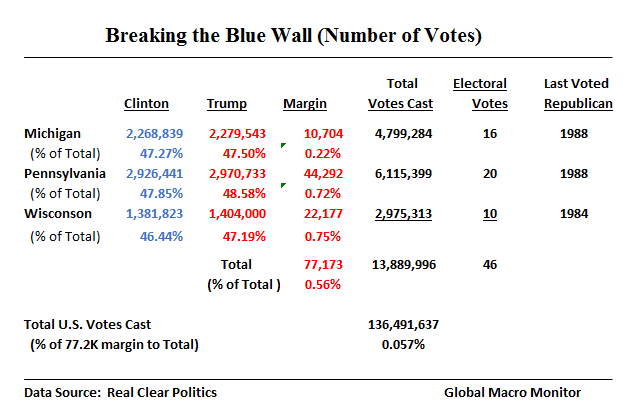
Donald Trump won the Presidency and Electoral College, 306-232, by picking off three of the traditional Blue States – Michigan, Pennsylvania, and Wisconsin with 46 electoral votes — which Hillary was supposed to have won and the Republicans have not taken since the 1980’s. Trump won these three states by a total of 77,744 votes, or by 0.56% of the sum total of all votes cast in the three states.
Furthermore, Trump’s winning margin of 77K votes in the three states equated to only 0.057 percent of all votes casts during the election. We are not trying to downplay President-elect Trump’s incredible surprise come from behind victory, but just trying to provide some perspective that his election was not exactly a landslide nor the impetus for a clear mandate. And is effectively, as Milton Friedman would say, “the tyranny of the minority.” The small group and sufficient amount of voters hurt by free trade and globalization, which had incredible energy and motivation, came out in these three Blue states and on the margin won the election for Donald Trump.
If HRC had won these three states as expected, the electoral vote tally would have swung in her favor 280-260 and we would be talking, instead, about a President-elect Clinton. But that, and $.62 can get you a cup of senior coffee at McDonald’s!
Remember, “there is no road to 270 for Donald Trump?” The so called experts and pundits also live in the same elitist bubble as the establishment does and Trump’s genius was to exploit this to his advantage.
Just 6 percent of people say they have a lot of confidence in the media, putting the news industry about equal to Congress and well below the public’s view of other institutions. In this presidential campaign year, Democrats were more likely to trust the news media than Republicans or independents. – US News and World Report April 18, 2016
Popular Vote
Hillary overwhelmingly won the popular vote, by a margin of 2.1 percent, or almost 3 million votes. Only five Presidents have won the Office while losing the popular vote: John Quincy Adams in 1824, Rutherford Hayes in 1876, Benjamin Harrison in 1888, George W. Bush in 2000 and Donald Trump this November.
Hey, but the number of hits doesn’t matter in baseball, it’s how many runs you score, no?
An interesting aside, we were in a brew pub last night and met up with a couple female Canadian millennials and staunch Bernie Sander supporters. I asked what they thought of our election to which they answered to some effect, “you [majority of Americans] did the right thing and voted against Trump.” In other words, they took comfort that HRC won the popular vote. Interesting and consoling, but no cigar for our friends north of the border.
Why Was The Blue Wall Broken?
So why did Hillary lose Michigan, Pennsylvania, and Wisconsin? Not enough of the white women vote? Millennials didn’t show? Not a high enough African-American turnout? Slice and dice all you want, but we think it was Trump’s negative messaging on trade and globalization.
Note, a very good economist friend of ours makes the distinction between free trade and globalization. Trade, he says, is where nations trade in goods and services. Globalization is where the factory that makes the goods and services moves offshore to cheaper labor centers. Keep that in mind when you contemplate the subject.
Academic Literature on Free Trade
The trade theory academic literature, where nations trade based on factor endowments –labor and capital — when we were in graduate school always assumed capital and labor immobility. And, apparently, there has been very little addition, growth or adaption to the literature to take the rapid increase in immigration and capital mobility into account. Capital and labor immobility is not the world we have lived over the past 20 years. The failure of the academics to update the trade literature has left a policy void and has contributed to the hollowing out of the middle class through globalization and, hence, the election of Donald Trump.
Trade Adjustment Assistance
Check out the federal governments lists of states who received Trade Adjustment Assistance in 2014. But, first, let us define Trade Adjustment Assistance.
The Trade Adjustment Assistance (TAA) program is a federal program that offers a variety of benefits and services to workers whose employment has been adversely impacted by foreign trade. Through training, employment and case management services, job search allowances, relocation allowances, and income support in the form of Trade Readjustment Allowances (TRA), the TAA program provides trade-affected workers with opportunities to obtain the skills, credentials, resources, and support they need to return to the workforce in a good job. In addition, Reemployment
TAA and Alternative TAA provide wage supplements for eemployed older workers whose wages are lower than those earned in their trade-affected employment.
Since the inception of the TAA program in 1974, nearly 4.9 million workers have been certified as trade affected and eligible to apply for TAA benefits and services. As of December 31, 2014, the TAA program has served 2,210,934 workers. . – Trade Adjustment Assistance for Workers, Fiscal Year 2014
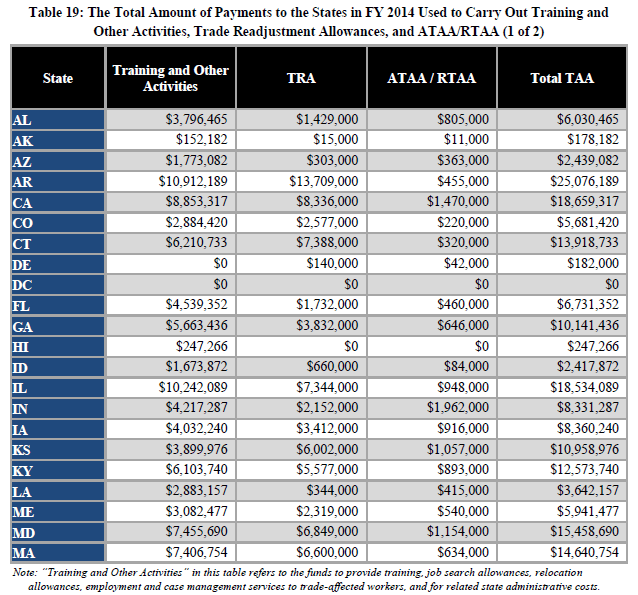
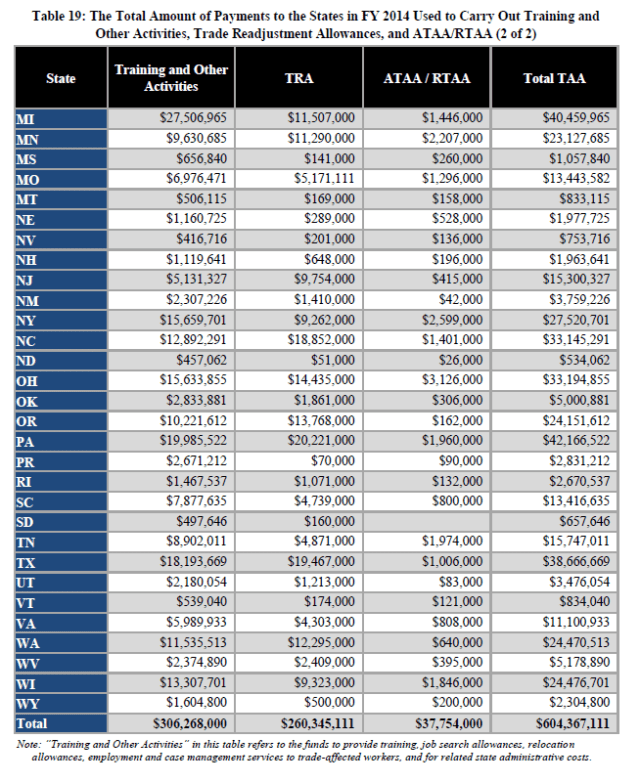 Note the relatively high levels of assistance going to the three states that swung the election, Michigan, Pennsylvania, and Wisconsin – almost 20 percent of the total budget going to 3 of the 50 states — even when adjusted for population. Note also only $604 million spent on TAA, not enough and needs to be beefed up significantly.
Winners and Losers From Trade and Globalization
We are free traders and believe the majority of the country benefits from trade and, dare we say, globalization. I used to pay $4,000 in the 1990’s for a Dell computer, for example, and now can buy one for less than $500 as Dell has moved their assembly plants and servicing centers offshore (prices also have been brought down by technological increases). Thus, my real income (purchasing power) has risen through trade and globalization and I have more money to buy other goods and services or leave a bigger tip for, say, the waiter at Denny’s. My higher real income increases my consumption and creates even more demand and thus jobs.
But, there are losers in this transaction. The small few who have lost their jobs at the Dell plant who assembled and serviced the computers. We, and the rest of the elites, have enjoyed the gains from trade and have, essentially, though not entirely, ignored the losers from trade and globalization. That has got to stop.
Rather, than shutting down trade, raising tariffs, where everyone would suffer through higher prices and lower real incomes, we need to beef up the Trade Adjustment Assistance mechanism, with say, maybe, something similar to a basic universal income package.
Also, note it is not easy to retrain a steelworker and turn him/her into a big data analyst, an artificial intelligence expert or python programmer. Raising tariffs and, say, doubling the prices at Costco and WalMart would only hurt more those en masse than the relatively few we are trying to help.
So let’s figure out the right policy and get on with it!
Personal Story
Now a relevant little story.
After finishing up my Ph.D. comprehensive exams in economics and in between the dissertation, I interviewed at the White House, Council of Economic Advisors (CEA), as a junior economist. They had a program where the CEA would hire graduate students for one year who were in between their comp exams and the dissertation.
Ronald Reagan was President at the time and the day long interview took place in April 1986, just a few days after the U.S. bombed Muammar Gaddafi. That day, security on the White House grounds and in the Old Executive Office Building, where the Council is located, was intense. Secret Service, dressed in their black garb and flack jackets, everywhere.
Beryl Sprinkel was Chairman of the CEA and Michael Mussa was the real intellectual heavy weight of the CEA. The entire council was made up of “Chicago Boys,” not Chileans, but academics from the University of Chicago. Very free market thinking in everything.
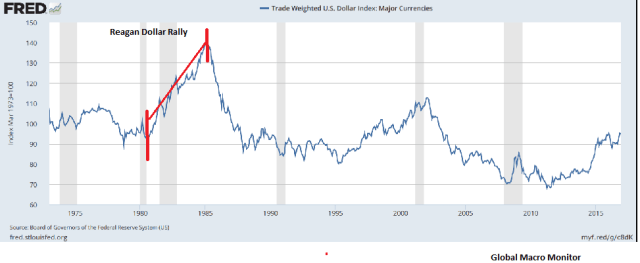
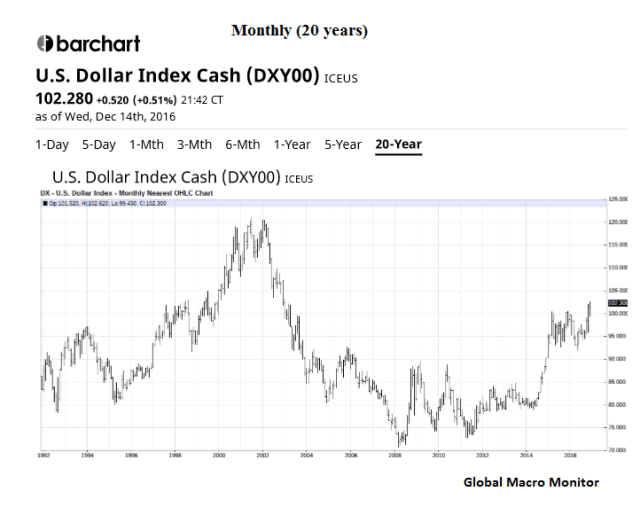
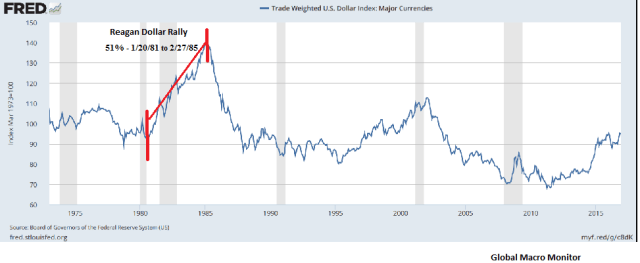
Note, this was during a period in the economy when the trade sector was getting hammered by the strong dollar. The trade weighted U.S. dollar index had increased almost 30 percent since Reagan took office and was causing real hardship in the tradable goods sector.
 So, the first question I was asked at the beginning of the interview was, “there is a bill in Congress to write the steelworkers, who have been displaced and lost their jobs through trade, a check for $100,000 [$221,000 in 2016 dollars]. What do you think of this bill?
I answered, “no, I think retraining and other polices may be more optimal”. They replied, “that’s what the Democrats think.” I didn’t get the job.
The Chicago boys think the individual can choose their future and retraining better than the government.
That $100,000 was real money and compensation back then, much more than what the government offers to the losers of free trade and globalization today. And, let’s get real, at the end of the day, it was an “effective bribe” to the steelworkers to allow the country to keep pursuing free trade policies.
The day long interview ended in Beryl Sprinkel’s office where he asked me, “[Gregor], can you make good charts? The President likes his charts.” Indeed, President Reagan did.
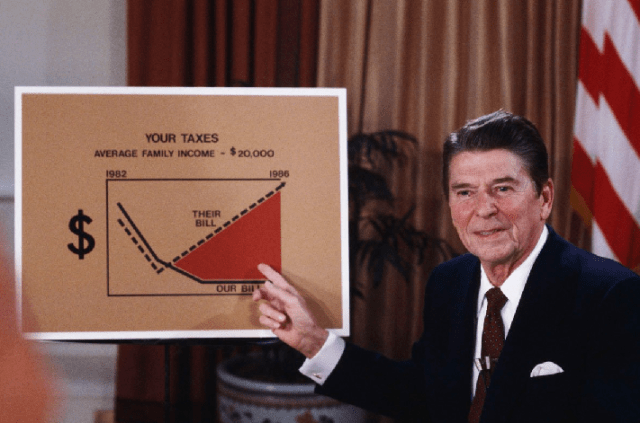
When I was leaving the Old Executive Office Building (OEOB) after the interview, I thought of taking a little tour of the White House grounds. I walked out of the east end of OEOB onto the White House grounds, probably no less than 100 feet from the Oval Office. I was met by a Secret Service officer in a black flack jacket carrying a high powered rifle, who asked what I was doing there. He booted me faster than a fighter jet. But, oh, so close to power!
So, concluding, I ask folks — whatever happened to that kind of thinking among the policymakers? That is, really compensating and taking care of the losers from free trade and globalization as we, the elites, enjoy the benefits of free trade and globalization in lower prices of goods and higher profit margins and stock prices? Tariffs and shrinking free trade and globalization are going to hurt all of us, including margins and stock prices.
Do you really wanna pay 30-50 percent higher prices at Costco and WalMart? That will cause a recession and stagnation faster than you can say snap! How about a surcharge on foreign goods at the cash register to help compensate and beef up the Trade Adjustment Assistance program and help those who have been harmed?
And let’s go a little further. How about a surcharge on global oil prices to compensate the American service men and women who spill their blood protecting the oil fields and shipping lanes in the middle east? We, in fact, import very little oil from the Mideast and are over there mainly to protect the oil supplies and keep the shipping lanes open for our allies thirst for middle east oil.
President-elect Trump is right in that respect: if the U.S. is going to be the global sheriff, let’s at least get paid for it.
Stay tuned, comrades.









 Global Macro Monitor