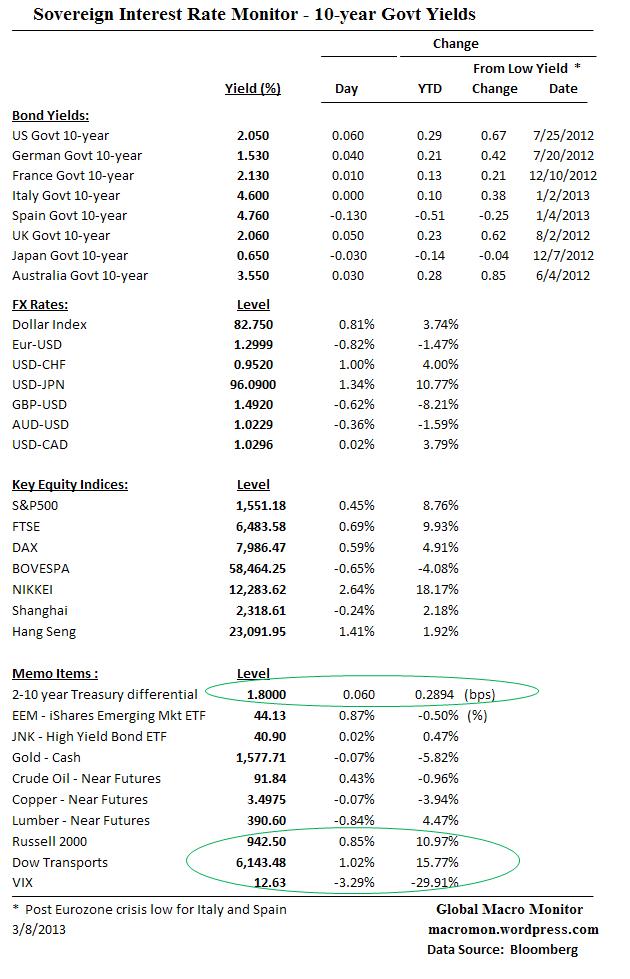
Daily Interest Rate Monitor – March 11

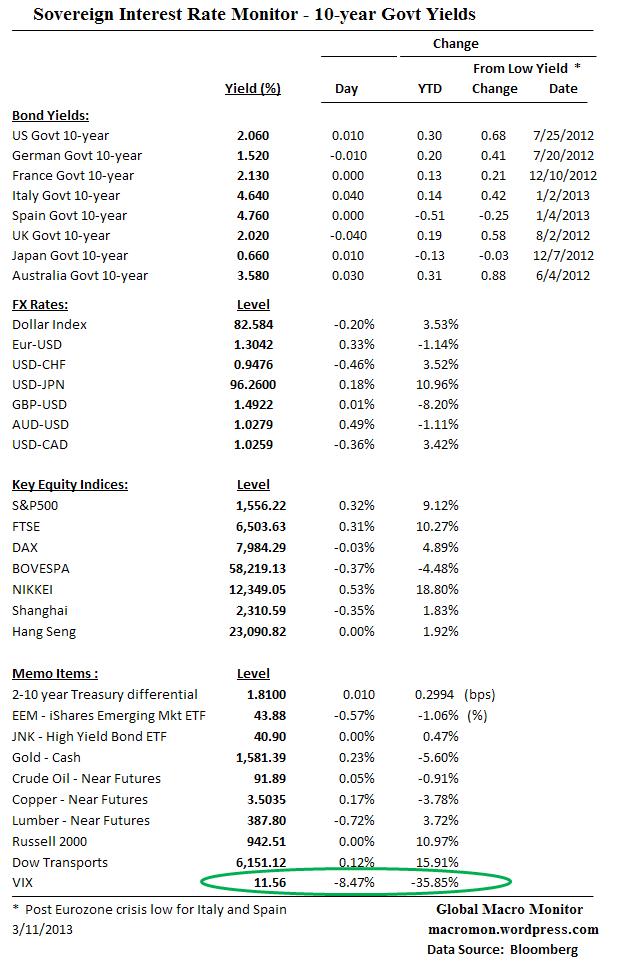
Interest Rate Monitor(click here if table is not observable)
Posted in Interest Rates | Tagged , , , | Leave a comment

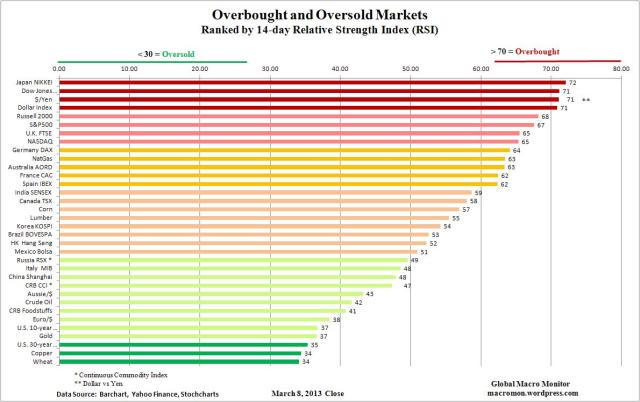
Overbought and Oversold Markets – March 8

The Relative Strength Index (RSI) is a momentum oscillator that measures the speed and change of price moves. The RSI moves between zero and 100 and is considered overbought with a reading above 70 and oversold when below 30.  Note the RSI can sustain an overbought (oversold) reading in a strong up (down) trend.

Click chart to enlarge.

WIR_Overbought

(click here if chart is not observable)

Posted in Overbought Markets | Tagged , , , , , | 4 Comments

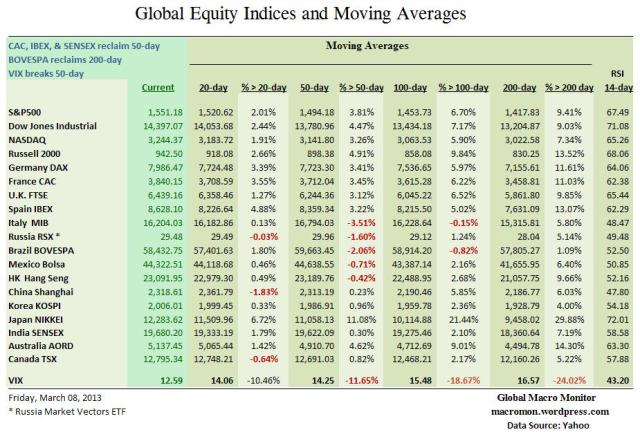
Global Trend Indicators

WIR_Global TrendWIR_Equity_MA(click here if tables are not observable)

Posted in Global Trend Indicators | Tagged , , , , , | 2 Comments

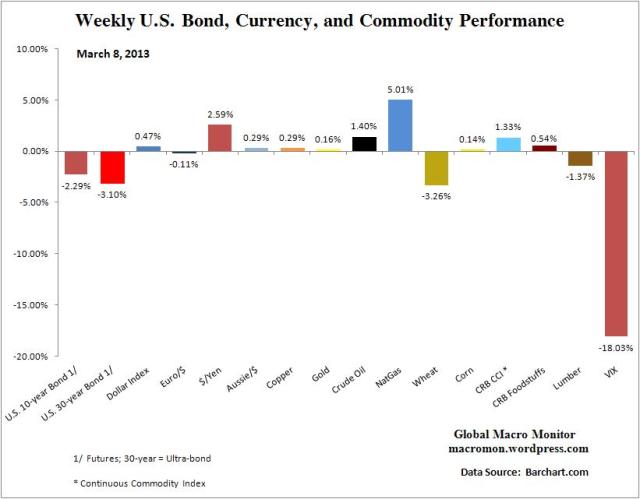
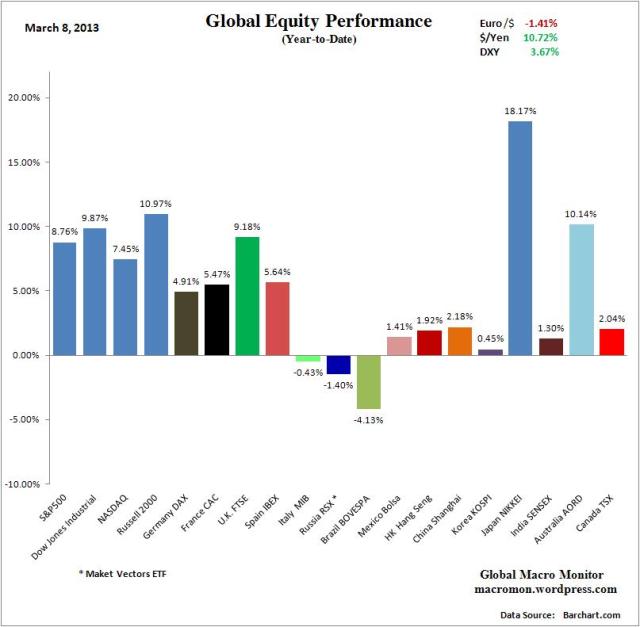
Week in Review

WIR_Key LevelsWIR_Equity_WeekWIR_Bond_WeekWIR_Equity_YTDWIR_Bond_YTD(click here if charts are not observable)

Posted in Week in Review | Tagged , , , , , , , , | 1 Comment

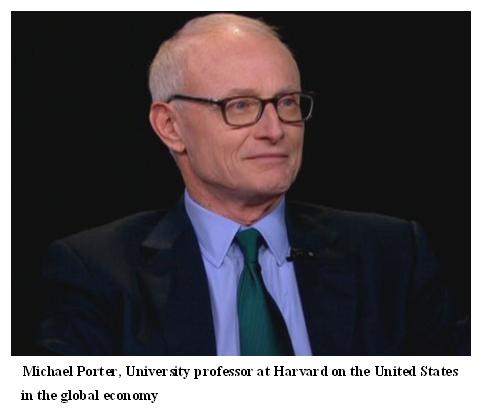
Weekend Lecture: Michael Porter w/ Charlie Rose

Charlie RoseExcellent interview with Harvard B. School’s Michael Porter.  They hit a wide range of policy issues, including health care, immigration, trade, corporate tax policy, energy development, and the fiscal deficit.   Porter attempts to answer the central question:

Can we [U.S.] restore the vitality of our economy?

Good stuff.   Click here for interview.

Michael Eugene Porter is an American academic focused on management and economics. He is currently the Bishop William Lawrence University Professor based at Harvard Business School where he leads the Institute for Strategy and Competitiveness. In 1984, he was one of the co-founders of Monitor Group, a global strategy and management consulting firm with headquarters in Cambridge, Massachusetts. In 1994, he founded the Initiative for a Competitive Inner City, a non-profit organization with a mission of fostering economic development in the impoverished inner city. He has been rated among the Thinkers 50, the most influential living management thinkers.

Mar8_Porter

(click here if photo is not observable)

Posted in Lectures, Video | Tagged , | Leave a comment

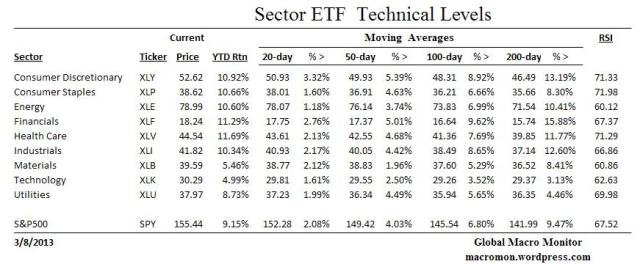
U.S. Equity Sector ETF Weekly Performance – March 8

Sector ETF_WeekSector ETF_YTDSector ETF_Technical(click here if charts are not observable)

Posted in Sector ETF Peformance | Tagged , , , , , , | 1 Comment

Daily Interest Rate Monitor – March 8

Interest Rate Monitor(click here if table is not observable)

Posted in Interest Rates | Tagged , , , , | Leave a comment

Weekly Eurozone Watch – Markets “Revert Back”

Key Data Points
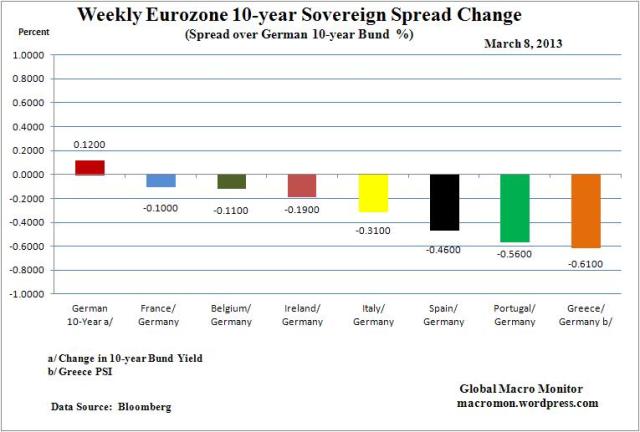
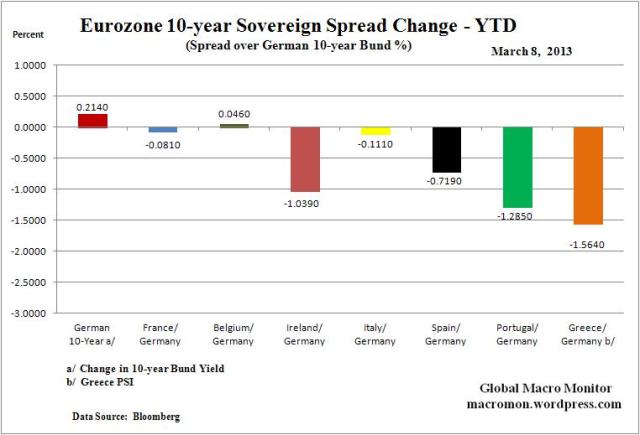
German 10-year Bund 12 bps higher;
France 10 bps tighter to the Bund;
Belgium 11 bps tighter;
Ireland 19 bps tighter;
Italy 31 bps tighter;
Spain 46 bps tighter;
Portugal 56 bps tighter;
Greece 61 bps tighter;
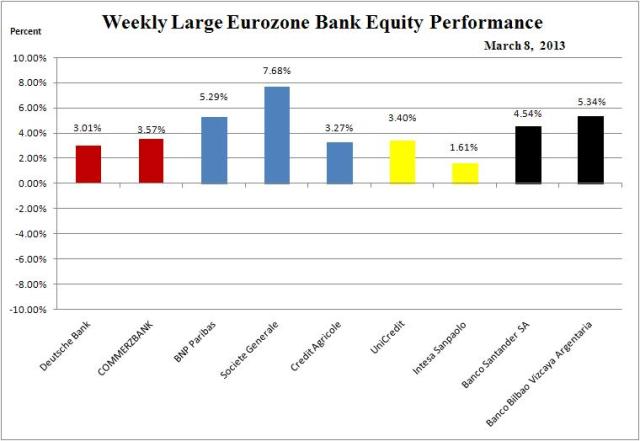
Large Eurozone banks weekly change,  3.0 to 7.7 percent;
Euro$ flat,   -0.02 percent.

Comments
– Periphery bond markets rebounded after the Italian election scare;
– Fitch cut Italy’s sovereign rating to BBB+ citing “the inconclusive results of the Italian parliamentary elections.
– The ECB decided to keep interest rates unchanged.

**************************************************************************

…markets – after some excitement immediately after the elections – have now reverted back more or less to how they were before. I think markets understand that we live in democracies… You also have to consider that much of the fiscal adjustment Italy went through will continue on automatic pilot. And also, if you consider this year, the net supply of government bonds is considerably less than last year – if I’m not mistaken it’s about €30 billion. So it’s very much a matter of rolling it over. All this is happening in a general environment where we have many signs that confidence is returning to the financial markets of the euro area.
Mario Draghi,  ECB President

**************************************************************************

Furious Friday sees strikes all over Europe

**************************************************************************

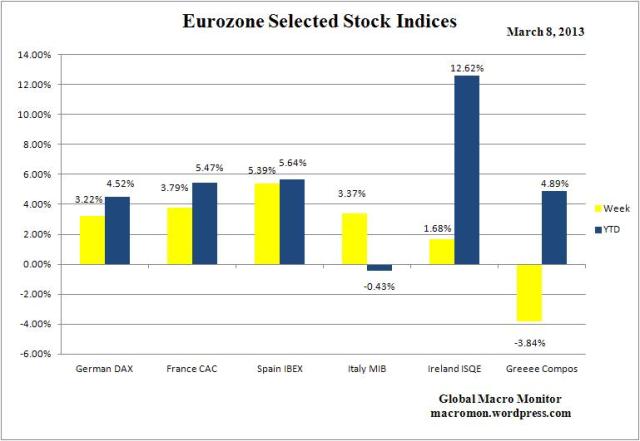
WEZ_Spread_WeekWEZ_Bank_WeekWEZ_Spread_YTDWEZ_Bank_YTDWEZ_YieldsWEZ_Stock_IndicesWEZ_Euro_FX(click here if charts are not observable)

Posted in Uncategorized, Weekly Eurozone Watch | Tagged , , , , , , , | 2 Comments

U.S. Employment Situation – February 2013

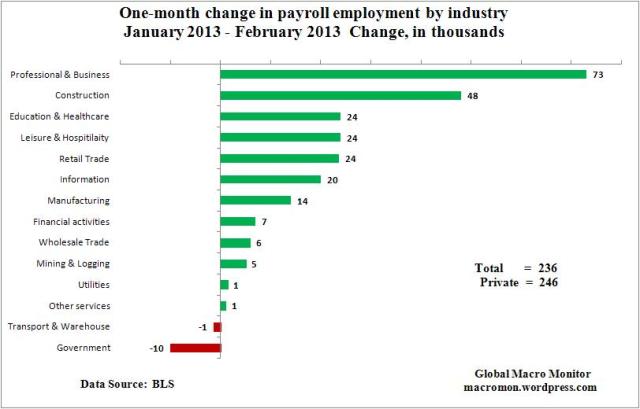
Strong employment data out of the BLS this morning.  Construction is breaking out, something we’ve been looking for, adding 48K jobs in January,  the largest monthly increase since March 2007.   Now that construction employment is leading it reinforces the notion, at least to us,  the Fed is no longer pushing on a string.   Monetary policy is really biting.

Here’s the BLS,

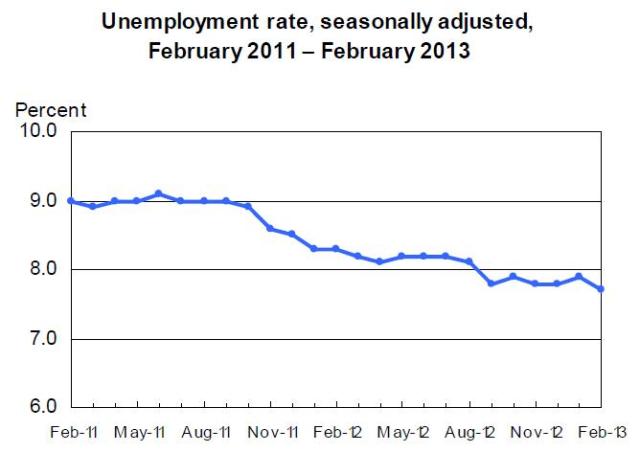
Total nonfarm payroll employment increased by 236,000 in February, and the unemployment rate edged down to 7.7 percent, the U.S. Bureau of Labor Statistics reported today. Employment increased in professional and business services, construction, and health care.

…In February, the average workweek for all employees on private nonfarm payrolls edged up by 0.1 hour to 34.5 hours. The manufacturing workweek rose by 0.2 hour to 40.9 hours, and factory overtime edged up by 0.1 hour to 3.4 hours. The average workweek for production and nonsupervisory employees on private nonfarm payrolls increased by 0.2 hour to 33.8 hours. (See tables B-2 and B-7.) Average hourly earnings for all employees on private nonfarm payrolls rose by 4 cents to $23.82. Over the year, average hourly earnings have risen by 2.1 percent. In February, average hourly earnings of private-sector production and nonsupervisory employees increased by 5 cents to $20.04. (See tables B-3 and B-8.) The change in total nonfarm payroll employment for December was revised from +196,000 to +219,000, and the change for January was revised from +157,000 to +119,000.

Mar8_NFPMar8_NFP_1Mar8_NFP_2

(click here if charts are not observable)

Posted in Employment | Tagged , , | Leave a comment

Stocks Better Than Alternatives – Economist

The Economist sums the melt up best:

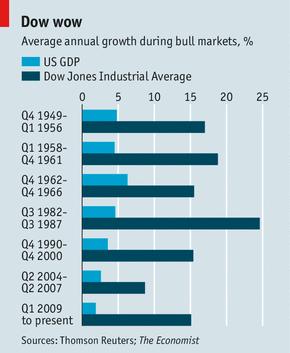
It is tempting to attribute the strength of the Dow to optimism about the American economy. Tempting, but wrong. Studies have shown almost no correlation between GDP growth and equity returns. Indeed, the Shanghai stockmarket trades at less than half its 2007 peak, even though the Chinese economy has performed much more strongly than that of America since then. As the chart shows, this rally in the Dow has been accompanied by the weakest GDP growth of all the bull markets since the second world war.

The main factors behind the current surge seem to be twofold. The first is a degree of confidence that some “tail risks” have been avoided, at least for now. The euro zone has not broken up and politicians in Washington, DC have not brought the entire economy to a halt over tax-and-spending policies. Hurdles remain (such as raising the debt ceiling) but investors assume a deal will be done.

The second factor is that equities look better than the alternatives. Cash yields are puny and central banks have made it clear that interest rates will not rise for a while. Ten-year government bonds in much of the rich world yield 2% or less. Although there is no sign of the much-heralded “great rotation” out of bonds and into equities (see Buttonwood), there are signs that investors are putting cash in both asset classes following a long period in which equity funds suffered withdrawals.

Mar7_Dow and GDP

Amen.

(click here if chart is not observable)

Posted in Economics, Equities | Tagged , , , | 1 Comment