
Times they are a-changin’.
House Speaker, John Boehner, just tweeted this (around 2:55 PM eastern):
Times they are a-changin’.
House Speaker, John Boehner, just tweeted this (around 2:55 PM eastern):
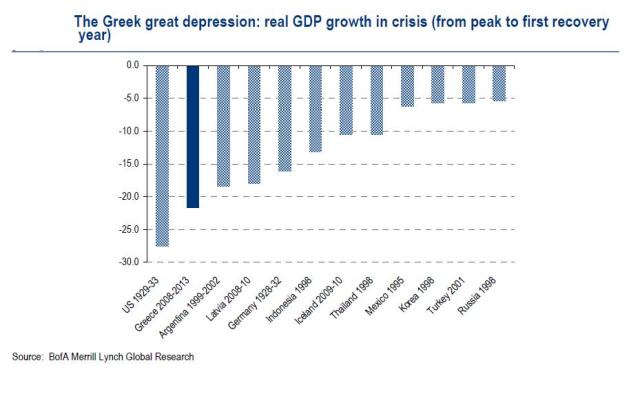
Bank of America Merrill Lynch provides an informative chart with perspective on how bad it is in Greece,
The Greek recession has been the most severe in the recent history of crisis and compares only to the U.S. Great Depression. Reasons include: the fear of the Euro exit; the credit crunch; aggressive and horizontal austerity; substantial reform delays; political risks; the pre-crisis structure of the economy; and the strong Euro.
Godspeed, Greece.
 (click here if chart is not observable)
How did we miss this? The interview with Foreign Affairs took place in September.
Good stuff. Ray Dalio is one smart dude.
Here is what jumped out at us,
The age of big returns is over. Of asset classes, in general. That’s true of bonds, that’s true of stocks, for structural reasons. And that has to do that when interest rates go down, it causes stocks and bonds to go up. And when interest rates come down to zero there is not much more room for those assets to benefit from declining interest rates…. That is all over for a relatively long time.
Tell us it ain’t so, Ray Dalio!
The Fed has shot its wad. Better get your stock picker and trader hats on.
(click here if video is not observable)
Nice ‘toon via Mashable!
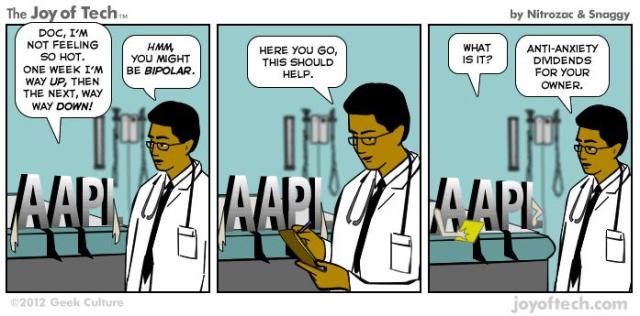
Is Apple ready to bounce after its horrid almost 30 percent two-month swan dive? Friday’s humungo reversal on humungo volume looks like a decent trading bounce is coming.
Even the bears seem to think so, including big uber Apple bear, Jeffrey Gundlach, who called into CNBC’s Options Action on Friday saying, though he is still longer term bearish, the stock can bounce $50 from here,
I do think the action this morning looks kind of like a classic short-term bottom, with the down and reversal to a modest upper close. It’s interesting that the low back in the middle of the year was around $525. It would have been very interesting to see apple close below $525. The fact that it didn’t, and basically had that big reversal earlier in the day, i think really, it’s headed higher in the near term…I think it’s going to rally up maybe $50 or something from where it is now.
We hope so.
 (click here if cartoon is not observable)

 (click here if tables are not observable)

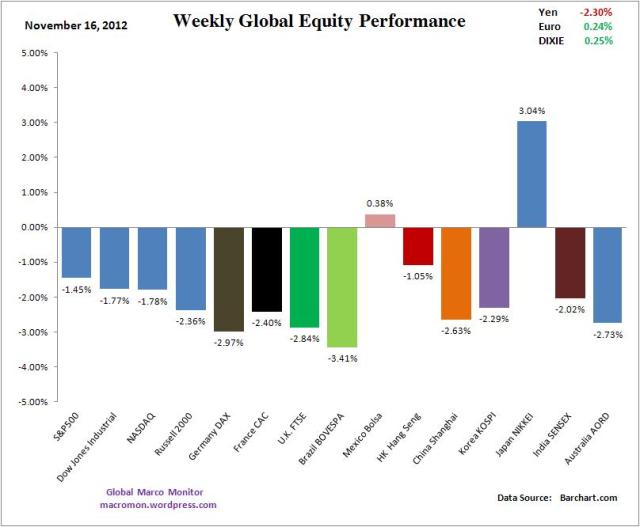
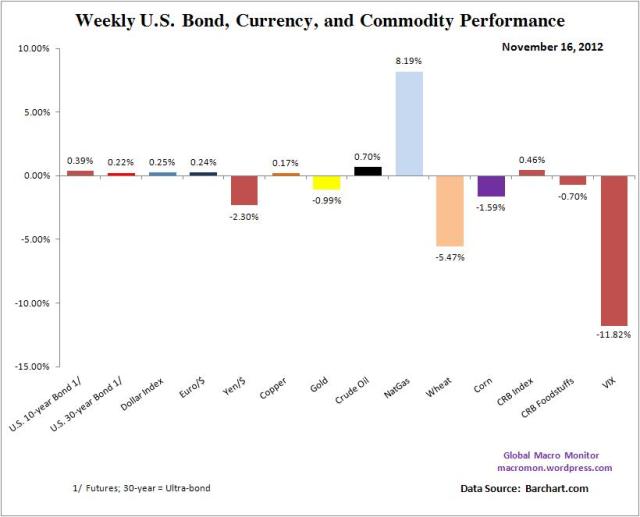

 (click here if charts are not observable)
The bad economist pursues a small present good, which will be followed by a great evil to come, while the true economist pursues a great good to come, at the risk of a small present evil.
– Frédéric Bastiat, circa 1850
Former Fed chairman, Alan Greenspan, dishes out some real gems to CNN’s Ali Veshi on the fiscal cliff and the country’s current economic situation, in general. He almost sounds like the inflation slaying Paul Volcker. Rather than inflation this time, it’s runaway government spending. Greenie says that a small recession may be worth the price to arrest that demon.
No worries, however, as we have a monetary policy repressing the government’s borrowing costs, which are at record lows. At the end of October, for example, the average rate on all interest bearing marketable Treasury securities was 2.075 percent. This is less than half the 4.857 percent average interest rate paid on the public marketable debt in October 2007. Of course interest rates will never reset higher, right?
The markets are currently grappling with some of these broader issues Greenspan discusses, of which, the fiscal cliff is just a small part. We will be selling on the cliff deal unless it really addresses the country’s long term structural fiscal problem.
The final deal should include a package of growth measures, preferably on the supply side, and it doesn’t necessarily mean taking a hatchet to current spending and raising taxes through the roof. Good luck on that one.
Greenspan’s money quotes:
– If we don’t close this deficit, fairly quickly, we are in real trouble.
– …until we reign in the spending growth, this economy can’t function.
-…we’re not going to get out of this thing without paying…all the low hanging fruit of solving these types of problems has long ago been picked.– Alan Greenspan, CNN Money – November 16, 2012
Click here for interview. It’s worth the three minutes.

(click here if photo is not observable)
Nice graphic from the WSJ’s ChinaRealTimeReport blog of the Chinese economy under the outgoing leadership of Hu Jintao and Wen Jiabao.
The upshot? The country’s new leaders have some tough shoes to fill with a slowing economy and the old drivers of growth — exports and real estate investment — either slowing or in free fall. It’s going to be fascinating to watch how China transitions.
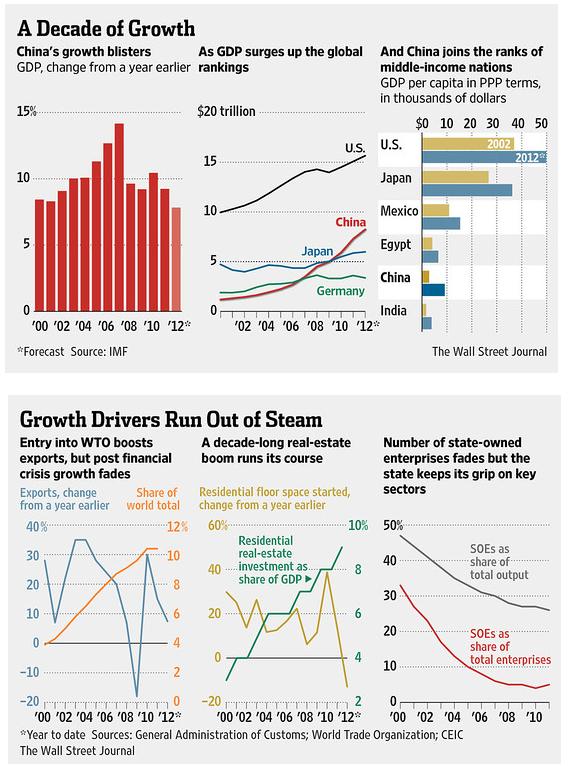
(click here if chart is not observable)
Stratfor’s Vice President of International Projects Jennifer Richmond discusses the challenges for China’s new leadership.
For more analysis, visit: http://www.Stratfor.com
(click here if video is not observable)

 Global Macro Monitor