Fed Ready to Fire Up the Printing Press

As we assess the benefits and costs of alternative policy approaches, though, we must not lose sight of the daunting economic challenges that confront our nation. The stagnation of the labor market in particular is a grave concern not only because of the enormous suffering and waste of human talent it entails, but also because persistently high levels of unemployment will wreak structural damage on our economy that could last for many years.  – Ben Bernanke,  Jackson Hole

The Global Macro Monitor believes the benefits of money drops and quantitative easing, which helps generate asset inflation (though on a diminishing scale) are not equitable and accrue mainly to those who own the most assets,  the 1 percent.   Furthermore, it hurts those who least can afford the commodity inflation usually associated with the QE.

Sure, as stock portfolios increase in value,  people may feel wealthier and spend a few more bucks at, say, WalMart, who may, or may not hire more retail clerks.   The BLS notes,

Retail salespersons and cashiers were the occupations with the highest employment in 2011.

Talk about trickle down economics!

The rapid technological advances, which are destroying jobs,  have probably weakened the  wealth effect and employment link,  in our opinion.    Think about the job security of  a Starbucks cashier, for example, as payments technology advances:

This fall, Square will begin processing all credit and debit card transactions at Starbucks stores in the United States and eventually customers will be able to order a grande vanilla latte and charge it to their credit cards simply by saying their names. – NY Times

You think Bill Gross is getting long baseball cards?   We’re buyers of Mike Trout’s rookie card.

(Click here if cartoon is not observable)

Posted in Commodities, Monetary Policy | Tagged , , | 2 Comments

The Golden Bernanke

We asked yesterday, albeit somewhat jokingly, what market needed to “see the money” the most.   Stocks, bonds, or gold?

Mr. Market has spoken.  The initial pop in stocks has faded with notable weakness in Apple, yet gold is holding its gains.  The GLD is up over 1.9 percent against the S&P500 0.34 percent move.

Markets are certainly setting up for an interesting September.

Have a great Labor Day weekend!

We leave you with a little history of the origins of Labor Day from our good friend and one of the smartest guys we know, Pat Alwell of Strategas Research.  This is from his must read daily missive.  If you’re not on his list,  get on it!

Labor Day in the US was established in 1894 after decades of conflict between capital and labor, and about 40 years after the publication of Das Kapital.   The holiday was championed by, among others, Eugene Debs, who ran for President as a Socialist not less than 5 times.  It was pro-Labor President Grover Cleveland, the first Democrat to break the Republican hold on the White House since Lincoln, who created the holiday after using Federal troops to quash a strike at the Pullman car Company.   Though Labor got a holiday, Cleveland removed it from the International Workers Day of May 1 which many American capitalists associated with red berets, strong coffee, and matching 401Ks.   So here we are 118 years after Labor Day became a national holiday contemplating the battles between labor and capital, the rich and the poor, individual rights over the collective.

Organized labor peaked decades ago and now union membership accounts for less than 12% of the US labor force.  The strongest representation for organized labor is within government with a unionized rate 5 times that of the private sector.   Education workers enjoyed the highest unionization rate of 37% while sales people enjoy (or suffer) the lowest at 3%.   Money capital, eager to flow where it is treated the kindest, dominates labor both in the US and abroad.   This is best reflected in the meager wage increases accruing to labor despite years of outstanding productivity increases.   At one point in 1997, Morgan Stanley Economist, Steve Roach, claimed that money capital would suffer a “worker backlash” as wages grew slower than productivity. It never happened.

(click here if chart is not observable)

Posted in Gold | Tagged , , | 2 Comments

Weekly Eurozone Watch

Key Data Points
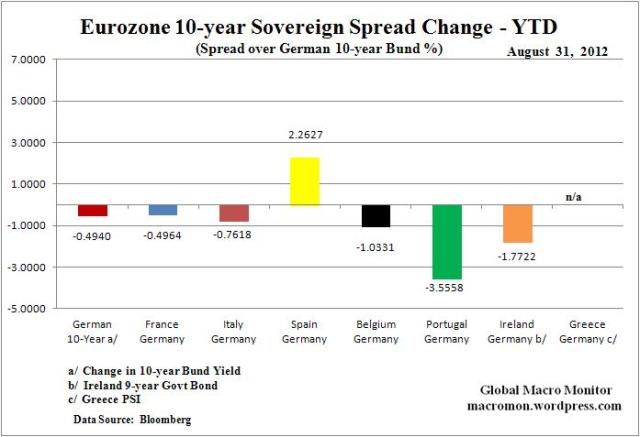
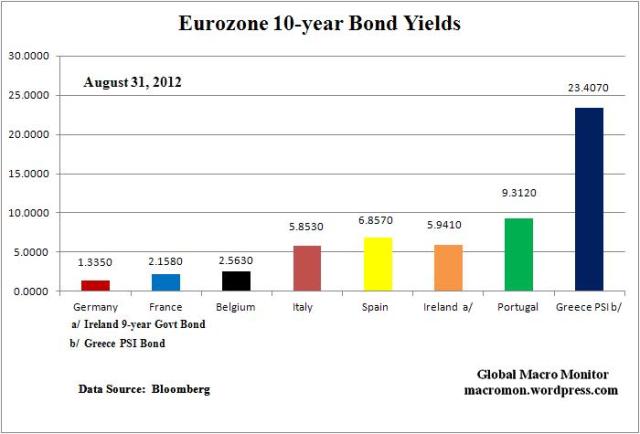
German 10-year Bund 2 bps lower;
Italy 10-year 15 bps wider to the Bund;
Spain 46  bps wider;
Portugal 7 bps tighter;
Greece 54 bps tighter;
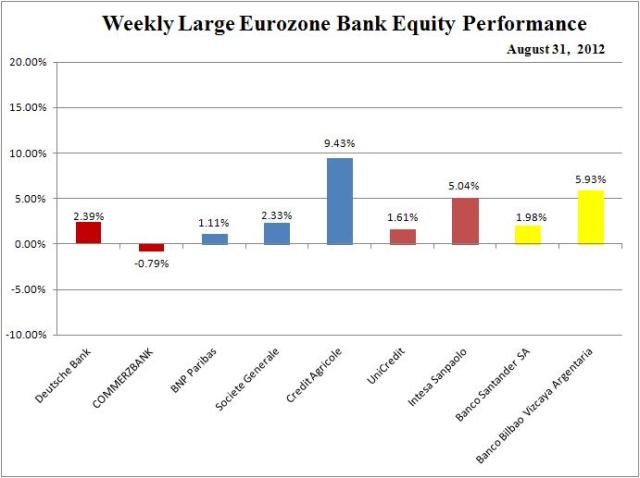
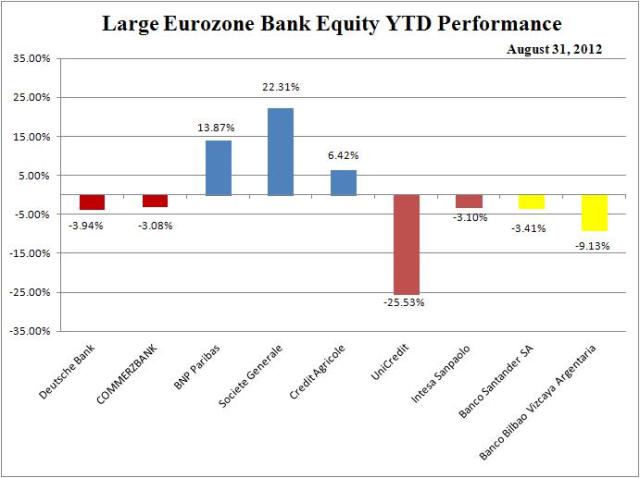
Large Eurozone banks higher;
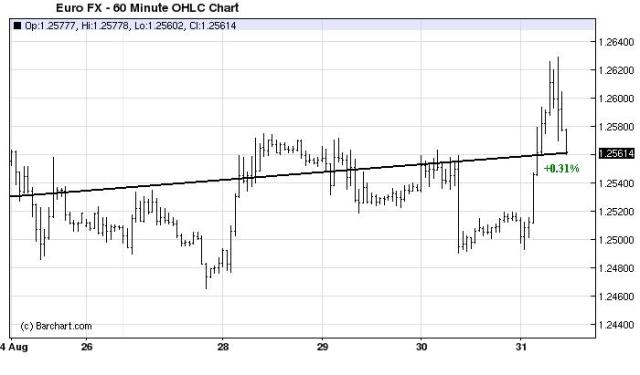
Euro$ up 0.31 percent.

Commentary

Prime Minister Mariano Rajoy delayed seeking a second rescue for Spain while pledging to continue bailing out its regions as Valencia requested more money to settle bills and cover debt…

Rajoy reiterated Spain won’t seek a second bailout until European leaders make aid conditions clear. Spain locked in as much as 100 billion euros in international aid for banks last month. The yield on Spain’s 10-year benchmark bond rose 13 basis points at 5:44 p.m. in Madrid, widening the gap with similar German maturities to 5.27 percentage points.  – Bloomberg

(click here if charts are not observable)

Posted in Weekly Eurozone Watch | Tagged , , , , , , | 1 Comment

The Market’s “Jerry Maguire” Moment

How can we pass on posting one of the funniest scenes in movie history,  which is an almost perfect allegory of where markets stand today?

We will let you decide if Ben Bernanke or Mario Draghi is the real Jerry Maguire (Tom Cruise) and which market –equities, bonds, or gold — is Rod Tidwell (Cuba Gooding, Jr.)  that really needs to “see the money.”     We shall know soon.

By the way,  do you think Bernanke and Draghi feels the same as Jerry Maguire appears in this scene when markets revolt and ask them both to “show me the money”?   Just askin’.

(click here if video is not observable)

Posted in Monetary Policy | Tagged , , , , | 1 Comment

Nonlinear Thinking: 3D-Printed Baseball Bat

We’ve posted several pieces about how 3D printing is going to revolutionize manufacturing and impact international trade flows (click here, here, and here) .   Imagine your local WalMart with several of these printers on site producing much of their own inventory.    How about having your own 3D printer and making Christmas toys for the kids?

One stock we own — but not enough — to take advantage of this technology is 3D Systems.  It’s been performing very well (see chart).

Objet creates a fully-functional baseball bat prototype on an Objet Connex Multi-Material 3D Printer and tests it against a variety of objects to see if it breaks. The bat is printed in Objet’s ABS-like Digital Material – a very strong and functionally versatile composite material that is unique to the Objet Connex range of 3D printers. Even though the bat has a very thin neck supporting a heavy end, it does not shatter or splinter upon hard contact with various objects.

The guy in the video is no Mike Trout and looks more like a former cricket player.  Don’t you think?

(click here if video and chart are not observable)

Posted in Nonlinear Thinking, Technology | Tagged , , , | Leave a comment

Picture of the Day: Technical Analysis

Boring market.  Let’s have some fun.

It is said that if you stare at the clouds long enough you can see any pattern you want to see.    So it is with potato chips — who can forget this classic episode of Johnny Carson. So it is with stock chart patterns, which is why one must remain flexible and disciplined when trading the charts.

This is especially the case in a market so manipulated by government intervention and driven by monetary policy.

That said, can’t you see the head and shoulders pattern in these bolts of lightning, which struck over the airport in Billings, Montana last week?  Also note the bearish divergence between the two charts.   Still can’t figure out the trade!

Let us know if you have one.

(click here if picture is not available)

Posted in Technical Analysis | Tagged , , | 1 Comment

James Grant on Markets, Fed Policy, Gold Standard

Bloomberg’s Tom Keene interviews Jim Grant.  Always worth a listen, especially with the gold standard back into the news.  He also takes a swipe at the Swiss National Banks.  Good stuff.

We need a central bank that has the humility not to do what it cannot do.  And the Fed cannot do what others have failed to do.  Namely, to plan an economy from a central desk in a capitol city.  –  Jim Grant

The Global Macro Monitor wants to go on record, Right here, Right now, that we do not support a return to the gold standard,  but are in favor of a rules based monetary policy.  One of the rules would be never suppressing nominal interest rates below inflation for an “extended period” of time.  We believe this is one of the main causes of the financial crisis and a major reason for the U.S.’ zombie-like economy recovery.

Click here for full interview

Posted in Gold, Monetary Policy | Tagged , , , , , | Leave a comment

Why Gold Is Money

Planet Money of NPR and its chemist explains why the some Repubs are not pushing for a “lithium standard.”   This piece originally aired last November.

(click here if video is not observable)

Posted in Gold | Tagged , , | 1 Comment

Sweet & Sour Channel Stuffing and the Shanghai Swan Dive

The news out China seems to be getting worse.

Last week the NY Times reported about China’s huge inventory build of unsold goods,

GUANGZHOU, China — After three decades of torrid growth, China is encountering an unfamiliar problem with its newly struggling economy: a huge buildup of unsold goods that is cluttering shop floors, clogging car dealerships and filling factory warehouses.

The glut of everything from steel and household appliances to cars and apartments is hampering China’s efforts to emerge from a sharp economic slowdown. It has also produced a series of price wars and has led manufacturers to redouble efforts to export what they cannot sell at home.

The severity of China’s inventory overhang has been carefully masked by the blocking or adjusting of economic data by the Chinese government — all part of an effort to prop up confidence in the economy among business managers and investors.

This followed the disappointing flash manufacturing PMI report, which showed a rapid deterioration in China’s industrial sector with the index falling to a 9-month low.

What is happening to all the unsold goods piling up in China and why isn’t the market working to clear the excess supply?   Government manipulation and good old fashion channel stuffing.

Writing for Forbes, Gordon Chang notes,

It’s hard to see how manufacturing will recover soon.  Manufactured goods are stockpiled at record highs across China.  “My supplier’s inventory is huge because he cannot cut production—he doesn’t want to miss out on sales when the demand comes back,” said Wu Weiqing to the New York Times.

Perhaps that explanation makes sense, but it’s far more likely that Wu’s supplier, which makes sinks and faucets, had been told by the local government to keep production lines going no matter what.  And why would city and municipal officials do that?  For one thing, local officials don’t want to deal with unrest that idle workers cause.  Moreover, lower-level cadres are judged by growth in their districts.  The value of a sink sitting in a factory’s inventory, even if never sold, is counted as gross domestic product.  Mr. Wu’s employer, a wholesaler, has seen its sales fall 30% over the course of the last year.

The steel and auto industry are also being hit hard,

The past for Chinese steel is unclear, but the future is certain.  The signs for the remainder of the year are, unfortunately, uniformly bad.  The price of benchmark hot rolled steel has fallen 19% since April.  In the first half of this year, the profits of steel companies dropped 96% from the corresponding period in 2011.  Steelmakers have been defaulting on their obligations to purchase iron ore, a sure sign production will tumble soon.  Daily output this month, according to the analysts at Mirae Assets Securities, could be as low as 1.85 million tons.  Record production in the face of weak demand suggests inventories must be rising.

Carmakers have solved their inventory problems by forcing dealers to take autos they cannot sell.  Inventories at the dealers in the first six months of the year increased 900,000 units.  These retailers are now carrying 2.2 million cars in their showrooms.  Even with dealers taking unneeded cars, the manufacturers are operating at around 65% of capacity when 80% is thought to be the breakeven point.  Eventually, the automakers will have to slam on the brakes: retail sales of cars are probably declining at this moment.

Anyone who thinks the slowdown in China will not affect growth and corporate earnings in the U.S. and elsewhere is, well, should we say,  smoking crack.

Chang does note, however,  because of government “can kicking” (sorry about that)  the inventory buildup,  imbalances and disequilibrium in China’s economy can go on longer than many think it can,

Censors have stopped the release of statistics on car registrations, and fictitious reporting has hidden the size of the inventory buildup across China’s manufacturing sector.  Yet government statisticians were unmasked by the HSBC Flash PMI.  The inventory buildup this month was the fastest ever recorded by the survey, which began in April 2004.

In free-market economies, the sustained rise of inventories is a prelude to recession.  In China, on the other hand, inventory accumulation can go on for years before it negatively affects growth.

The Shanghai Composite stock index is not fooled, however,  and continues its swan dive.

As markets pin their hopes on the Magic Draghi of the West it would behoove traders and investors to keep a close eye on the Dragon of the East.   The shock of a shrinking China and unstable political economy would be the tipping point for the global economy.

(click here if charts are not observable)

Posted in Black Swan Watch, China, ECB | Tagged , , , | 5 Comments

Is Apple’s Patent Victory Enough to Push Stock to $700?

Here’s a couple of interesting takes on Apple’s victory over Samsung in the patent infringement lawsuit, which was announced after the market close on Friday.   Though an interesting perspective, Al Jazeera’s piece (bottom) is a bit of a stretch, in our opinion, and much too biased toward Samsung.

The only question in our mind is Friday’s victory enough of a catalyst to take the stock to $700?   Stay tuned.

(click here if videos are not observable)

Posted in Apple | Tagged , , | Leave a comment