Northern Europe Most Competitive

(click here if video is not observable)

Posted in Economics | Tagged , | Leave a comment

Europain: Young and Unemployed

The following chart from the Washington Post of Europe’s unemployed youth really captures the human suffering of the European debt and banking crisis.   It also illustrates why labor reform needs to be a key component of the structural adjustment in the European periphery.

As the market obsesses over the Magic Draghi’s next move, we wonder if reform fatigue will constrain Spain and others from asking for help.   Conditionality will no doubt be a precondition for ECB support, in our opinion.  That may be what disappoints markets on Thursday.

After all, take a look what the Trioka is asking of Greece as reported by RT,

A leaked email sent to the Greek Ministries of Finance and Labor from the Troika says Greek private sector workers should work six days a week and longer hours.

The letter, which was published on August 31, shows that the Troika expects the Labor Ministry to implement a number of other new measures. They include reducing the notice period before firing a worker, and cutting certain severance packages by 50 per cent by giving employers the right to reduce workers’ time in service. Restrictions on overtime are also expected to come into effect.

“It also wants a dismantling of the labor inspectorate which is the public service that is responsible for implementing labor law. So it’s not only about making the labor market more flexible,” Panagiotis Sotiris from the University of the Aegean told RT.

(click here if chart is not observable)

Posted in Employment, Euro, PIIGS, Spain | Tagged , , , | Leave a comment

The tweet that turned the market

Bill Gross was credited for turning the market around today with the following tweet:

PIMCO ‏@PIMCO
Gross: Draghi appears willing to write 2-3 year “checks” to peripherals. Very reflationary. Buy gold, TIPS, real assets.

Talk about nervous shorts!

(click here if chart is not observable)

Posted in Equities | Tagged , , , , | Leave a comment

Apple Closes Just Shy of All-Time High

Apple closed up almost $10 today after the company sent invitations out to its September 12th product launch.   Note what appears the figure 5 in the shadow of the graphic that accompanied the invite.  It was enough to get the market lathered up about the new iPhone 5.

The stock usually rallies up until the actual release date.   It’s working and we’re staying with it.

(click here if charts and video are not observable)

Posted in Apple | Tagged , | Leave a comment

September!

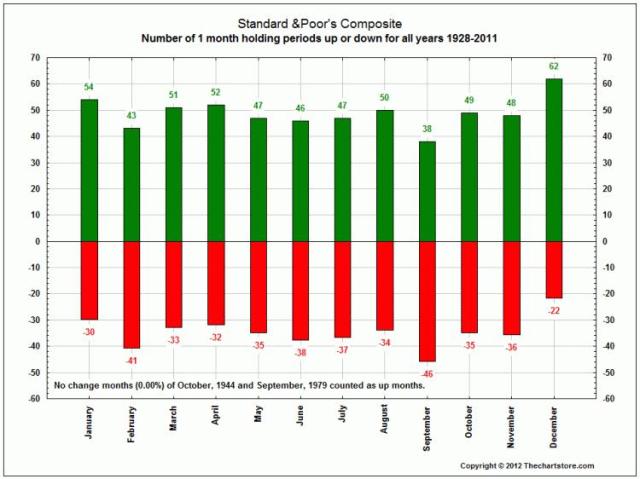
Great charts from our friends over at The Chart Store.

September is — ON AVERAGE — the cruelest month for stocks and FedEX is reinforcing the monthly seasonality trading down $3 in AH after warning of global weakness.

MEMPHIS, Tenn., September 4, 2012 … FedEx Corp. today announced that earnings for the first quarter ended August 31, 2012 are expected to be in the range of $1.37 to $1.43 per diluted share, compared to $1.46 per diluted share last year. The company’s original first quarter forecast was for earnings of $1.45 to $1.60 per diluted share.

Earnings during the quarter were lower than originally forecast, as weakness in the global economy constrained revenue growth at FedEx Express more than expected in the earlier guidance.

The company has not yet closed the books for the quarter. Additional information will be available on September 18, 2012, when the company releases a full earnings report at 6:30 a.m. CDT and conducts its quarterly earnings conference call at 7:30 a.m. CDT.

Equities had a nice bounce today, which once again reinforces our view there are not many real sellers out there.  The bears are having trouble breaking the market and shorts are too afraid and/or emasculated to let ’em ride when support holds and the market turns.

(click here if chart is not observable)

Posted in Equities | Tagged , | Leave a comment

America’s Minimum Wage Recovery

The Miami Herald out with a piece today on Florida’s recovery being led by minimum-wage jobs, which also reflects a national trend. The Herald reports,

Florida’s employment recovery hasn’t brought back many well-paying jobs.

That’s the conclusion of a new study timed for Labor Day showing the gaps of the Sunshine State’s slow but unmistakable bounce back in hiring. And it reflects a national trend, driven largely by the ripple effects of the collapsed housing market.

The three industries that account for 63 percent of all minimum-wage jobs in Florida — hospitality, retail and healthcare — also have been leading the recovery, according to the study by Florida International University’s Research Institute on Social and Economic Policy.

The National Employment Law Project looks at employment trends on a national level and concluded in their August brief:

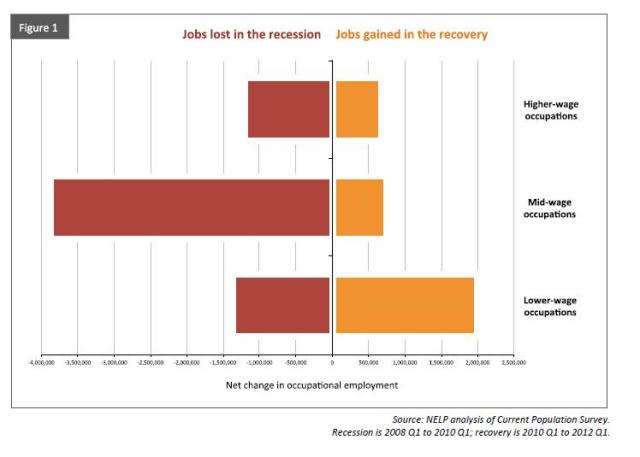
During the recession, employment losses occurred throughout the economy, but were concentrated in mid-wage occupations. By contrast, during the recovery, employment gains have been concentrated in lower-wage occupations, which grew 2.7 times as fast as mid-wage and higher-wage occupations. Specifically:

– Lower-wage occupations were 21 percent of recession losses, but 58 percent of recovery growth.
– Mid-wage occupations were 60 percent of recession losses, but only 22 percent of recovery growth.
– Higher-wage occupations were 19 percent of recession job losses, and 20 percent of recovery growth.

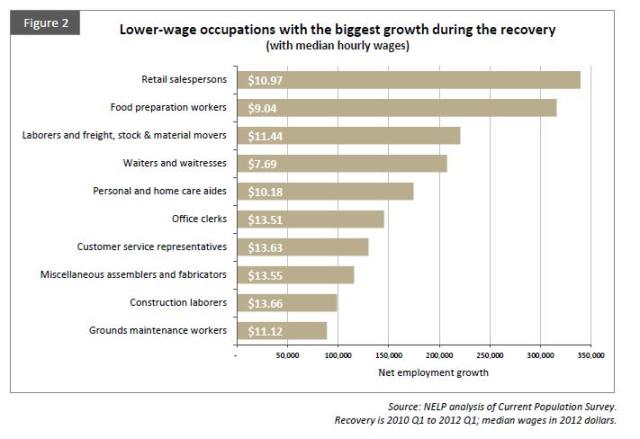
The lower-wage occupations that grew the most during the recovery include retail salespersons, food preparation workers, laborers and freight workers, waiters and waitresses, personal and home care aides, and office clerks and customer representatives.

Even as housing recovers construction hiring remains punk and at its lowest percentage of nonfarm payrolls since 1946 (watch for our piece later in the week).   Coupled with the decline in state and local government hiring it’s no surprise aggregate demand remains weak.

The recovery, at least to us, increasingly looks like it is built on sandy ground.

(click here if charts are not observable)

Posted in Employment | Tagged , , | Leave a comment

Germany’s FinMin says court to back European bail out fund

(click here if video is not observable)

Posted in Germany, Sovereign Debt, Sovereign Risk, Spain | Tagged , , | Leave a comment

China’s Bad Debt Problem

Reuters out today with a must read piece on China’s deteriorating commercial bank loans to the country’s steel sector, which now has a total debt burden of $400 billion, about the size of South Africa’s economy.

Could this be one of the reasons why the Chinese government is dragging its feet on another round of stimulus?

China’s banks are coming after the country’s steel traders, hauling executives into court to chase down loans that some traders said they didn’t initially need and can’t now repay.

The heavy push to recover the loans is another sign of strain on China’s financial system at a time when the country’s leaders are contemplating another round of stimulus to boost the economy, and when banks are worried about bad debts piling up.

This is incredible,

The battle between the banks and steel traders also exposes flaws in the 4 trillion ($629 billion) stimulus round in 2008, and offers a warning to those calling for pumping more money into the system. At that time, Chinese banks threw money at the steel trade – a crucial cog in supplying the country’s massive construction and infrastructure growth.

But those steel loans, after offering a quick fix, became excessive, poorly managed, or a combination of the two. Government officials insisted more money was needed to prop up the industry. Steel executives said the money flow was too heavy, and they had to put the money to work in real estate and the stock market.

Yikes!  

Posted in China | Tagged , , , , | Leave a comment

Week in Review

(click here if charts are not observable)

Posted in Week in Review | Tagged , , , , , , | 1 Comment

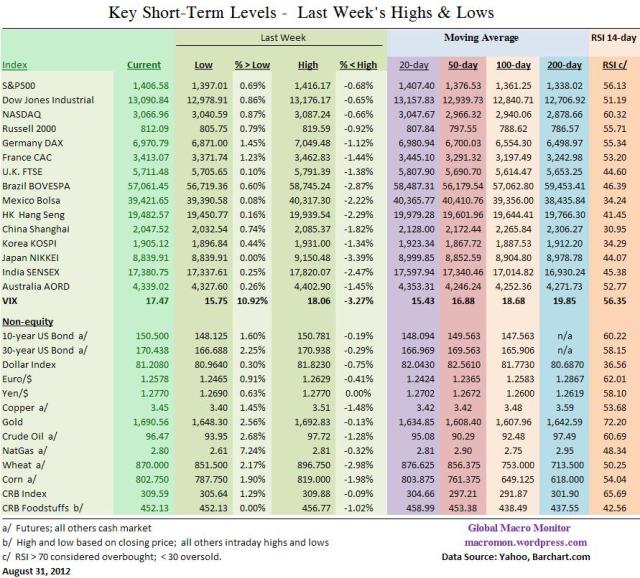
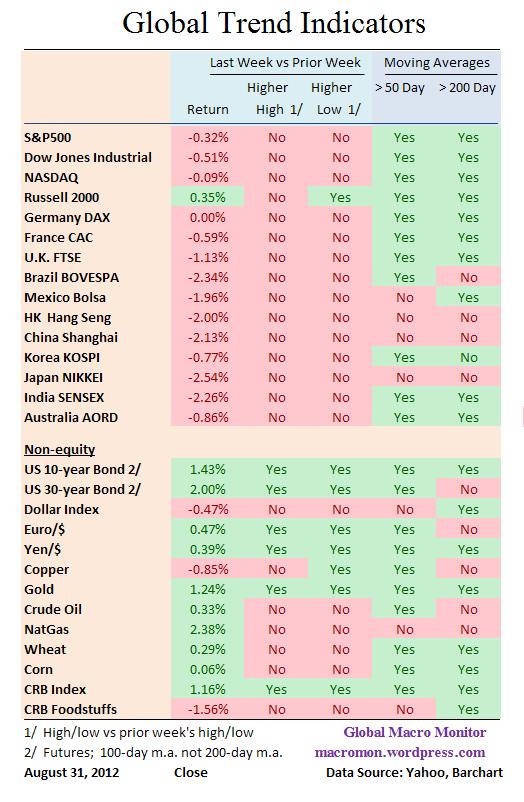
Global Trend Indicators

(click here if tables are not observable)

Posted in Global Trend Indicators | Tagged , , , , , , | 1 Comment