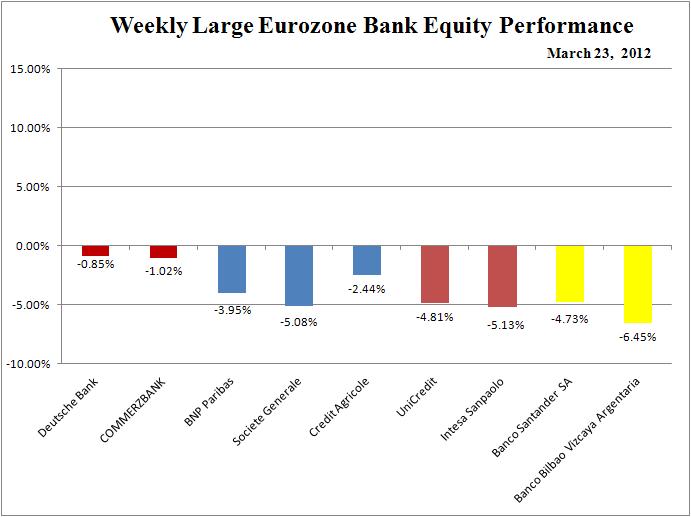
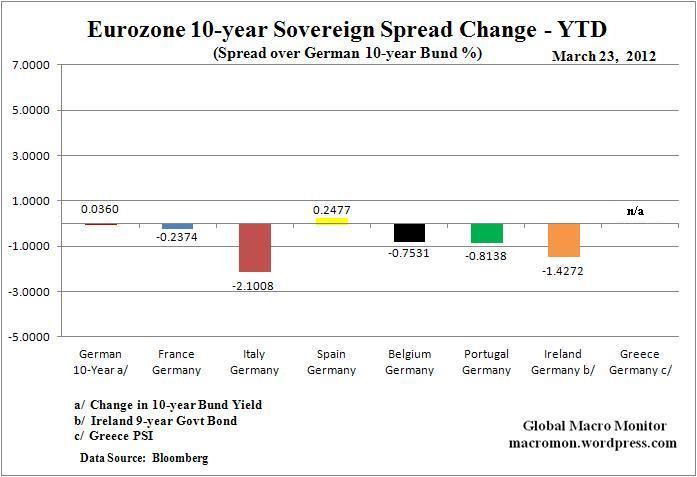
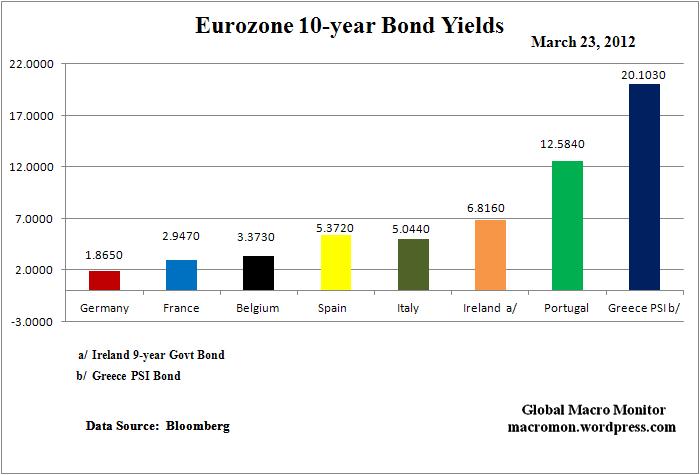
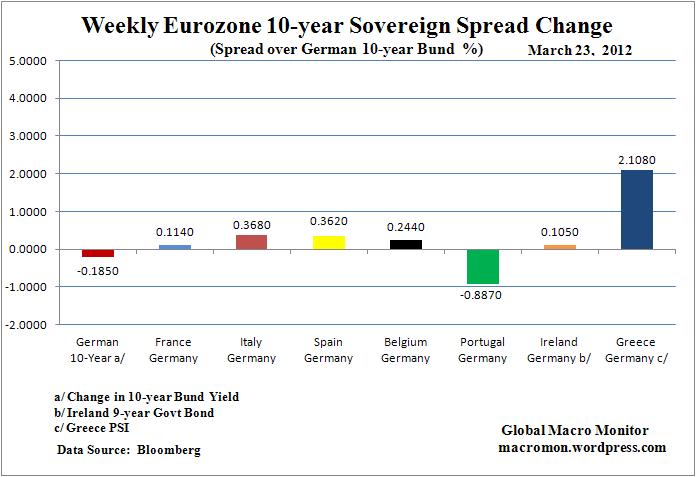
Weekly Eurozone Watch: The Pain in Spain

(click here if charts are not observable)

Posted in Weekly Eurozone Watch | Tagged , , | Leave a comment

Hong Kong’s Growing Income/Wealth Gap

The goes to show the U.S. is not the only country with a growing wealth and income gap. Very interesting video from CNBC Asia.

(Click here if video is not observable)

Vodpod videos no longer available.

Posted in Uncategorized | Leave a comment

Is Inflation Driving the U.S. Wealth/Income Gap?

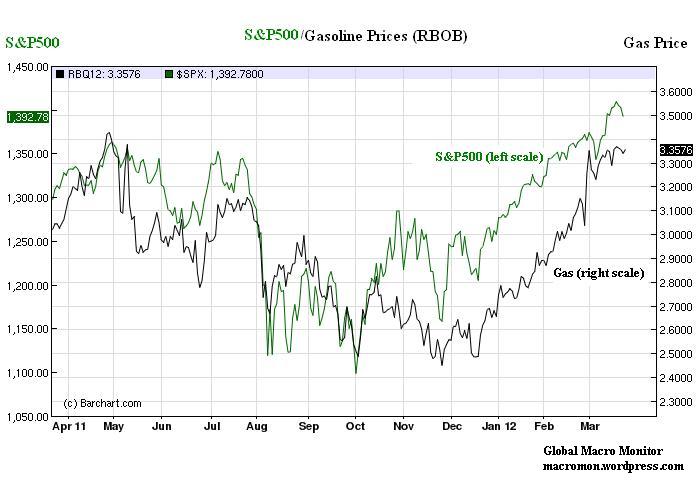
The bears video got us motivated to put together a chart of the S&P500 and gas prices over the past year.   It’s stunning, though not surprising, to see how both series move together.   The two charts below help explain a big part of what’s driving U.S. wealth/income inequality and why this recovery feels so shitty for what’s left of the middle class, in our opinion.

Higher income households hold more common stock than those of lower income groups.  In fact, data from the Census Bureau show that in 2007,  91 percent of the families in the 90-1oo percentile income group (> $141 K) own stocks versus only 34 percent of households in the 20-4o percentile ($21-37 K).

As stocks increase with inflation — or gas prices as the chart illustrates —  higher incomes groups are partially hedged with their stock holdings whereas the real wages of the lower income groups decline without the wealth hedge.  a/

This evident in the second chart and one that should concern President Obama.  Though job creation has picked up,  real wages have not.  In fact, isn’t that a big part of why hiring has increased?   As real wages fall (prices)  demand for labor increases?

Also, check out the bears video if you already haven’t.  Priceless, especially 4 minutes in.

a/ This is reinforced further as housing is the largest proportion of the wealth of the lower income groups, which continues to head south.

(click here if charts and video are not observable)

Posted in Economics, Employment, Energy, Equities, Video | Tagged , , , | 12 Comments

TR50: The 50 Most Innovative Companies (1-5)

We will posting Technology Review’s 50 Most Innovative Companies in 2011 in increments of five as not to overwhelm you.   Innovation is the place to be, in our book.

1)  Alcatel-Lucent
Why:
Has created a cellular network that can cope with our growing appetite for mobile data.
Key innovation:
Its LightRadio architecture uses many small, efficient, and easily upgraded base stations in place of the larger, less efficient cell towers of today.

2)  Alta Devices
Why:
Its high-efficiency gallium arsenide–based solar cells provide a way to lower the cost of solar power.
Key innovation:
Can economically produce robust cells that use only small amounts of the expensive semiconductor.

3)  Apple
Why: 
The Siri virtual assistant built into the iPhone 4S demonstrates a new kind of conversational voice-operated interface.
Key innovation:
 Software that can interpret ambiguous sentences allows Siri to understand even casual commands.

4)  Applied Materials
Why:
 A key supplier of equipment for making solar cells, it is helping to lower the cost of solar power.
Key innovation: 
A new manufacturing system allows solar producers to increase the output and efficiency of their cells.

5)  ARM Holdings
Why:
By reducing the electricity demands of data centers, ARM is making cloud computing cheaper.
Key innovation:
Its powerful server processors use an architecture originally developed for energy­-conscious mobile devices.

Posted in Apple, Technology | Tagged , , , , , , | 3 Comments

China HSBC Flash PMI At 4-Month Low

The HSBC Flash China Manufacturing PMI is showing further contraction.

Could worries over China slowing, coupled with renewed jitters in Europe, be the catalyst for the long awaited correction in global equities?  That’s how we’re positioned, but recognize it’s a crowded camp.   China’s weakening domestic demand will result in further monetary easing by the country’s policymakers, which could also limit the downside for equities.

A  pullback in the S&P500 to, say, the 20-day moving average at 1378, or even the 50-day at 1348,  would be healthy for the market,  in our opinion.  It sure doesn’t feel like the market wants to go down,  but it also felt like Apple wanted to close over $610 today until it fell $7 in the last half hour of trading to close in the red.

Markit quotes Hongbin Qu, Chief Economist, Co-Head of Asian Economic Research at HSBC on the weak China data,

“Weakening domestic demand continued to weigh on growth, as indicated by a slowdown in new orders which came in at a four-month low. External demand remained in contraction territory, but the decline was at a slower pace, implying that there are no improvements in the demand outlook. More worryingly, employment recorded a new low since March 2009, suggesting slowing manufacturing production was hindering enterprises’ hiring desire. The soft-patch in manufacturing was in line with the recent downside surprise in industrial production growth. Growth momentum could slow down further amid a combination of sluggish export new orders and softening domestic demand. This calls for further easing steps from the Beijing authority.”

(click here if chart and tables are not observable)

Posted in Black Swan Watch, China, Economics | Tagged , , , | Leave a comment

Quote of the Day: Beautiful Credit!

‘I wasn’t worth a cent two years ago, and now I owe two millions of dollars.’
–  Mark Twain,  The Gilded Age

Posted in Quote of the Day | Tagged , , , | Leave a comment

Charlie Rose: China’s Macro Challenges

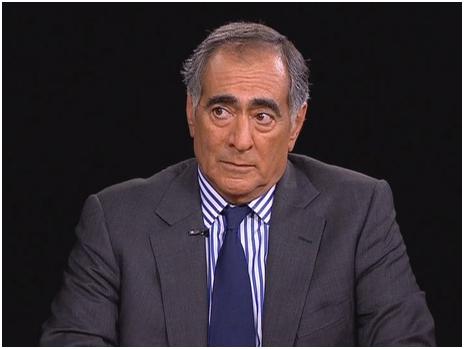
Excellent group discussion on doing business in China and the macro challenges facing the country.  The panel has experience and great perspective, especially Ian Bremmer of the Eurasia Group,  who has an interesting view on China’s transition to a domestic demand driven economy.

A discussion about doing Business in China with Ian Bremmer, President of the Eurasia Group; David Novak, CEO of Yum Brands; John Mack, former CEO of Morgan Stanley; and Zhang Xin,CEO of Soho China

Click here for interview.

(click here if pictures are not observable)

Posted in Black Swan Watch, China | Tagged , , , , , | Leave a comment

Debt and the New World Order

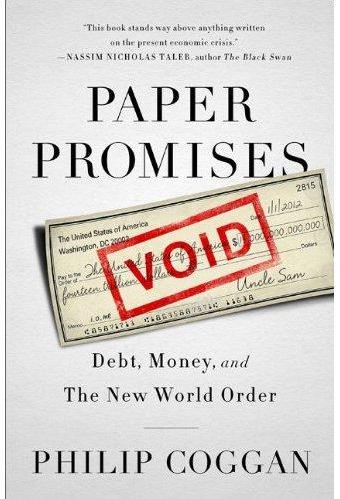
The IMF does a good job interviewing Phillip Coggan, the columnist for the Economist, on his new book,  Paper Promises: Debt, Money, and the New World Order.  Good stuff!

DEBT AND REFORM
Debt Can Reshape Current Economic, Political Order—Coggan

IMF Survey online
March 9, 2012

  • In the long term, debt crisis change nature of monetary system
  • Current debt levels are unprecedented in history
  • China, largest creditor nation, will set new economic order

Current debt levels, which have led to a sovereign debt crisis in Europe and turmoil in world markets, threaten to reshape our economic and political world order, says economist Phillip Coggan.

If there is a single word that has defined the economic crisis in Europe and the United States, it is debt, Coggan says. Debt has been all consuming, drowning homeowners and mortgages, leaving cities and counties bankrupt, and forcing countries to make public cuts, even in the face of fierce opposition.

In his latest book, Paper Promises: Debt, Money, and the New World Order, Coggan, columnist for The Economist magazine, looks back in history at other debt crises in attempt to analyze the current situation.

In an interview with IMF Survey online, Coggan explains that this is not the first time in history unsustainable debt levels meant drastic changes for how the world does business.

IMF Survey online: Can you explain the premise of your book?

Coggan: The thesis of the book is that history is a battle between creditors and debtors, and the battleground is the nature of money. Over time, creditors have insisted on forms of sound money, whether the money is linked to precious metal like gold, or whether currencies are fixed in rates against each other.

Debtors have tended to want their value of money to be flexible. They have wanted more money to be created at times of crisis, or exchange rates to move, float on the markets so that they can devalue away their debts.

What has happened in history is that we have had a series of periods in which debts have built up. There have been crises—the 1930s, the 1970s, and now—and as those crises unfolded, the nature of the monetary system changed, and a new order came into place; that new order tended to be set by the creditor nation.

IMF Survey online: How did the levels of debt that we have accumulated in the past decade compare to other periods of high debt?

Coggan: We have much higher levels of total debt relative to economic output—gross domestic product—than we have before. There have been moments in history when governments have had higher ratios of debt to GDP than they have now. But, we have not had debt right across the economy in the consumer sector, in the corporate sector, and in the banking sector, in the same way that we have had today.

We are talking about most of the developed world having scenes of 300 to 400 percent debt levels of GDP; and of course we saw in Ireland and Iceland scenes of seven to nine times debt levels to GDP. These are pretty much unprecedented in history.

IMF Survey online: There are sure to be implications for such high levels of debt. What will they be?

Coggan: Well, the reason the book is called Paper Promises is debt, like paper money, really, is a paper promise. And I could also throw in the promises governments have made to citizens in the form of benefits, like pensions and healthcare.

Not all these promises can be honored. That is the implication of these very high debt levels. And so economic history going forward is all going to be about a battle to decide who gets the wrong end of the stick.

We will see taxpayers battling public sector workers, we will see the young battling the old, the rich battling the poor, and some countries battling—not in a military sense, but arguing—with other countries about how much debt they should pay off and how much should be forgiven.

IMF Survey online: How does your thesis about debt levels relate to what went on in the housing market in the United States in recent years?

Coggan: We have to go back to 1971 when the last link between paper money and metal was removed. When President Nixon got rid of the gold window, he removed the linking of the dollar to gold, and ended the era of fixed exchange rates. Since then, we have been in a unique era in history, in which there has been no anchor to money at all.

During that period, there has been no constraint on the amount of credit that could be created. In previous systems, there was, because you had to control the value of money. Money was generally used to buy assets and was lent against assets by the banking system. So, we had a huge rise in debt level to GDP, a huge surge in importance in the finance sector, and an unprecedented rise in valuations in the sector market. Then, when the stock market collapsed in early 2000 and central banks cut interest rates, the speculative activity moved to the housing market in the United States.

It moved there for a couple of reasons. One is that it was almost the last thing to buy, because there was an argument that house prices would never go down. There is no surer way of creating a bubble than to argue that the price of an asset can never go down. And the second reason was that there was a need for safe assets with an attractive yield, which had been created because the Asian central banks had been buying Treasury bonds and forcing down Treasury bond yields.

So suddenly, investors were looking for something else to invest in, and bonds linked to mortgage loans became that attractive factor. That is really why the pressure built up in the housing market in the United States.

IMF Survey online: The housing crisis did not stop in the United States. It spread to Europe, where it became a sovereign debt crisis. Why has Europe struggled to contain the crisis?

Coggan: The bargain in Europe has been that the northern Europe countries will lend the southern European countries money, provided that the southern European countries go for austerity programs.

The problem with that bargain is that southern European economies have been in recession. Those recessions have gotten worse in the face of these austerity programs, so debt-to-GDP ratios have tended to go higher, not lower. And of course, this makes the problem look even worse.

Now there’s a joke that we were sent at The Economist, which is: An Irishman, an Italian, and a Greek go into a bar. Who pays for the drinks? And the answer is, the German. In the end, the creditors will have to pay.

So, the Germans and the northern Europeans have two choices. They can actually send money to Greece and Portugal, or they can lend money to Greece and Portugal that will not get paid back. Either way, it does not really make much difference. They will not get their money back.

Eventually, the populations in northern European countries will have to realize that. But we are really in a democracy trying to sort out where the pain will fall. So how much can Greek voters suffer without revolting? How much will German voters suffer in terms of writing off debts without revolting?

IMF Survey online: What are the long-term consequences of all this debt?

Coggan: I think the long-term consequence of the debt crisis is a remade order. In the 1930s, the gold standard collapsed. When politicians came to remake the system in the 1940s —what was called the Bretton Woods agreement in 1944—they changed the parameters altogether. They abandoned the formal use of gold coins, which had disappeared for a while after the First World War, and they moved to fixed exchange rates against the dollar, with the dollar the only currency that was formally linked to gold. But it took ten or so years to do.

Then, when Bretton Woods collapsed in the 1970s, they moved to a new system of floating exchange rates. We had an immediate inflationary problem in the 1970s, and we dealt with that problem by having strong central banks with a mandate to control inflation.

And so, we eventually worked out a system whereby consumer inflation was under control, and creditors could have some confidence that their loans would not be inflated away.

The collapse of this system will again bring out a new order in the world.

Britain set the terms of the original gold standard when it was the creditor nation of the world. America set the terms of Bretton Woods. So any new order that emerges will be set by China, which is the largest creditor nation.

(click here for Coggan’s audio interview with the Economist)

Posted in Black Swan Watch, Commodities, Currency, Sovereign Debt, Sovereign Risk | Tagged , , , | Leave a comment

Charlie Rose: Arminio Fraga In the Greenroom

Great short piece – 3:37 minutes — with our friend and former colleague, Arminio Fraga.   He discusses his first job; gives career advice; his career low and high points;  current work;  favorite books; and the greatest challenge facing Brazil.    Great guy, good stuff!

   Click here for interview

                      (click here if pictures are not observable)

Posted in BRICs, Interviews, Whales | Tagged , , | Leave a comment

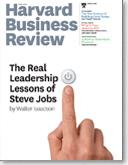
HBR: The Real Leadership Lessons of Steve Jobs

Walter Isaacson follows up his biography of Steve Jobs with an “insanely great” piece in the April HBR.   He drills down on the factors that helped to catapult the legendary entrepreneur into an elite league of American business leaders, including Thomas Edison, Henry Ford, and Walt Disney.

The 14 factors listed below continue at Apple as part Jobs’ legacy, which is helping drive the stock on an epic run,  now up 67 percent since November 25th and adding $240 billion to the company’s market capitalization.  That’s a lot wealth creation — equivalent to 1.6 percent of U.S. GDP.  No wonder the animal spirits are running again.

1)    Focus;
2)   Simplify;
3)   Take Responsibility End to End;
4)   When Behind, Leapfrog;
5)   Put Products Before Profits;
6)   Don’t Be a Slave To Focus Groups;
7)   Bend Reality;
8)   Impute;
9)   Push for Perfection;
10) Tolerate Only “A” Players;
11)  Engage Face-to-Face;
12)  Know Both the Big Picture and the Details;
13)  Combine the Humanities with the Sciences;
14)  Stay Hungry, Stay Foolish.

Below are the first few paragraphs of the article with a link to the full article.   This is a must read, folks!

The Real Leadership Lessons of Steve Jobs
by Walter Isaacson

His saga is the entrepreneurial creation myth writ large: Steve Jobs cofounded Apple in his parents’ garage in 1976, was ousted in 1985, returned to rescue it from near bankruptcy in 1997, and by the time he died, in October 2011, had built it into the world’s most valuable company. Along the way he helped to transform seven industries: personal computing, animated movies, music, phones, tablet computing, retail stores, and digital publishing. He thus belongs in the pantheon of America’s great innovators, along with Thomas Edison, Henry Ford, and Walt Disney. None of these men was a saint, but long after their personalities are forgotten, history will remember how they applied imagination to technology and business.

In the months since my biography of Jobs came out, countless commentators have tried to draw management lessons from it. Some of those readers have been insightful, but I think that many of them (especially those with no experience in entrepreneurship) fixate too much on the rough edges of his personality. The essence of Jobs, I think, is that his personality was integral to his way of doing business. He acted as if the normal rules didn’t apply to him, and the passion, intensity, and extreme emotionalism he brought to everyday life were things he also poured into the products he made. His petulance and impatience were part and parcel of his perfectionism.

One of the last times I saw him, after I had finished writing most of the book, I asked him again about his tendency to be rough on people. “Look at the results,” he replied. “These are all smart people I work with, and any of them could get a top job at another place if they were truly feeling brutalized. But they don’t.” Then he paused for a few moments and said, almost wistfully, “And we got some amazing things done.” Indeed, he and Apple had had a string of hits over the past dozen years that was greater than that of any other innovative company in modern times: iMac, iPod, iPod nano, iTunes Store, Apple Stores, MacBook, iPhone, iPad, App Store, OS X Lion—not to mention every Pixar film. And as he battled his final illness, Jobs was surrounded by an intensely loyal cadre of colleagues who had been inspired by him for years and a very loving wife, sister, and four children.

So I think the real lessons from Steve Jobs have to be drawn from looking at what he actually accomplished. I once asked him what he thought was his most important creation, thinking he would answer the iPad or the Macintosh. Instead he said it was Apple the company. Making an enduring company, he said, was both far harder and more important than making a great product. How did he do it? Business schools will be studying that question a century from now. Here are what I consider the keys to his success.

(click here for full article)

Hat tip to David Jones (not the Aussie retailer)!

Posted in Apple, Technology, Whales | Tagged , , , | 1 Comment