Kondratiev Wave: End to 30-year bond market rally

Interesting stuff from this morning’s CNBC European Squawk,

The updated reading of the work of 1920s Russian economist Nikolai Kondratiev shows that interest rates have reached the bottom of a 60-year-long wave, and are bound to go up, Chris Watling CEO of Longview Economics, told CNBC.

(click here if video is not observable)

Vodpod videos no longer available.

Posted in Black Swan Watch, Bonds, Equities | Tagged , , , , , | 3 Comments

Ugly Chart Contest: Safe Haven Swan Diving

There’s something happening here
What it is ain’t exactly clear….
Everybody look what’s going down
– For What It’s Worth – Buffalo Springfield,  circa 1967

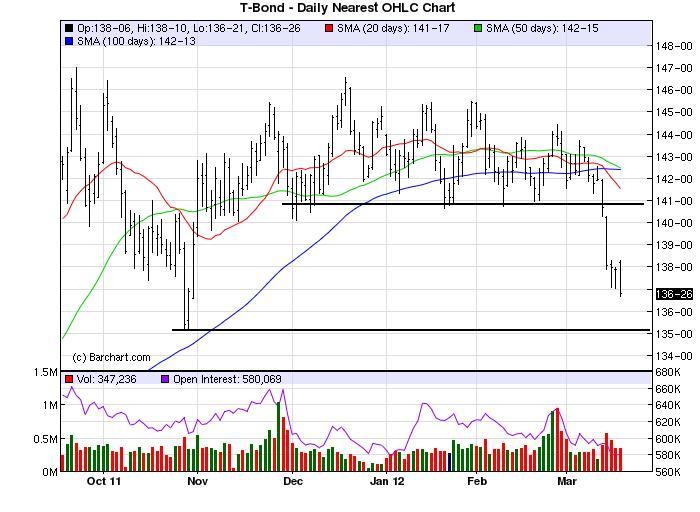
The former safe havens – U.S. treasury bonds, gold, and the Japanese yen — have been swan diving of late.

Gold concerns us.  We’ve been riding this bull for 8 years and we were even once mocked by the former Vice Chairman of the Federal Reserve Board on CNBC in 2005 for being bullish and linking it to easy monetary policy.  The yellow metal now seems to need ever increasing marginal liquidity to keep it moving or even just levitated.    We thought LTRO2 would blast it off and it didn’t.

Our biggest concern now is two of world’s largest current account surpluses,  of China and Japan,  are now shrinking or turning negative, thus diminishing the potential flow of surplus dollars, not only to be recycled into U.S. Treasuries, but also into the gold market.   Petro dollars will have to pick up the slack and then some.

We kind of fancy what Jack Crooks of Money and Markets wrote this weekend,

If so, it means Japan and China recycle less of their yen and yuan, respectively, back into the U.S. capital markets. And that means the global economy could finally see some rebalancing between the major deficit country, the U.S., and the major surplus country, China.

It also means the U.S. current account deficit, which seems to worry many people and economists alike, is likely to improve, as Japan and China morph increasingly into capital importers instead of capital exporters.

Has this rebalancing begun?

We don’t know yet. But interestingly, given the needs for Japan to rebuild and China to change its growth model, it could very much be the next major global macro trend for the global economy.

Nevertheless, when seeing market moves this large, this fast, all confirming each other it behooves us to ask, as Yosemite Bear Vasquez did when viewing the now You Tube famous double rainbow,

                                   What does this mean?

Global rebalancing, anyone?  The coming moves in various markets, which may well have already begun,  could be epic.

(click here if charts are not observable)

Posted in Black Swan Watch, Bonds, Currency, Dollar, Economics, Gold, Japan | Tagged , , , , , | 2 Comments

What’s Driving U.S. Inflation?

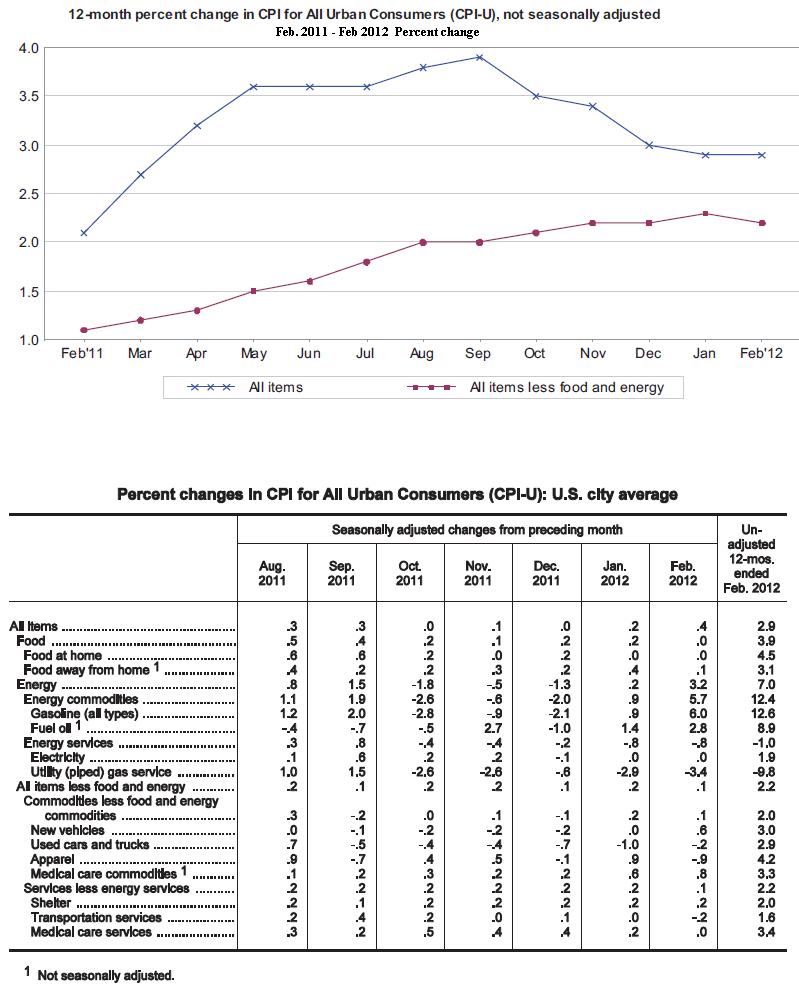
The Consumer Price Index for All Urban Consumers (CPI-U) in the U.S. increased 2.9 percent in February before seasonal adjustment.  These BLS charts and table illustrate what is driving the increase.

(click here is charts and table are not observable)

Posted in Economics, Inflation/Deflation | Tagged , , , | 1 Comment

China’s Depressed Animal Spirits

Here’s a report from Al Jazeera’s Rob McBride in Hong Kong.   We’re trying to diversify our China media sources in response to suggestions from our readers in Asia.   The caption to the video reads,

China’s strong consumer base has kept the country stable in times of global economic uncertainty.

But alternative economic indicators may now be pointing to tougher financial times for the world’s second-biggest economy.

The country’s towering skyline, made up of plenty of new but vacant buildings, is a sure indicator for many that it is heading for trouble.

Half of all the world’s skyscrapers currently under construction are in China.

And like New York in the run-up to the Wall Street crash of 1929, or Dubai before the 2008 financial collapse, analysts point to the link between building for pride and an impending economic fall.

Recall our piece in 2010 on China’s wine bubble.

(click here if video is not observable)

Posted in Black Swan Watch, China | Tagged , , , , , | Leave a comment

Week in Review: Open Season on Equity Bears x/ Pandas

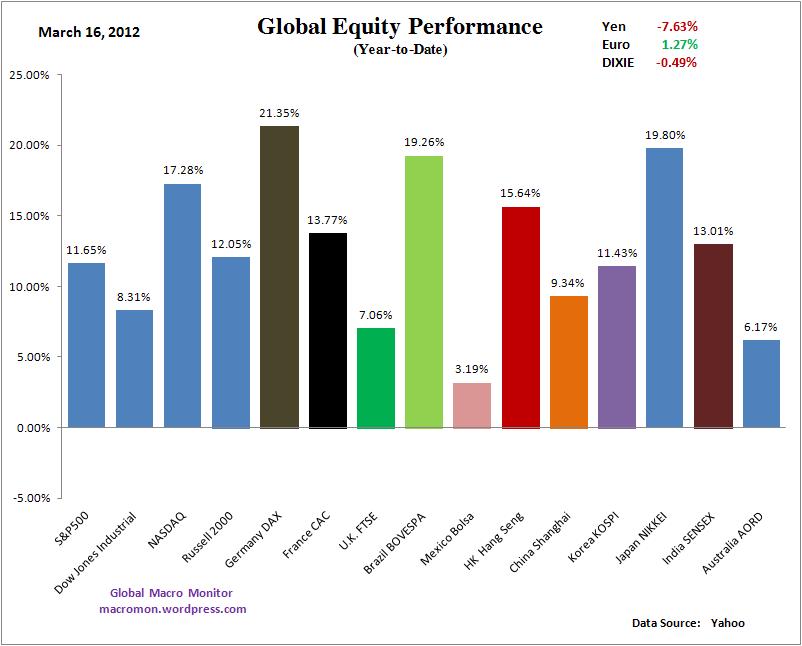
(click here if charts are not observable)

Posted in Uncategorized, Week in Review | Tagged , , , , , , , | 1 Comment

Game Change: Bakken Shale Production 1985-2010

We have this sense that the global economic tectonic plates are shifting before our very eyes.  America, the land of cheap energy and the new efficient production frontier?

Here’s Reuters last week,

America’s steel industry, for decades a symbol of industrial decline, is betting on natural gas to make it more competitive against foreign producers.

U.S. Steel Corp (X.N) and Nucor Inc (NUE.N), the two largest U.S. steel producers, are changing their traditional manufacturing processes as relatively cheap domestic natural gas supplies become more plentiful.

Some experts believe the new techniques will not only allow steelmakers to cut costs and lower selling prices at home, but also give U.S. companies a chance to compete with Japanese, South Korean and European rivals for a slice of the export pie.

The U.S. competitive in steel?   We were once asked in an interview at the Council of Economic Advisers what we thought of the U.S. government writing a $100K (1986 dollars!) check to steel workers displaced by foreign imports.

Stratfor also weighs in on the potential consequences of the collapse in natural gas prices,

…domestic natural gas prices have decreased rapidly as production levels have risen. The benchmark price of natural gas in the United States was about $88 per thousand cubic meters (mcm) March 2, down from about $135 per mcm the previous year and much lower than the prices in the European markets ($409 per mcm) or Japanese markets ($589 per mcm). Low natural gas prices are harming U.S. domestic producers, which need prices to hover around $140 per mcm to remain profitable…

Several other U.S. industries are also affected by lower natural gas prices. Natural gas fuels approximately one-quarter of U.S. electricity generation, an amount that is expected only to rise as the country moves to decrease dependence on coal. Natural gas is also used as a base material for numerous manufacturing operations in the petroleum, plastics and chemical industries, and anywhere from 5 percent to 15 percent of these operations’ expenses can be attributed to natural gas costs.

Lower natural gas prices could prompt manufacturing plants to remain in or move to the United States for production, as evidenced by Dow Chemical Co.’s recently announced intent to build its first new U.S. plants since 2001. Royal Dutch Shell announced in 2011 plans to build a new plant in the Appalachian region. Additional interest to increase production in the United States has been expressed by numerous other companies, including Formosa Plastics Corp., Chevron Phillips Chemical Co. and Occidental Chemical Corp.

So while traders fret over every 10 point move in the S&P5oo, this is what is happening in the real world.      Let’s hope the politicos and policymakers don’t screw this up with a fiscal or monetary crisis.

(click here if chart is not available)

Posted in Black Swan Watch, China, Commodities, Crude Oil, Energy, Fiscal Policy, Geopolitical | Tagged , , | Leave a comment

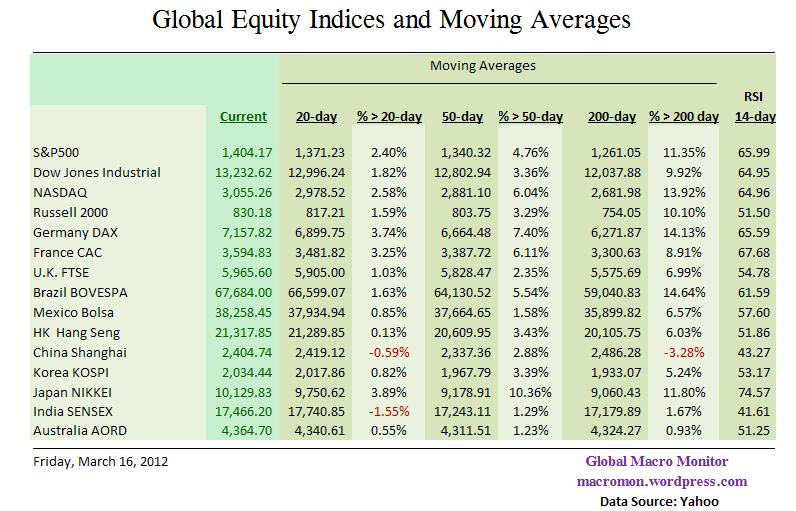
Global Trend Indicators

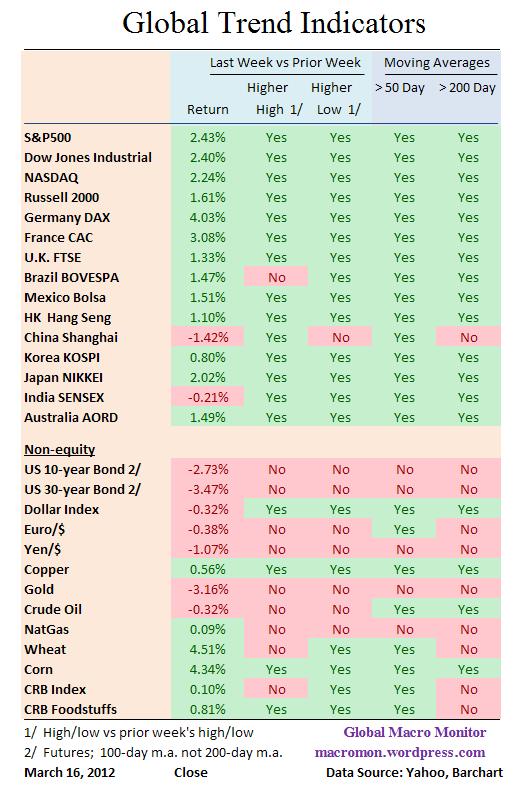
(click here if tables are not observable)

Posted in Global Trend Indicators | Tagged , , , , , , | 3 Comments

iPad Mania

People stand in a line to purchase Apple’s new iPad in front of Apple Store Ginza in Tokyo March 16, 2012. Apple’s new iPad went on a sale in Japan on Friday and more than 450 people waited on the line to purchase the new device in front of the shop prior to its opening.

(click here if picture is not observable)

Posted in Apple | Tagged , , | Leave a comment

China Development Forum 2012 Agenda

“China and the World: Macro Economy and Structural Adjustment”.

(click here for videos)

Posted in China, Economics | Tagged | Leave a comment

China Development Forum 2012: Christine Lagarde

From the International Monetary Fund website:

Opening Ceremony, China Development Forum 2012

Guest Speech by Christine Lagarde, IMF Managing Director
Beijing, Sunday, March 18, 2012

As prepared for delivery

Good morning.

It is an absolute pleasure to be back in Beijing and so soon after my excellent visit last November. My desire to be here reflects just how important China has become for the global economy.

It is a great privilege to be among such esteemed company. I would also like to thank Li Wei and his colleagues at the Development Research Center of the State Council for inviting me here today.

“China & the World: Macroeconomic Stabilization and Economic Restructuring.” At this juncture, I cannot think of a better theme for this year’s forum.

The specific economic challenges that countries face today naturally differ, with positive signs emerging in some corners of the globe and severe stresses still prominent in others. Yet, there are common goals that unite us all—the quest for growth and stability—lasting growth, shared growth, growth that delivers jobs and a better livelihood for all.

This event provides an excellent opportunity to reflect on the remarkable role that China is playing, and can continue to play, in pursuing these global goals.

I am very much looking forward to hearing Vice Premier Li Keqiang speak, as I’m sure you all are too. So, let me reflect briefly on two things: first, the state of the global economy; and second, China’s leading role in securing economic stability and prosperity.

Global Economic Challenges

The past few years have been extremely difficult for many parts of the world. And, even just a few months ago, the situation was decidedly gloomy. Indicators for the last quarter of 2011—namely for Europe and the United States—did not provide much reassurance.

Yet, today, we are seeing signs of stabilization; signs that policy actions are paying off. Financial-market conditions are more comfortable and recent economic indicators are beginning to look a little more upbeat, including in the United States.

Important decisions and policy actions, particularly by the European Central Bank and some European countries, have helped. I have said for some time that we can avoid the worst if all partners play their part.

Moving forward with renewed support for Greece—from both the IMF and European partners—is an important milestone in this regard. The measures are ambitious and it will be important to focus on implementation and monitoring, but we have made an important step forward.

On the back of these collective efforts, the world economy has stepped back from the brink and we have cause to be more optimistic.

Still, optimism must not lull us into a false sense of security. There are still major economic and financial vulnerabilities we must confront. I’ll mention three.

  • First, financial systems are still fragile and high public and private debt persists in many advanced economies—euro area public sector and bank rollover needs total about 23 percent of GDP during 2012. Renewed pressure in either area could compound the other, leading to much larger, and more protracted, contractions in credit and output.
  • Second, the rising price of oil is becoming a threat to global growth.
  • And, third, there is a growing risk that activity in emerging economies will slow over the medium term.

And we must not forget that there are still too many people, in too many countries, who are enduring the hardship of unemployment.

So, the global economy may be on a path to recovery, but there is not a great deal of room for maneuver and no room for policy mistakes.

It is often said that a reputation is “gained in inches and lost in miles”. The same could be said of economic progress. All countries must persevere with their policy efforts if the progress of yesterday is to translate into the promise of a brighter tomorrow.

So, what are the main challenges?

  • The advanced economies need to capitalize on the newly gained breathing space and push forward with policies that will enable them to emerge from the crisis. This means continued macroeconomic support and a balanced fiscal approach, together with financial sector reforms and structural and institutional reforms to repair the damage done by the crisis and to improve competitiveness.
  • Emerging market economies need to calibrate macroeconomic policies—both to guard against further fallout from the advanced economies as well as to keep overheating pressures in check. And, by continuing to invest in reforms—such as increasing social transfers or lowering consumption taxes—they can, over time, translate higher growth into better living standards for all.

China’s Leadership

This brings me to my second point—China’s global leadership.

For many years now, China’s economic successes have captured the world’s attention. We have looked on in awe as, year after year, China has posted spectacular growth and, in the space of three decades, created 370 million jobs and lifted half a billion people out of poverty.

When the global crisis hit, China again showed leadership and adept policy skills. Indeed, the global economic situation might have been even more calamitous had it not been for the impetus that China provided to growth and stability.

China’s leadership role in global institutions has mirrored these economic successes. As one of the IMF’s largest shareholders and as an influential member of the G-20, China has been instrumental in helping to make the global economic system less prone to damaging crises.

Yet, lingering weaknesses in the global outlook reinforce the importance of China continuing to forge ahead—by maintaining a prominent role in global policy discussions and by sustaining its efforts to accelerate the transformation of the Chinese economy.

So, as I see it, the priorities for China are now threefold:

  • First, to support growth. On this score, China is in the enviable position of having the space to provide some modest fiscal support for its economy as outlined at the recent National People’s Congress.
  • Second, to continue shifting the drivers of economic growth away from investment and exports, and toward domestic consumption.
  • Third, to improve household livelihoods so that China’s citizens may all share in the dividends of high and sustained growth.

I am encouraged that the government has embraced these goals, reflected in the comprehensive policy agenda in the recent 12th Five Year Plan.

Conclusion

Finally: If I had one piece of advice for policymakers around the world, I might borrow the words of Confucius:

“In all things, success depends on previous preparation.”
凡事预则立, 不预则废

We have seen China’s previous preparation bear the fruits of today’s success. And we are beginning to see the small successes from recent action in Europe.

But today’s risks are still very much global. We are all interconnected and we are all affected by each other’s policy actions. We need to prepare for success together. If we stand together, the whole will be more than the sum of the parts.

And, in this, China is a leader of the global economy—leading by example, leading by responsible economic policy, leading by engagement.

Thank you.

Posted in Black Swan Watch, China, Economics | Tagged , , | Leave a comment