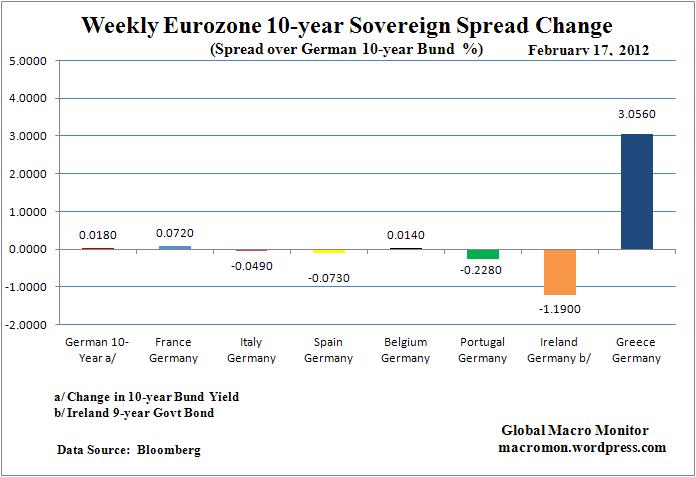
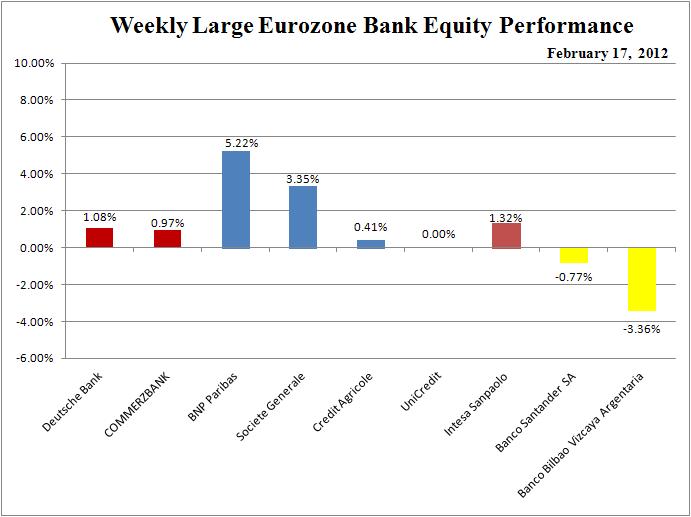
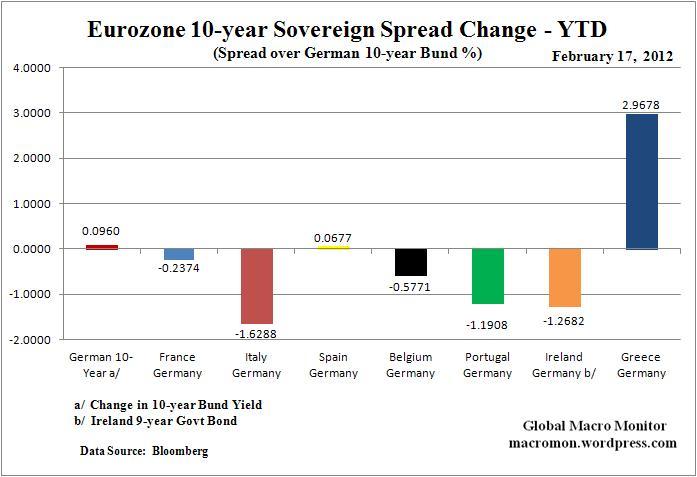
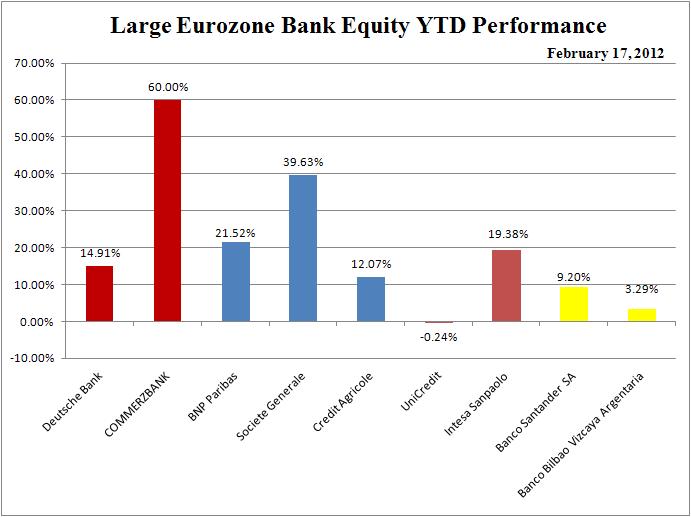
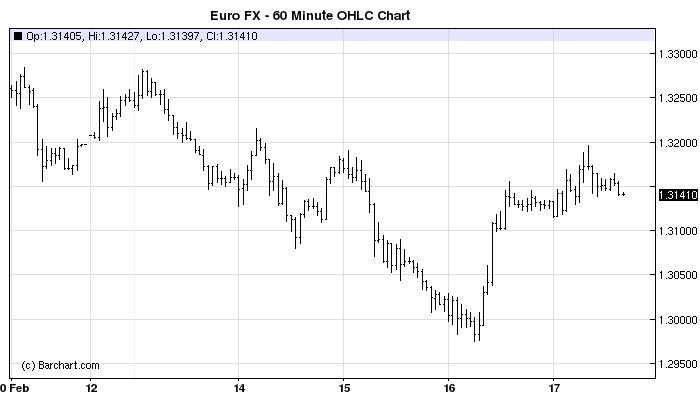
Weekly Eurozone Watch

(click here if charts are not observable)

Posted in Weekly Eurozone Watch | Tagged , , , , , | Leave a comment

Is the Fed ready for the bond market’s Arab Spring?

We’ve updated our database of the Federal Reserve’s ownership of the U.S. Treasury coupon curve.  The resulting chart highlights a couple of interesting issues about its structure and holdings of outstanding notes and bonds.

First, though nothing new, it shows the relatively small stock of longer dated securities and illustrates the ease at which the Fed can repress longer term interest rates and engineer short squeezes.   The result has been the castration of the bond market vigilante and early grave for many hedge fund managers.

Second, the Fed holds over 40 percent of the Treasuries outstanding in several of the years in which they mature.  In many of the specific maturities, the Fed owns up 60-70 percent of the total outstanding issue.  The Fed had to “relax” its self imposed 35 percent limit on SOMA holdings of individual issues and included recently issued securities in order to execute its maturity extension program announced last September.

It’s going be interesting to see how longer-term interest rates behave as the economy regains some of its mojo and money comes out of the Treasury safe haven.    The Fed has yet to fight the markets in its repression of long rates as Operation Twist has been riding the tail winds of positive market psychology and strong demand for safe havens due to Europe’s sovereign debt and banking crisis.   See chart below.

As the issuance and stock of longer dated Treasuries increase with a larger structural U.S. budget deficit the Fed will need more firepower than just the interest earnings and roll off of maturing securities to keep rates from rising, in our opinion.   They will need an even bigger bazooka if they are seen falling behind the curve on the economy or inflation.  They will need a tactical nuke if the markets begin to lose confidence in the U.S. government’s fiscal and debt policies and starts to price credit risk.   As the greatest QB in NFL history once said, “Confidence is a very fragile thing.”

No wonder there’s still talk of quanto easing and reassurance from the FOMC that interest rates will stay at “exceptionally low levels…at least through late 2014” even as the stock market moves back to levels not seen since before the Lehman Crisis.   Either stocks are wrong at pricing a better future than a U.S. monetary policy still in crisis mode or it will need more QE crack to keep the buzz alive and momentum intact.

We’re the first to admit nobody knows the future, most of all us,  but we smell a potential fight or flight in the bond market, comrades.  An Arab Spring in the bond pit, if you will.    With oil prices north of $100 and rising rents, which is the largest component of the CPI, it is our sense the Fed better be able “to float like a butterfly and sting like a bee.”

We know it’s too early, but maybe this potential macro swan — rising interest rates and an emerging crisis of confidence in the Federal Reserve and the U.S. G’s fiscal and debt policies — has a fatter tail than currently perceived and should be on the radar.  You never know,  for sure, until you do, but then it’s too late.   Thus, we will constantly remind ourselves of this in the new bull market in stocks — i.e., to make sure we panic before everyone else.

As they say in the ring, “Ladies and Gentleman, Let’s get ready to rumble!”

Click on charts to enlarge and for better resolution.

(click here if charts are not observable)

Posted in Black Swan Watch, Bonds, Sovereign Debt, Sovereign Risk | Tagged , , , , , | 3 Comments

The Greek Tragedy

(click here if video is not observable)

Posted in Black Swan Watch, Euro, PIIGS, Sovereign Debt, Sovereign Risk | Tagged , | Leave a comment

Apple Gone Wild!

Apple is in full parabolic repricing mode.

The stock, alone, has created $150 billion of wealth since early October, which is almost 1 percent of U.S. GDP.   The market cap has become so large that if AAPL is repriced to a multiple that we think its deserves, the economy and markets are going to look much different than they do today.    Think about the “wealth effect”  a repriced Apple will have just on the allocation and rebalancing of portfolios.

We can’t recall, however, seeing an RSI of 95 — short-term severely overbought — in this stock and are hoping for some sideways action to consolidate the gains before moving on up.    You know our view, however,  the global central banks have set the stage for another massive asset bubble and they are probably going to get it, in our opinion.

The story is in place — the wireless revolution.  Valuations are not unambiguously extreme,  or, at least,  still ambiguous, and many, if not most,  are still not in the game.   Furthermore, the macro swans that spoiled last year’s party have either drowned in central bank liquidity or temporarily flown the coop (as in China hard landing).   “Temporarily” is a perception that keeps the wall of worry in place and also makes for some dangerous trading in parabolic moves.

Ride ‘Em, Cowboy!

(click here if chart is not observable)

Posted in Apple, Equities | Tagged , , | 2 Comments

Spain facing fine over manipulating deficit data

We’re shocked, shocked to find out that governments manipulate their economic data.   Not!

(click here if video is not observable)

Posted in Black Swan Watch, Euro, Fiscal Policy, PIIGS, Sovereign Debt, Sovereign Risk | Tagged , , | Leave a comment

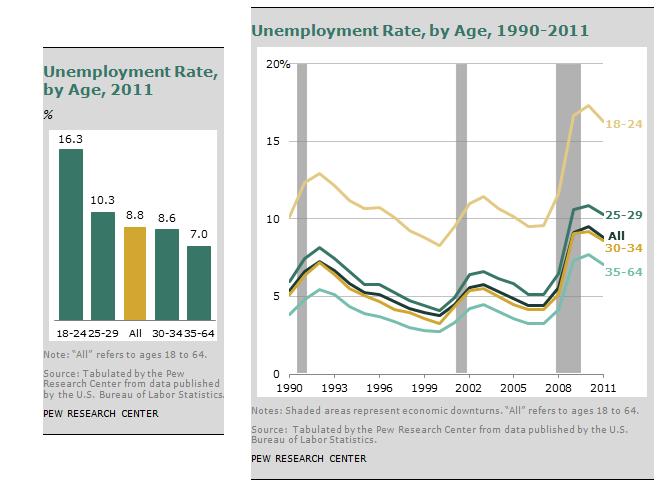
Clash of Generations: Young Adults Hit Hard

Take a look at the Pew Research Center’s study of the relative unemployment rates among various age groups in the United States.   Young adults have been hammered by the Great Recession.

Isn’t this the generation that is going to pay off the debt their parents and grandparents have run up?

We’ve posted several pieces on our view of a coming clash of generations.    Here is something from the Pew  piece to fan those flames,

Older adults have maintained their standard of living. If any age group has weathered the economic storm better than others, it has been adults ages 65 and older. In a 2004 Pew Research survey, similar shares of young adults (50%), middle-aged adults (52%) and older adults (50%) rated their personal financial situation “excellent” or “good.” By 2011, a large gap had opened up between older adults and everyone else: 54% of older adults gave their personal financial situation a high rating, compared with roughly one-third of younger and middle-aged adults.

Stay tuned.

(click here if charts are not observable)

Posted in Demographics, Employment | Tagged , | 1 Comment

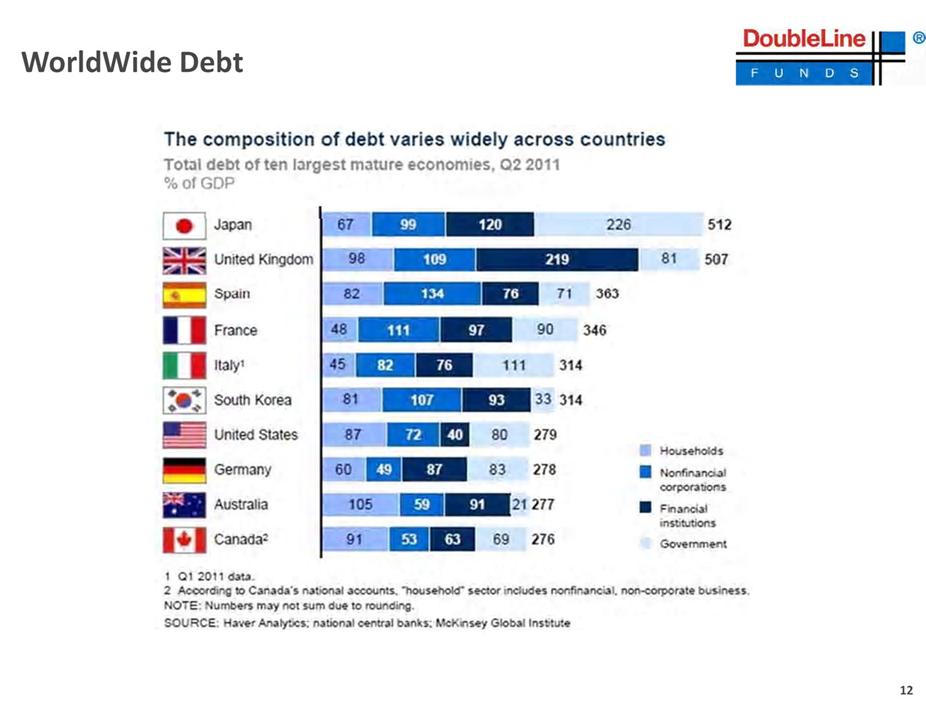
Worldwide Debt

Shocking chart from Jeffery Gundlach’s  “Fall of the Roman Empire” presentation.

Looks like the global central banks’ balance sheet expansion is only in the first inning.   Not by choice but by necessity.

Freakin’ stunning!

Click on chart to enlarge and for better resolution.

(click here if chart is not observable)

Posted in Black Swan Watch, Bonds, Budget Deficit, Sovereign Debt, Sovereign Risk | Tagged , , | 1 Comment

Athens traders count the cost of anti-austerity riots

(click here if video is not observable)

Posted in Euro, PIIGS, Sovereign Debt, Sovereign Risk | Tagged , , , | 2 Comments

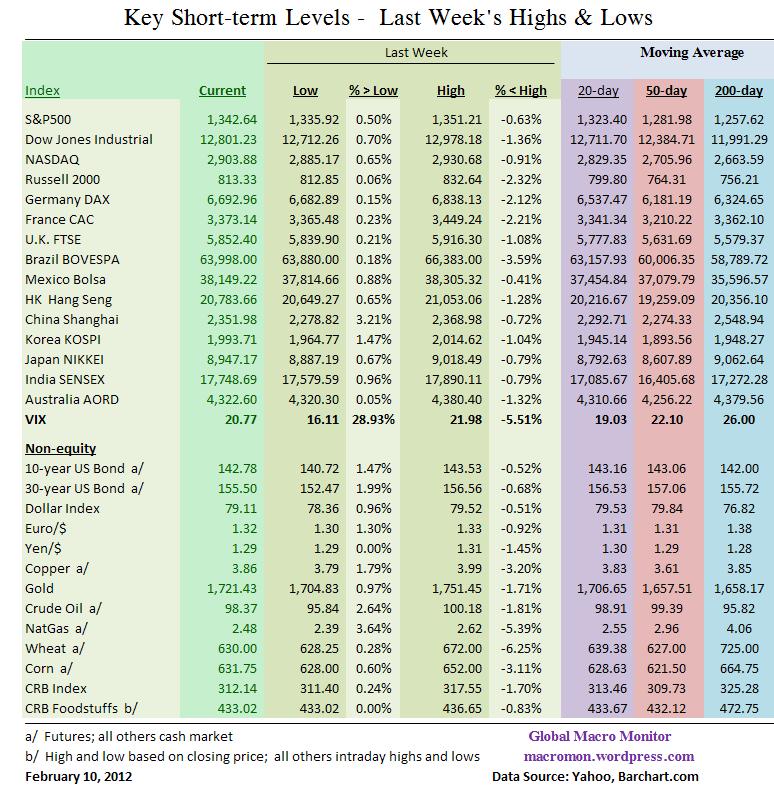
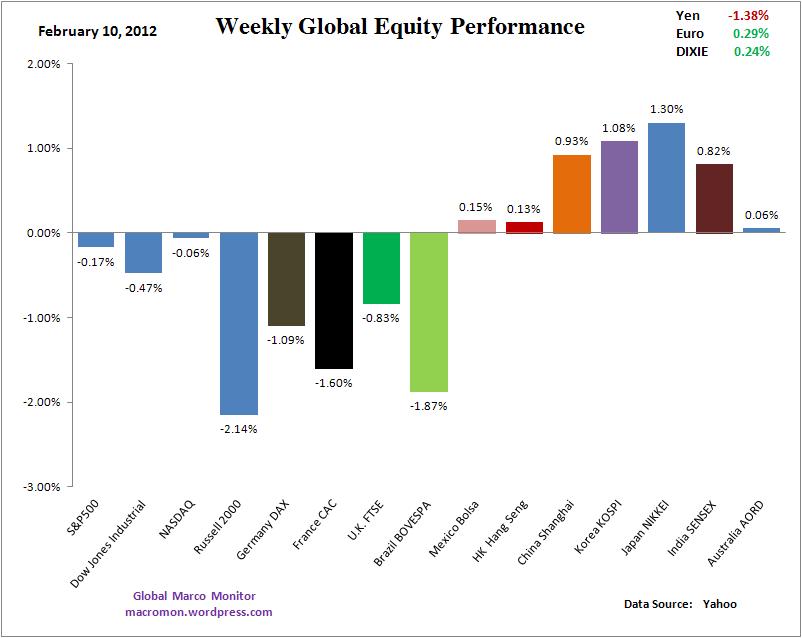
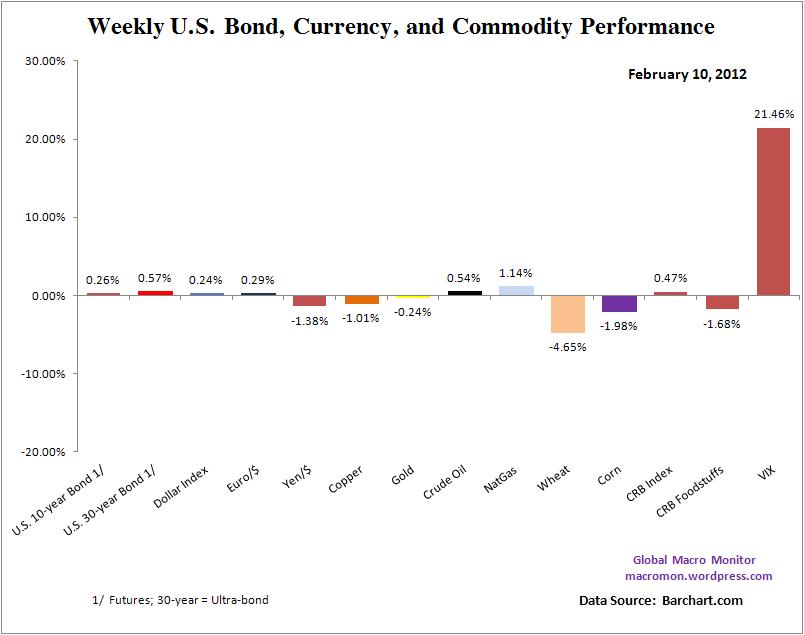
Week in Review: VIX spikes

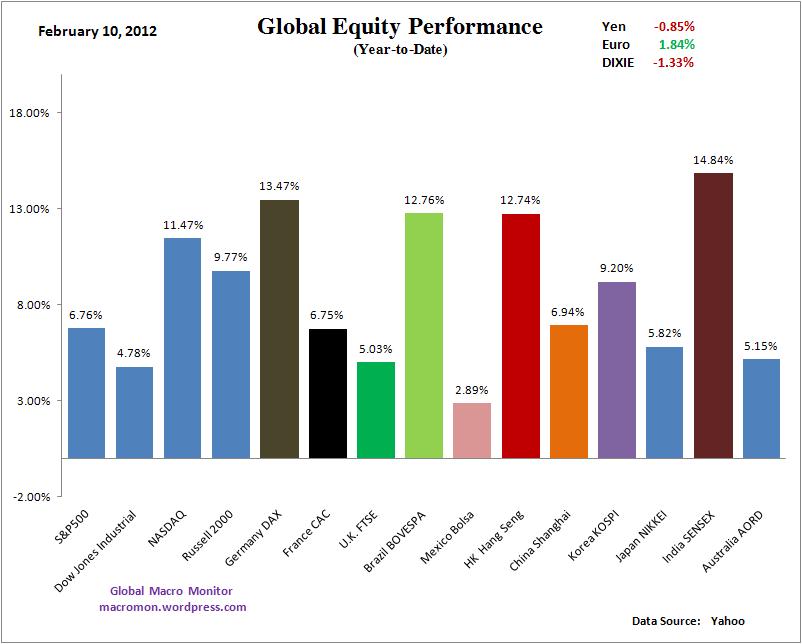
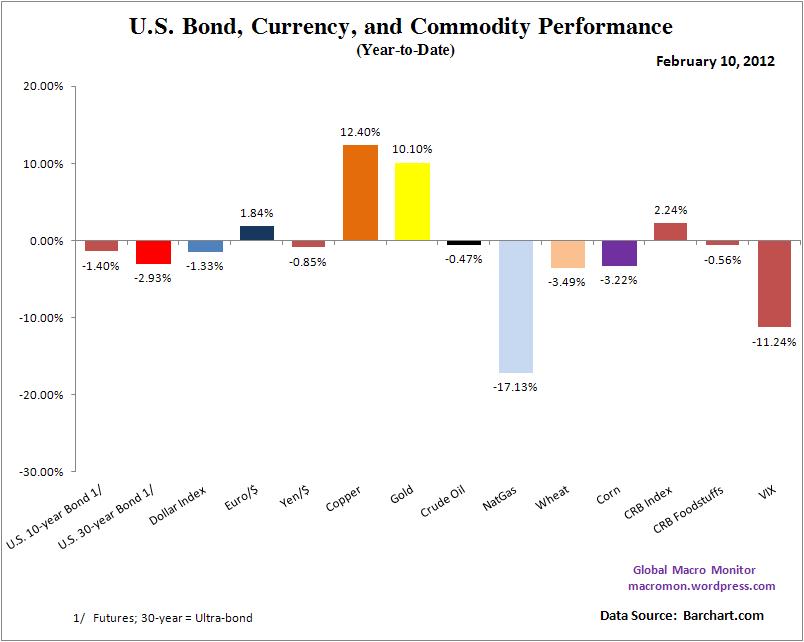
We have added the Australia All Ordinaries Index to our tables, not just because of our friends down under but because it is a player in the international equity market.   Also note the spike in the VIX.

(click here if charts are not observable)
Posted in Week in Review | Tagged , , , , , , , , | 1 Comment

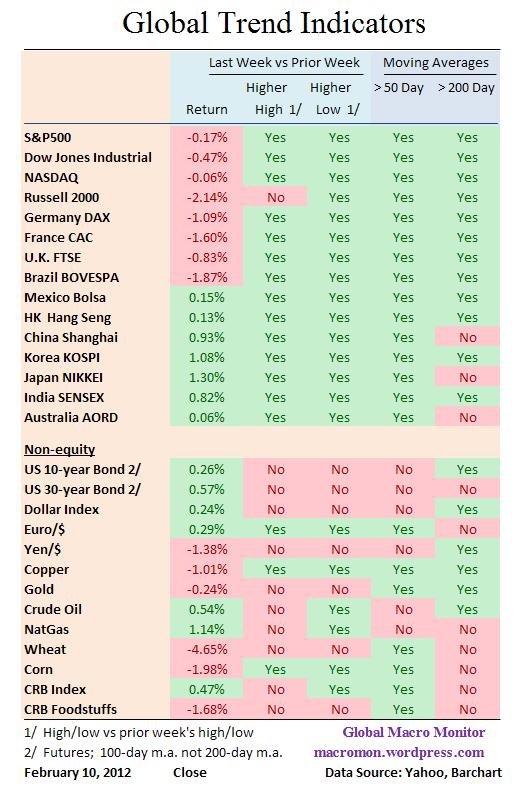
Global Trend Indicators

(click here if tables are not observable)

Posted in Global Trend Indicators | Tagged , , , , , , , | 1 Comment