The 2012 Blind Side: China’s Housing Bust

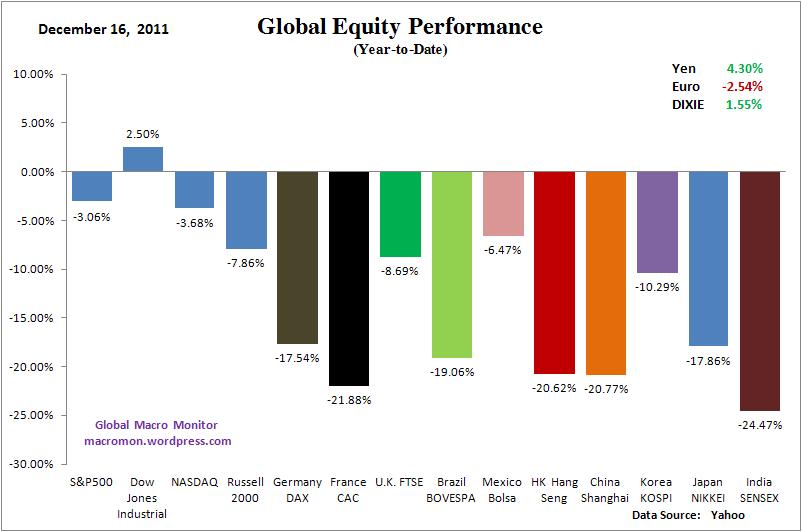
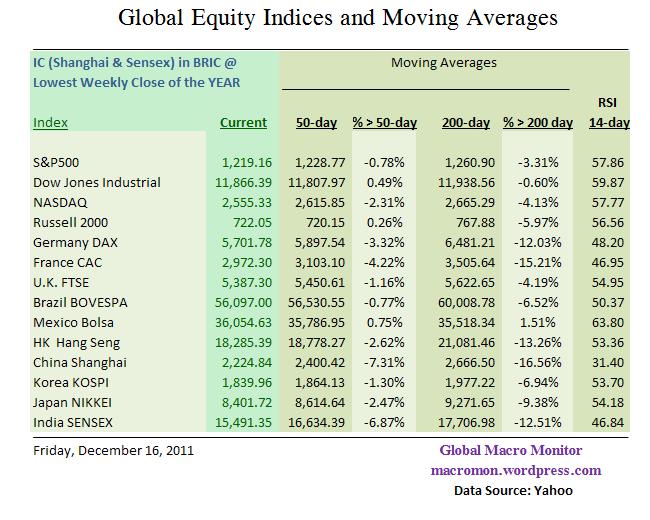
As the world’s attention focuses on the death of Kim Jong Il and shorts keep piling up in the Euro,  China’s real estate bubble appears to have finally burst.   This is the one macro swan that could really smack developed markets in 2012 as few are focused even though the Shanghai composite and Hang Seng are down over 25 percent from their highs earlier in the year.  Both are down 21 percent for 2011 with Shanghai closing at its lowest weekly close for the year on Friday.

Foreign Affairs has just posted a must read piece, China’s Real Estate Bubble May Have Just Popped,  which will sound very familiar to Global Macro Monitor readers.

Here are a few money quotes,

For years analysts have warned of a looming real estate bubble in China, but the predicted downturn, the bursting of that bubble, never occurred — that is, until now. In a telling scene two months ago, Shanghai property developers started slashing prices on their latest luxury condos by up to one-third. Crowds of owners who had recently bought apartments at full price converged on sales offices throughout the city, demanding refunds. Some angry investors went on a rampage, breaking windows and smashing showrooms. 

Shanghai homeowners are hardly the only ones getting nervous. Sudden, steep price reductions are upending real estate markets across China. According to the property agency Homelink, new home prices in Beijing dropped 35 percent in November alone. And the free fall may continue for some time. Centaline, another leading property agency, estimates that developers have built up 22 months’ worth of unsold inventory in Beijing and 21 months’ worth in Shanghai. Everyone from local landowners to Chinese speculators and international investors are now worrying that these discounts indicate that “the biggest bubble of the century,” as it was called earlier this year, has just popped, with serious consequences not only for one of the world’s most promising economies — but internationally as well…

The next three months will be a watershed moment for a Chinese investor class that has been flush with cash for years but lacking a place to put it. Instead of developing a more balanced, consumer-based economy, an entire regime of Beijing technocrats — drunk on investment-led growth — let the real estate market run red hot for too long and, when forced to act, lacked the credibility to cool the sector down. That failure threatens to undermine the country’s continued economic rise.

This should put the Wukan protests in the Guangdong province in better context,

In a few cities, such as coastal Wenzhou and coal-rich Ordos, the collapse in property prices has sparked a full-blown credit crisis, with reports of ruined businessmen leaping off building rooftops; some are fleeing the country. The central bank’s decision on December 5 to lower the reserve requirement ratio for the first time in three years signaled a broader move to pump money into the economy. Beijing has directed banks in Wenzhou to extend emergency loans to troubled borrowers. Of course, officials could halt the sell-off simply by handing developers enough cheap loans to allow them to carry their inventory. But such a strategy risks re-inflating the bubble.

The impact of a housing downturn would have a significant impact globally. International suppliers who have been fueling China’s construction boom — iron-ore miners in Australia and Brazil, copper miners in Chile, lumber mills in Canada and Russia, and multinational equipment makers such as Caterpillar and Komatsu — could be hard hit. Heavy losses on real estate and related lending could damage investment and consumer confidence, undermining the rising tide of Chinese demand that has been a much-needed growth engine for everything from Boeing airplanes to Volkswagen and GM automobiles to KFC and McDonald’s fast food.

We’re going to be spend a lot time over the holidays thinking how this plays out in China’s financial sector and the implications for markets.

Finally, this should sound familiar as the author, Patrick Chovanec, writes,

Beijing’s response to the global financial crisis added jet fuel to the fire. To maintain GDP growth of nearly ten percent during a massive downturn in global demand, China’s leaders engineered a lending boom that expanded the country’s money supply by roughly two-thirds. Real estate was already the preferred place for the Chinese to stash cash; now, investors had that much more cash to stash. Prices rose accordingly: In many locations, the cost of prime new properties doubled in just two years.

But this run of speculation has bid up the price of housing and left people who actually need a place to live in the lurch. Given the prices prevailing earlier this spring, the average wage earner in Beijing would have had to work 36 years to pay for an average home, compared to 18 years in Singapore, 12 in New York, and five in Frankfurt. The bidding war has further pushed developers to build ever more costly luxury properties that investors crave but few ordinary people can afford.

Take the time to read the piece in full.   It may help as you determine your 2012 strategy.

Posted in Black Swan Watch, China | Tagged | 2 Comments

Week in Review: Will Santa Keep Stocks on the Naughty List?

In a low volume market with almost no liquidity anything can happen.  In the past few days there have been sellers of the S&P500 at the 50-day moving average, however,  and the market will need a catalyst to bust it higher and spook the shorts.

Lot’s of chatter over the weekend that the ECB’s new collateral and three-year lending facility is a backdoor “big bazooka” as banks can now put on a massive sovereign carry trade thus providing the backstop the markets have been looking for.  We’re skeptics but will let the markets decide on this one.

In the past few months,  bank stocks have been rewarded by announcing reductions in sovereign exposure,  not increases.    We don’t fully dismiss this positive scenario, however,  as sovereign risk is all about market confidence and, we believe,  at least Italy has a chance to regain it.    Watch sovereign spreads, mainly in Spain and Italy,  and equity prices of the large European banks as a clue that this scenario is unfolding.

Add North Korea to your radar screen.   Monitor for regime stability in the short-term.  More certain uncertainty to an already uncertain 2012.

(click here if charts are not observable)

Posted in Black Swan Watch, China, Week in Review | Tagged , , , , , , | 2 Comments

CNBC Interview: Julian Robertson, Hedge Fund Legend

“I am breathing hard and scared…”

In case you missed it,  we’re posting Julian Robertson’s  interview with CNBC’s Squawk Box from last week.   Click below to hear Mr. Robertson opine on the various topics.  A must watch.

Where markets are headed.  Click here.
Printing Money Is Not the Answer
.   Click here.
Invest in China Cautiously. 
Click here.

                              (click here if picture is not observable)

Posted in Whales | Tagged , | Leave a comment

Global Trend Indicators

(click here if tables are not observable)

Posted in Global Trend Indicators | Tagged , , , , , , , | 1 Comment

Nonlinear Thinking: Drone High Rise Construction Workers?

Imagine if/when this becomes scalable.   Another potential example of the structural change taking place in the labor force and employment trends.  Remember the 11th Commandment:  Those who remain flexible shall not be broken (and better let your children grow up to become engineers!).

(click here if videos are not observable)

Posted in Employment, Nonlinear Thinking | Tagged , , , | Leave a comment

European Bank Recapitalization

                                                                     Source:   Der Spiegel

(click here if chart is not observable)

Posted in Black Swan Watch, Euro, Sovereign Debt, Sovereign Risk | Tagged , , | 3 Comments

Crony Capitalism Illustrated…

The revolving door to and fro.  And this is just one firm in one country, folks!

(click here if chart is not observable)

Posted in Politics | Tagged , | 2 Comments

Now for Some Hope Before Christmas…

OK.  We’ve posted some gloomy pieces tonight and can’t leave you without some Hope.  Take the 10 minutes and watch it.  It will make you thankful for the memories if you’re old enough and educate you about an American cultural icon if you’re not.  Hat tip Lawrence “of America” Wagner!

(click here if video is not observable)

Posted in General Interest | Tagged | 4 Comments

China’s Wukan Protests: This Time is Different

As the world prepares to ring in the New Year, we read the headlines and watch the news and the words of W.B. Yeats keep ringing louder in our ear,

Things fall apart; the centre cannot hold;
Mere anarchy is loosed upon the world…
The best lack all conviction, while the worst
Are full of passionate intensity.
Surely some revelation is at hand;

The following video about China’s Wukan protests is truly a revelation.  Stratfor writes why,

So why is this one any different? There are several things about this protest that have caught our attention.

First, the duration. The villagers have maintained these protests for over several months. Usually these protests die down when local officials are able to buy off a handful of people or strike some sort of negotiation.

Second, the numbers. Although the protesters themselves only amount to a thousand or so citizens, the entire village of approximately 20,000 appears united in its stance against the local government.

And third, the response. The protests lead to the retreat of village officials and the cordoning off of the entire village from any ingoing or outgoing traffic. Although we’ve seen this tactic employed at least once before in Zhejiang province, it is not common and therefore notable.

As we’ve always stated before, many of these protests are local and can be contained locally. Ultimately they pose little threat to the central government. However, we’ve noted several incidents, including the recent protests over a factory in Dalian, where the local government has capitulated to citizen demands…

As China’s economy slows — and we are witnessing a rapidly slowing economy as Europe’s economic turmoil affects China’s exports — protests increase and put increasing pressure on Beijing to manage local uprisings with dwindling economic resources.

As similar protests occur throughout the country, and if they demonstrate the same level of solidarity as in Wukan, Beijing will be forced to respond and will do so through a mixture of force and incentives.

If Beijing mishandles these protests — and the margin for error increases as the protests expand and become more united — the focus could turn to the central government. Further, if protest tactics are able to increasingly force a favorable response for the citizens, they become emboldened. In the end, Beijing will not hesitate to resort to force, especially if the mandate of the Chinese Communist Party comes into question.

The Chinese will ring in their New Year on January 23rd.  The “Year of the Dragon,” which is the only animal of the Chinese zodiac calendar that is not real and seen as a symbol of power, superiority and rule.

(click here if video is not observable)

Posted in Black Swan Watch, China | Tagged , | 7 Comments

Bubble Trouble in the U.S. Heartland?

The “smart money” has been buying up farmland hand over fist for the past few years and you can see how they helped drive up land prices in the U.S. heartland.   Some think this is the place to be if the shit really hits the fan.  Not gold, but productive assets that you can eat.

Remember the Jan. ’09 NY Magazine piece of the U.S. hedge fund manager entertaining buying a zodiac and “putting it in storage unit on the West Side, so he could get off the island quickly” in the event of a total financial collapse and social breakdown?   Same concept.

On a similar topic, see here for an interesting Telegraph article on how the British military is concerned about the potential collapse of the Euro.   The Telegraph writes,

The military planning work has come to light after The Daily Telegraph disclosed last month that British embassies in the eurozone have been told to prepare emergency plans for the demise of the euro and the possible civil disorder that could follow.

Nevertheless,  with ag commodities starting to rollover,  farmland prices have probably seen their best days.   The Wall Street Journal reports,

The Federal Reserve issued a memo to farm bankers in late October warning that the market for cropland “may reflect overly optimistic long-term expectations” and that land values would fall if interest rates increase abruptly and farm profits shrink.

The sharks smell blood and no doubt the hunt for overly exposed farm banks is on.

(click here if charts are not observable)

Posted in Black Swan Watch, Commodities | Tagged , | 1 Comment