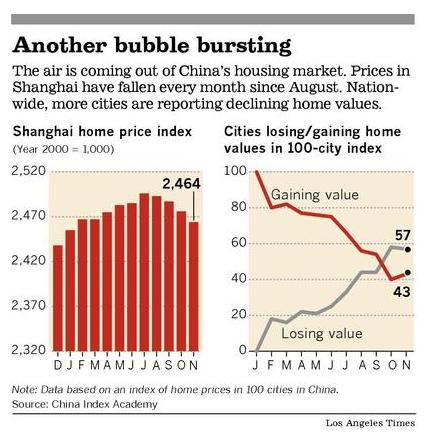
China’s Deflating Housing Bubble

Much of China’s rapid credit — 33 percent in 2009 — as part of its massive stimulus program was directed into nonproductive sectors.   Balance sheet risks have increased.   Sound familiar?

This could be next year’s big bad story.    Commodities as reflected in the CRB index, which broke support today, seem to think so.

(click here if chart is not observable)

Posted in Black Swan Watch, China, Commodities | Tagged , , | 1 Comment

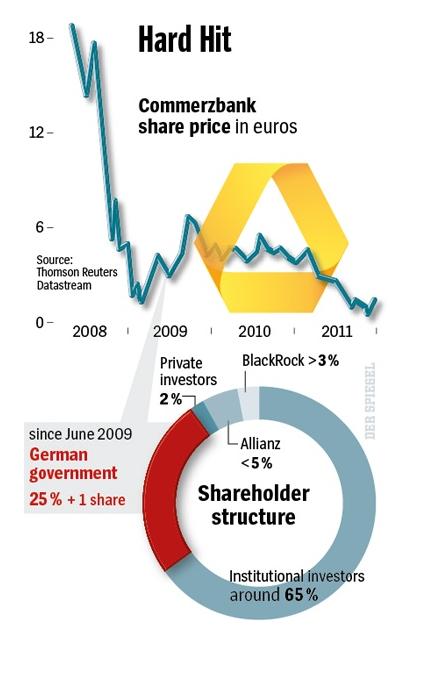
Wither Commerzbank

As the markets digest the Reuters report Commerzbank is seeking more state aid here’s  an interesting graphic from Der Spiegel.   Where’s that hidden bazooka?

(click here if chart is not observable)

Posted in Black Swan Watch, Euro, Sovereign Debt, Sovereign Risk | Tagged , , , | 1 Comment

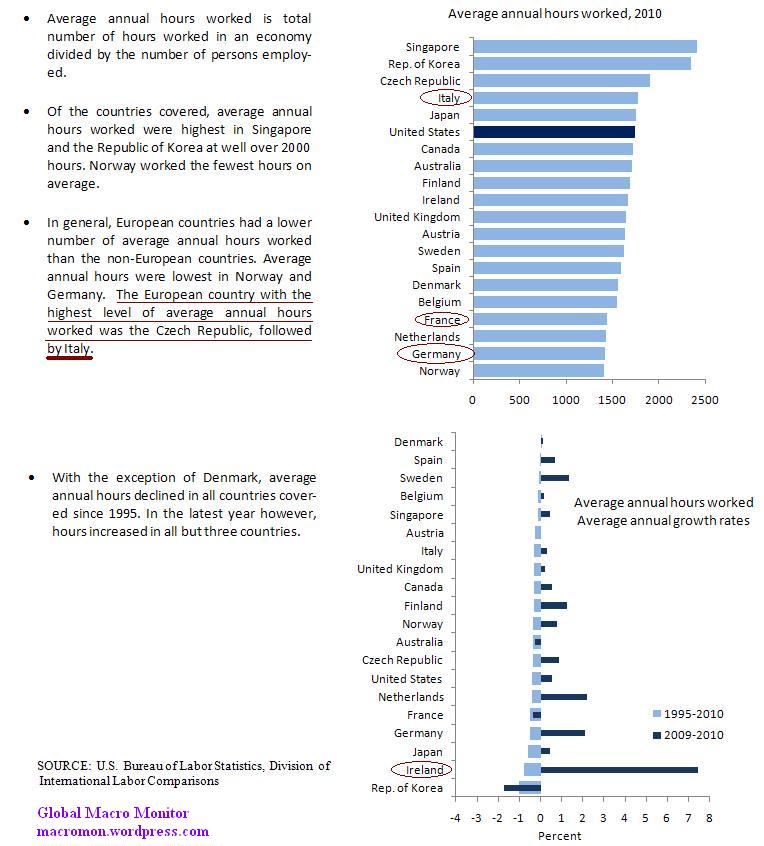
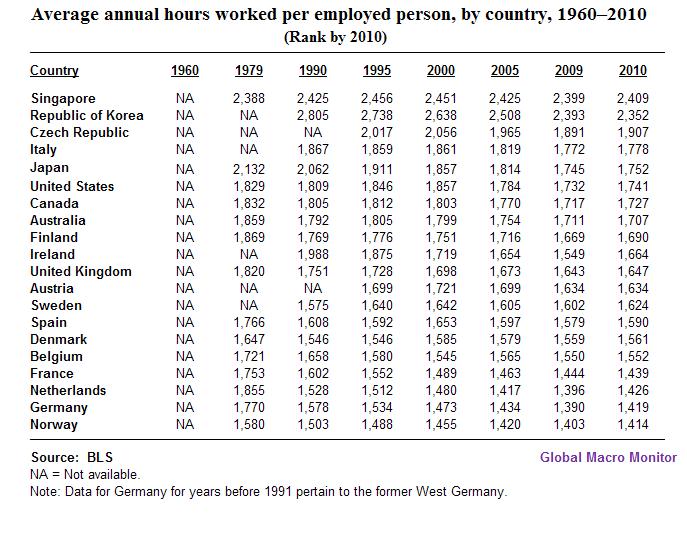
Italy Works Over 20% More Hours Than Germany and France

The stereotype of lazy southern Europe and the hard working North is just not reflected in the data.   We came across this BLS data set over the weekend which was very enlightening and, in part, smashes this widely held generalization.

First, a couple caveats.  It is macro data — total number of hours worked in an economy divided by the number of people employed –, may be subject to measurement errors, doesn’t take into account productivity per worker, and ignores deleterious labor policies that may contribute to unemployment.

Nevertheless, the data and charts below show that the average number of hours worked for an employed person in Italy – 1,778 hours in 2010 – is 25 percent higher than that of Germany’s 1,419 hours.   The French are not far off.  The average number of hours worked by an employed person in France was 339 hours less than in Italy, or Italy’s average hours worked was 23 percent higher than France.   Surprising, no?

The data also interestingly shows that Ireland’s average number of hours worked increased dramatically from 2009-10, increasing by over 7 percent.     The market seems to like it as Ireland’s bonds have been some of the best performing in the world since July with their sovereign spread over 10-year German bunds tightening more than 500 basis points.

Unfortunately, we didn’t have data for the rest of the European periphery.

(click on chart and table for better resolution)

(click here if charts are not observable)

Posted in Black Swan Watch, Employment, Euro, Sovereign Debt, Sovereign Risk | Tagged , , , , | 5 Comments

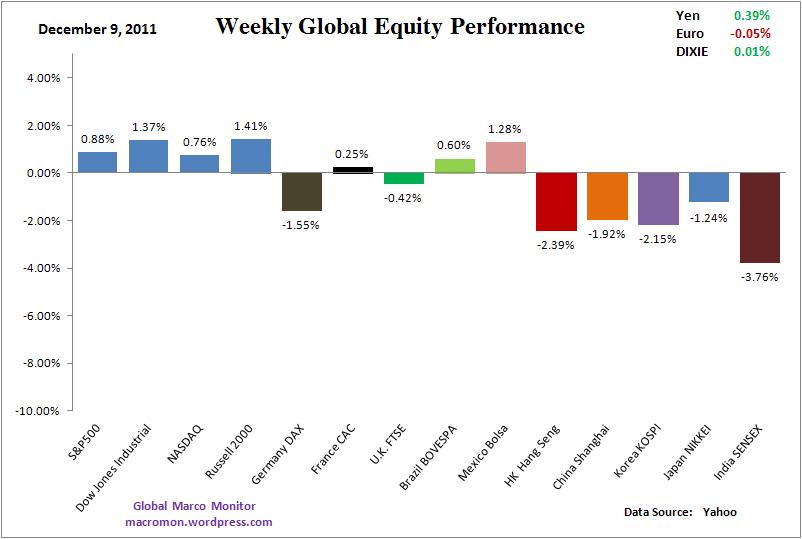
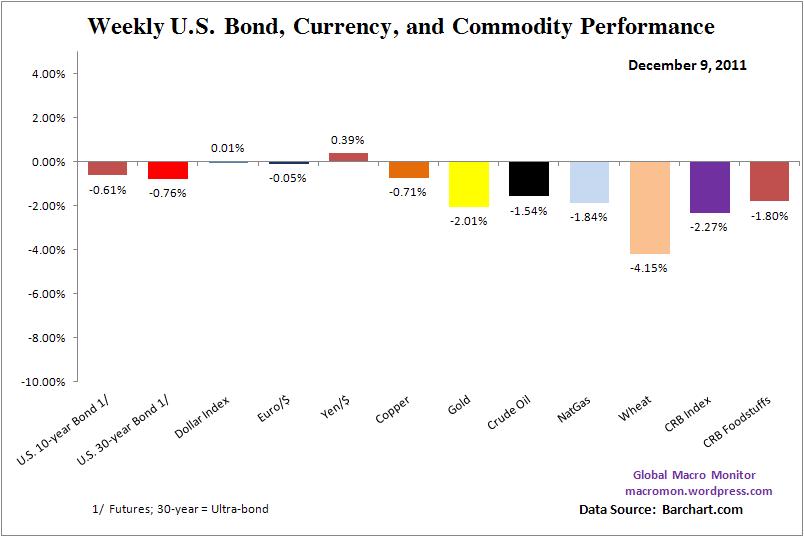
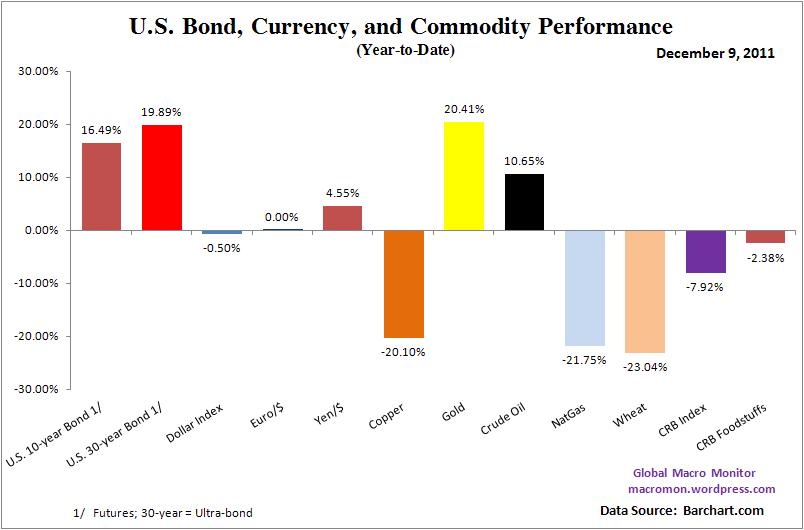
Week in Review: Dow Up 5% for Year

(click here if charts are not observable)

Posted in Week in Review | Tagged , , , | Leave a comment

Interview: Italian Prime Minister Mario Monti

(click here if video is not observable)

Posted in Black Swan Watch, Euro, Sovereign Debt, Sovereign Risk, Video | Tagged , , | 1 Comment

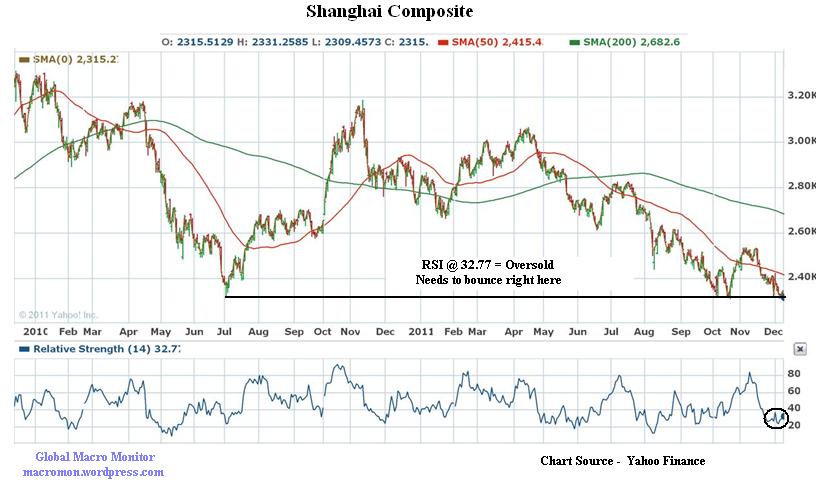
The Ugly Chart Contest

Here’s a couple ugly charts we’re monitoring:   China’s Shanghai Composite stock index and Commodity Research Bureau Index (CRB).   Do you think there’s causality here?  Remember the “China is buying/hoarding every commodity” story?

Both are at key support levels.    Stay tuned.

(click here if charts are not observable)

Posted in China, Commodities | Tagged , , , | 1 Comment

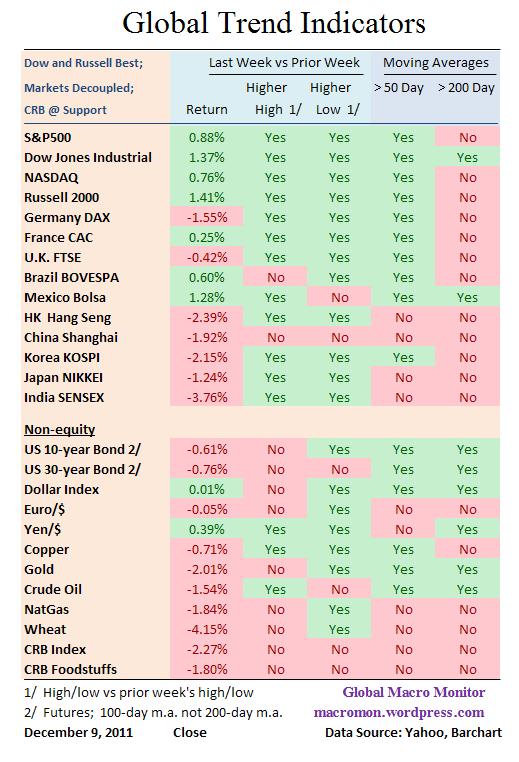
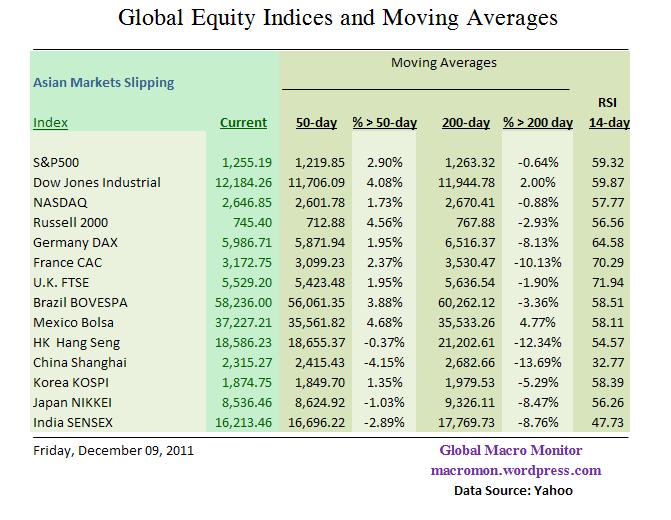
Global Trend Indicators

(click here if tables are not observable)

Posted in Global Trend Indicators | Tagged , , , , , , | 1 Comment

Tough Christmas in Greece

(click here if video is not observable)

Posted in Black Swan Watch, PIIGS | Tagged , | 1 Comment

The EU’s Camouflaged Bazooka?

Many were disappointed that the EU Summit didn’t conclude with a hard number backstop for the ‘zone’s sovereign debt rolling over next year.   We believe if you scratch the surface the bazooka is there.

The EU President, Herman Van Rompuy, stated in the wee hours of this morning,

As regards private-sector involvement, we have made a major change in our doctrine: from now on we will strictly adhere to the IMF principles and doctrines,” and added “or, to put it more bluntly, our first approach to PSI, which had a very negative effect on debt markets is now officially over.

We read this as an unequivocal backstop even if the official statement is not explicit.

If their PSI approach is over, that is bailing in the banks and bondholders who hold the questionable sovereign debt , the full blown bailouts, if needed, will continue.    By explicitly stating PSI is over, the EU is implying the big bazooka will be there to fund any shortfalls in rolling over bond maturities.

The earthquake and severe aftershocks that has shaken even the German banking system and has increased global systemic risk has put the fear of God in the EU leaders.   They now know what’s at stake but a wholesale bailout of the banks and bondholders is a hard sell to their domestic constituents and parliaments.   Ditto for debt monetization and the German public.

The EU may have also learned an important lesson that the markets will surely test any number they put on the bazooka.   The fiscal pact is a step in the right direction and clears the way for ECB bazooka if needed, in our opinion.  Furthermore, many analysts were very skeptical after the details were released, yet the markets are up and sovereign spreads are slightly tighter.   This is a good sign.

The structural problems are far from solved and the markets will be back to challenge the Eurozone’s resolve, but it does appear the fiscal pact has provided the fig leaf for some short-term relief, and, ironically may have camouflaged the bazooka, if you don’t look carefully.   The markets may be up today because the numbers don’t add up.

Yes, Virginia, there just may be a Santa Claus rally this year and nobody believes it.   We are fully aware of the S&P Grinch who could downgrade these countries next week.  Should they?

A close above 1263.32, the 200-day SMA, on the S&P500 could set off the rampfest into year-end that we’re expecting.    We’re mainly traders, can always could be wrong,  and always use stops.  Stay tuned.

                                      (click here if chart is not observable)

Posted in Black Swan Watch, Euro, Sovereign Debt, Sovereign Risk | Tagged , , , | 8 Comments

Nonlinear Thinking: Drone Valet Parking Attendents

Wow!  Life is getting too easy.   Guess the driving tests of the future will require the knowledge of how to use a smart phone.  Just another example of Schumpeterian innovation that will destroy some jobs and create others.  No more negative externalities — i.e., fender benders?   Bad for body shops!

If this doesn’t convince  you we’re on the elbow of the technology exponential curve, nothing will.   Stay tuned, it’s going to be interesting next 20 years!

Hat tip Lawrence “of America” Wagner!

(click here if video is not observable)

Posted in Nonlinear Thinking | Tagged , , , | 4 Comments