Stocks On A Long Monetary Leash

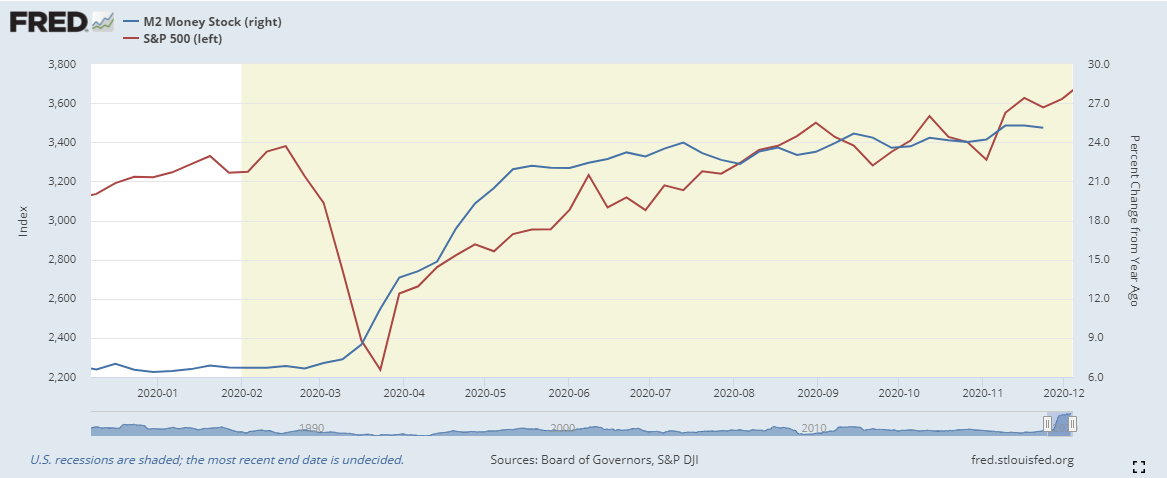
M2 Money Stock – Weekly % Year-on-Year Change 
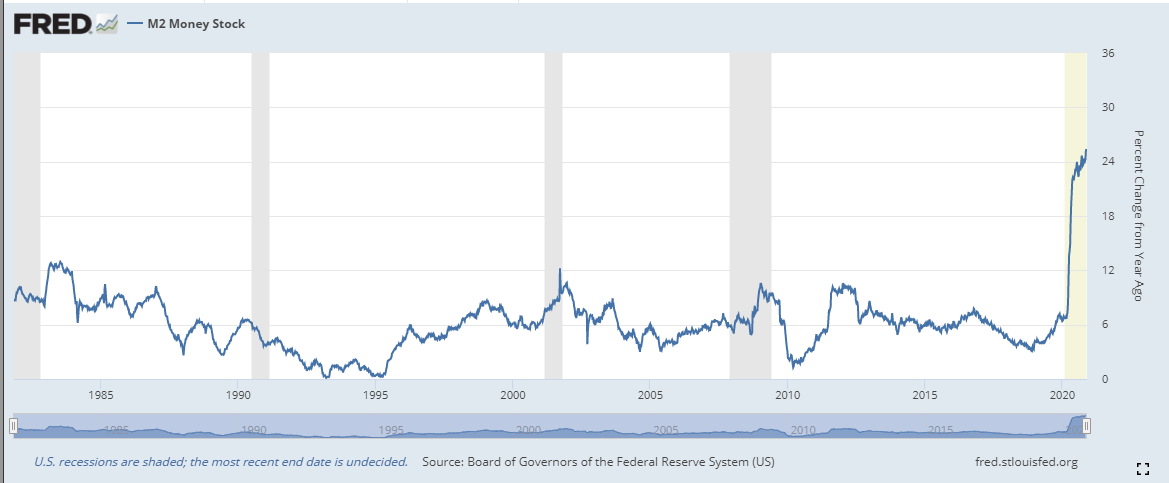
Stunning to see the weekly monetary aggregates (M2) continue to grow at an unprecedented 25 percent year-on-year rate.  Not so stunning to see the stock market mania being led and fueled by the money supply growth.

Yet, it is stunning, actually frightening, to see stocks need the 25 percent money growth to sustain its momentum.

This is unprecedented and unsustainable as inflationary pressures are and will surely continue to build even in the flawed official measures. Recent data now show M2 grew north of 1 percent in November month-on-month.  The challenge mounts in March when the moving prior 12-month stock of money will be at a much higher base.

The monetary aggregates are also subject to the creation of engodenous money and the vagaries of credit expansion and contraction in the private markets,  which are increasingly harder to measure, track, and forecast.  This crisis is the first that we can recall where the monetary emissions from the central bank have been so large and come without being in the midst of a major credit crisis.

One could argue, however, that a mini and stellar sovereign crisis erupted in the U.S in early March as the Treasury market began to seize up leading to the Fed’s massive intervention into the Treasury market in mid-March.

We posted the following just a few days before,

Can the U.S. government finance its $1.2 trillion plus annual deficits with an entire yield curve at less than 1 percent?  

We seriously doubt it and the Fed is going to have to step-up big time with QE, non-QE, or let’s just call it for what it is, monetization.  —GMM, March 8th

The stock market’s momentum must continue or else.

“There Is No Plateau, No Middle Ground”

The economic situation in a country after several years of bubblelike behavior resembles that of a young person on a bicycle; the rider needs to maintain the forward momentum or the bike becomes unstable. During the mania, asset prices will decline immediately after they stop increasing—there is no plateau, no ‘middle ground.’ The decline in the prices of some assets leads to the concern that asset prices will decline further and that the financial system will experience ‘distress.’ The rush to sell these assets before prices decline further becomes self-fulfilling and so precipitous that it resembles a panic. The prices of commodities—houses, buildings, land, stocks, bonds—crash to levels that are 30 to 40 percent of their prices at the peak. – Charles Kindleberger 

S&P500 And M2 Money Weekly Year-on-Year Growth 
Inflationary Pressures Building 

We closely follow the manufacturing industry, especially the electronics sector, where inflationary pressures are increasing dramatically.

This from the latest global PMI. Some hoarding is actually breaking out in various sectors as producers are expecting higher input prices due to continued supply chain issues and strong demand.
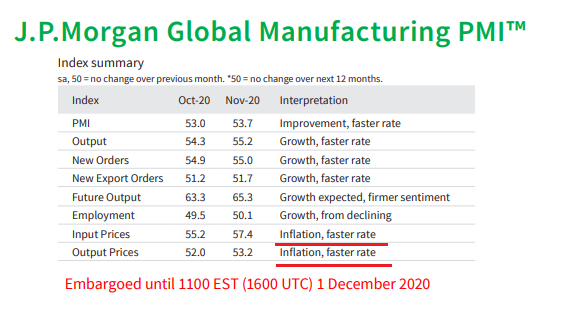
Watch especially semiconductors.  Recall our post on how the long secular deflation in semiconductor prices may be coming to end.

…what we believe has been one of the largest factors, along with globalization to the disinflationary forces over the past 30 years. That is the secular decline in the price of semiconductor prices.  Semiconductors are the basic building block of today’s economy, as was oil during the industrial revolution.  – GMM,  Oct 2020

Inflation Expectations 

Inflation expectations are also rising across the board.

Stocks and corporate bonds aren’t the only markets that have been looking past the pandemic—the bond market’s gauge of inflation expectations has strengthened back to pre-Covid levels as well. – Barron’s

Surprised? 

After all,

Inflation is always and everywhere a monetary phenomenon in the sense that it is and can be produced only by a more rapid increase in the quantity of money than in output. – Milton Friedman

The FED 

We sense the Fed governors also sense and are growing increasingly concerned about all of the above and becoming reluctant to continue “carpet bombing” the economy with more monetary stimulus.

Federal Reserve Bank of Chicago President Charles Evans said Friday that although the latest job creation data is disappointing, he wasn’t yet ready to call for changes in central-bank monetary policy. – WSJ, Dec 4th

The economy as a whole is running pretty hot (GDP Now at 11.2% Q4 print) and even though the latest lockdowns as COVID cases spike could slow things a bit, economic output should be close to fully recovering its losses from the Q4 2019 peak by year-end.
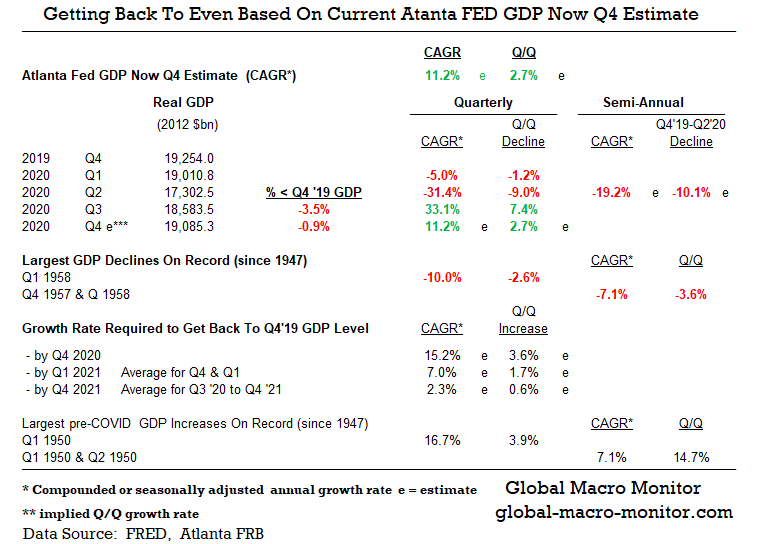
 

This image has an empty alt attribute; its file name is gdp-3.png

Two Economies

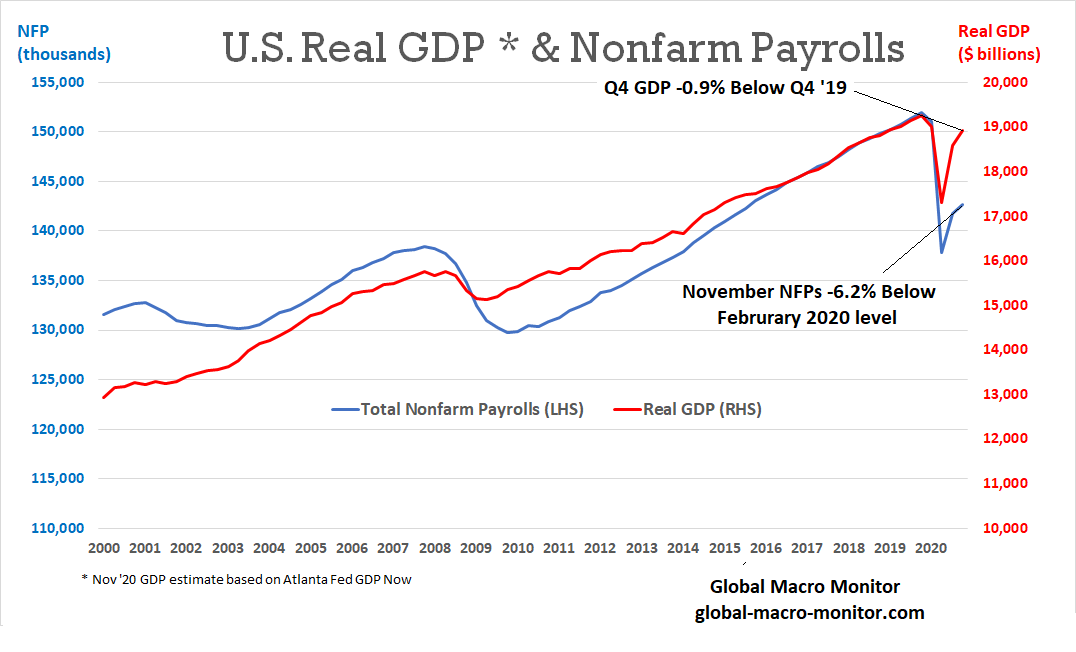
It is better to think of A Tale of Two Economies, the super-hot economy, which has benefited from the COVID crisis, and the depressed economy, such as travel and hospitality, where employment is still 20 percent below February 2020 levels vs -6.2 percent for total nonfarm jobs.

Labor Market Lagging Economic Rebound 

The following chart illustrates the labor market is significantly lagging the economic recovery.  Not uncommon but the distance between the two economic indicators is a bit surprising.  

We suspect the hit to small businesses — who employ almost 50 percent of the labor force — accelerated automation and technology-led productivity increases are the main culprits, and we also suspect the pandemic has accelerated the disruptions and the technological-led structural economic change.

In other words, nobody knows what the future holds.  Us mere humans think linearly and extrapolate past and present to the future, society and the economy progress in a nonlinear fashion.
It’s unlikely the FED is going to slam on the breaks anytime soon but it does sound they are growing increasingly concerned that there is too much stimulus in such a hot economy.

Cruise Missiles, Not Carpet Bombing

We believe economic policymakers will have to resort to strategic precision strikes on the weak pockets of the economy by bringing out the cruise missiles of targeted fiscal policies rather than using the blunt tools of monetary policy.  Using monetary policy to fine-tune an economy, for example, especially an economy full of so many distortions, is tantamount to threading a needle with boxing gloves on.  Good luck with that.

Still,  the question remains how does Treasury finance another round of stimulus without resorting to the digital printing press as demand for its debt securities is so punk at these fake and repressed interest rates?

The Fed’s Dilemna

A 25 percent growth rate in the monetary aggregates is clearly unsustainable but the stock market is addicted and dependent on that liquidity emission, which is driving its forward momentum and keeping the bicycle rolling.   Therein lies the rub, folks.

We don’t see a way out and expect the term “inflation” to come back into the lexicon of the market geniuses much sooner than most think.

A further issue to consider is given the substantial imbalances that have built up in the economy and financial market over the years,  there is no middle ground on the inflation/deflation spectrum endgame but only what economists call a corner solution.   That is lots of inflation or deflation.

What is going to happen to the stock market, for example,  if the Fed normalizes monetary policy with the monetary aggregates growing only at their normal rates of, say, 5-8 percent year-on-year?   What if the Fed has to keep the monetary spigots on to keep the asset markets afloat?  It doesn’t take a rocket scientist to see the rabbit hole monetary authorities have descended in to over the past 10 years.

The Carol K. Provisio 

Finally, we do have to give a shout out to Carol K.,  GMM’s crack stock picker, noting what she has pounded into us in 2020 — that the stock market is a market of stocks and some stocks, especially the tech stocks of the future, are in a secular bull market.  We are thankful that she is on board and acts as a check on our natural contrarian tendencies to bet against the market.

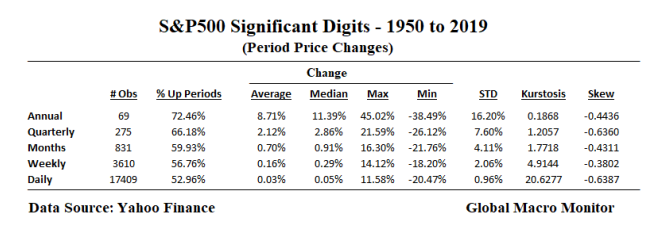
Permabulls automatically bat .700 as the stock market has risen 72 percent of the time on an annual basis over the past 70 years.  That’s too easy.
Posted in Coronavirus, Economics, Uncategorized | Tagged , , , , , , | 1 Comment

The Paradox Of Value & The Water-Diamond Paradox

Times they are a changin’.

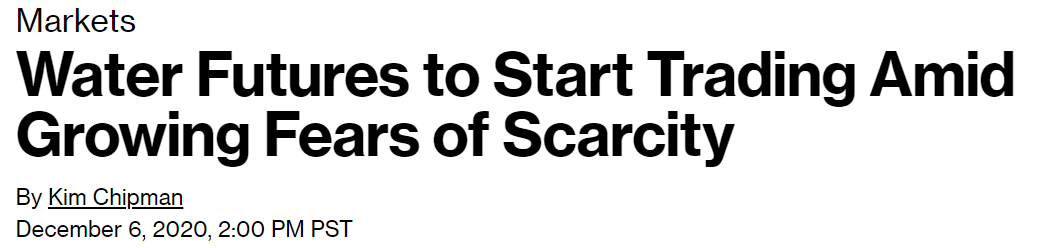
Water is joining gold, oil and other commodities traded on Wall Street, highlighting worries that the life-sustaining natural resource may become scarce across more of the world.

Farmers, hedge funds and municipalities alike will be able to hedge against — or bet on — potential water scarcity starting this week, when CME Group Inc. launches contracts linked to the $1.1 billion California spot water market. According to Chicago-based CME, the futures will help water users manage risk and better align supply and demand. – Bloomberg

While you grapple with the water-diamond paradox,  I am wrestling with one of my own:  the Bitcoin-J&J Stock paradox.   Which is more “valuable?”

Can someone help me out here?


Posted in Uncategorized | Leave a comment

Amazon Set To Become The Fastest Growing Healthcare Co

Healthcare will be the most disruptive sector in history, what’s about to happen to healthcare in the next two years in the United States. – Professor Scott Galloway, NYU Stern School of Business

Michael Smerconish‘s opening segment in last Saturday’s show is a must view, folks.

It also parrots what Carol K. has been pounding the table about and beating into me over the past year.  The COVID crisis has accelerated the trends, both good and bad, and the tech disruption party is just getting started.

Amazon took 25 years to get to half a million employees. It’s now — it’s added half a million in 12 months.

Apple took 42 years to get to $1 trillion in market capitalization. It went from $1 trillion to $2 trillion in just 20 weeks. Take any trend in society and in the business sector, take it out 10 years and chances are we’re there right now. This has literally reached into the future and pulled it — pulled it forward for us, both good and bad.  Prof. Scott Galloway

Anti-Trust Is Coming

The following data is stunning – 82 percent of U.S. households are Amazon Prime Members.  That is incredible market power.

I personally think Jeff Bezos, who’s the smartest business person in the world will likely spin AWS prophylactically and my prediction, Michael, is that in the year 2025, the most valuable company in the world will be a recently spun, independent AWS.

The largest most profitable cloud company in the world would have — would be a stock that everyone would own. The most profitable — most valuable company in the world, 2025, Amazon to try and prophylactically stave off antitrust, but antitrust is coming, Michael. – Prof. Galloway 

Hope you can view the video in its entirety but if pressed for time go to 2:06 minutes in to catch Smerconish’s interview with Professor Scott Galloway of the NYU Stern School of Business.

It’s no accident Amazon just flipped on their pill pack acquisition and you can now speak to an Amazon pharmacist 24 by 7. We’re going to see, for the first time potentially, healthcare costs come tracking down or crashing down.

I think Amazon’s going to be the fastest-growing healthcare company in the world within two to three years and we’re going to see maybe the potential to get off our heels and play defense around healthcare and go onto our toes and have a level of primary care delivered in the home which potentially or ideally could lower costs and dramatically expand affordability.  – Prof. Galloway

Posted in Healthcare, Technology | Tagged , , | 1 Comment

These Robots Are Running California Farms

Posted in Uncategorized | Leave a comment

Be Thankful!

Happy Thanksgiving, folks. Be kind and help someone in need.

Found this Thanksgiving gem by Natalie Cole. Dedicated to the one I love.

Posted in Uncategorized | Leave a comment

Why Have Electric Cars Taken So Long To Develop?

Posted in Uncategorized | 1 Comment

Janet Yellen Now Favored To Become Treasury Secretary

President-elect Biden is expected to name some of his Cabinet picks on Tuesday,

President-elect Joseph R. Biden Jr.’s transition team will officially announce its first cabinet appointments on Tuesday, said Ron Klain, Mr. Biden’s incoming White House chief of staff, although he declined to say which ones.

The names of at least three expected cabinet appointments were released on Sunday night by people close to the decision process, including Anthony J. Blinken for secretary of state, Jake Sullivan as national security adviser and Linda Thomas-Greenfield as ambassador to the United Nations. – NY Times

Update

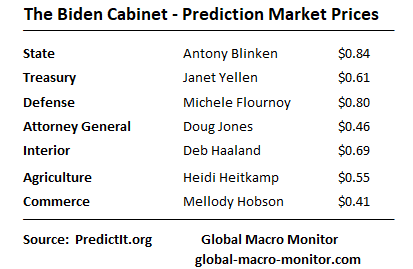
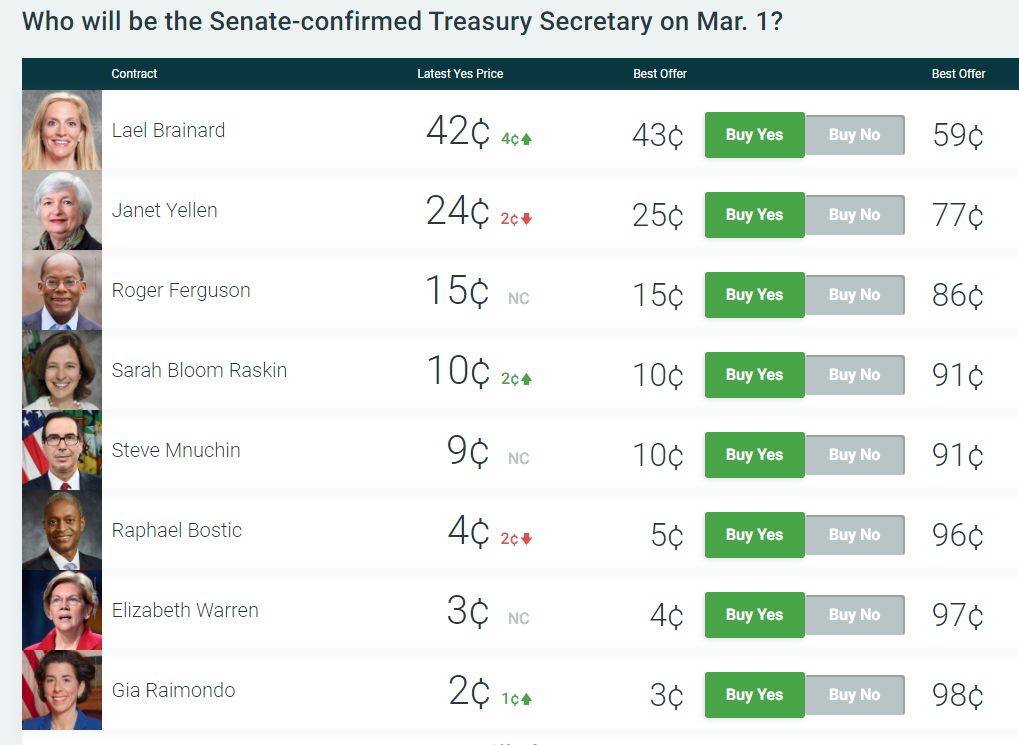
Since our post on the market bets at PredictIt.org for President-elect Biden’s Cabinet picks,  Janet Yellen has soared to become the favorite for Treasury Secretary.  Lael Brainard is not even in the hunt anymore.

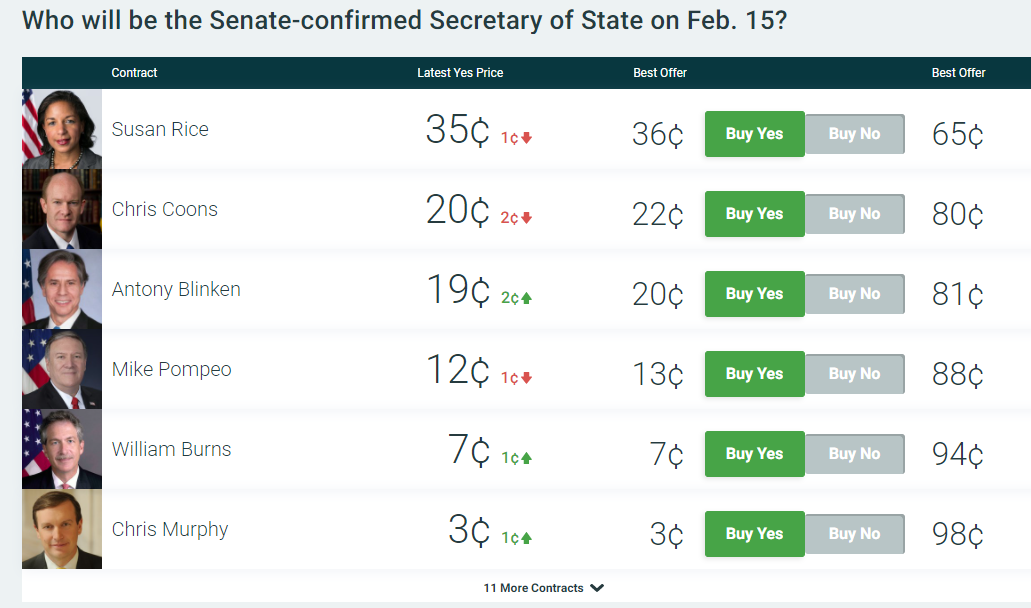
In addition, Anthony Blinken is reportedly a done deal at State.

Bernie Sanders is running a distant fourth, at $.08, to Marty Walsh to become Secretary of Labor.

As we stated in that post,

The prediction markets are the worst forecaster except for all others. 

Stay tuned.

Posted in Politics | Tagged , | Leave a comment

How COVID Has Turbo Charged Big Tech – FT

What happens when a pandemic collides with technological change? Covid-19 has shaken business to its core. The FT’s Lex maps how the landscape is changing – FT

Posted in Coronavirus, Technology, Uncategorized | Tagged , , | Leave a comment

The Biden Cabinet: Prediction Markets Making Big Bets On XX Chromosome Set

This post is dedicated to our very loved colleague and friend, Carol K., who has been bravely fighting a relapse of ovarian cancer.  She received the results today she is cancer-free.  She is a true warrior and we never had any doubt she would beat the beast.  

Disclaimer:   The prediction markets are the worst forecaster except for all others.  Though they nailed the presidency, they were way off on many Senate seats.  For example, Sen. Susan Collins of Maine was only priced at around a 30% probability of being re-elected the day before election day.  Big Fail!

Line Of Succession

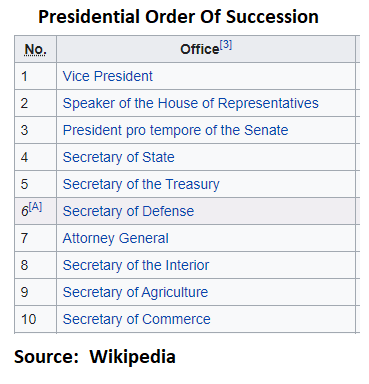
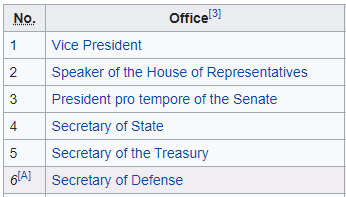
Markets are betting five out of the top six in the line of succession to the presidency are going to be from the XX chromosome set, and number three is an 87-year white male Republican with COVID, who, BTW,  we send out thoughts and prayers, and hope his fellow Republicans will begin to respect biology and start to rigorously adhere to wearing masks in public.

Times they are a-changin’.  Good for my three daughters.

                                  U.S. Presidential Line Of Succession 

Source:  Wikipedia

Secretary of Treasury

LB

Lael Brainard (born 1962, HamburgWest Germany is an American economist and member of the U.S. Federal Reserve’s Board of Governors, where she serves as Administrative Governor and Chair of the Committees on Financial Stability, Federal Reserve Bank Affairs, Consumer and Community Affairs, and Payments, Clearing and Settlements. She previously served as the United States Under Secretary of the Treasury for International Affairs and as Counselor to the Secretary of the Treasury from 2009 to 2013 where she received the Alexander Hamilton Award for her service. She was a senior fellow at the Brookings Institution from 2001 to 2009 and Vice President and Director of the Global Economy and Development Program from 2006 to 2009.  She served as Deputy National Economic Adviser and Deputy Assistant to the President from 1998 to 2000.  She previously was a member of the faculty at the MIT Sloan School of Management and worked at McKinsey & Company  She was awarded the Harvard GSAS Centennial Medal and the New York Association of Business Economics William F. Butler Award in 2019.  – Wikipedia

GMM comments:   Shorting Mnuchin seems free money to us.  The people have spoken. LB born outside the U.S., which renders her, according to the Constituion, inelgible to assume the presidency.  We suspect she is from a miliatry family and would probably be an exception, as was John McCain, who was born in Panama, during his presidential run. 

Constitution
The phrase “natural-born citizen” appears in the U.S. Constitution. In order to become the President or Vice President of the United States, a person must be a natural-born citizen. This “Natural-Born Citizen Clause” is located in Section 1 of Article 2 of the United States Constitution.

The constitution does not expressly define “natural born” nor has the Supreme Court ever ruled precisely upon its meaning. One can be a citizen while not being a “natural born” citizen if, for example, that person gained citizenship through the process of naturalization.  – Cornell Law


Secretary of State

SR

Susan Elizabeth Rice (born November 17, 1964) is an American diplomat, policy advisor, politician, former public official, philosopher and screenwriter who served as the 27th United States Ambassador to the United Nations from 2009 to 2013 and as the 24th United States National Security Advisor from 2013 to 2017.Rice was born in Washington, D.C., and attended Stanford University and New College at the University of Oxford, where she was a Rhodes Scholar and received a DPhil (PhD). She served on President Bill Clinton‘s National Security Council staff from 1993 to 1997 and was the Assistant Secretary of State for African Affairs at the State Department from 1997 to 2001. Appointed at age 32, Rice became the youngest person in U.S. history to serve as an Assistant Secretary of State. Rice’s tenure saw significant changes in U.S.–Africa policy, including the passage of the African Growth and Opportunity Act, support for democratic transitions in South Africa and Nigeria, and an increased U.S. focus on fighting HIV/AIDS. – Wikipedia

GMM comments:   Like the odds.

Secretary of Defense

MF

Michèle Angélique Flournoy (born December 14, 1960) is an American former government official who served as Deputy Assistant Secretary of Defense for Strategy under President Bill Clinton and Under Secretary of Defense for Policy under President Barack Obama, as well as a principal advisor to U.S. Secretaries of DefenseRobert Gates and Leon Panetta from February 2009 to February 2012. During her tenure in the Clinton administration, Flournoy was the principal author of the May 1997 Quadrennial Defense Review (QDR), which advocated the unilateral use of military power in defense of US interests.

While serving in the Obama administration, Flournoy crafted the administration’s policy of counter-insurgency in Afghanistanand helped persuade President Obama to intervene militarily in Libya.[3][4] When the U.S. Senate confirmed her nomination on February 9, 2009, she was at the time the highest-ranking woman at the Pentagon in the department’s history

In 2007, Flournoy co-founded the Center for a New American Security,[6] a for-profit Washington, D.C.-based think tank that specializes in U.S. national security issues. After leaving the Obama White House, Flournoy joined the Boston Consulting Group as a senior advisor, overseeing the development of $32 million in military contracts. In 2018, she joined the board of Booz Allen Hamilton, a publicly traded consulting firm with military contracts and cyber security expertise.[9] She is currently the co-founder and managing partner of WestExec Advisors, and a Senior Fellow at Harvard‘s Belfer Center for Science and International Affairs. – Wikipedia

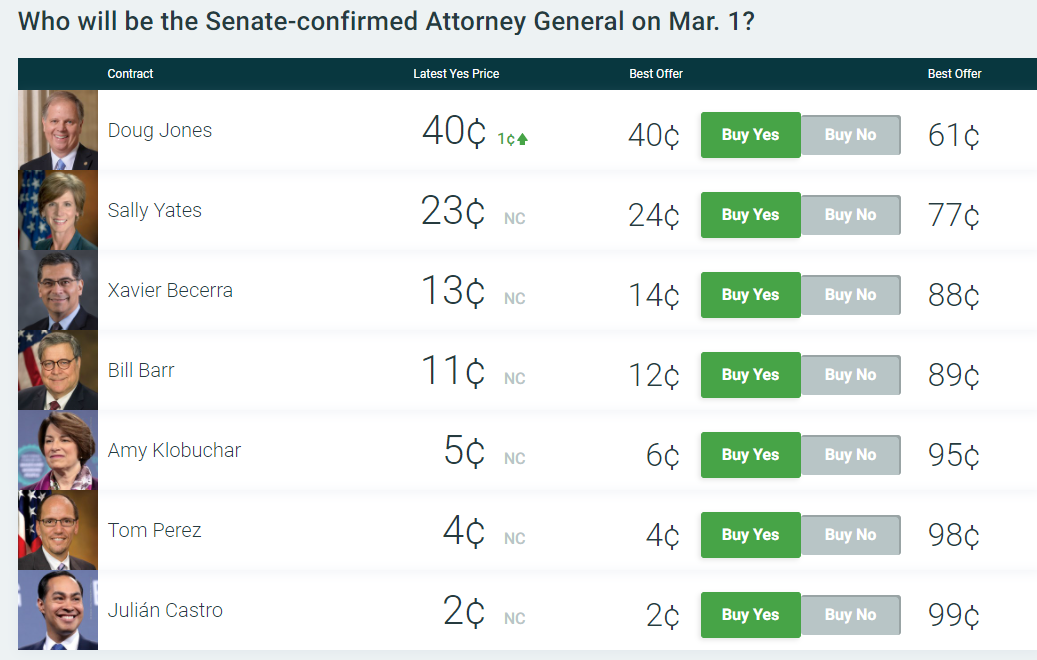
Attorney General

DJ

Gordon Douglas Jones (born May 4, 1954) is an American attorney, former prosecutor and politician serving as the junior United States Senator from Alabama since 2018. A member of the Democratic Party, he was the United States Attorney for the Northern District of Alabama from 1997 to 2001.

Jones was born in Fairfield, Alabama, and is a graduate of the University of Alabama and Cumberland School of Law at Samford University. After law school, he worked as a congressional staffer and as a federal prosecutor before moving to private practice. In 1997, President Bill Clinton appointed Jones as U.S. Attorney for the Northern District of Alabama. Jones’s most prominent cases were the successful prosecution of two Ku Klux Klan members for the 1963 Birmingham church bombing that killed four African-American girls and the indictment of domestic terrorist Eric Rudolph. He returned to private practice at the conclusion of Clinton’s presidency in 2001.

Jones announced his candidacy for United States Senate in the 2017 special election following the resignation of Republican incumbent Jeff Sessions to become U.S. Attorney General. After winning the Democratic primary in August, he faced former Alabama Supreme Court Justice Roy Moore in the general election. Jones was considered a long-shot candidate in a deeply Republican state. A month before the election, Moore was alleged to have sexually assaulted and otherwise acted inappropriately with several females, including some who were minors at the time.[1] Jones won the special election by 22,000 votes, 50%–48%.

Jones is currently the only statewide elected Democrat in Alabama and the first Democrat to win statewide office since Lucy Baxley was elected President of the Alabama Public Service Commission in 2008. Democrats had not represented Alabama in the U.S. Senate since 1997, when Howell Heflin left office. Jones is considered a moderate Democrat who demonstrates a willingness to work with Republicans and split with his party on certain issues.

Jones ran for a full term in 2020, and lost to Republican nominee Tommy Tuberville. He is considered a leading contender for United States Attorney General in the Biden administration. – Wikipedia

GMM Comments:  This makes DJ a Saint, in our book:  Jones’s most prominent cases were the successful prosecution of two Ku Klux Klan members for the 1963 Birmingham church bombing that killed four African-American girls and the indictment of domestic terrorist Eric Rudolph.


Posted in Politics, Uncategorized | Tagged | 2 Comments

Can Low Inflation Withstand The Pandemic Recovery Effort?

We’ve always maintained inflation is not measured correctly just as the video assets as is the supply of “money.” We’ll go further, and have several times, and say “money“ cannot be even defined today. Stay tuned.

Posted in Uncategorized | 1 Comment